


Sport
Athletic go down fighting

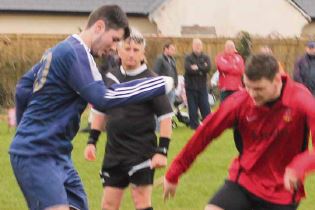
 Milford Athletic 2
Swansea Dockers 4
MILFORD Athletic were knocked out of the West Wales cup after they lost 4-2 to an impressive Swansea Dockers side on Saturday. However, after the Dockers had a man sent off, Milford brought it back to 2-2 and a real upset looked on the cards. A freak own goal from Nathan Lewis, just a minute later, put the Dockers back in the lead and that derailed Milford’s comeback.
Swansea started the game well and went ahead in the tenth minute when Raymond Ali slotted home a penalty. Midway through the first half the Dockers doubled their lead. Luke Darling dummied the ball well to allow Liam Staines to run through and round the keeper to slot the ball into an empty net.
Milford pulled a goal back ten minutes into the second half when Jamie Bird shot low into the bottom right corner after the Dockers defence failed to clear a corner.

They were then given a real boost when the Dockers were reduced to 10 men as Cameron Rob, attempting to clear the ball, caught an Athletic player as he pounced on the loose ball and Rob was shown a straight red card.
Despite being a man down, the Dockers still looked dangerous going forward and were unlucky when Luke Darling’s shot rebounded back off the post. With twenty minutes to go Milford had a great chance to draw level but Dockers keeper Brian Sparks pulled off a great save to deny Gary Power.
Just three minutes later they finally had their equaliser when Shane Walsh broke the offside trap to shoot low into the bottom left corner of the goal.
Milford were on top but just a minute later their hopes were dashed with an own goal. The Milford defence panicked as a long ball was played forward and the unlucky Nathan Lewis saw his header loop over the keeper and into his own net.

That ended Milford’s comeback and heavy rain made conditions tricky in the final fifteen minutes. With ten minutes to go the Dockers made the game safe when Staines shot from a tight angle and the wet ball seemed to slip through the grasp of the keeper and into the net.
Staines could have had a hat trick but his shot five minutes from the end was well saved by Milford keeper Ian Hawkins. Milford produced a spirited performance but it is the Dockers who progress to the third round.



PLANS for works at Tenby’s historic sailing club building, part of the ‘iconic view’ of the town’s harbour have been given the go-ahead by the national park.
In an application to Pembrokeshire Coast National Park, Tenby Sailing Club, through agent David J P Morgan RIBA Architect sought permission for the two openings in second floor gable wall along with two new windows at Tenby Sailing Club, Penniless Cove Hill, along with a related listed building consent.
The application was supported by Tenby Town Council and Tenby Civic Society, the latter saying it will “add value to the use of the building and maintain the character and value of the listed building and the conservation area”.
Supporting documents for the application said: “The proposal is to form two new openings in the stonework and install two windows. These will replicate the existing windows at first floor level below. The openings will have red brick head as on existing original openings on the building. The proposal will have very little adverse impact on the listed building.”
They added: “The proposed new windows will improve observation of the harbour and bay from the second-floor level. This is where yacht racing is monitored and observed by officials and safety personnel.”
An officer report, recommending approval said: “The sailing club was built as a warehouse c. 1825, abutting the C17 sluice. Originally wine stores, it was later used by the local fishermen for stores and is now the home to Tenby Sailing Club, established in 1936. The rubble-built building is of three storeys and four bays, the glazing all later C20 with a slated roof and a modernised interior. There is a large steel stair to north (seaward) elevation.”
It added: “The building forms part of a group picturesquely clustered around the sluice, in turn forming part of the iconic view of Tenby Harbour. The proposal is to insert two windows at second floor level to the north (seaward) elevation, flanking the existing door,” adding: “The area retains its mercantile character not just in appearance, but also through its character due to ongoing use as fishing boat stores and winter moorings.
“The sailing club has occupied the building for many years and remains very active. The proposal is intended to improve the amenity of the building to provide better viewing at elevation and seeks to copy the detail and proportions of the windows at first floor stage.”
The application, and the related listed building consent, was conditionally approved by park planners.

Myherin forest takes centre stage as revised route sets up demanding Mid Wales season-opener
THE SEVERN Valley Stages – supported by Axon Commercial Catering Equipment – will make a much-anticipated return in 2026 as the opening round of the Motorsport UK British Rally Championship on Saturday (April 11).
The acclaimed gravel event is back with renewed momentum and a new-look route for crews and spectators, after the rally was cancelled in 2025 following the impact of Storm Darragh, which restricted access to large parts of the Welsh forest estate.
Organised by Midland Manor Motor Club, the Builth Wells-based rally will again offer one of the longest and most cost-effective forest events in Wales, featuring more than 50 competitive stage miles across some of the country’s most revered gravel roads.
A major talking point for 2026 is a significant route evolution. While driven by forest availability, organisers say the changes have produced what could be one of the most demanding Severn Valley Stages in recent years.
The world-famous Myherin Forest block will take centre stage, forming the backbone of the event and being used to its fullest potential. In combination with the Tarenig complex, organisers have created a series of challenging tests within Myherin, supported by the classic Sarnau stage, promising a flowing, high-speed but technical challenge throughout the day.
The rally will build towards a dramatic finale, with a joined Myherin–Tarenig stage in the afternoon forming an 18-mile test to close the event – a true sting in the tail for competing crews.
Proceedings begin on Friday evening at the Metropole Hotel & Spa in Llandrindod Wells with a ceremonial start designed to bring fans closer to the action and officially launch the weekend’s competition.
Builth Wells will host pre-event formalities and service, while the Metropole will act as rally headquarters and host the finish celebrations on Saturday evening.
As the 2026 BRC curtain-raiser, Severn Valley Stages will welcome the latest generation Rally2 machinery and many of the UK’s leading drivers.

The event will also host the return of the Fuchs Lubricants British Historic Rally Championship, alongside rounds of the Motorsport UK Pirelli Welsh Rally Championship, West Wales Rally Spares HRCR Stage Masters and the T.C.S Plant Rally Challenge.
Clerk of the course Keith Ashley said: “After a frustrating year away, we’re incredibly proud to bring the Severn Valley Stages back for 2026 and to do so as the opening round of the British Rally Championship, alongside the returning British Historic Rally Championship, is something special.
“The revised route has allowed us to create a real driver’s rally, with Myherin at the heart of the event and a spectacular long stage to finish. We’re looking forward to welcoming competitors, championships and fans back to Mid Wales for what promises to be a memorable return.”

Fans can follow the event’s social media channels for updates:
www.facebook.com/SevernValleyStages
www.twitter.com/svstages
The 2024 Severn Valley Stages.
Credit: British Rally Championship
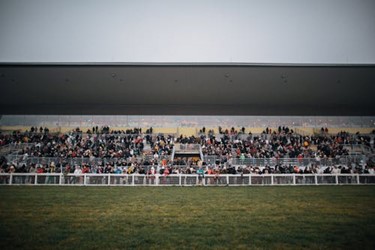
Pembrokeshire has no permanent racecourse, yet horse racing still finds a place in everyday sporting life across west Wales. From rural fields hosting traditional meetings to packed minibuses heading east on race days, the sport travels well beyond the rails.
That persistence is not accidental. Racing has long fitted the rhythms of farming communities, weekend socialising, and regional travel, adapting to local circumstances rather than disappearing when facilities are absent. In 2026, it remains a shared reference point, even for those who only engage from a distance.
What matters is not just the spectacle of big events, but how racing threads itself through habits and decisions made closer to home. These quieter connections help explain why the sport continues to matter locally.
Local point-to-point traditions
Grassroots point-to-point racing has long bridged the gap between elite courses and rural life in west Wales. These meetings, often staged on farmland, turn sport into a community event, blending competition with socialising and fundraising. Families attend as much for the atmosphere as the racing itself.
These events underline how racing culture survives without grandstands. The focus is on continuity, keeping familiar customs alive while quietly absorbing new ways of engaging with the sport.
Travel to regional race meetings
When Pembrokeshire residents want the full racecourse experience, travel fills the gap. Trips to Ffos Las or Chepstow are regular fixtures in many diaries, turning race days into planned outings rather than spontaneous visits. Transport, food stops, and overnight stays all become part of the occasion.
Preparation for these days now mixes tradition with modern routines. Conversations about form and fixtures increasingly happen online during the week, and it is common for followers to glance at early indicators when planning a visit. For many, that includes checking midweek previews and scanning resources like tomorrow’s horse racing tips as part of deciding which races to follow and when to gather. The information rarely dominates the day, but it adds to the sense of shared anticipation and helps racegoers plan ahead.
Nationally, racing’s scale helps explain why these visits and bets matter. A parliamentary debate confirmed that the sport contributes over £4 billion annually to the UK economy. That economic footprint filters down to regions like West Wales through travel spending and hospitality.
The real point is less about headline numbers and more about habit. Regular travel keeps racing visible, reinforcing it as a normal leisure choice rather than a distant niche interest.

High street and hospitality links
Race days rarely exist in isolation. Pubs open early for televised coverage, cafés time busy periods around afternoon cards, and accommodation providers benefit from visitors passing through the county en route to meetings. These links may be informal, but they are consistent.
That makes policy changes a local concern. A regional forecast reported by the Monmouthshire Beacon warns that proposed betting tax harmonisation could remove £18 million from the Welsh economy over five years and cost 168 jobs in the first year alone. Even areas without a course would feel the knock-on effects.
For Pembrokeshire, the issue is about resilience. When racing activity contracts elsewhere, the secondary spend that reaches local high streets and hospitality venues shrinks with it.

Race days in the weekly diary
Beyond travel and spending, racing maintains a quieter presence in weekly routines. Fixtures are pencilled in alongside football matches and community events, often forming the backdrop to social gatherings rather than the sole focus.
Employment figures help explain this reach: horse racing supports around 85,000 jobs across the UK. That workforce extends into media, transport, and leisure, shaping how and when people encounter the sport.
For West Wales, the takeaway is simple. Horse racing endures not because of proximity to a track, but because it adapts to local patterns of life. As long as those routines persist, the sport will continue to find its place in Pembrokeshire’s sporting landscape.


Crime12 hours ago
Manhunt intensifies after woman seriously injured in Carmarthen park stabbing
Police say suspect known to victim as attempted murder investigation continues A MAJOR police manhunt is under way after a...

Health1 day ago
Consultation reveals lack of public trust in health board
EARLIER this week, Hywel Dda UHB published the results of a consultation into the future configuration of its clinical services....


Community1 day ago
Specialist team searches River Teifi in ongoing hunt for missing man
A SPECIALIST search team has carried out a renewed and highly technical search of the River Teifi in Cardigan as...


News2 days ago
Wales’ first minister keeps distance from Starmer before May vote
Senedd race not Westminster THE FIRST MINISTER has moved to draw a clear dividing line between the Welsh Labour campaign...

News3 days ago
Kurtz raises Gumfreston flooding in the Senedd as petition deadline nears
LOCAL Senedd Member Samuel Kurtz has raised the long-running flooding problems affecting the B4318 at Gumfreston in the Senedd, as...

Community3 days ago
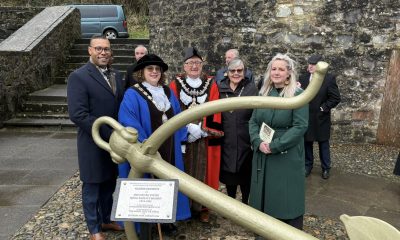
Anchor re-dedicated to mark 30 years of US–Haverfordwest ties
Service honours shared history, service and friendship on the Quayside A SYMBOL of Haverfordwest’s wartime and Cold War connections with...


Business3 days ago
Senedd urged to act as Welsh pubs fall further behind England on business rates
Industry leaders warn of closures and job losses as pressure mounts on ministers to pass on funding PUBS across Wales...


Crime4 days ago
Haverfordwest man jailed for online death threat
A Haverfordwest man has been sentenced to a year in prison after sending a threatening message online. Michael Carruthers, 34,...

Community4 days ago
Storm Chandra: Morning impacts across Pembrokeshire
HEAVY overnight rain and strong winds brought by Storm Chandra have caused disruption across Pembrokeshire, with fallen trees and localised...


Business4 days ago
Business voices heard as Kurtz and Davies urge action on business rates
LOCAL businesses from across West Wales have voiced serious concerns about the impact of business rates at a dedicated roundtable...
-
Health6 days ago
Health Board to decide on future model for nine clinical services
-
Health1 day ago
Consultation reveals lack of public trust in health board
-
 News3 days ago
Caldey still unsafe, survivors warn — despite Abbey’s reform claims
-

 Community2 days ago
Pembrokeshire students speak at national Holocaust Memorial Day event
-
 Climate6 days ago
Petition opposing climate emergency reaffirmation and ‘tax hikes’ to be heard
-

 Business6 days ago
Pembroke Dock battery box energy scheme is approved
-

 Crime6 days ago
Pay boost for over 1,000 Pembrokeshire school support staff pledged by Labour
-

 News4 days ago
Wales warned against single police force as Lib Dems cite Scotland ‘lesson’