


international news
NATO jets scrambled as Russian aircraft approach UK airspace


NATO fighter jets were scrambled today after Russian military aircraft approached allied airspace, in the latest sign of rising tension on Europe’s northern flank.
According to defence sources, the aircraft were detected flying close to NATO-controlled airspace over the North Atlantic and Norwegian Sea, prompting a rapid response from alliance air policing forces. Fighter jets were launched to identify and monitor the Russian planes, which did not file flight plans or communicate with civilian air traffic control.
The incident follows a familiar pattern seen repeatedly since Russia’s invasion of Ukraine, with Moscow increasing long-range bomber and reconnaissance flights close to NATO territory. While the Russian aircraft did not enter sovereign airspace, officials said the response was a routine but necessary defensive measure.
NATO confirmed that the scramble was carried out to “ensure the integrity of allied airspace” and that the situation was closely monitored throughout.
Pembrokeshire link to wider security concerns

The latest aerial incident comes against the backdrop of earlier Russian surveillance activity much closer to home, including off the Pembrokeshire coast.

During the summer, a Russian intelligence-gathering vessel was tracked operating off south-west Wales, raising concerns about undersea infrastructure and maritime security. The ship, identified by defence analysts as the Yantar, is officially classed as an oceanographic research vessel but is widely regarded by NATO as a spy ship used to map seabeds and monitor communications cables.
At the time, Royal Navy and RAF assets were deployed to shadow the vessel as it loitered in international waters near Pembrokeshire, an area through which critical transatlantic data cables pass. Defence officials said the ship’s movements were consistent with intelligence-gathering activity rather than civilian research.
Local marine observers and coastal monitoring groups also reported unusual naval and aerial activity in the area during the period, highlighting how global security tensions were playing out on Wales’ doorstep.
Further sightings off Scotland
In recent weeks, the same Russian vessel has again been detected further north, operating off the coast of Scotland, where it was monitored by Royal Navy ships and RAF maritime patrol aircraft.

The Ministry of Defence has since confirmed that UK forces have increased surveillance around the British Isles in response to sustained Russian naval and air activity. Officials have warned that undersea cables, pipelines and offshore energy infrastructure are increasingly viewed as potential targets in modern hybrid warfare.
Today’s NATO jet scramble is understood to be part of this broader defensive posture, with alliance forces on heightened alert as Russian military movements continue near European airspace and waters.
While no immediate threat to the UK has been identified, defence sources have made clear that both air and maritime activity are being treated as connected elements of a wider pattern.



Officers monitor local tensions following terror attack on Jewish event in Sydney
DYFED-POWYS POLICE have issued reassurances to communities across west Wales following the mass shooting at Bondi Beach in Sydney, where gunmen opened fire during a large Hanukkah celebration, killing numerous people and injuring many more.
The attack, which took place at the “Chanukah by the Sea” event attended by around 1,000 people, is being treated by Australian authorities as a terrorist incident targeting the Jewish community. One of the attackers was shot dead by police at the scene, while another was detained after being disarmed by a bystander.

In response, Dyfed-Powys Police said they are closely monitoring any local tensions and maintaining contact with community groups to offer reassurance.
A spokesperson said: “We are deeply saddened to hear of the events that have been reported from Australia, and our thoughts are with all those affected, particularly members of the Jewish community. We will continue to monitor any tensions in our area closely. Local teams will be engaging with different groups, businesses, and key individual networks throughout Dyfed-Powys to provide reassurance to the community.”
No specific threat identified in west Wales
The force has not announced any increase in patrols, but says that routine engagement with faith groups, schools, and community organisations will continue as part of their ongoing reassurance work.
Impact on local Jewish community
West Wales is home to small but longstanding Jewish communities who have previously worked with Dyfed-Powys Police on hate-crime awareness and safeguarding campaigns.
The force says it will continue dialogue with these groups in the coming days as international reactions to the Bondi Beach attack unfold.
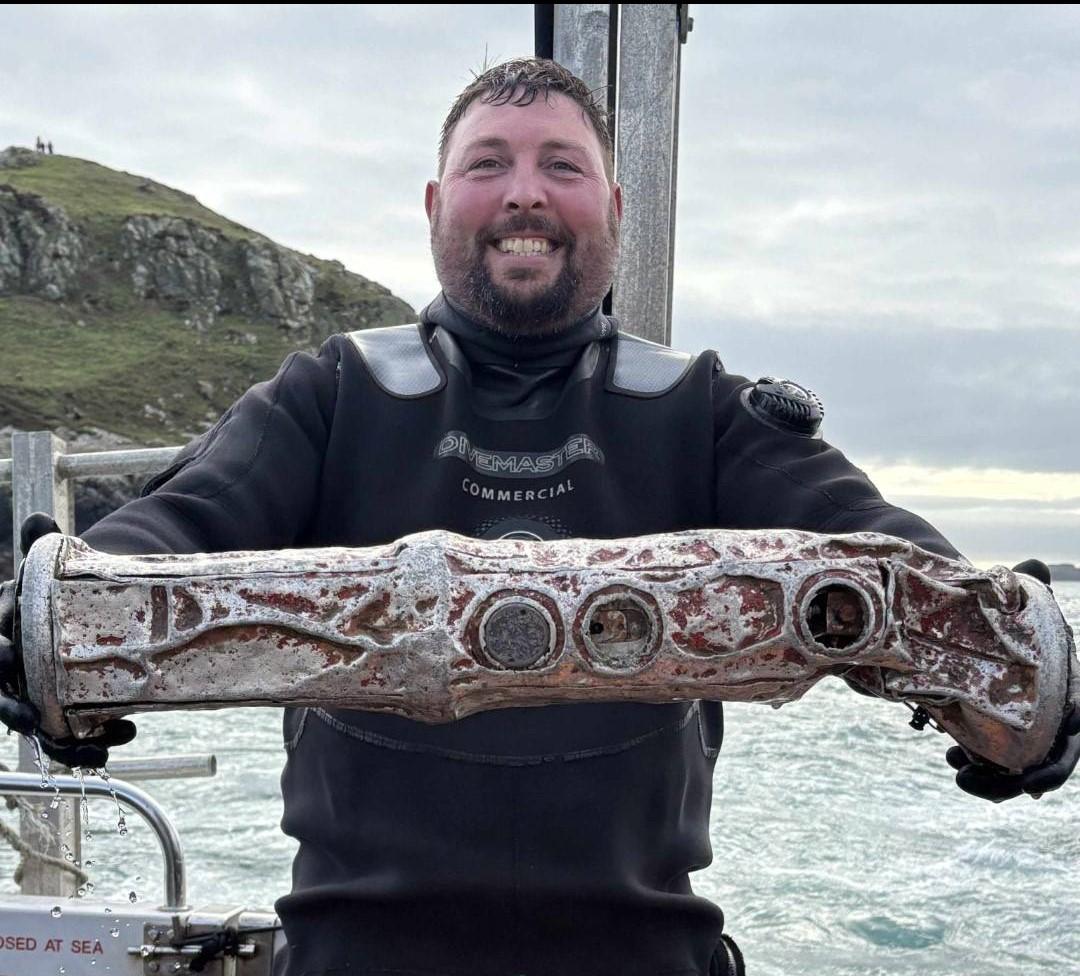
Find comes months after Russian vessel monitored off Pembrokeshire coast
A SUSPECTED Russian sonobuoy – the type used to track submarine movements – has been recovered from the seabed off Skomer Island, Pembrokeshire, just months after a notorious Russian surveillance ship was monitored operating off the Welsh coast.
Volunteer divers from Neptune’s Army of Rubbish Cleaners (NARC) made the discovery on Saturday, November 15, during one of their routine seabed clean-ups near Wooltack Point. The cylindrical device, thick with barnacles and marine growth, appears consistent with equipment used by foreign militaries for underwater monitoring. The team also removed several discarded fishing weights from the conservation area.
Sonobuoys are normally deployed from aircraft and are used to detect submarine activity. Some operate passively by listening for acoustic signatures through hydrophones, while others emit sound pulses and analyse returning echoes before transmitting data back to aircraft or nearby vessels.
The object has now been handed to the relevant authorities for formal assessment.
 HMS Somerset flanking Russian ship Yantar near UK waters in January (Royal Navy/PA)
Heightened tensions at sea
The timing of the discovery has sharpened local concerns, coming in the same week Defence Secretary John Healey confirmed that the Russian spy ship Yantar has been operating on the edge of UK territorial waters.
RAF pilots monitoring the vessel reported that lasers were directed at their aircraft – an action Mr Healey described as “deeply dangerous”. He added that the UK has “military options ready” should the vessel head further south.
Yantar is known within NATO for its deep-sea intelligence capabilities, including the ability to locate, map and potentially tamper with critical undersea infrastructure. This includes fibre-optic communications cables, energy pipelines and data routes vital to the UK’s economy and national security.
It is the second time this year the vessel has entered wider UK waters. In July 2025, Yantar was tracked off the Pembrokeshire coast, prompting RAF surveillance flights and a Royal Navy frigate to be dispatched to shadow it. At the time, defence officials told The Herald the ship was “lingering unusually close to sensitive undersea cables”.
Local concerns and unanswered questions
While the origins of the object discovered off Skomer have not yet been confirmed, its presence near a protected Welsh marine reserve has raised eyebrows among security specialists.

Experts note that sonobuoys can be lost or abandoned during military exercises, and it is not yet clear whether the device is Russian, British or from any other nation. However, the combination of recent Russian naval behaviour, the location of the find and the increasing strategic focus on undersea infrastructure makes the discovery particularly notable.
Skomer and the surrounding waters form one of Wales’ most important marine conservation zones, attracting thousands of visitors and researchers every year. The area is protected for its seabird colonies, grey seals and rich underwater habitats.
NARC, which has removed more than 1,000 tonnes of debris from Welsh waters over the past two decades, say they will continue their regular programme of clean-ups to protect the site from hazards.

A spokesperson for the group said further details about the recovered device will be released once authorities have completed their analysis.

Corporation insists defamation claim has ‘no basis’ after apology over 2021 speech edit
THE BBC has said there is “no basis” for Donald Trump’s threatened multibillion-dollar lawsuit, insisting the disputed Panorama documentary was not broadcast in the United States and caused no reputational harm.
The corporation confirmed it has had “no further contact” from the former US president’s lawyers, despite his renewed pledge to sue for “between one and five billion dollars” over the programme Trump: A Second Chance?, which aired ahead of the 2024 US election.
The controversy centres on a January 6, 2021 speech in which Mr Trump’s remarks were edited in a way that appeared to link his words more directly to the Capitol riots. The BBC apologised last week, calling the splice “an error of judgment” but denying it was malicious or defamatory.
A spokesperson said on Saturday: “We have had no further contact from President Trump’s lawyers at this point. Our position remains the same.”
In an interview with GB News, Mr Trump said he had an “obligation” to sue, claiming: “This was so egregious. If you don’t do it, you don’t stop it from happening again with other people.”
The BBC’s lawyers have set out five key arguments rejecting liability:
- the Panorama episode was not shown on US channels and was geo-restricted to UK viewers on iPlayer;
- Mr Trump suffered no damage, having gone on to win re-election;
- the edit was intended only to shorten a lengthy speech and was not motivated by malice;
- the clip should be viewed in the context of the full hour-long programme; and
- political expression is strongly protected under US defamation law.
The fallout from the broadcast led to the resignations of director-general Tim Davie and BBC News chief Deborah Turness. Chairman Samir Shah wrote personally to the White House to apologise and confirmed a review of editorial standards is under way.
Mr Davie told staff this week: “We must stand up for our journalism. The BBC is a unique and precious organisation, and I see the free press under pressure. I’m really proud of the work we do locally and globally—it’s utterly precious.”
The Panorama episode will not be re-aired, and the BBC has posted a retraction notice on its website.



100th shout of the year on Christmas Eve for Angle RNLI
ANGLE RNLI lifeboat crew were called out on Christmas Eve for the one-hundredth time this year after reports of red...

Planning appeal dismissed as enforcement action upheld at Milford function centre
A WELSH GOVERNMENT planning inspector has dismissed appeals relating to unauthorised works at the Imperial Function Centre at Milford Haven’s...

Painter accused of knocking partner unconscious after ‘years of abuse’
Man charged with assault, threats to kill and knife possession will face trial at Crown Court A PEMBROKESHIRE painter and...


Ministers raise inheritance tax threshold for farmers after months of protest
THE UK GOVERNMENT has increased the inheritance tax relief threshold for farmers from £1 million to £2.5 million, following months...


Council chief’s son spared jail after drug-fuelled A40 crash
Judge says driver showed “breathtaking arrogance” after taking cocaine, cannabis and diazepam A SENIOR council officer’s son came close to...


Man left with broken jaw after assault outside Saundersfoot nightclub
Police appeal for witnesses after early-morning incident near Sands DYFED POWYS-POLICE are investigating an assault outside Sands Nightclub in Saundersfoot...


Festival of Nine Lessons and Carols held at St Davids Cathedral
ST DAVIDS Cathedral was filled to capacity on Monday evening (Dec 22) as the annual Festival of Nine Lessons and...


Emergency departments in Wales record worst November waits on record
ONE in seven patients waited more than twelve hours as doctors warn system is beyond breaking point Emergency departments across...


Milford Haven man sent to Crown Court over assault and strangulation allegations
ASSAULT AND STRANGULATION CHARGES A MILFORD HAVEN man accused of multiple assaults, criminal damage and intentional strangulation has been sent...


Tenby Round Table spreads festive cheer with chocolate surprise for local pupils
Community group delivers 1,200 boxes to primary schools after successful Santa Run TENBY ROUND TABLE capped off its charitable work...
-
Crime2 days ago
Council chief’s son spared jail after drug-fuelled A40 crash
-

 Crime5 days ago
Woman jailed for stealing £245,000 from Pembrokeshire charity
-
 Crime6 days ago
Milford Haven man denies child sex charges as trial date set
-

 Business5 days ago
Pembroke Dock restaurant to close on Christmas Day after £23,000 rates rise
-
Crime3 days ago
Cannabis dealer caught with thousands in cash and drugs hidden in bedroom safe
-

 News2 days ago
Five-vehicle collision closes A477 at Pembroke Dock junction
-
News3 days ago
Milford Haven man sent to Crown Court over assault and strangulation allegations
-

 Crime7 days ago
Bail revoked for teenager charged with rape following Sands Nightclub allegation