News
Sea Empress disaster 20 years on

 IT WAS one of the biggest environmental disasters ever to hit UK shores and now 20 years on from the Sea Empress disaster RSPCA staff are looking back at the role they played in helping to save hundreds of seabirds and mammals.
Early on the evening of 15 February, 1996 the Sea Empress, a single hull oil tanker, hit rocks on its way into the Cleddau Estuary and the ship’s cargo of 130,000 tonnes of crude North Sea oil started to spill into the waters off Pembrokeshire.
The RSPCA launched a massive rescue operation in response to the disaster in an effort to save the thousands of oiled and dying seabirds that were so badly affected by the slick.
Scores of volunteers helped open and run a makeshift animal hospital – set up in an old industrial unit – where more than 7,000 dead or oiled birds were taken – while inspectors, drivers and wildlife centre staff experts worked around the clock to nurse, clean and feed as many of the birds back to health as they could.

“The rescue operation took a massive team effort,” said RSPCA chief inspector for the south west Wales inspectorate group, Romain de Kerckhove, who held the same position 20 years ago.
“It quickly became apparent that this incident was of a scale that needed national resources, and a roster was arranged that invited colleagues from all over England and Wales to become involved,” he said.
“Officers would attend, for a limited period, and would work extremely long days, responding to calls from the public, and patrolling beaches to search for victims of the disaster.
“They were accommodated locally, and would be replaced by other colleagues in order to keep the team fresh and strong. Some officers would actually sleep on camp beds at the temporary bird rescue holding/cleaning facility, in order to ensure that there were people on site overseeing the welfare of the birds 24/7.

“This was a rescue that involved teams from across the entire RSPCA, as well as countless volunteers who would work with us, and assist the RSPCA teams both at the cleaning and rehab centre, as well as on the beaches.
“It was hard work, but everyone enjoyed the atmosphere and being involved in such a worthwhile and much needed rescue operation.”
Richard Abbott, who is now an RSPCA chief inspector, was the officer on duty the night the Sea Empress ran aground. “I recall speaking to a Brecon RCC (Brecon Regional Control Centre) tasker who said they had received a call saying a tanker had run aground at Milford Haven and was leaking 30,000 gallons of oil.
I recall thinking, no chance, that’s never going to have happened, not these days with twin hulled tankers. I asked the tasker to ring the Coastguard to double check as I was driving and enroute to an emergency at the time, about 10.30pm ish.

“She rang me back about five minutes later and said to my astonishment that the Coastguard had confirmed the report. I pulled over and rang the chief inspector Romain de Kerckhove at home and started the response.
“I got back in about 1am that night and by 7am I had the call that I was needed to help set up the emergency response centre. A few hours later chief inspector Romain de Kerckhove arrived and took over.
“It was incredibly stressful for those three to four weeks, as we dealt with thousands birds and managed many rescue organisations. It was a steep learning curve.”
RSPCA inspector Rohan Barker attended the day after the incident with chief inspector Romain de Kerckhove.
“We spent two days putting together our response working with several organisations with very few birds coming in during the initial couple of days – but then the onslaught started.
“We worked 15 hour shifts collecting birds, setting up the cleaning station at a local industrial estate building provided by the council.
“Birds were collected by inspectors, animal collection officers and members of the public, brought to the station, initially cleaned and shipped off to RSPCA West Hatch Wildlife Centre by a fleet of vans.”
Dermot Murphy, who is now assistant director of inspectorate at the RSPCA, was one of the convoy of ambulance drivers drafted in from across the country at the time of the disaster to help ship stricken birds from the Pembrokeshire coast to the makeshift hospital.
“I was an RSPCA Ambulance Driver in London then, with just over a year’s service. I was sent to Milford Haven with an Inspector for a week.
“I had never seen anything like it. So many birds covered in oil in a terrible state, they were still being washed up two weeks into the operation. The birds that stuck in my mind were the common scoter, which is a sea duck. There were so many of them, an incredible amount and in such a bad way too.
“We had a busy week and did a range of duties, from collecting food to feed staff, patrolling beaches looking for oiled birds and cutting up food to feed the birds. It was a massive cleaning operation.”
Inside the RSPCA West Hatch Wildlife Centre in Somerset Paul Oaten was one of the team at the ready to take in casualties as they arrived in their droves from the Welsh coastline.
“We took in around 1,200 oiled birds. at the time of the Sea Empress disaster. They were covered in thick oil. Most of the casualties were scoters, and they were very badly affected.
“Luckily we had a lot of volunteers that came in to help with the sheer volume of birds that were coming in through the doors every day. People were happy to come in and wash towels while others spent their days cutting up sprats (fish) for the birds to eat.
“Those that were tasked with washing the birds would be in teams of two. One would hold the birds, the other would clean it using Fairy liquid. They would have a pre-clean where we would try to get as much of the oil off as possible without stressing the birds out. It was so important to get the oil off their plumage, not just because of the feathers but so that we could try to prevent them from ingesting the oil and stop it from burning them too.
“A lot of the birds were emaciated because they could not feed so building their strength back up and increasing their weight was also an important part of the process.”
He added: “Every role was vital to ensure we could keep the steady flow of birds through the cleaning system and the sense of teamwork was immense. That is my overwhelming memory of that time. the teamwork. It was so uplifting. The days were long and it was hard work but we were all working towards a common goal of trying to save these poor stricken birds.”
WWF-UK Head of Marine Policy Dr Lyndsey Dodds said told The Herald: “20 years on from the Sea Empress, Welsh waters are busier than ever but management is still piecemeal.
“The forthcoming Welsh National Marine Plan offers the opportunity to strategically manage activities that can impact upon Wales’s natural assets and should include provisions to ensure that the risks to the most sensitive areas from both accidental and chronic pollution are minimised.”



THIS week in the Senedd, the Welsh Liberal Democrats renewed their demands for the implementation of child poverty targets.
According to a report from the Bevan foundation, 29% of children living in Wales are currently experiencing poverty (an estimated 190,000 children).
The same report highlighted that the largest percentage of children living in poverty are from working households or in couple households.
The Welsh Lib Dems are now renewing calls for the Welsh Government to create a set of targets for reducing child poverty, which the party argues will allow for more accountability.

The party has previously called for the implementation of targets, citing recommendations from the Calling Time on Child Poverty Report published in November last year.
Commenting, the Leader of the Welsh Liberal Democrats Jane Dodds MS said: “The latest statistics on childhood poverty in Wales paints a very distressing image of families across the country struggling to make ends meet.
Over the course of the last six years, the proportion of children in poverty has skyrocketed. Fuelled by worsening economic conditions and a complete lack of action from both governments in Westminster and Cardiff Bay.
We cannot act complacent about these figures nor accept the clear lack of progress in fighting child poverty, behind each statistic is a child that the state has failed.

It remains painfully clear that the Welsh Government is failing to make any meaningful progress in this fight, which is why they must follow through with the implementation of clear set targets that will allow for further accountability.
We as a party have continuously called for the creation of these targets and we will not be silenced. For the sake of future generations we urge the Welsh Government to listen.”

RETAIL trade union Usdaw is deeply concerned by today’s police recorded crime statistics showing that in 2023 there were significant increases in shoplifting across all constabulary areas in Wales. In the whole of England and Wales there has been a persistent upward trend since the pandemic, which continued with a 37% increase and has now risen to the highest level in 20 years.
The Office for National Statistics released figures showing a 39% increase in shoplifting incidents across Wales and by constabulary area as follows:
- Dyfed-Powys +11%
- Gwent +47%
- North Wales +23%
- South Wales +51%
Usdaw’s 2023 annual survey of over 5,500 shopworkers found that 60% had suffered incidents of violence, threats and abuse that were triggered by shoplifting and armed robbery.
Paddy Lillis, Usdaw General Secretary says: “Shoplifting is not a victimless crime, theft from shops has long been a major flashpoint for violence and abuse against shopworkers. Having to deal with repeated and persistent shoplifters can cause issues beyond the theft itself like anxiety, fear and in some cases physical harm to retail workers. This 39% increase in shoplifting across Wales is further evidence that we are facing an epidemic of retail crime, which is hugely concerning.
“Our members have reported that they are often faced with hardened career criminals in the stores and we know that retail workers are much more likely to be abused by those who are stealing to sell goods on. Our latest survey results show that 7 in 10 retail workers suffered abuse from customers, with far too many experiencing threats and violence. 60% of respondents said theft from shops and armed robbery were triggers for these incidents.
“The scale of assaults, abuse and threats towards shopworkers and extent of the retail crime epidemic has been a disgrace for many years. This has been made worse by police cuts and a failure to legislate to protect retail staff. Usdaw has long called for action that includes a standalone offence for assaulting a shopworker and that has been vehemently opposed by this Government and their Conservative MPs on many occasions.
“Recently the Government performed a long overdue U-turn after many years of sustained campaigning by Usdaw and others. Our members have had to wait too long for their voices to be heard and common sense to prevail. We will have to see the detail of what Ministers are proposing and we are clear that it must be at least what we won in Scotland three years ago. It also cannot fall short of Labour’s commitments to 13,000 more uniformed officers, patrols on high streets, banning repeat offenders and ending the perverse £200 threshold for prosecuting shoplifters.
“The dither and delay by this Government on this issue over many years, has led to thousands of shopworkers needlessly suffering physical and mental injury. Today’s stats should ensure that their promise to legislate is done speedily. We hope that whatever the Government is proposing will be substantial and effective in giving shopworkers, key workers in every community, the respect that they have long deserved and regrettably too often do not receive.”


FAST-growing Welsh company Paramount is relishing the challenge of creating an “irresistible dining destination” after winning the contract to play a key role in the multi-million transformation of the McArthurGlen Designer Outlet Bridgend.
The Cardiff-based design, build, fit-out and refurbishment specialist will spearhead the re-development project of the shopping centre after being handed responsibility for revamping its popular food court over the summer.
In the coming months, the development will see the Food Court transformed into three modern, and bright restaurants, welcoming new food and beverage brands to the centre and creating more than 100 new job opportunities for the local community.
Paramount’s Construction Director, Paul Thomas, said: “The team behind the scenes at McArthurGlen Designer Outlet Bridgend have fantastic plans for the future and we’re delighted to have been entrusted with the mission to help turn their exciting vision into a reality.
“Paramount prides itself on creating places where people want to be, and my team are relishing the opportunity to help create what will be an irresistible dining destination. It’s certain to be a complex project, but we have the expertise and local knowledge to deliver outstanding results in close collaboration with our project partners.”
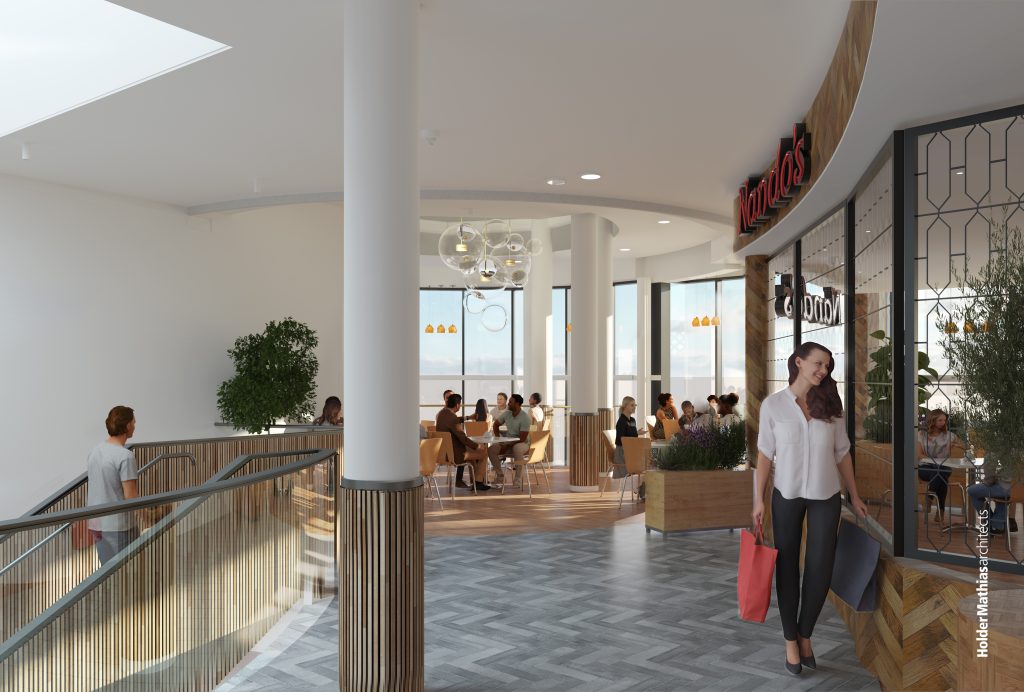
The owners of the shopping centre, which has been attracting local people and visitors for more than 25 years, have promised a “substantial investment to redevelop the Food Court area and replace it with new and exciting restaurants”.
Now the Paramount team is ready to lay the groundwork by removing some existing structures around the Food Court and will then introduce a series of new features as part of the overall facelift. These include new glazed entrance doors within glazed curtain walling shopfront, render and a new entrance lobby with new stairs and lifts.
The work to completely develop the Food Court in the shopping centre starts this week, and is expected to be completed in late autumn. As a result, customer favourites including Nando’s, McDonald’s and Chopsticks will be closed while work is under way.
Patrick Finney, Head of European Construction, McArthurGlen Group, said: “After celebrating our 25th anniversary last year, we’re extremely pleased to welcome Paramount on board in this important step of revitalising the Food Court area.
“These are exciting times for everyone at one of South Wales’ best-loved retail complexes and we know Paramount will work closely with us to create a truly special place for diners and shoppers of all ages.”
Paramount, whose turnover reached £45 million in 2023, employs 60 people who own a majority shareholding of the business – 51 per cent – following completion of an Employee Ownership Trust (EOT) scheme in 2021, a deal which marked a major milestone for Paramount after a period of sustained growth.
The company is well known across Wales and England where it has created high-quality inspirational space for a number of leading companies. These include the multi-million-pound redevelopment of Hodge House and Fusion Point One in central Cardiff, and the fit out of Par 59 bars in South Wales and South West.

Over the next few months, Paramount’s construction team will also be completing on a multi-million-pound social housing development in Porthcawl, Mid-Glamorgan with Valleys to Coast.



All three school stabbing victims discharged from hospital, police confirm
POLICE remain at Ysgol Dyffryn Amman today, following an incident yesterday in which three people were injured, Dyfed-Powys Police confirmed...


Pembrokeshire pensioner accused of 17 sexual offences against children
A 72-YEAR-OLD Pembrokeshire man has appeared before magistrates charged with 17 sexual offences against children under the age of 14....

Police and air ambulances at ‘serious incident’ at West Wales school
DYFED POWYS POLICE has said it is dealing with an incident at a west Wales school. There has been a...


Haverfordwest interchange: Next stage of £19m project backed
The second stage of building Haverfordwest’s near-£19m transport interchange has been backed, with senior councillors hearing it could cost the...


20mph U-turn: Some roads will return to 30mph following public outcry
IN a recent shift in policy, Transport Secretary Ken Skates announced that some roads in Wales will revert to a...

Police issue update on the search for Luke, missing from Pembroke Dock
POLICE have made the difficult decision to end the search for Luke, following a joint decision by all the agencies...


NoFit State Circus set to thrill Pembrokeshire this summer
NoFit State Circus is set to captivate Pembrokeshire once again this summer, as they bring back their thrilling big top...

Search for missing teenager Luke continues at Pembroke Dock
THE SEARCH for the missing 19-year-old, Luke, continues unabated into its fourth day, with efforts increasingly centred around the waterways...

Estate agents admit health and safety failings following fatal market incident
WEST WALES estate agents J J Morris have appeared before Pembrokeshire law courts charged with failing to discharge general health,...


Pembroke man sent ‘grossly offensive and disgusting’ message to sister
A DISTRICT Judge has described how a Pembroke man sent a ‘disgusting, appalling and grossly offensive’ message to his sister...
-
News6 days ago
Police issue update on the search for Luke, missing from Pembroke Dock
-
News1 day ago
Police and air ambulances at ‘serious incident’ at West Wales school
-
 Sport7 days ago
Herbrandston clinch promotion to Division One
-
News5 days ago
20mph U-turn: Some roads will return to 30mph following public outcry
-
 Community5 days ago
Miracle pup finds her forever home after heart-wrenching journey
-

 Community2 days ago
County Hall to offer space for community banking
-
Crime1 day ago
Pembrokeshire pensioner accused of 17 sexual offences against children
-

 Crime3 days ago
Brian Davis: Wanted on suspicion of commercial burglary