


News
International help for Stepaside School



International help: From Elder Zollinger and Elder Bellen
AN INTERNATIONAL project has benefitted Stepaside School as two guests from far-flung corners of the world have been pitching in to help get the school into shape ahead of the summer term.
The two international guests are missionaries from the Church of Jesus Christ of Latter Day Saints who are serving in this area.
Elder Zollinger, from Washington State, USA, and Elder Bellen, from the Philippines, have given up two years to serve a mission for their church.
Stepaside CP School secretary, Mrs Williams, has an insight into the great sacrifice these two young men are making as her own son, Gareth, a former Stepaside CP pupil, is currently serving a mission for the Church in California.
The two Elders helped by clearing a shed, moving chairs, sorting through PE equipment, weeding and clearing leaves. “Having missionaries in our community has been a real help to the school this Easter holiday. They were only too happy to help in any way we needed them.

“Sometimes we are too reluctant to ask for help and there are many groups of people out in the community, just like these young men, who would willingly help with projects if asked,” commented Mrs Williams who arranged the project.


CHEMICAL science contributed £1.9bn to the Welsh economy in 2023, according to a new report which warns that skills shortages and pressure on universities could put future growth at risk.
The Royal Society of Chemistry says the sector is one of Wales’ most productive, generating £99,500 in Gross Value Added per worker. That compares with £73,300 per worker across the wider UK workforce and places Wales among the strongest-performing parts of the UK for chemistry-related economic output.
The findings are contained in The Contribution of Chemistry, a report commissioned by the Royal Society of Chemistry and carried out by Metro Dynamics. It examines the role of chemistry in economic activity, workforce development, research, innovation and regional growth.
The report says chemistry is often “hidden” within wider economic statistics, despite being embedded across major industries such as clean energy, advanced materials, healthcare, food and drink, construction, agriculture and manufacturing.
Across the UK, nearly half of chemistry-using professionals work in government priority growth sectors, compared with just over a quarter of the wider workforce. The RSC says this shows how important chemistry is to industrial strategy, local prosperity and high-value employment.
However, the report also warns that the skills pipeline is under pressure. Universities are described as playing a critical role in supplying graduates, supporting businesses and helping research move into commercial use. The RSC says funding pressures in higher education could make it harder for Wales and the wider UK to maintain access to the talent and facilities needed for future growth.
Helen Pain, Chief Executive of the Royal Society of Chemistry, said the figures showed the “enormous significance” of the sector.
She said: “With chemistry injecting nearly £2bn in GVA contribution to the Welsh economy, our report underlines the enormous significance of our sector to both Wales and the UK.
“As more and more universities across the country face funding cuts, it’s more important than ever that both the Welsh and the UK governments recognise how central chemistry is to the economy within wider innovation and skills strategies and ensure opportunities to study chemistry do not fall away.”
The report also highlights the value of chemistry graduates to the labour market, saying 83% go into high-skilled roles. It says maintaining that pipeline will depend on stronger links between schools, colleges, universities, technical training and employers.
For Wales, the issue is not only about university departments, but also about the businesses and local economies that depend on chemistry skills. The report argues that sectors relying on chemical science can be affected if there are shortages in skilled workers, research capacity, laboratory space or scale-up support.
The Royal Society of Chemistry is calling on local, devolved and UK governments to make chemistry a core part of economic, science, industrial, innovation and skills strategies. It also wants reforms to higher education and research funding to recognise the cost and importance of chemistry teaching and research, including the need for laboratories, equipment, specialist staff and consumables.

The report says chemical sciences GVA across the UK grew by 18% between 2019 and 2023, but warns that growth could be held back without better access to lab space, pilot facilities and support for businesses trying to scale up new products and technologies.
Ms Pain added: “Chemistry is critical to many local growth ambitions, straddling sectors ranging from clean energy and advanced materials to healthcare and manufacturing.
“A sustainable chemicals and materials sector is vital for national resilience and local growth, providing both the everyday products we need and vital supply chains for many more economic sectors.”
Fiona Tuck, Director at Metro Dynamics, said the report showed why leaders needed to look beyond traditional sector labels when planning for growth.
She said: “Now more than ever, leaders need to understand what really underpins growth in places. Too often, the capabilities that matter most are not the easiest to count.
“Chemistry shows why this matters: it is woven through our research base, industrial supply chains and priority sectors, but its contribution can be hidden when we look only through traditional sector lenses, or at technology alone.”
Dr Alexander Reip, Chair of Enterprise Oxfordshire, trustee of the Royal Society of Chemistry and a member of the project steering group, said chemistry should be treated as essential economic infrastructure.
He said: “Chemistry’s contribution to the UK economy is substantial, and this report finally puts hard numbers to what many in the sector have long understood.
“Chemistry-intensive activity runs through the industrial base of communities across the UK, underpinning jobs, supply chains and innovation capacity in ways that rarely get the visibility they deserve.”
He added that local and devolved governments needed to support the education pathways, laboratory facilities and commercialisation support that allow research to become real economic activity.
The report says supporting chemistry-based businesses at the scale-up stage is particularly important, because promising innovations can fail to reach commercial success without the right facilities, finance and skilled workforce.
The Royal Society of Chemistry says the sector has a major role to play in future challenges including clean energy, healthcare, environmental protection, secure food and water supplies, and resilient manufacturing.
The full report can be found on the Royal Society of Chemistry website.

THE WELSH AMBULANCE SERVICE has announced changes to the way it assesses eligibility for its Non-Emergency Patient Transport Service (NEPTS), saying the move is needed to cope with increasing demand and ensure support is available for those who need it most.
The service, which provides transport to and from healthcare appointments for patients who are unable to travel independently because of their medical condition or mobility needs, is introducing a more consistent approach to applying Welsh Government eligibility criteria.
In a statement released on Tuesday (July 1), the trust said it was also improving the way patient journeys are planned and managed, with the aim of reducing short-notice cancellations and making the service more reliable for eligible patients.
The announcement comes just days after the Welsh Ambulance Service declared a critical incident following a significant rise in demand across its emergency services, highlighting the wider pressures facing healthcare transport across Wales.
The trust said the eligibility criteria themselves are not changing, but assessments will be carried out more consistently to ensure limited resources are directed towards patients with the greatest need.
A spokesperson said: “We’re strengthening how we assess eligibility for our non-emergency patient transport to help ensure support is available for those who need it most.
“Due to increasing demand, we are applying Welsh Government eligibility criteria more consistently and improving how journeys are planned and managed. Our aim is to reduce short-notice cancellations and provide a more reliable service for eligible patients.”
Patients who currently use the service may notice additional questions or checks when transport is booked or reviewed.
The Non-Emergency Patient Transport Service is separate from the 999 ambulance service and is primarily used by patients attending regular hospital appointments, dialysis, cancer treatment and other healthcare services where independent travel is not possible.
The Welsh Ambulance Service is encouraging anyone concerned about their eligibility or transport arrangements to contact the service for further information.
The changes are expected to be rolled out across Wales over the coming months.
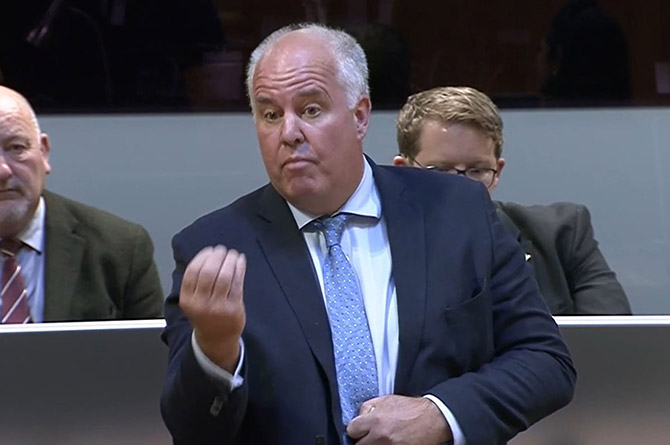
ANDREW RT DAVIES has accused the new Plaid Cymru Welsh Government of backtracking on a pledge to hold a Wales-specific Covid inquiry.
The Conservative Senedd member for the Vale of Glamorgan and Bridgend challenged ministers in the Senedd this week, asking whether the Government’s proposed examination of Wales’s pandemic response would be a full public inquiry under the Inquiries Act 2005.
Such an inquiry would have statutory powers, including the ability to compel witnesses and evidence.
Mr Davies said Plaid had repeatedly called for a Wales-specific inquiry while in opposition, but claimed ministers were now using the language of a “review” instead.
Speaking in the Senedd, he asked Trefnydd and Culture Minister Heledd Fychan to clarify whether the process would be an inquiry under the 2005 Act.
He said: “In his statement last week, he referred constantly to the Covid review rather than the Covid inquiry that the Government promised when they were in opposition.
“It was quite clear that, when you were in opposition, you were voting for an inquiry.
“Can we have clarity, please, via a statement, to understand the Government preparations in putting this together and that it will be an inquiry under the Inquiries Act 2005?”
Ms Fychan did not directly confirm whether the process would be statutory, but said Plaid would stand by its manifesto commitment and continue working with families affected by the pandemic.
She told the Senedd: “I will refer the Member to the Plaid Cymru manifesto, where it was clear, and the commitment that was made in working with Covid bereaved families, in terms of what we would commit to.
“Certainly there will be an update when that work does progress.
“He will also know that we stood shoulder-to-shoulder and have been calling for lessons to be learned. And that’s what needs to happen here: lessons should be learned, so that preparations are better for the future.”

Responding afterwards, Mr Davies said the answer suggested Plaid was watering down its previous position.
He said: “Plaid Cymru’s first weeks in power have been marred by broken promises.
“Their failure to commit to a Covid inquiry with full statutory powers suggests they’re backtracking on this too.
“The cynical way in which many politicians fail to keep their pledges is the reason public trust in politics has collapsed.”
The dispute matters because there is a significant difference between a statutory public inquiry and a non-statutory review.
A statutory inquiry can compel documents and witnesses. A review may be quicker and cheaper, but its powers depend on the terms set by ministers.
Plaid’s position has developed over time. While in opposition, the party was among the strongest voices calling for Wales-specific scrutiny of the pandemic response. In November 2025, following the publication of the UK Covid Inquiry’s report into core decision-making, Heledd Fychan said a Plaid Government would conduct a dedicated “gap inquiry” to examine Welsh Government decisions.
However, Plaid’s 2026 manifesto promised to “establish a review of Wales’s Covid response, its legacies and lessons for the future within the first year of the next Senedd term, with a targeted focus on Wales-specific matters and questions not covered by the UK-wide inquiry.”
That wording is likely to be central to the political row now developing in Cardiff Bay.
The UK Covid Inquiry has already considered aspects of Wales’s pandemic response. Module 2B focused on core political and administrative decision-making in Wales, including decisions taken by the First Minister and Welsh Ministers between early 2020 and the lifting of remaining restrictions.
The inquiry has also published reports on resilience and preparedness, decision-making, healthcare systems, and vaccines and therapeutics. Further reports are expected on procurement, social care, test and trace, children and young people, economic support, and the wider impact of the pandemic.
For many families in Pembrokeshire and across Wales, the issue remains deeply personal rather than political.
Pandemic decisions affected care home visits, hospital appointments, school closures, business support, funeral arrangements, access to GPs and the rules governing daily life. In rural areas such as west Wales, the impact was felt by older residents, tourism businesses, farming families, pupils, carers, NHS staff and people who lost loved ones in difficult and often isolated circumstances.
Covid Bereaved Families for Justice Cymru has continued to call for a Wales-specific statutory public inquiry. The group has argued that Wales does not need simply to repeat the UK-wide inquiry, but does need a short, focused and economical process capable of answering questions specific to Wales.
The Welsh Government says it remains committed to learning lessons from the pandemic and has pointed to its manifesto commitment to a targeted review.
The key question now is whether that review will have the legal force demanded by opposition politicians and bereaved families, or whether ministers will opt for a narrower process intended to report more quickly.
The Herald has asked the Welsh Government whether the planned Covid review will be established under the Inquiries Act 2005, whether it will have powers to compel evidence and witnesses, when its terms of reference will be published, and how bereaved families in Wales will be involved.



Crime1 day ago
Judge calls pensioner a ‘dirty old man’ as he avoids jail for exposing himself to women
Judge says 75-year-old Stewart Laugharne behaved ‘disgracefully’ as he avoids jail but is ordered to sign sex offenders register A...


Health1 day ago
Stroke services consultation reaches halfway point as public urged to have say
HYWEL DDA University Health Board is urging people to take part in its consultation on the future of stroke services,...


Business1 day ago
Welsh firms eye share of £5bn defence drone boom
WELSH defence and aerospace firms could be in line for a share of billions of pounds in new military spending...


Community3 days ago
Thousands line Cardigan streets for Lord Rhys homecoming parade
THOUSANDS of people lined the streets and quayside in Cardigan on Saturday as the town marked 850 years since Lord...


Crime4 days ago
Dyfed-Powys Police rated only ‘Adequate’ in organised crime inspection
A WATCHDOG has rated Dyfed-Powys Police only “Adequate” in its response to serious and organised crime, despite praise for the...


News4 days ago
Two taken to hospital after aircraft ditches in Cardigan Bay
Coastguard helicopter spotted two casualties after light aircraft came down off west Wales coast TWO people were taken to hospital...


Sport5 days ago
Long Course Weekend gets underway in Tenby as thousands head for county
Three days of swimming, cycling and running begin with The Wales Swim at North Beach THOUSANDS of athletes and supporters...


Climate5 days ago
Welsh waters, Westminster profits: Crown Estate row reignited in Wales
PLAID CYMRU has renewed calls for the Crown Estate to be devolved to Wales after figures showed income linked to...


News5 days ago
Reform MS: ‘I felt like shouting get out of the water’
Paul Marr says children playing in streams at Pembrokeshire beaches deserve better protection from pollution risks REFORM UK MS Paul...
Health6 days ago
Senedd backs call to rule out hospital downgrades after heated NHS debate
Reform UK amendment passes as West Wales hospital fears remain central political issue THE SENEDD has backed a call for...
-

 Crime6 days ago
Police appeal after reported rape at Young Farmers rally
-
Crime4 days ago
Dyfed-Powys Police rated only ‘Adequate’ in organised crime inspection
-

 News2 days ago
Biker dies and woman seriously injured in Black Mountain crash
-

 Entertainment5 days ago
Torch cuts children’s cinema tickets to £5.25 for summer
-

 Farming6 days ago
Farmers urged to protect themselves as heatwave brings health risks
-

 Farming6 days ago
Rural Wales ‘left out’ of net zero debate, warns carbon entrepreneur
-
News5 days ago
Reform MS: ‘I felt like shouting get out of the water’
-

 Community7 days ago
Council ‘did not request or give direction’ to cancel Tenby Summer Spectacular