


News
Puffins ‘hit hard’ by last winter’s storms

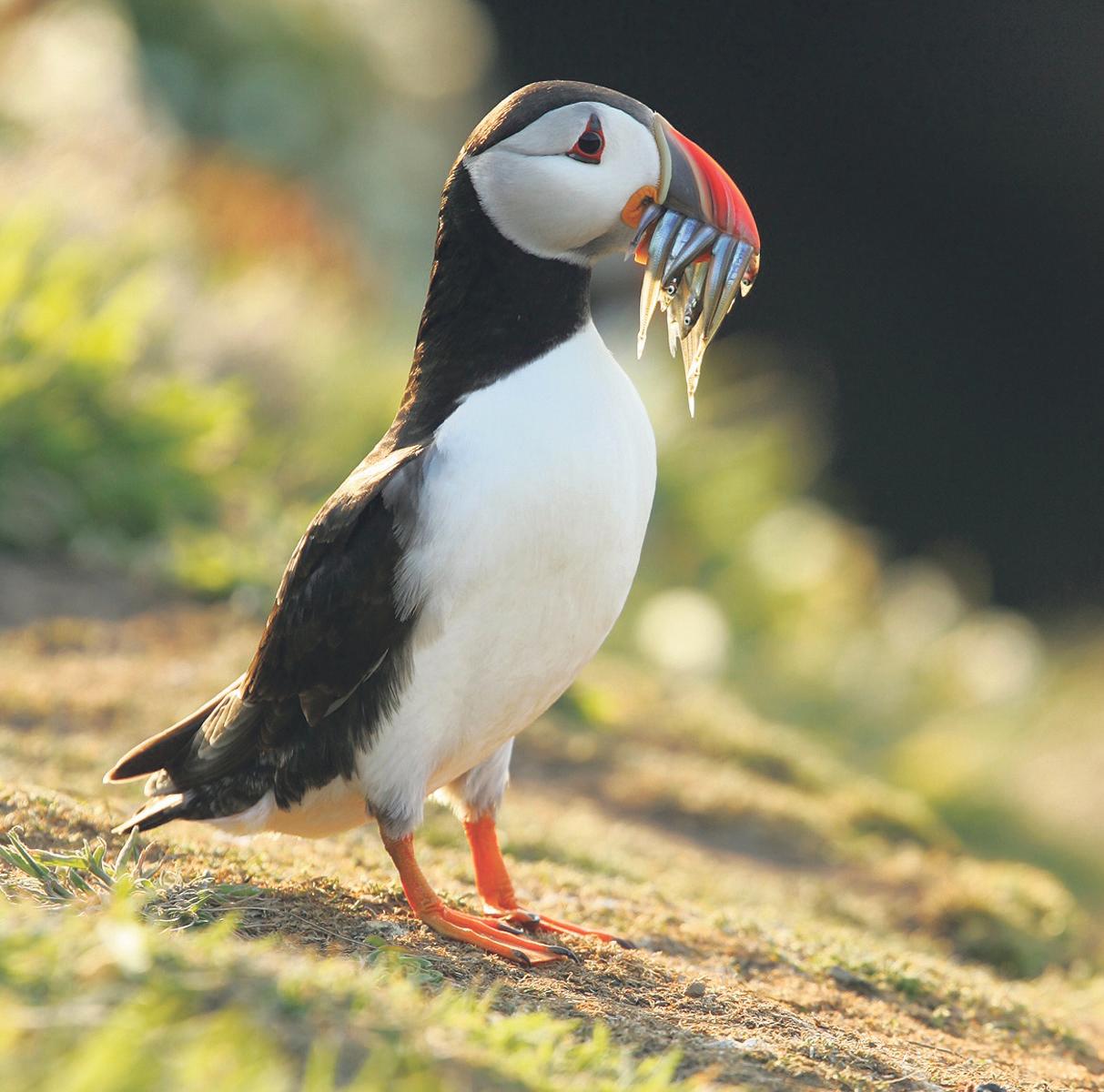

Seafood snack: Adult Puffin with his lunch
AS the first storms of the winter turn the Atlantic into a gargantuan washing machine, research is revealing the harsh consequences of last winter’s storms for seabirds in Wales. Dr Matt Wood, from the University of Gloucestershire, is helping to uncover the consequences for thousands of puffins on Skomer Island, in Wales. Around 50,000 dead seabirds, including puffins, guillemots and razorbills, were washed ashore in a severely emaciated state – they’d basically starved as storm after storm prevented them from catching enough fish to eat.
With unknown numbers dying out at sea, this was the biggest seabird wreck recorded in Europe. By the end of 2014’s breeding season, the numbers of adult puffins returning breed was down by 25% on the previous year: a quarter of the puffins on Skomer and Skokholm islands may have died, around 5,000 birds. “Puffins typically live in large island colonies, seabird cities if you like,” said Dr Wood. “Now take a city like Cardiff and imagine what would happen if a quarter of people didn’t come back after the Christmas holidays, by mid-January things would be going seriously wrong, and it looks like that’s what happened to the puffins”.
Field assistant Ros Green found that Skomer puffins bred unusually late, their chicks hatching two weeks later than usual and being fed at only a third of the rate in 2013. As a result, breeding success dropped markedly by 25%, with only just over half of puffin pairs raising a chick. This was the worst year on record for puffins on Skomer, in the 43 years of the study (since 1972).
“The long-term seabird studies on Skomer are an amazing resource. One of the puffins that was still around until recently was first seen in 1973, the year I was born,” Matt said. “With studies like this, with birds we know and study as individuals, we can understand how populations work in the detail we need to face the challenges of the future.
Will more storms impact seabird populations? I’d say ‘probably, yes’, but it’ll take us years to get a true picture of what happened in 2014, and only long-term monitoring at key sites like Skomer can provide reliable answers to questions like that.” Long-lived seabirds like puffins can take a gap year if times are tough, but Matt believes that the numbers of birds washed up dead on beaches last winter are little cause for optimism.

Matt added: “Seabird wrecks are not unprecedented, these are tough little birds that can usually cope with a storm, but forecasts of global climate change predict that these extreme storms will become bigger and more frequent. The effects of the recent seabird wreck will only become clear over the next five to ten years: longterm studies are vital to understand how the populations will cope in the Seafood snack: Adult Puffin with his lunch long-term”

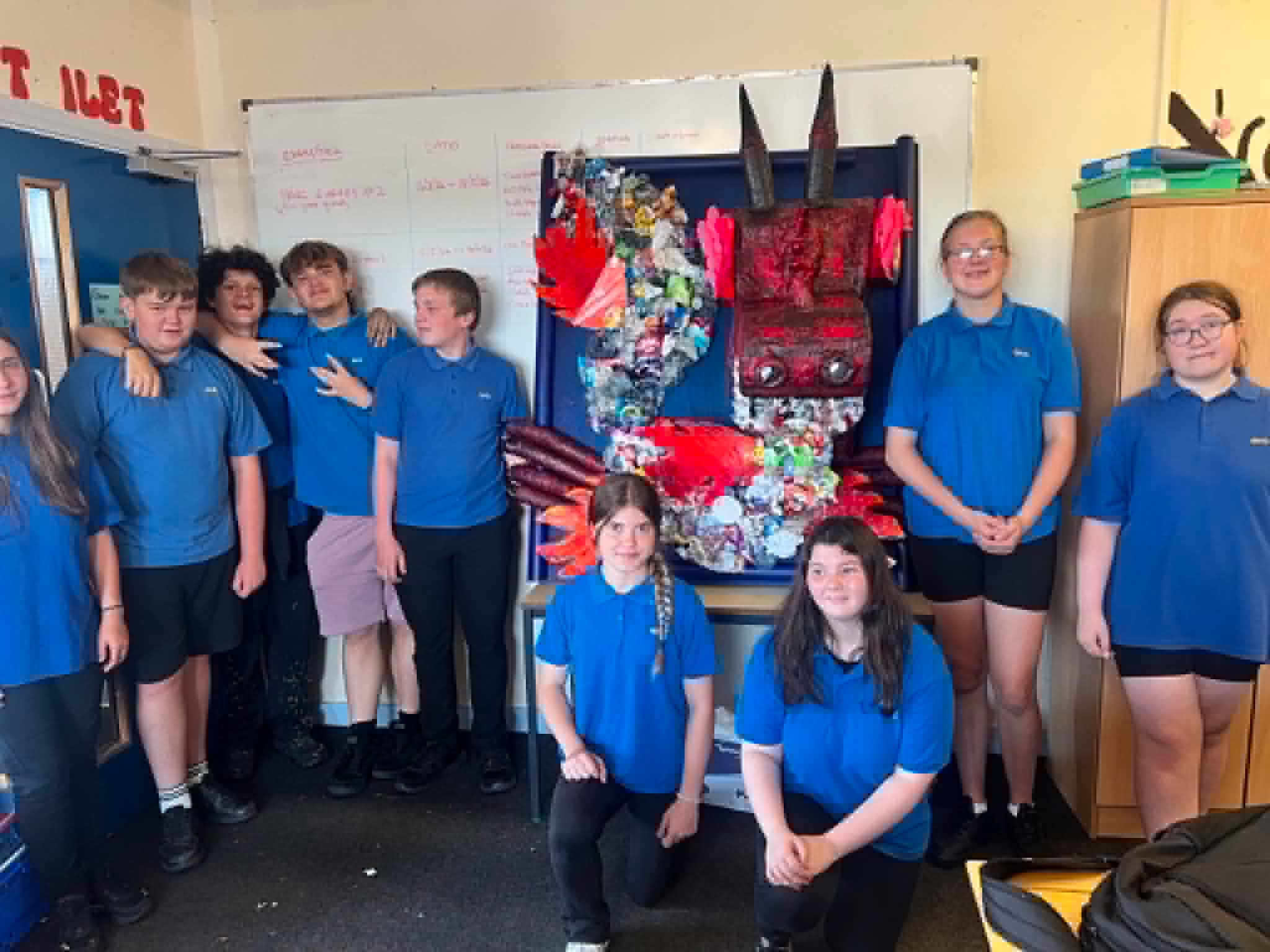
Students from 10 Usk have combined creativity, teamwork and environmental awareness for their King’s Trust Sustainability Project
PUPILS at Milford Haven School have transformed discarded materials into an impressive dragon as part of a project promoting recycling and sustainability.
Students from 10 Usk wanted their work to leave a lasting impression beyond simply collecting litter, so they set out to educate others about the importance of reusing materials and reducing waste.
The dragon was created entirely from recycled items, while its dramatic “fire” was made using rubbish gathered by pupils during their litter-picking sessions.
Miss Crolla said she was extremely proud of the commitment, creativity and teamwork demonstrated by the group, adding that the pupils had exceeded all expectations.
She said the project showed what could be achieved when young people were passionate about making a positive difference to the environment.
Special thanks were also given to Miss George, whose creativity, support and expertise helped bring the pupils’ vision to life.
The school said the completed dragon demonstrated how, with a little imagination, yesterday’s rubbish could be transformed into tomorrow’s masterpiece.

Ceredigion Penfro MS says disease is placing severe emotional and financial pressure on farming families
Paul Davies MS has urged the Welsh Government to use every available measure to tackle bovine tuberculosis and work towards eradicating the disease in Wales.
The Ceredigion Penfro Senedd Member raised the issue during a Senedd debate, warning that bovine TB continues to have a devastating impact on farmers, their families and rural communities.
Mr Davies called for a science-led and comprehensive strategy that addresses every potential source and route of infection.
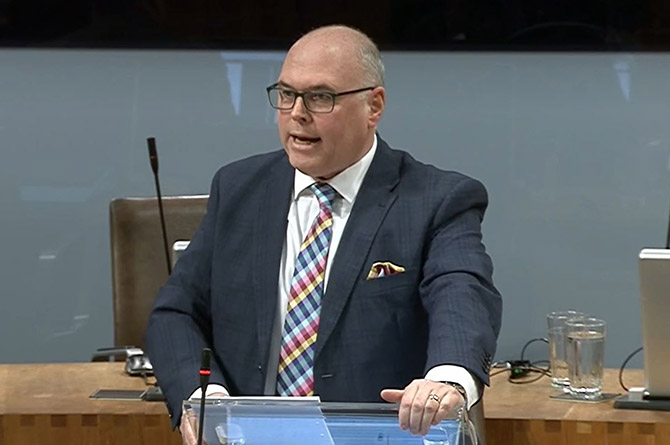
He said farmers across west Wales needed clear leadership from the new Welsh Government and greater confidence that ministers were prepared to take effective action.
Mr Davies said: “Bovine TB continues to have a huge impact on farmers, their families and rural communities across Wales.
“It places enormous emotional and financial pressure on farming businesses and remains one of the most significant challenges facing our agricultural industry.
“Farmers and the wider rural community are looking to the new Welsh Government to provide leadership by introducing a holistic approach that addresses all routes of transmission.
“The Welsh Government must do everything it can to eradicate this appalling disease.
“I will continue to raise this issue on behalf of farmers in west Wales and press the Welsh Government to use every lever available to tackle bovine TB.”


Audit Wales says councils need earlier decisions, clearer forecasts and a full review of how billions of pounds are distributed
THE SYSTEMused to distribute Welsh Government funding to councils has not been independently reviewed for more than 20 years and still relies partly on information dating back to 1991, a new report has warned.
Audit Wales says the current arrangements do not always help Wales’ 22 principal councils secure value for money or plan essential public services effectively.
Its report, Funding Councils, calls on the Welsh Government to provide funding information earlier, offer councils greater certainty about future settlements and ensure decisions are based on accurate, up-to-date evidence.
Councils rely heavily on Welsh Government funding to pay for services including education, social care, waste collection, highways and housing support.
However, auditors found that councils are often given limited information about how much funding they are likely to receive in future years, making long-term financial planning more difficult.
The report says both councils and the Welsh Government should prepare for a range of possible funding settlements so that decisions do not have to be rushed once final figures are announced.
It also raises concerns about the formula used to distribute the majority of unrestricted council funding.
The system has not undergone a full independent review for more than two decades, while some of the indicators used to calculate allocations continue to draw on census and other information from 1991 and 2001.
Audit Wales said there had been significant demographic, economic and social changes across Wales since those figures were collected.
The report also questions the number, design and timing of specific grants handed to councils.
Some grants are announced late in the financial year, leaving authorities with little time to spend the money and increasing the risk that decisions are made quickly rather than as part of a wider strategic plan.
Five recommendations have been made to the Welsh Government, including a review of the funding formula, clearer indications of future funding levels and improvements to the administration of grants.

Auditor General for Wales Adrian Crompton said many of the problems identified reflected recurring concerns he had encountered during his time in office.
He said: “This report finds that the way the Welsh Government funds councils does not always help them to achieve value for money, particularly over the longer term.
“Addressing these themes is essential if the Welsh Government and local authorities are to navigate today’s extreme financial and demand challenges and deliver sustainable public services to the people of Wales.”
The annual local government settlement provides councils with money that is not restricted to a particular service. The amount received by each authority is calculated using a formula intended to reflect local needs and circumstances.
Councils also receive separate grants that must be used for specified purposes.
The latest findings follow previous Audit Wales reports examining the financial sustainability and capital planning arrangements of Welsh local authorities.



Community3 hours ago
Tenby Summer Spectaculars brought to an end after harbour licence revoked
Round Table says it was willing to make major safety changes but could not secure the access controls needed to...
Local Government2 days ago
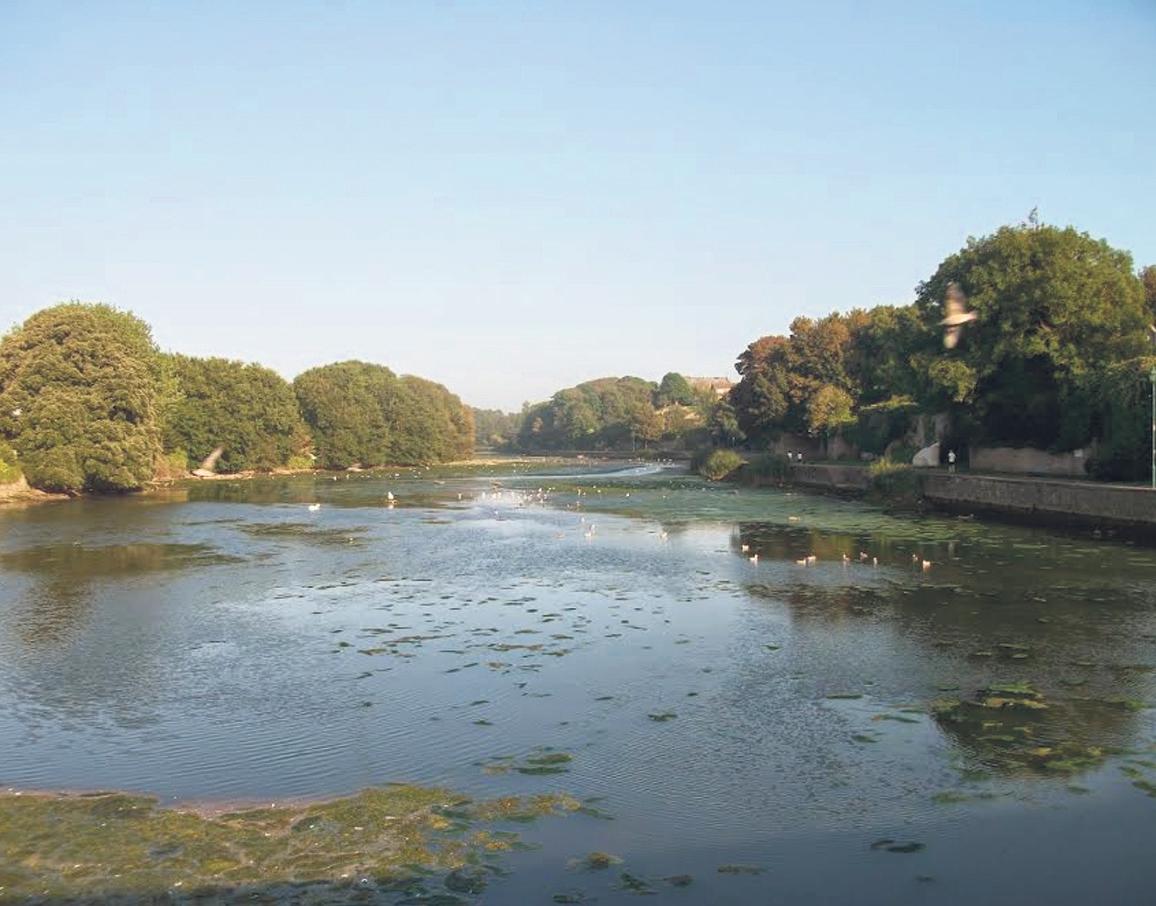
Catapult attacks suspected after wildlife deaths at Pembroke Mill Pond
Wildlife Crime Officers are investigating after the town council said around five animals showed signs of deliberate injury WILDLIFE found...


Crime2 days ago
Narberth retailer speaks of shoplifting toll after ‘collectable bear’ stolen
Independent shop owner said rising costs meant businesses could not afford to absorb losses caused by theft A NARBERTH retailer...


Crime2 days ago
Teen accused of attempting to murder teacher says she lied about stabbing
Defendant accepts teacher was terrified and that a knife wound to the head could kill, but denies deliberately attacking her...


Local Government4 days ago
Calls grow for independent investigation into Manorbier school closure
Councillor alleges misleading figures, inadequate insurance and poor treatment of staff CALLS for an independent investigation into the controversial closure...


Community4 days ago
Neyland Carnival hailed a huge success after streets fill with colour and crowds
NEYLAND CARNIVAL organisers have thanked the community, volunteers and local businesses who helped make this year’s event a memorable success....


Community4 days ago
Tenby Summer Spectacular: Anger grows over ‘disaster waiting to happen’ warning
A growing backlash has followed police calls for the event’s licence to be revoked, with supporters questioning why authorities failed...


Charity5 days ago
RSPB secures ‘missing link’ to reconnect wildlife habitats in Carmarthenshire
RSPB CYMRU has purchased a 96-hectare upland site in Carmarthenshire, describing it as a vital step towards reconnecting one of...


Crime6 days ago
Ann Widdecombe: Welsh politicians pay tribute as murder probe launched
Prime Minister Sir Keir Starmer has praised the former minister’s “conviction and dedication”, while political figures in Wales remembered her...


News6 days ago
Solardo pulls out of Haverfordwest show as organisers offer full refunds
Headline act confirms non-appearance as Park House Series announces major event changes DANCE music duo Solardo will no longer perform...
-

 Farming7 days ago
Working Carmarthenshire farm opens gates to visitors with new holiday cottages
-

 Crime7 days ago
Greenacres confirms seized dogs are safe as investigation continues
-

 Health6 days ago
Hospital ward closed after highly contagious scabies outbreak
-

 Crime2 days ago
Letterston footballer guilty of eye-gouging assault during match
-
Crime7 days ago
Teacher stabbing trial: The first week of evidence
-
 Education7 days ago
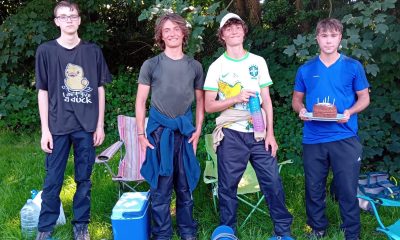
Pembrokeshire College students complete three-day Silver expedition
-
 Cymraeg7 days ago
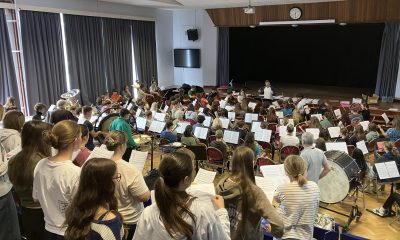
Young musicians to bring National Eisteddfod to a spectacular close
-

 Entertainment7 days ago
Videos of Brits secretly filmed on spycams found being shared online