


News
1950s women’s group questions ‘new evidence’ claims and £180k DWP payment


Welsh campaigners demand clarity from ministers as WASPI legal costs deal faces scrutiny
CAMPAIGNERS representing women born in the 1950s have written to the UK Government demanding urgent clarification over what ministers are calling “new evidence” on state pension age changes – and why the Department for Work and Pensions (DWP) agreed to pay £180,000 towards legal costs when a High Court cap had been set at £90,000.
In a strongly worded email sent on Monday (Dec 15), Jackie Gilderdale and Kay Clarke, writing on behalf of 1950s Women of Wales, 50s Women United and Pension Partners for Justice, asked Pensions Minister Torsten Bell and Work and Pensions Secretary Pat McFadden to explain the Government’s position ahead of a planned meeting with MPs in January.
They warn that, if ministers do not provide a “full and substantive” response, they will file Freedom of Information requests and escalate the issue to the National Audit Office (NAO) and the House of Commons Public Accounts Committee.
FIRST, THE ‘NEW EVIDENCE’
The Welsh-based group say they are “seeking urgent clarity” about repeated references in Westminster to “new evidence” relating to the way changes to women’s state pension age were communicated.
They argue that key material being talked about publicly is not new at all, but was uncovered years ago during the early stages of the Women Against State Pension Inequality (WASPI) campaign.

In their letter, Jackie and Kay say the omission of state pension age rises for women from automatic pension forecasts “as early as 2003” was documented by the original WASPI co-founders, widely used in campaigning work and held by law firm Bindmans “for almost a decade”.
“It CANNOT credibly be described as new,” they write.
The email asks the ministers to spell out:
- What evidence is being described as “new”;
- When that evidence first came into the possession of Government, MPs and legal representatives; and
- Why “long established, documented evidence is now being presented in this manner”.
They also point to the fact that some material was once published on the WASPI website but later removed by the current WASPI leadership, led by Angela Madden, saying the reason “has never been explained”.

COSTS CAP AND £180,000 PAYMENT
The second major concern raised in the correspondence is the size of the DWP’s contribution to WASPI’s legal costs after the recent judicial review was halted.
The campaigners highlight that a costs capping order in the High Court proceedings limited the department’s liability to £90,000, yet the DWP has since confirmed it will pay £180,000 towards WASPI’s costs.
“This raises significant concerns regarding value for money, propriety and regularity, which fall within the scrutiny remit of the National Audit Office and the Public Accounts Committee,” the letter states.

“It is unclear on what basis this excess payment was authorised, who approved it, or how it complied with principles of public financial management and ministerial accountability.”
Jackie and Kay say that unless ministers set out a clear justification for the payment, they will “proceed with a formal Freedom of Information request and refer the matter to the National Audit Office and the Public Accounts Committee for full investigation”.
They also argue that, in a climate of tight public finances, any decision to go beyond a court-imposed cap should be fully explained to Parliament and the public.

CALL FOR INCLUSIVE MEDIATION
Underpinning the exchange is a long-running demand by 1950s Women of Wales and allied groups for formal mediation between the Government and all major campaign organisations representing women affected by pension age changes.
They point to recent changes to the Civil Procedure Rules and to case law encouraging courts and public bodies to make greater use of Alternative Dispute Resolution (ADR), including mediation.
“As Pensions Minister, Mr Bell has a duty to engage constructively in mediation with leaders of all 1950s women groups,” they write, adding that these groups “possess further evidence requiring scrutiny”.
“To decline or ignore such engagement would risk breaching ministerial duties; fail to meet legal expectations and be manifestly unjust to the women impacted.”
The letter asks for written confirmation that the Minister will now engage in mediation “in line with the Civil Procedure Rules and 2024 ADR requirements”.
SECRECY ROW OVER DECEMBER HEARING
The latest intervention also revisits controversy around the handling of a court hearing on 3 December, linked to the WASPI judicial review.
In earlier emails copied into the thread, Jackie and Kay describe the arrangements for public access to that hearing as an “extraordinary scandal”, claiming the DWP and WASPI agreed to conditions which “effectively repudiated the principle of open justice” by limiting or charging for access.
They say it took an intervention by a High Court judge shortly before the hearing to restore open access, after which both parties withdrew their applications and the case did not proceed.
The campaigners argue that this sequence “raises profound questions” and are calling for greater transparency about why the case collapsed and what, if anything, was being “concealed”.
Those comments are allegations by the campaign group; there is no suggestion that any party has accepted that characterisation of events.

WASPI GOVERNANCE QUESTIONS
Alongside criticism of Government, the Welsh group is also calling for scrutiny of WASPI’s own governance.
In previous correspondence, they raised concerns about:
- apparent discrepancies between public statements about resignations and the directors still listed on Companies House;
- the group’s internal accountability; and
- whether WASPI’s leadership structure reflects those it claims to represent.
They argue that, by WASPI’s own figures, the organisation represents a relatively small proportion of the estimated 3.8 million women affected by state pension age changes, and say ministers should not treat it as the sole voice of the cohort.
“Government cannot be expected to engage with a company whose own governance raises such substantial questions,” one email says, while stressing that all groups – including WASPI – should be involved in any settlement process.
“WOMEN DESERVE HONESTY”
The latest message concludes by saying that women born in the 1950s “deserve honesty, transparency and accountability”.
“Anything less further undermines trust in the political process and perpetuates an injustice that has already endured for far too long, and cost a vast number of lives,” Jackie and Kay write.
They tell the ministers that, if their questions are ignored, they will ensure the full group of All-Party Parliamentary Group members, cross-party MPs and the wider public “are fully informed”.
The Herald has approached Torsten Bell MP, Pat McFadden MP, WASPI and Bindmans for comment.
In an emailed response to The Herald’s questions on Monday, a DWP spokesperson said: “Last month we committed to retake the decision and as set out, we will do so within 3 months.
“This should not be taken as an indication that Government will necessarily decide that it should award financial compensation.”


DYFED-POWYS POLICE have launched a winter policing operation aimed at tackling town centre crime, antisocial behaviour and dangerous driving during the festive period.
The force is taking part in the Home Office’s Winter of Action campaign, with officers concentrating on crime “hotspots” across Dyfed, Powys and West Wales in the run-up to Christmas and New Year.
Police say the focus will be on reducing shoplifting, street crime and antisocial behaviour, alongside increased patrols linked to the night-time economy. The operation also includes measures targeting violence against women and girls, as well as alcohol-related disorder.
The winter campaign is being supported by Operation Ivydene, a dedicated antisocial behaviour initiative funded by the Office of the Police and Crime Commissioner. Dyfed-Powys Police received almost £500,000 in 2024 to deliver additional patrols and targeted responses in identified problem areas.
According to the force, Operation Ivydene delivered more than 12,000 hours of patrols during its first year, with reported antisocial behaviour falling by around 40% in hotspot locations.
The second year of the operation began this autumn. Inspector Darren Crockford said lessons learned during the first phase were now being used to broaden the focus.
He said: “Whilst we are still working towards the original aim of reducing antisocial behaviour, there is now an added emphasis on reducing serious violent crime, knife crime and retail crime.
“So far, over 2,050 hours of patrols have taken place across hotspot areas, with more than 70% of those patrols involving engagement with local businesses, charities and third-sector organisations.”
Operation Ivydene is currently active in a number of towns, including Haverfordwest, Milford Haven and Pembroke in Pembrokeshire, along with Ammanford, Llanelli and Carmarthen in Carmarthenshire, Aberystwyth and Lampeter in Ceredigion, and Newtown and Llandrindod Wells in Powys.
Community engagement forms a key part of the operation. Police say more than 6,300 surveys were carried out during the first year of Operation Ivydene to gather feedback from residents and businesses in hotspot areas.
Inspector Crockford added that the responses had helped officers better understand local concerns and shape patrol activity.
Alongside town centre policing, Roads Policing Units are also increasing patrols over the festive period, with a focus on drink and drug driving.

Police said officers would also be targeting the so-called “Fatal Five” offences – speeding, using a mobile phone while driving, not wearing a seatbelt, driving without due care, and driving under the influence of alcohol or drugs – which are the most common causes of fatal and serious collisions.
Dyfed-Powys Police covers more than 8,500 miles of road across the force area. Officers are urging drivers not to feel pressured into risky decisions and to take responsibility for staying safe behind the wheel.
Updates on the winter operation are being shared through Dyfed-Powys Police social media channels and the Dyfed-Powys Connects messaging service.

MEMBER of the Senedd Paul Davies MS has praised the “vital role” played by the voluntary sector in Pembrokeshire following a visit to PAVS – Pembrokeshire Association of Voluntary Services.
Mr Davies met with Chief Executive Jess Bickerton and members of the PAVS team, who provide support to individuals, volunteers, community groups and charities across the county.
During the visit, the Preseli Pembrokeshire MS was briefed on the wide range of advice, guidance and practical assistance offered by PAVS to help local organisations operate effectively and respond to community needs.
PAVS works closely with voluntary and third-sector groups, supporting everything from governance and funding applications to volunteering and community development, and plays a key role in strengthening local networks across Pembrokeshire.
Speaking after the visit, Mr Davies said the organisation’s work was crucial in helping communities thrive, particularly at a time when many voluntary groups are facing increasing pressures and rising demand for support.
He thanked Ms Bickerton and her colleagues for their work and for the warm welcome, describing their contribution as “invaluable” to communities throughout the county.
PAVS supports hundreds of organisations and volunteers each year and is a central hub for the voluntary and community sector in Pembrokeshire.

NEW data released by Ordnance Survey (OS) could significantly improve how coastal erosion and flood risk are monitored across Great Britain as sea levels rise and extreme rainfall becomes more frequent.
The continuous tidelines dataset provides a clearer and more accurate picture of where high and low tides fall around the coast and along tidal rivers. The data is expected to support environmental monitoring, flood modelling, and long-term planning as the impacts of climate change accelerate.
Earlier this year, the Environment Agency updated its National Flood Risk Assessment (NaFRA), which for the first time factored in projected climate change impacts. The assessment found that around 6.3 million homes and businesses in England — roughly one in five — are currently at risk of flooding. That figure could rise to one in four properties by 2050.
The Agency has also updated its national coastal erosion risk map, which estimates that around 3,500 properties could be affected by coastal erosion by 2055.
The new OS dataset builds on existing information held in the OS National Geographic Database (OS NGD). Previously separate tidal boundary features have now been automatically merged into continuous high- and low-tide lines, creating two new feature types within the OS NGD Water theme. These can also be used as overlay layers through the OS Tiles API, allowing for clearer visual mapping and large-scale analysis.
The data is expected to support a wide range of environmental and regulatory work, including coastal erosion and flooding modelling, updating boundary features to reflect coastal change, climate change impact assessments, and identifying areas of foreshore that act as natural flood defences.
William Russell, Senior Coastal Process Scientist at the Wales Coastal Monitoring Centre, said the dataset would remove uncertainty from coastal monitoring.
“One of our core values is ‘data, not opinions’. When information is missing, we seek out or collect the data needed to support sound decision-making,” he said.
“The OS Continuous Tidal Boundaries dataset removes uncertainty from our strategic monitoring programme and gives us clearer insight into intertidal extents, delivering cost savings and efficiencies for our survey contractors.”
Ordnance Survey says the data is particularly valuable for environmental policy and regulation, including decisions around water discharge and flood management. Accurately defining the intertidal zone helps identify natural coastal defences, which play a vital role in protecting communities and ecosystems.
Intertidal information has also been enhanced within the Land theme of the OS NGD, with improved coverage of previously obscured areas to create a more complete national coastal dataset.
Lily Brown, Product Manager at Ordnance Survey, said the data would support evidence-based decision-making.
“The OS National Geographic Database contains trusted, accurate features that support everything from climate resilience and infrastructure planning to coastal management,” she said.
“By incorporating authoritative tideline data, we are enabling decisions that will help protect and monitor Britain’s evolving coastlines.”

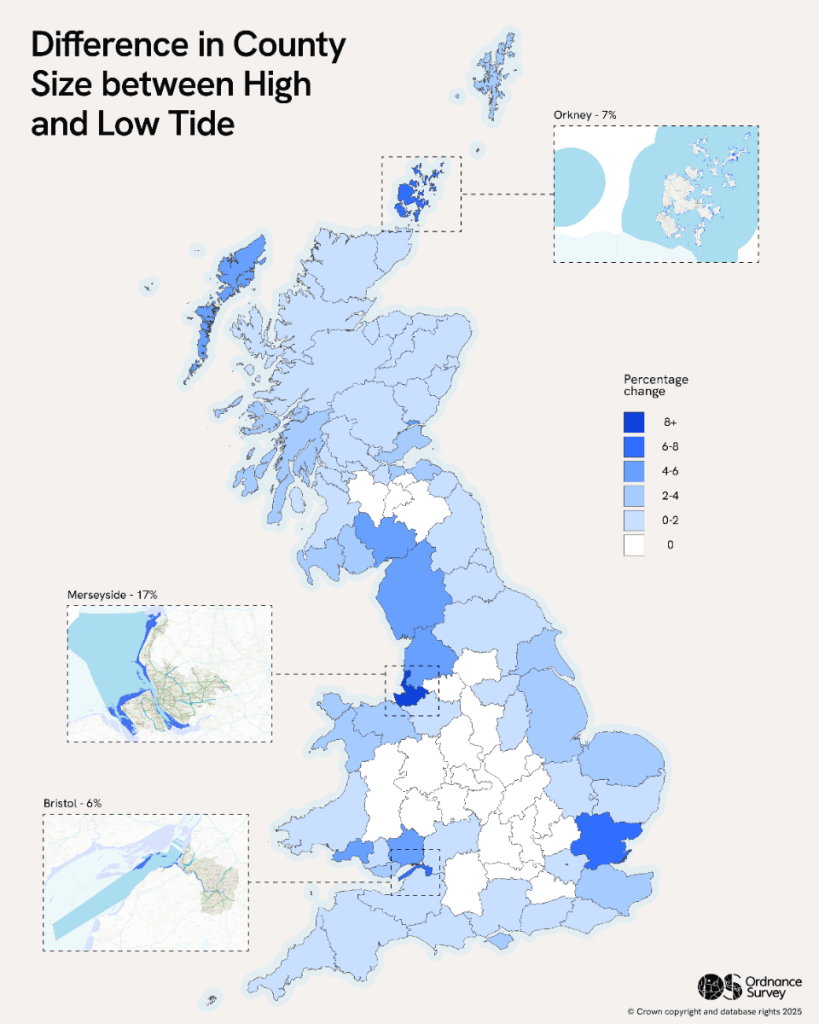
Following the dataset’s release, Ordnance Survey analysed how ceremonial counties change in size between high and low tide. Merseyside showed the greatest variation, with a nearly 17% difference, followed by Orkney at around 7%.
The analysis also highlighted that counties considered landlocked, such as Nottinghamshire and South Yorkshire, still experience significant tidal influence due to rivers like the Trent and the Don being tidal far inland.
When combined with Unique Property Reference Numbers (UPRNs), the tideline data shows that Greater London has the highest number of homes and businesses within 15 metres of the high-tide line, at around 5,500. Cornwall ranks second with just over 3,000 properties, followed by Devon with around 2,400.
The new data has been released under the Public Sector Geospatial Agreement (PSGA), which provides emergency services and public sector organisations with access to Ordnance Survey data and services.



Three inmates deny murder of Lola James killer at Wakefield prison
THREE prisoners have denied murdering child killer Kyle Bevan, who was found dead in his cell at HMP Wakefield. Bevan,...


Dyfed-Powys Police reassure communities after Bondi Beach mass shooting
Officers monitor local tensions following terror attack on Jewish event in Sydney DYFED-POWYS POLICE have issued reassurances to communities across...


Search under way in Pembroke Dock for missing man Lee
Coastguard, RNLI and rescue helicopter launched as fears grow he entered the water A MAJOR search and rescue operation is...


Search under way in Pembroke as man reported missing
Rescue teams battle worsening weather ahead of amber rain warning A MULTI-AGENCY search and rescue operation is under way in...

Amber weather warning as ‘danger to life’ rain set to hit Pembrokeshire
Dyfed-Powys Police and council teams prepare as Monday deluge expected COMMUNITIES across Pembrokeshire are being urged to brace for severe...


Former Army Cadet leader sentenced for child abuse image offences
Judge condemns “horribly abused” victims as Carmarthen man admits offences A FORMER Army Cadet instructor from Carmarthen has been sentenced...


Trefin dog case ends in forfeiture order after protection notice breach
Village protest followed months of complaints about barking A WOMAN from north Pembrokeshire has been fined £1,000 and ordered to...


Man spared jail after baseball bat incident in Milford Haven
Judge says offence was so serious only a prison sentence was justified A 44-YEAR-OLD has been given a suspended prison sentence after...


Rural cannabis factory exposed after five-year operation in Carmarthenshire
Family-run drugs enterprise brought in millions before police raid during lockdown A FAMILY who relocated from England to a remote...


Senedd rejects calls to ‘eliminate’ rates for small businesses
A CONSERVATIVE call to abolish rates for all small businesses in Wales has been voted down by the Senedd amid...
-

 Crime6 days ago
Phillips found guilty of raping baby in “worst case” judge has ever dealt with
-

 Crime5 days ago
Kilgetty scaffolder sentenced after driving with cocaine and in system
-

 Crime5 days ago
Housing site director sentenced after failing to provide breath sample following crash
-

 News1 day ago
Dyfed-Powys Police launch major investigation after triple fatal crash
-

 Crime5 days ago
Motorist banned for three years after driving with cannabis in system
-
Crime2 days ago
Man spared jail after baseball bat incident in Milford Haven
-

 Education4 days ago
Teaching assistant struck off after asking pupil for photos of her body
-

 Crime5 days ago
Milford Haven pensioner denies exposure charges