


News
Disappointment over cuts to YFC funding

FOLLOWING the news that Wales YFC has been unsuccessful in its recent bid for a renewal of its core funding, William Powell

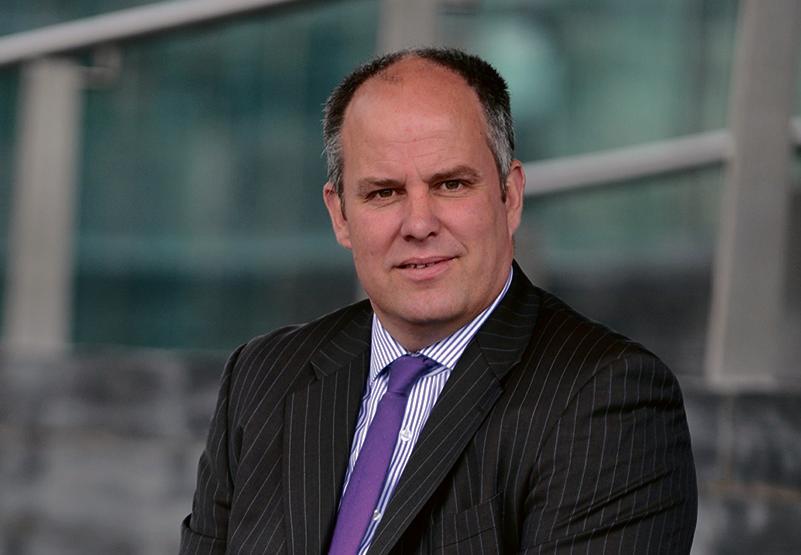
Minister has questions to answer: Welsh Tory leader Andrew RT
Davies.
AM called on the First Minister to ensure that the impact that this loss of funding will have on the future of the Young Farmer’s Movement in Wales is fully assessed.
Wales YFC is the largest rural youth organisation in Wales with current membership standing at just under 6000 10 – 26 year olds, operating across 157 YFC Clubs throughout rural Wales. The programme enables young people to develop new skills and gain invaluable training in a range of different areas.
Despite its longstanding success and support over a number of years through a Welsh Government administered grant from the National Voluntary Youth Organisations (NVYO), Wales YFC were recently informed that their latest bid for continued funding was unsuccessful and that funding would cease from April 2015, with the next window for applications not opening until 2018.
Mr Powell told the Senedd: “The YFC’s loss of some £700, 000 of core funding over three years – from the NVYO fund – threatens to undermine the YFC’s work at a national level, in supporting the County Federations right across Wales. The contribution of Young Farmers Clubs to nurturing both leadership and self-confidence is second to none and the Welsh Government needs to make a full assessment of the impact that this dramatic loss of funding will have on the Young Farmer’s Movement in Wales.”

Alun Richards, West Wales businessman and previous Wales Young Farmer of the Year, commented: “The Wales YFC was a big part of my childhood and provides and it continues to benefit young people in rural communities throughout the country. It is also unique in the sense that it is a movement truly run by young people for young people. The organisation is irreplaceable and it would be extremely disappointing if we were to see the organisation lose its core funding.”
Tory Senedd leader Andrew RT Davies said: “YFC events offer young people from rural communities an opportunity to develop skills such as public speaking, and the organisation plays a vital role in the promotion of cultural aspects of Welsh life, such as the language.”
He continued: “To go from the current level of funding to zero overnight would show just how little this Welsh Government understands and values the Welsh countryside and its communities.”
Commenting on the decision to pull the funding, Mr Davies concluded: “Whilst everyone appreciates the financial pressures that governments are under, the YFC is part of the very fabric of Wales and I believe that the Minister has serious questions to answer if these cuts do go ahead as planned.



A NEW BBC documentary examining one of Pembrokeshire’s most disturbing crimes will be broadcast this week — and includes contributions from two journalists closely involved in reporting the case at the time.
The programme, The Truth About My Murder: A Killing in Lockdown, focuses on the killing of Judith Rhead by her son Dale Morgan at her Pembroke Dock flat during the Covid-19 pandemic.
Morgan was jailed for life in October 2021 after admitting murdering his 68-year-old mother, striking her repeatedly with a hammer before living in the property alongside her body for around two months.
The documentary explores the events leading up to the discovery of Judith’s body in February 2021, the subsequent police investigation, and the impact on her family and community.
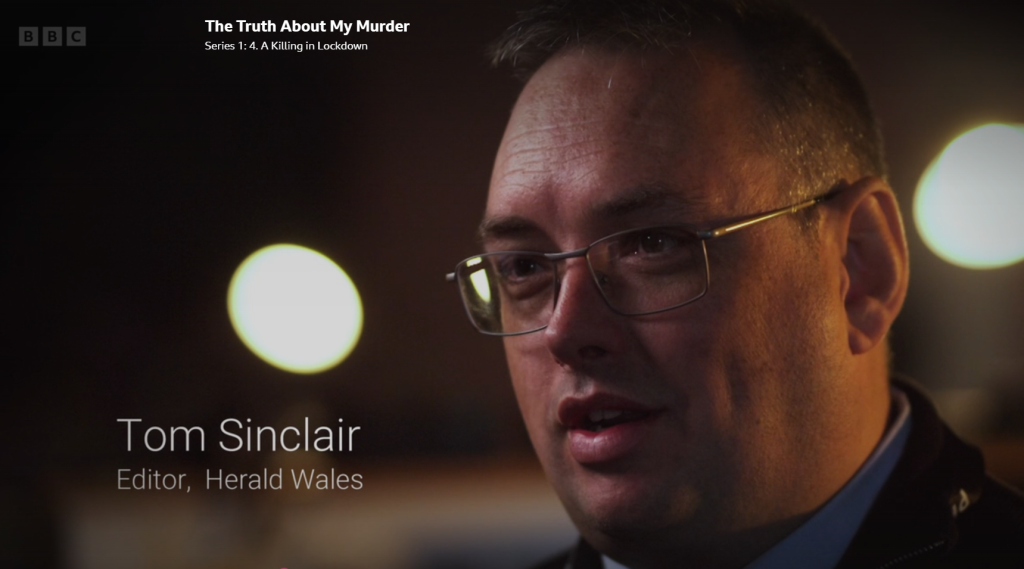
It also features contributions from local journalists including Herald editor Tom Sinclair and his deputy Jon Coles, who both covered the case extensively during the investigation and court proceedings.

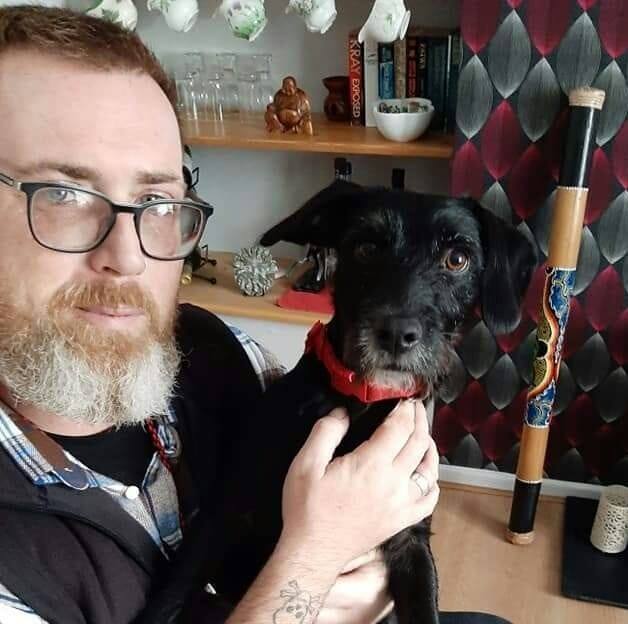
Judith Rhead, described by friends as sociable and caring, had worked as a social work assistant and carer. She was well known locally and enjoyed music and karaoke.
Concerns were raised when neighbours had not seen her for some time during lockdown. Morgan initially told people she was unwell and later claimed she had been admitted to hospital, prompting further checks.
Police eventually attended the flat on Saturday, February 20, 2021, where officers discovered her body inside the bedroom.
A post-mortem examination confirmed she had died from multiple head injuries consistent with a hammer attack. Evidence suggested she had been dead for several weeks before being found.
Morgan later handed himself in to police and admitted the killing. At Swansea Crown Court he was sentenced to life imprisonment with a minimum term of 21 years and six months.
Sentencing him, the judge described the attack as savage and sustained against a defenceless woman.
Dyfed-Powys Police said procedures relating to welfare concerns have since been reviewed, with greater emphasis placed on face-to-face contact where vulnerability is suspected.

The Truth About My Murder: A Killing in Lockdown will be broadcast on BBC One Wales at 10:40pm on Tuesday (Feb 24), and is also available to watch on BBC iPlayer.
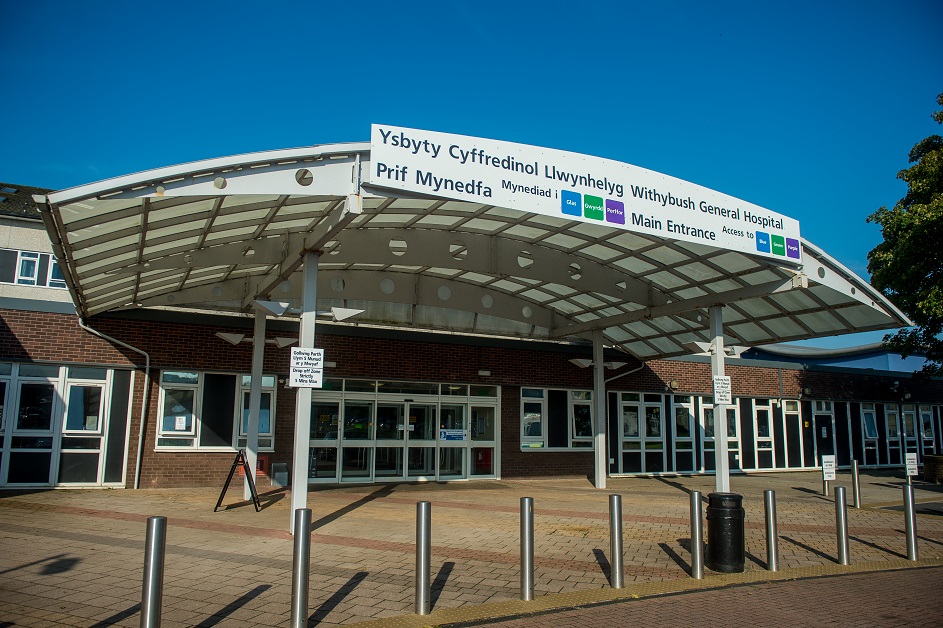
Row deepens over emergency services wording as health board decision sparks political clash
A POLITICAL row has erupted over planned changes to services at Withybush Hospital after First Minister Eluned Morgan accused Preseli Pembrokeshire MS Paul Davies of “scaremongering” about the future of emergency care in the county.
The dispute centres on a decision by Hywel Dda University Health Board to remove general emergency surgery from the hospital — a move that has prompted strong criticism from local campaigners and politicians concerned about patient access and travel times.
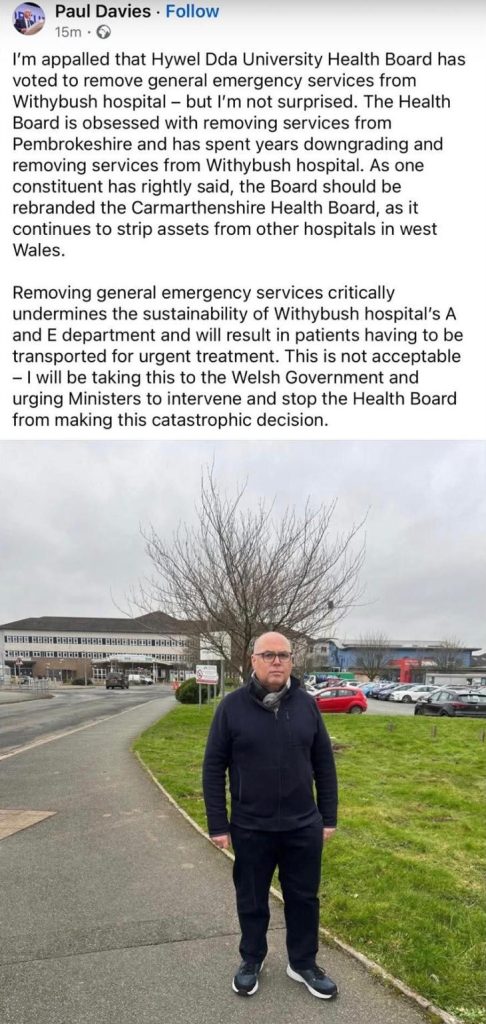
In a social media post earlier this week, Mr Davies said he was “appalled” that the Health Board had voted to remove what he described as “general emergency services” from Withybush, warning that the decision would undermine the sustainability of the hospital’s A&E department and force patients to travel further for urgent treatment.
However, the First Minister rejected that characterisation, saying the decision relates specifically to emergency surgery rather than the closure of accident and emergency services.
She said: “There’s a big difference between emergency services and emergency surgery. One affects the entire population, one affects around five people a week. You can’t shout ‘crisis’ at the first draft and quietly edit it to something completely different once the facts catch up.”
Ms Morgan also pushed back against claims that services at Withybush have been systematically downgraded, adding: “It’s still there, it’s still providing services.”
Accountability and responsibility
Health is fully devolved to Wales, meaning the Welsh Government is responsible for NHS policy, funding and oversight. While health boards make operational decisions locally, they remain accountable to Welsh ministers.
The Welsh Conservatives have consistently argued that pressures within NHS Wales — including waiting times, workforce shortages and service centralisation — are the result of policy decisions made by successive Labour-led governments in Cardiff Bay.
Mr Davies has pledged to raise the issue directly with ministers and has called on the Welsh Government to intervene, describing the Health Board’s decision as “catastrophic”.
What is changing?
Hywel Dda University Health Board says centralising certain emergency surgical procedures is intended to address staffing pressures and improve patient safety, with some cases expected to be transferred to other hospitals within the health board area.
Accident and emergency services at Withybush are not being removed and will remain in place.
The debate has reignited long-standing concern in Pembrokeshire about the future of hospital services, with previous changes over the past two decades prompting repeated public campaigns and protests.

As political tensions escalate, attention is now turning to whether Welsh ministers will step in — or whether the Health Board’s decision will proceed as planned.
A DEVOTED volunteer and former employee at Fishguard RNLI has stepped down from his final role after more than five decades of outstanding service to the local community and those in need at sea.
After 50 years of unwavering commitment, Chris Williams has retired from the Royal National Lifeboat Institution (RNLI), bringing to a close a remarkable chapter defined by professionalism, compassion and lifesaving impact.
Chris and his wife Brenda returned to the area in 1974 when he took up the position of second engineer with British Rail Ferries. Shortly afterwards, he was approached by then assistant mechanic Roy Williams, who, anticipating his own retirement, recognised the station would soon need a new mechanic. Chris joined the lifeboat crew and answered his first callout in 1976.
He was already closely connected to the station. His mother had been a founding member of the local Women’s Lifeboat Guild, raising vital funds for the charity, and Chris had often helped with fundraising efforts.
In 1979, when full-time station mechanic Noel Murrow retired, Chris stepped into the role. Having spent five years sailing between Fishguard and Rosslare, he decided to dedicate himself fully to the station — a position he held until 2005.
In 2006, Chris became the station’s Volunteer Water Safety Advisor, leading community engagement initiatives to promote safety around the coast — a role he carried out until 2021. Alongside this, he took on additional responsibility in 2016 as Launch Authority, a crucial volunteer position coordinating communication between the lifeboat station and HM Coastguard.
Following the departure of the previous Lifeboat Operations Manager (LOM) in 2021, Chris stepped in to lead the station on a temporary basis. In 2024, he was formally appointed to the role. As LOM, he served as station manager and the key link between Fishguard RNLI and RNLI headquarters in Poole, a responsibility he fulfilled with diligence and dedication until his retirement this month.
Over the course of his career, Chris served aboard three successive classes of lifeboat as they came into service.
The first was the Watson class lifeboat Howard Marryat. Reflecting on those early days, Chris recalled:
“On a rough night you got wet as you hit the water at the bottom of the slip — and you stayed wet until you got back.”
The Watson was followed by the Arun class lifeboat Marie Winstone. Chris described her as:
“A huge step up in speed — 18 knots — and space; you could almost hold a dance in the wheelhouse. She was highly manoeuvrable, but a very uncomfortable sea boat. She had a vicious roll and could slam so hard in a heavy sea you thought the fillings would come out of your teeth.”
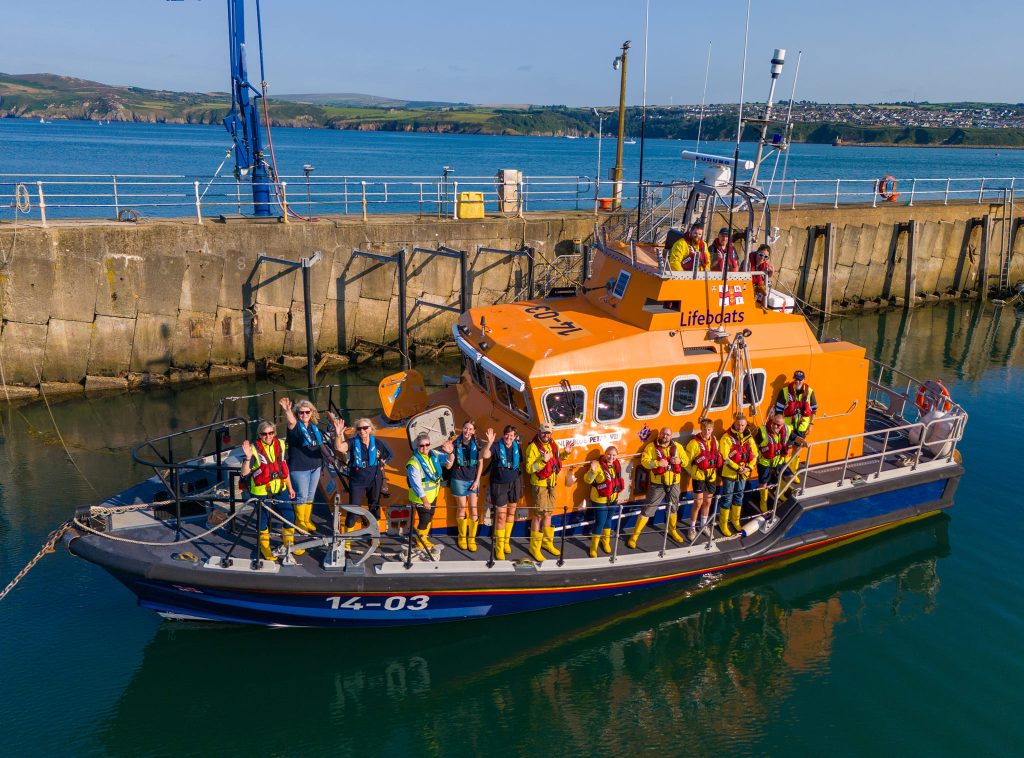
His favourite, however, is the current Trent class lifeboat Blue Peter VII, which arrived on station in 1994.
Among many memorable moments, Chris described his most poignant as being part of the crew tasked with taking a replacement lifeboat to Newlyn the day after the loss of the Penlee lifeboat Solomon Browne in 1981 — the last time an RNLI lifeboat and all her crew were lost at sea. Battling severe conditions, the journey from Fishguard took 25 hours. On arrival, they were met by dozens of local people cheering and waving in support.

While his later years as LOM brought different challenges from those faced at sea, Chris approached each with the experience and professionalism gained from a lifetime of service.
Asked what he is most proud of after more than half a century with the RNLI, Chris answered in characteristically understated fashion:
“Simple. On the certificate of service the Area Operations Manager recently gave me, it says that during the 50 years I was involved with Fishguard Lifeboat in various roles, at least 114 lives were saved. That’s it.”
Reflecting on his career, he added: “Over the years it’s been a real privilege to work with crew members from such diverse backgrounds who are united by one purpose — saving lives at sea.”
Throughout his service, Chris has been supported by his wife Brenda, who was presented with a bouquet of flowers on behalf of the RNLI during the ceremony marking his retirement.
Recruitment for the role of Lifeboat Operations Manager has now been completed, and the new post holder will be announced shortly.
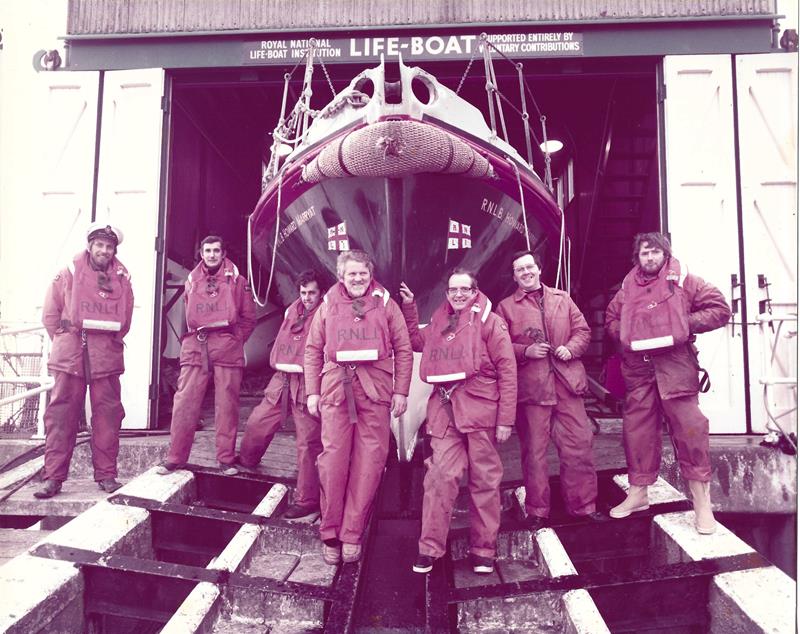
Caption: The crew of Fishguard RNLI in 1980 lined up in front of the lifeboat Howard Marryat. Pictured left to right are = Chris Williams, Huw Evans, Roger Strawbridge, Brian Hughes (cox), John Knight (nav), John Monk (head launcher), Keith Bean.
Cover photo: The crew of Fishguard RNLI in 1980 lined up in front of the lifeboat Howard Marryat. Pictured left to right are: Chris Williams, Huw Evans, Roger Strawbridge, Brian Hughes (cox), John Knight (nav), John Monk (head launcher), Keith Bean.


Crime13 hours ago
Herald journalists feature in BBC documentary about Judith Rhead’s murder
A NEW BBC documentary examining one of Pembrokeshire’s most disturbing crimes will be broadcast this week — and includes contributions...


Sport1 day ago
Late heartbreak as Scotland snatch victory in Cardiff thriller
Wales 23 – 26 Scotland WALES suffered agonising late heartbreak at the Principality Stadium on Saturday (Feb 21) as Scotland...

Local Government1 day ago
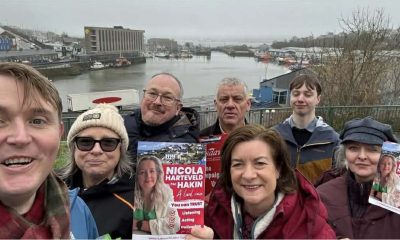
First Minister left red-faced as Labour candidate pulls out during Hakin campaign visit
Candidate says withdrawal follows ‘abuse’ towards candidate’s son and backlash over Withybush Hospital downgrade plan THE FIRST MINISTER was left...


Business2 days ago
Pembrokeshire businesses ‘squeezed to breaking point’ amid economic pressures
MS highlights concerns from local firms as Wales employment figures lag behind UK BUSINESSES in Pembrokeshire are feeling increasingly squeezed...

News3 days ago
Council tax to rise again as Pembrokeshire sets new budget
Schools and social care receive extra funding in 2026–27 spending plans PEMBROKESHIRE COUNTY COUNCIL has approved its budget for the...

Health3 days ago
Stroke patients to be transferred to Carmarthen under new health plan
Withybush to provide initial treatment before specialist care elsewhere PEMBROKESHIRE patients who suffer a stroke are set to be transferred...

Health4 days ago
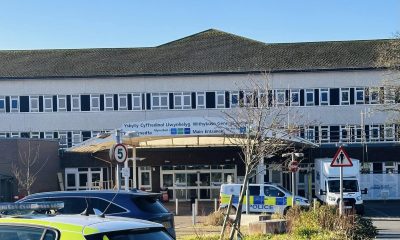
Health board confirms major hospital changes across west Wales
Emergency surgery centralised as Withybush role shifts toward planned care MAJOR changes to hospital services across west Wales have been...

Health4 days ago
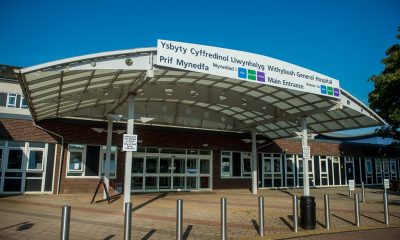
Withybush loses emergency surgery in shock health board decision
Paul Davies vows Senedd fight as fears grow over travel times and patient safety PEMBROKESHIRE patients will be forced to...

Business4 days ago
Mounting complaints: More Computer Solutions Wales customers claim losses
Business owner issues legal threats and IPSO complaint to this newspaper while refusing to answer detailed questions about customers who...


Local Government4 days ago
Milford Haven Hakin by-election candidates confirmed
THE LIST of candidates standing in the upcoming Pembrokeshire County Council by-election for the Milford Haven: Hakin ward has been...
-
Health4 days ago
Withybush loses emergency surgery in shock health board decision
-
Health4 days ago
Health board confirms major hospital changes across west Wales
-

 Health2 days ago
Concerns grow over Bronglais stroke plans as politicians demand clarity
-
 Health4 days ago
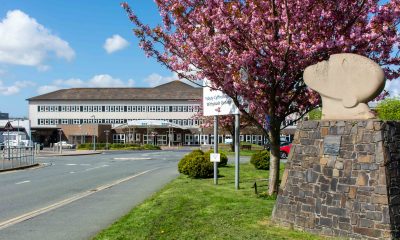
Health board: Changes will bring “resilience and sustainability” to West Wales services
-
 Local Government17 hours ago
Candidate who withdrew from Hakin race will still appear on ballot paper
-
 Business6 days ago
MS’s host business advice surgery following demand from Business Rates Online Forum
-

 Business6 days ago
Svitzer crews at Milford Haven vote for industrial action in pay dispute
-

 Crime7 days ago
Man who attacked woman outside Milford Haven bar ‘shows no remorse whatsoever’