


Crime
Jury retires in trial of man accused of attempting to murder former partner


James McKenna admits carrying out a planned knife attack on Joanne Sidaway but denies intending to kill her
THE JURY has retired to consider its verdict in the trial of a Carmarthen man accused of attempting to murder his former partner during a knife attack in Carmarthen Park.
James John McKenna, aged 57, of Bro Hedydd, Carmarthen, admits attacking Joanne Sidaway with a kitchen knife on January 29 this year.
He has pleaded guilty to wounding Ms Sidaway with intent to cause grievous bodily harm and possessing a bladed article in a public place, but denies attempted murder.
The central question for the jury is not whether McKenna carried out the attack, which he accepts, but whether he intended to kill Ms Sidaway or intended to cause her really serious injury and no more.
The case has been heard at Swansea Crown Court before Judge Paul Thomas KC. James Wilson prosecuted, while Caroline Rees KC represented McKenna.

The relationship
The jury heard that McKenna and Ms Sidaway first met online through a photography group in 2022 and began a relationship in September 2024.
McKenna said the relationship initially went well but ended in September 2025. The pair continued to see each other intermittently until Ms Sidaway brought the relationship to a final end in November.
Giving evidence in his defence, McKenna said he struggled to accept the relationship was over and described himself as distressed, sad and angry.
He claimed his mental health had deteriorated following the break-up, although the prosecution pointed out that no medical evidence had been presented to the court in support of that account.

McKenna said he saw Ms Sidaway about a week and a half before the attack, but she showed little interest in speaking to him. He told the jury that he lost his composure and became upset and angry.
Looking for Ms Sidaway
On January 29, McKenna placed a large kitchen knife inside a rucksack and went to places where he believed Ms Sidaway might be found.
He admitted visiting Carmarthen Park in the morning because he knew she regularly walked her dog there.

Asked by Judge Thomas why he had gone to the park, McKenna replied: “I was looking for her, your honour.”
He was carrying the concealed knife at the time and admitted that he had taken it because he wanted to cause Ms Sidaway really serious harm.
McKenna said no attack took place that morning because other people were present.
He later travelled to the museum in Abergwili, believing Ms Sidaway might be there, before returning to Carmarthen town centre and visiting Time Coffee Bar, which was close to a shop where she volunteered.
The prosecution said these movements demonstrated that McKenna had deliberately spent the day looking for his former partner.
CCTV evidence shown to the jury traced McKenna’s movements around Carmarthen and showed him returning to the park during the afternoon.
The court heard that he spent time close to the Picton Terrace entrance before seeing Ms Sidaway approaching with her dog.
The attack
McKenna admitted checking that the park was quiet and hiding in a hedge near the entrance.
He told the court that he crouched down to conceal himself and could hear Ms Sidaway speaking to her dog as she approached.
McKenna then emerged from the hedge and attacked her with the knife.
He estimated that the incident lasted between ten and 15 seconds and said he delivered around six or seven blows.
Ms Sidaway suffered injuries to her chest, upper arm and hands. The jury was shown photographs of four wounds around the chest area and cuts to her hands which forensic physician Professor Jason James-Payne described as consistent with defensive injuries.
Professor James-Payne said a single stab wound could be fatal if it penetrated the chest cavity or damaged the heart or lungs. He said whether such an injury proved fatal could be a matter of chance.
The jury also heard that Ms Sidaway’s coat contained marks consistent with nine stabbing actions and two slashes.
A woman walking her dog nearby heard screaming and saw a man running away from the bushes before finding Ms Sidaway bleeding.
During a 999 call, Ms Sidaway identified McKenna as her attacker and repeatedly asked for an ambulance. She said the attack had happened so quickly that she had been unable to use a whistle she was carrying.
Knife recovered from allotment shed
After the attack, McKenna ran from the park towards the Five Fields Allotments.
Police later recovered his rucksack from an open allotment shed. Inside was a bloodstained kitchen knife wrapped in a calendar.
The court heard that Ms Sidaway’s blood was found on the knife and McKenna’s fingerprint was found on its handle.
A photograph of McKenna and Ms Sidaway was also found inside the rucksack.
McKenna did not contact the emergency services or check on Ms Sidaway following the attack.
He remained in the Bronwydd area for several days before travelling by taxi and bus to Aberystwyth.
He was arrested on February 2 after attending Bronglais Hospital suffering from frostbite. McKenna said he knew he would be arrested when he entered the hospital and regretted not handing himself in sooner.
The prosecution case
In his closing speech, Mr Wilson told the jury that McKenna’s actions had been “planned, calculated and deliberate”.
The prosecution argued that McKenna’s anger about the end of the relationship had been building for some time and that he had chosen a large, sharp knife before deliberately searching for Ms Sidaway.
Mr Wilson said McKenna knew her routine, checked that the park was quiet, concealed himself in a hedge and waited until she was close before ambushing her.
He asked jurors to consider the number of blows, the parts of the body targeted and the potentially fatal consequences of repeatedly using a kitchen knife against an unarmed woman.
The prosecution argued that if McKenna had only intended to injure Ms Sidaway, there were numerous ways he could have done so without repeatedly stabbing towards her upper body.
Mr Wilson also highlighted McKenna’s decision to run away without seeking help, arguing that Ms Sidaway could have been left bleeding to death in the park.
He told the jury that the only reason she had survived was “pure luck”.
The defence case
Ms Rees accepted on McKenna’s behalf that the attack had been planned and that he had intended to cause Ms Sidaway really serious harm.
However, she argued that planning an attack did not necessarily prove that McKenna had planned to kill.
McKenna told the jury that he had been in a rage and had aimed generally towards Ms Sidaway’s upper body without looking directly at where the knife was landing.
He denied aiming for her heart, lungs, throat or other vital organs and said he had never wanted her to die.
The defence said there had been no previous threat by McKenna to kill Ms Sidaway and argued that he had the opportunity to kill her but did not do so.
Ms Rees also asked jurors to consider that the blows were delivered through Ms Sidaway’s clothing and that the medical evidence described the force used as at least moderate, rather than the highest level of force.
She said McKenna had admitted behaving in an appalling and seriously criminal way, but warned that this did not automatically make him guilty of attempted murder.
The defence argued that the evidence was at least equally consistent with an intention to cause grievous bodily harm, the offence to which McKenna has already pleaded guilty.
Ms Rees said the prosecution had to make the jury sure that McKenna intended to kill and that, if they were not sure, their verdict on attempted murder must be not guilty.
The issue for the jury
Summing up the case, Judge Thomas reminded jurors that the prosecution carries the burden of proving guilt and that McKenna does not have to prove anything.
He said it was accepted that McKenna took a large kitchen knife to Carmarthen Park and repeatedly used it against his former partner.
The issue was why he had done so.
The jury must decide whether McKenna intended to cause really serious harm but no more, or whether he intended to kill Ms Sidaway.
The jury has now retired to consider its verdict.



A HAVERFORDWEST man has been jailed for seven years after being convicted of raping and indecently assaulting a girl during the 1980s.
Alan Pyart, aged 60, of North Court, Haverfordwest, was found guilty following a trial at Swansea Crown Court earlier this year.
Pyart had denied raping and indecently assaulting the victim, who was under the age of 16 at the time of the offences.
The case returned to court for sentencing after being adjourned for more than two months so that a further psychiatric report could be prepared.
Judge Geraint Walters sentenced Pyart to seven years in prison for rape and four years for indecent assault. The sentences will run concurrently, meaning he will serve an overall custodial term of seven years.
Pyart was also made subject to an indefinite restraining order and will remain on the sex offenders register for life.
He had previously been remanded in custody while awaiting sentence.
Reporting restrictions are in place which legally protect the identity of the victim.
Detective Inspector Sarah Totterdale, of Pembrokeshire CID, praised the victim for coming forward many years after the abuse took place.
She said the case demonstrated the lasting effect sexual abuse can have on victims and their families, adding that it was never too late to seek justice.
DI Totterdale said: “I would like to commend the victim for the immense courage she has shown in coming forward and speaking about what happened to her all those years ago.
“Abuse of this nature can leave deep and long-lasting scars, but it is never too late to seek justice.

“We hope this conviction and sentence sends a clear message that Dyfed-Powys Police will pursue offenders, no matter how much time has passed.”
She encouraged anyone who has experienced sexual abuse, either recently or in the past, to contact police, saying they would be listened to, supported and taken seriously.
Information about reporting rape and sexual assault, as well as details of available support services, can be found through the Dyfed-Powys Police website.

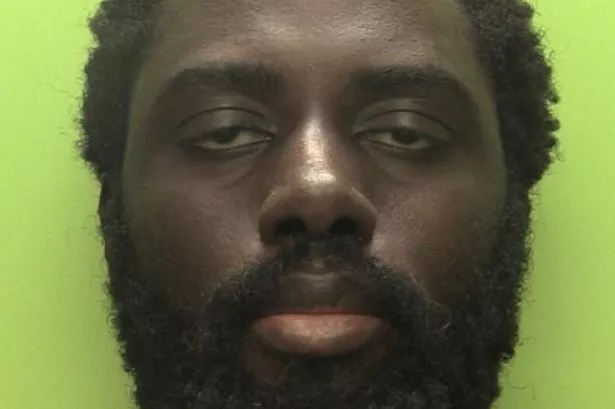
Police examine care given to Valdo Calocane before he killed three people in Nottingham
THE MENTAL health trust responsible for treating Haverfordwest-raised Valdo Calocane before he killed three people in Nottingham is now the subject of a corporate manslaughter investigation.
Northumbria Police has begun examining the care and treatment provided to Calocane by Nottinghamshire Healthcare NHS Foundation Trust between 2020 and 2022.
The outside force is conducting the investigation on behalf of Nottinghamshire Police, whose own contact with Calocane before the attacks has been scrutinised during a separate public inquiry.
The trust has confirmed that it will cooperate fully with detectives.
Calocane grew up in Haverfordwest after moving to Britain with his family and attended the former Sir Thomas Picton School, now part of Haverfordwest High VC School.
He later moved to Nottingham, where he studied mechanical engineering at the University of Nottingham.
In the early hours of June 13, 2023, Calocane fatally stabbed 19-year-old students Barnaby Webber and Grace O’Malley-Kumar as they walked home after celebrating the end of their university exams.
He then killed 65-year-old school caretaker Ian Coates before stealing his van and deliberately driving into three pedestrians, leaving them seriously injured.
Calocane pleaded guilty to three counts of manslaughter on the grounds of diminished responsibility and three counts of attempted murder.
He was sentenced in January 2024 to an indefinite hospital order and is being held at a high-security psychiatric hospital.
The decision to investigate the NHS trust represents a significant escalation in attempts to establish whether the deaths resulted not only from individual errors, but from serious organisational and management failures.
There has been no decision to prosecute the trust, and the opening of an investigation does not mean that any criminal offence has been proven.

Under corporate manslaughter legislation, prosecutors would need to establish that the way an organisation’s activities were managed caused a death and amounted to a gross breach of a duty of care.
The involvement of senior management must also have been a substantial part of the alleged breach. An organisation convicted of the offence can receive an unlimited fine, although individuals cannot be prosecuted for corporate manslaughter itself.
Repeated contact with mental health services
Calocane was diagnosed with paranoid schizophrenia and had repeatedly come into contact with mental health professionals and the police during the three years before the attacks.
He was sectioned four times while under the care of Nottinghamshire Healthcare NHS Foundation Trust.
Despite concerns about violence, his refusal to take medication and his repeated failure to attend appointments, Calocane was eventually discharged from specialist mental health services and referred back to his GP.
A statutory public inquiry has heard that members of the Early Intervention in Psychosis team had effectively “lost” contact with him.
An independent NHS England investigation published in February 2025 identified clear failings in the care and treatment provided to Calocane.
NHS England apologised to the victims’ families and said the system, including the health service, had got the case wrong.
Mental health trusts across England were subsequently instructed to review their procedures, including policies which allowed seriously ill patients to be discharged simply because they had stopped attending appointments.
The police investigation is separate from the Nottingham Inquiry, which is being chaired by former senior judge Her Honour Deborah Taylor.
The inquiry’s main evidence hearings took place between February and June this year, during which evidence was heard about risk assessments, communication between agencies, decisions surrounding Calocane’s treatment and the failure to arrest him on an outstanding warrant.
Closing submissions are scheduled to be heard on September 8 and 9, with the inquiry’s final findings and recommendations expected in 2027.
Emma Webber, the mother of Barnaby Webber, described the corporate manslaughter investigation as the “beginning of the reckoning”.
She said the development should send shockwaves through public services and called for everyone involved to cooperate with complete candour and transparency.
Nottinghamshire Healthcare NHS Foundation Trust said: “Northumbria Police, acting on behalf of Nottinghamshire Police, have begun an investigation into matters relating to the care and treatment of Valdo Calocane.
“We know how important the independent inquiry and police investigation are for the affected families, the survivors and our local communities.
“We will, of course, be co-operating fully with Northumbria Police.”

Kelly Rees receives further 27-month sentence while already serving prison term for notorious taxi robbery
TWO women have been jailed after chasing a man through a Milford Haven home before inflicting deep wounds with knives.
Demi Oliver, aged 26, and Kelly Rees, aged 36, appeared before Swansea Crown Court for sentence following the serious attack on Warren Harper at a property in Precelly Place.


The women had originally been charged with wounding with intent to cause grievous bodily harm, an offence under Section 18 of the Offences Against the Person Act 1861.
During an earlier hearing at Swansea Crown Court, both defendants denied the more serious charge but pleaded guilty to the lesser alternative offence of inflicting grievous bodily harm.
Oliver was sentenced to 17 months’ imprisonment, while Rees received a further 27-month prison term in addition to the sentence she is already serving for a separate knife-point taxi robbery.
The court heard that Oliver and Rees had been drinking at Rees’s home in Precelly Place on July 28, 2024, when Harper joined them at the property.
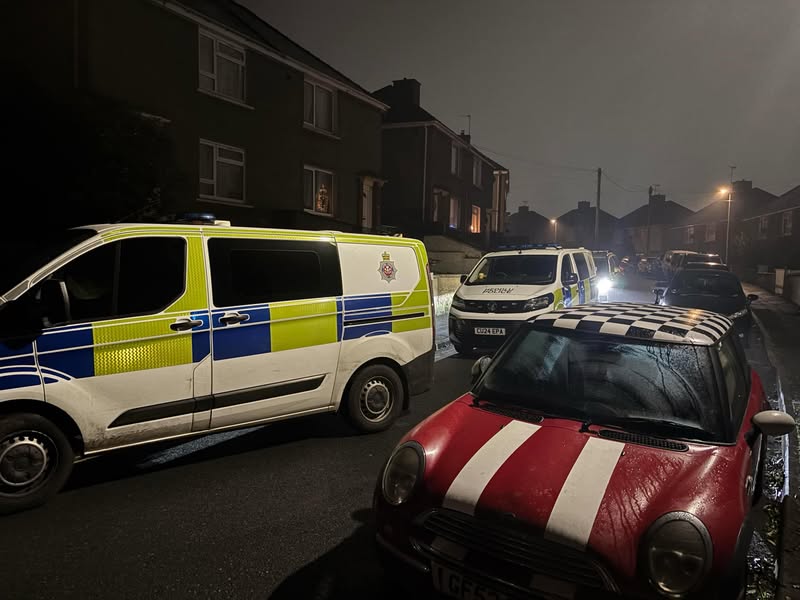
Mr Ibrahim, representing Rees, said she had also been smoking crack cocaine before an altercation developed.
Both women began chasing Harper through the house, eventually forcing him to lock himself inside the downstairs bathroom.
The court heard that Harper remained behind the locked door before eventually saying: “This stops.”
When he came out, he was confronted by Oliver and Rees, who were both armed with knives.
Rees produced what was described in court as a Stanley knife and slashed Harper’s left wrist, causing an extremely deep and damaging wound.
Oliver then approached him carrying a black-handled knife and inflicted a deep laceration to his left shoulder.

Harper later told police that he felt “a deep sharp pain” during the attack.
In a desperate attempt to escape the women, he ran upstairs and entered another bathroom.
He considered jumping from the bathroom window but realised that the drop was too high.
Harper eventually managed to get downstairs and escape from the property through the front door.
Harrowing Ring doorbell footage shown to the court captured him fleeing the house covered in blood.
He ran to a friend’s home, where he was described as sweating, shaking and covered in blood.
An ambulance was called and Harper was taken to Withybush Hospital.
He required surgery to repair damage to his muscles and tendons caused by the wounds.
After seeing photographs of the injuries, Judge Huw Rees intervened to emphasise their seriousness.
“These are not just slash marks,” he said.
“These are very deep cuts, of which I can see his muscle.”

Oliver had no previous convictions
Mr Singh, representing Oliver, told the court that his client deeply regretted her actions.
He said Oliver had no previous convictions and drew attention to the fact that she had been supported in court by the two grandparents who had raised her.
Oliver, of Precelly Place, had been released on bail following the earlier plea hearing while pre-sentence reports were prepared.
The judge concluded that the seriousness of the violence meant an immediate custodial sentence was necessary.
She was sentenced to 17 months in prison, with the sentence beginning immediately.
Rees described as “seasoned offender”
Rees, who was already being held at HMP Downview, was treated differently because of her extensive record of previous offending.
Addressing her directly, Judge Rees said: “You are a seasoned offender.”
The judge noted that she was already serving a prison sentence for the notorious robbery of a Milford Haven taxi driver.
That attack took place on October 18, 2024, less than three months after the assault on Harper.
Rees and fellow defendant Ashlee Rees targeted the driver after he collected them in Milford Haven.
During the robbery, the driver was threatened with a knife and attacked with a needle before a bag containing his takings was stolen.
The driver was left fearing that he may have contracted an infection and was required to undergo blood tests following the attack.
He also suffered recurring nightmares and anxiety as a result of the ordeal.
The case attracted widespread attention in Milford Haven, with members of the community later raising money to support the driver.
Kelly Rees had admitted robbery but denied using the needle. She was convicted of that element of the offence following a trial and was sentenced to three years and nine months in prison.
For the attack on Harper, Rees received a further sentence of 27 months’ imprisonment, to be served in addition to the sentence she is already serving.



Community2 hours ago
‘Paying £29 to reach a cashpoint is absurd’: Narberth’s urgent ATM appeal
Residents, businesses and visitors are being urged to provide evidence after two High Street cash machines were removed, leaving the...


Crime18 hours ago
Haverfordwest man jailed for seven years for historic rape and sexual assault of girl
A HAVERFORDWEST man has been jailed for seven years after being convicted of raping and indecently assaulting a girl during...


News23 hours ago
Burnham more willing to listen on Welsh devolution, says First Minister
Rhun ap Iorwerth says he will press the new Prime Minister for powers over policing, railways and Wales’ natural resources...


Crime1 day ago
Women jailed after man chased through Milford home and attacked with knives
Kelly Rees receives further 27-month sentence while already serving prison term for notorious taxi robbery TWO women have been jailed...


Crime1 day ago
Mother headbutted and clawed police officers after threatening social worker
Court shown body-worn footage of violent confrontation at Goodwick property A COURT has been shown police body-worn footage capturing the...


Crime2 days ago
Man, 37, found dead following major police response in Pembroke Dock
Death not being treated as suspicious as police make statutory referral to IOPC following active investigation A 37-YEAR-OLD man has...


Community2 days ago
Household Cavalry drum horse returns home to Pembrokeshire for final farewell
Dyfed Willa Rose, who became Major Juno and the first mare to serve as a Household Cavalry Drum Horse, was...


News3 days ago
Jo Stevens out as Welsh Secretary as Burnham reshapes government
Cardiff East MP repeatedly visited Pembrokeshire to champion clean energy jobs, but her successor inherits unresolved questions over Milford Haven’s...


Crime3 days ago
Teen cleared of attempted murder but guilty of GBH after Milford teacher stabbed
Jury returns 11-1 majority verdict on charge of causing grievous bodily harm with intent, with sentencing set for September 3...


Community3 days ago
French troops march through Fishguard as Britain’s last invasion returns to life
Battle scenes, cavalry displays and a surrender procession brought one of Pembrokeshire’s most extraordinary stories back to the streets MUSKET...
-

 Crime1 day ago
Drunken rail passenger tried to headbutt police after being refused travel
-

 featured2 days ago
From a father-and-son project to an award-winning campervan business
-
Crime1 day ago
Women jailed after man chased through Milford home and attacked with knives
-
News23 hours ago
Burnham more willing to listen on Welsh devolution, says First Minister
-
Crime18 hours ago
Haverfordwest man jailed for seven years for historic rape and sexual assault of girl
-

 Entertainment2 days ago
Robin Hood: A magical show by young talent at The Torch Theatre
-
Crime1 day ago
Mother headbutted and clawed police officers after threatening social worker
-

 Community1 day ago
Senior councillors to consider call for ‘impartial investigation’ into Manorbier school closure