


News
Welsh-made Raspberry Pi board found in Russian attack drone used against Ukraine


Computer manufactured at Sony’s Pencoed plant was recovered from wreckage following an attack on homes in Dnipro
A COMPUTER board manufactured in Wales has reportedly been found inside a Russian attack drone used against targets in Ukraine.
The Raspberry Pi board, produced at Sony UK’s manufacturing plant in Pencoed, near Bridgend, was recovered from the remains of a drone that damaged homes in the eastern Ukrainian city of Dnipro earlier this year.
The discovery was revealed in an exclusive investigation by Martin Shipton for Nation.Cymru.
A photograph of the recovered component was passed to former Pontypridd MS Mick Antoniw, who has Ukrainian heritage and regularly travels to the country as part of a team delivering humanitarian aid.
Mr Antoniw said markings visible in the photograph appeared to identify the component as a Raspberry Pi 4 Model B, a small single-board computer first introduced in 2019.

The device is designed as an affordable civilian computer and is widely used in education, industry, research and electronics projects around the world.
However, evidence gathered in Ukraine indicates that commercially available Raspberry Pi computers have also been incorporated into the onboard electronics and telemetry systems of Russian Geran-2 attack drones.
Ukrainian news outlet United24 Media previously reported claims that tens of thousands of the computers had been obtained through supply networks before being routed into Russian drone production.
The claim was attributed to the Polkovnik Gsh Telegram channel, which is linked to the Ukrainian Armed Forces. The precise number of devices involved has not been independently verified.

Millions manufactured in Wales
Raspberry Pi computers have been produced at the Sony UK Technology Centre in Pencoed since 2012.
Around 75 million Raspberry Pi devices have now been manufactured, with the overwhelming majority assembled in Wales following the company’s decision to move production from China to the Bridgend County Borough site.
The appearance of one of the boards inside a Russian weapon highlights the difficulties faced by manufacturers attempting to prevent widely available civilian technology from being diverted through third countries for military use.

Raspberry Pi told Nation.Cymru that it had introduced controls going beyond the requirements of UK and international sanctions to stop its products reaching Russia.
A company spokesperson said some products nevertheless continued to enter the country through complicated onward supply networks, often involving businesses or organisations in east and central Asia.
The company said it had seen evidence of Raspberry Pi products being used in military applications and was working with data specialists, including the Kyiv School of Economics, to identify sanctions breaches.
It was also working with licensed manufacturers and approved resellers to close down supply routes suspected of delivering products to Russia.
‘Shocking misuse of Welsh technology’
Mr Antoniw described the use of the Welsh-manufactured equipment in Russian weapons as deeply disturbing.
He said it was important to recognise that Raspberry Pi was attempting to prevent its products from reaching Russia, but called for further action to identify and disrupt the supply chains involved.
He said: “This is a shocking misuse of Welsh technology.
“It’s good to hear that the company is aware of this and anxious to stop this happening. It’s crucial that steps are taken to prevent more innocent lives being lost.
“Hopefully it will be possible to identify the supply chain and end this.”
The discovery raises wider questions about how civilian electronic components produced in Britain and other Western countries continue to reach the Russian defence industry despite sanctions imposed following the invasion of Ukraine.
Original reporting: Martin Shipton, Nation.Cymru.


Fast-paced adaptation of The Hound of the Baskervilles comes to Milford Haven this October
SHERLOCK HOLMES is returning to the Torch Theatre this autumn in a riotously funny adaptation of one of his most famous mysteries.
The Torch Theatre Company will present The Hound of the Baskervilles for a limited run from Wednesday, October 7, to Saturday, October 17.
Adapted for the stage by John Canny and Stephen Nicolson, the production promises a fast-paced mixture of chaos, clues and canine capers as Sir Arthur Conan Doyle’s classic tale is transformed into a slapstick comedy.
Following the success of The Turn of the Screw in 2025, audiences will once again have the opportunity to see a professional production created in Pembrokeshire and featuring theatre talent from across Wales.

At the centre of the story is a mysterious death, a cursed family and a terrifying howl heard across the moors.
Sherlock Holmes and his trusted companion, Dr Watson, must investigate the supposed Baskerville family curse and save Sir Henry Baskerville before it is too late.
Featuring rapid costume changes, inventive staging and a comedy-packed script, the production has been compared to theatrical hits including The Play That Goes Wrong and The 39 Steps.
Torch Theatre’s award-winning artistic director, Chelsey Gillard, said: “What I love about this version is that it is packed to bursting with joy and adventure.
“The Hound of the Baskervilles is one of the best Sherlock mysteries. This play takes everything you love about Conan Doyle’s original and stuffs in as many jokes as possible, resulting in a wonderful theatrical experience like The Play That Goes Wrong or The 39 Steps.”
A British Sign Language-interpreted performance will take place on Tuesday, October 13.
Tickets start at £18 and are available by calling the Torch Theatre box office on 01646 695267 or visiting torchtheatre.co.uk.
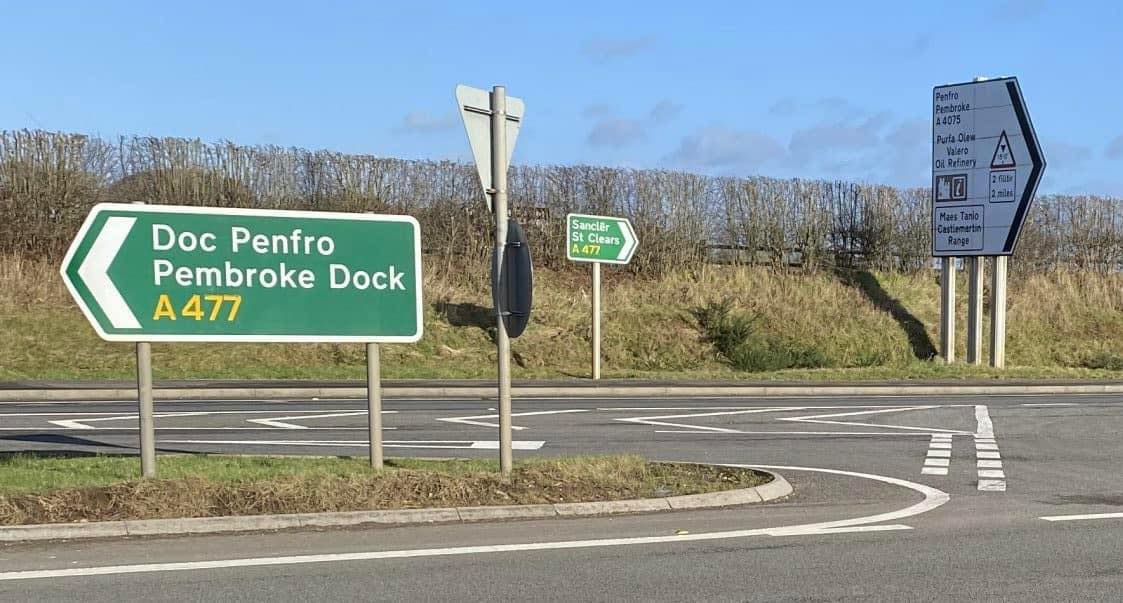
Welsh Government plans further safety measures at the Nash Fingerpost following years of concern over collisions and near misses
A PERMAMENT 40mph speed limit and a ban on U-turns are being proposed for the A477 at the Nash Fingerpost Junction near Pembroke.
The Welsh Government has published plans covering a section of the trunk road around the junction with the A4075, which links the A477 with Pembroke.
Under the proposed order, motorists would be prohibited from making U-turns through the gap in the central reservation opposite the A4075 junction.
Officials say the measures are intended to improve road safety and help traffic move more safely through the junction.
The proposed 40mph restriction would cover the A477 from a point approximately 57 metres west of the junction with the lane leading to Lower Nash to a point around 416 metres east of the U6357 road leading to Upper Nash.
The junction has been the subject of longstanding safety concerns, with residents and motorists reporting serious collisions, near misses and vehicles travelling at high speed.
Further improvements were completed at the site in August 2024, including the installation of traffic signals designed to respond to approaching vehicles and changing traffic conditions.
Those works followed the death of motorcyclist Ashley Rogers at the junction and a public campaign calling for urgent safety improvements.
A petition supporting changes at Nash Fingerpost attracted more than 10,000 signatures in just 36 days.
Campaigners said the response demonstrated the strength of concern across Pembrokeshire about the junction and the need to prevent further serious incidents.
If the new permanent order is introduced, the existing temporary speed restriction and prohibition order covering the junction would be revoked.
Copies of the proposed order, accompanying plan and statement of reasons are available for inspection at Pembroke Library and Pembroke Dock Library.

Members of the public and other interested parties have 21 days from July 22 to submit comments or objections to the proposals.

CMA calls for new regulatory regime after households faced cancelled orders and sharp price increases
BEN LAKE MP has welcomed proposals for stronger protections for households that rely on heating oil, following a major investigation by the Competition and Markets Authority.
The Ceredigion Preseli MP said people living in rural and off-grid communities should receive protections comparable to those available to customers connected to the mains gas and electricity networks.
Around 1.5 million UK households depend on heating oil. Customers currently lack several protections available elsewhere in the energy market, including consistent support for vulnerable people and access to independent dispute resolution when complaints cannot be settled directly with suppliers.
The CMA launched its investigation after conflict in the Middle East disrupted supplies and caused heating oil prices to rise sharply earlier this year.
Its final report found that the market remained generally competitive and that suppliers had not profited materially from the crisis. Most of the increase was attributed to higher wholesale costs.
However, the regulator concluded that customers remained particularly exposed during periods of disruption, with uncertainty over prices, deliveries and the support available when problems arose.
In Wales, the average retail price rose from 64p per litre in February to 106p in March, an increase of 42p. Across the UK, prices peaked at 123p per litre in April, 92% above February’s average.
The CMA has recommended a proportionate regulatory regime requiring heating oil suppliers to register and meet minimum standards.
Proposed protections would cover the way prices are quoted, how cancellations are handled and access to independent dispute resolution. Suppliers could also be required to explain available payment plans and minimum purchase quantities more clearly.
A register of vulnerable customers has also been proposed, alongside a review of minimum-order rules to determine whether households should be allowed to buy smaller quantities.
Heating oil is generally purchased in bulk, leaving households facing bills of £500 or more at a time. The CMA said allowing smaller orders could make the fuel more accessible to customers experiencing financial difficulties.
Ben Lake old The Herald: “I welcome the Competition and Markets Authority’s call for a new regulatory regime for heating oil suppliers, together with action to compensate households affected by last-minute order cancellations earlier this year.

“Requiring suppliers to meet minimum standards, clearly explain payment plans and minimum purchases, and maintain a register of vulnerable households would help protect off-grid customers during sudden price increases or periods of crisis.
“These recommendations are welcome, but I will also be pressing for similar protections to be introduced for households that rely on LPG.”
The CMA estimates that around 1,700 customers may have had orders cancelled in circumstances that breached their contracts.
Although those customers received refunds, some were forced to place replacement orders at much higher prices, potentially leaving them between £150 and £350 worse off. Others were unable to obtain replacement fuel.
Several suppliers have agreed to compensate affected customers. Those who paid more for a replacement delivery are expected to receive the difference, while customers who did not purchase replacement oil should have their original orders honoured at the agreed price.
The CMA said some suppliers had not yet agreed to provide compensation and warned that it was preparing possible court enforcement action.
Mr Lake said the regulator’s findings reflected concerns raised by constituents across Ceredigion Preseli.
He said: “The conclusions of the CMA’s report will not surprise residents of Ceredigion Preseli.
“Many saw the price of their regular fuel deliveries changing at very short notice during the Middle East fuel crisis. I am also aware of cases where customers were not told the final price until the delivery lorry had arrived at their property.
“Ceredigion Preseli has one of the highest proportions of households in Great Britain that are not connected to the mains gas network. The crisis therefore had a disproportionate effect on the amount many residents were forced to pay to heat their homes.”
Mr Lake welcomed the commitment to compensate affected households but said further information was needed about how eligible customers would receive payments.
He added: “I welcome the announcement that compensation will be paid, but the eligibility and process remain unclear.
“I have asked for further details about how customers can make sure they receive the money they are owed. I am determined that constituents in Ceredigion Preseli should receive every penny of compensation to which they are entitled.”
The CMA will now work with the UK and devolved governments, regulators and the heating oil industry to consider how its recommendations should be implemented.



Health19 hours ago
More than 3,000 people have their say as Hywel Dda stroke consultation closes
Final decision on proposals, including a central 24-hour stroke unit at Glangwili and treat-and-transfer services at Withybush, is expected in...


Crime21 hours ago
James McKenna guilty of attempted murder after Carmarthen Park knife attack
Jury rejects defendant’s claim he only intended to cause serious injury after ambush attack on former partner SPECIAL REPORT FROM...


Community2 days ago
New creative team transforms the Maes ahead of Eisteddfod y Garreg Las
Festival site in Llantwd is taking shape ahead of the National Eisteddfod’s arrival in Pembrokeshire from August 1 to 8...


Community2 days ago
From Tenby to Llandudno: Wales’ seaside towns face the same signal crisis
Businesses in two of Wales’s busiest resorts say unreliable mobile coverage is disrupting payments, bookings and everyday life TWO of...


Crime2 days ago
Judge orders Dyfed-Powys Police review after £3,912 fraud error
Force responsible for policing Pembrokeshire criticised after an officer understated the amount stolen from a vulnerable care-home resident A JUDGE...


Community3 days ago
Narberth bursts into colour as carnival brings Civic Week to spectacular close
Crowds lined the streets for an afternoon of floats, fancy dress, music and family entertainment at one of Pembrokeshire’s longest-running...


Community3 days ago
More than 100 racers take to Castle Pond for Paddle West’s inaugural regatta
Successful community event raised money for Forever11 and launched three consecutive weekends of waterside activity in Pembroke MORE than 100...


News3 days ago
NASA chief meets west Wales scientist helping search for life on Mars
Aberystwyth-led technology will guide Europe’s first Mars rover as it drills beneath the planet’s surface, while the proposed DARC radar...


News4 days ago
Princess Royal celebrates Pembrokeshire craftsmanship at family-run weaving mill
A Pembrokeshire business that began after a mother grew tired of waiting three weeks for her children’s name tapes has...


Local Government4 days ago
Burger King could be coming to Haverfordwest as plans submitted
Plans have been lodged for a Burger King outlet at the Morrisons petrol station on Bridge Meadow Lane BURGER KING...
-

 Community18 hours ago
Huge water main burst sends geyser over Fishguard town centre
-

 Crime2 days ago
Steynton man fined after breaching dog mess and anti-social behaviour notice
-

 Crime15 hours ago
Man in custody accused of intentionally strangling woman in Haverfordwest
-

 Health13 hours ago
Welsh A&E performance hits record low as parties clash over NHS pressures
-

 Sport2 days ago
Haverfordwest County Women begin preparations for Tier 3 campaign
-
Community2 days ago
New creative team transforms the Maes ahead of Eisteddfod y Garreg Las
-

 Health2 days ago
Welsh NHS executive pay revealed as patients face lengthy waits
-

 News2 days ago
Landmark rural law could reshape public services across west Wales