


News
Being homeless in Pembrokeshire


By Tess Delaney
I HAD reason recently to get in touch with the homeless unit at Pembrokeshire County Council.
I spoke to a nice lady, and they can help me.
As I’m responsible for my son, we can be accommodated at the hostel in Pembroke. The thing is, I used to work at the Prince’s Trust, with kids that lived at the hostel, and there is no way on earth I’m taking my kid there.
Not happening.
And Pembroke? A forty-five-minute drive from my land, which I have to visit twice each day to tend my livestock. Given that one of the reasons for a Council officer’s refusal of my OPD planning permission was it involved too much driving, that’s a solution to a problem created by the Council which seems absurd, to say the least.
So now what?
Luckily, having procured a gig here at your favourite local newspaper, I’ve got a few more resources available.
So, let’s have a look, shall we?
Looking around at the prices of properties available to rent can leave one feeling pretty bereft.
What I want to know, is how does anyone afford these rents?
The cheapest two-bedroom I can find close to my land is in Clunderwen.
It looks fabulous in the pictures, but I know it’s rough because someone I know used to live there.
It’s a pretty little place, with a good amount of space, but the garden is shared – which isn’t mentioned in the particulars of course – and there are usually snails in the front room.
The fridge has to live in a cupboard under the stairs because the kitchen isn’t big enough, and there’s a washing machine, but it doesn’t work.
My point is, anything close to affordable is slightly sketchy.
It’s weird when you’re renting, and you lie there in bed, looking up at someone else’s peeling paint on the ceiling, unable to do anything about it because they don’t want you to, and you’re not really inclined to, being that your contract is at most a year long.
And who in Pembs is in a position to buy? Really? Are there any first-time buyers left? And what do they buy? There’s not much on the market locally for under 100k. How do people raise mortgages?
Some people have to rely on parents or suchlike, but some don’t have that kind of help. And there are no council houses because they all got sold.
I remember my grandad refusing to buy his council house. “They’re social houses for people in need” he used to say. The next people to live there bought it. Now, it’s a private let, with rent as high as any other three bed in that particular town.
I’ve put my name down on the council house register because the council are basically not giving me a lot of choice.
It’s daft.
I own and work on land that I have to leave at night times. I’m there all day. What’s the big deal about where you actually sleep? Why does that constitute home? What is home?
I can’t be homeless when I’ve got more of a potential home than someone who is actually proper homeless, but they’re telling me I’m homeless.
Define homelessness.
When I bought my land I tried to rent a house nearby.
Even though there are loads of empty and dilapidated properties, none are available for use. I put a shout out on the local Facebook page and got not one reply.
A week or so later, someone put a post on the same page, asking for a holiday let for their family to use at Christmas. About thirty people replied, with photos of lovely little houses that looked small enough to be affordable to a local family to rent. But they’re all holiday homes.
Every single one.
It’s no secret that many villages in our county are made up almost entirely of holiday lets and second homes.
Our prices are inflating all the time, especially when bright sparks at the Daily Mail publish articles on how you can get a house in Pembs for half the price of Cornwall, so why not move to Pembs, and buy up all the housing stock?
It wouldn’t be so bad if the housing stock got replaced, but every time someone puts a planning application in for affordable homes, or even any homes, the vigilantes come out, insisting on keeping as big a radius as possible around them, even though they’re usually people that moved here to retire, and all they’re really worried about is their property prices and the feeling that any new builds will spoil their postcard.
It’s an endless circular mess, and to be honest, who of you, reading this, would rather take your kid to the hostel than move onto your land illegally and face court? If that’s the choice, I know what I’ll be doing.
I’m lucky in that my son’s dad is letting me, as well as the kid, crash at his place while I look for somewhere, or get planning at appeal, whichever comes first.
So, ultimately, if you don’t have an ex that’s a brilliant dad and not only takes responsibility for the kid, but for me too, and steps in to help in this way, what do you do?
If you don’t have friends offering you places to stay, like I’ve had, you have the hostel as an option, and that’s it.
How can there be, as reported recently, so many homeless people wandering around Tenby that the Tenby Chippy is giving out free meals? How did that happen? When did that happen?
There was no homelessness back in my school days in Tenby. If there was one homeless person they were almost a curio, like that guy who used to wander around Whitland and tragically, and almost unnoticeably, died in that fire.
Now we have so many homeless that they’re noticeably cold and alone in a place like “Fair and Fashionable” Tenby, relying on the kindness of the chip shop?
According to the council’s reasoning, I’m eligible for free chips. Perhaps I’ll gather up everyone down there and let them live on the field.
It’s always an option…



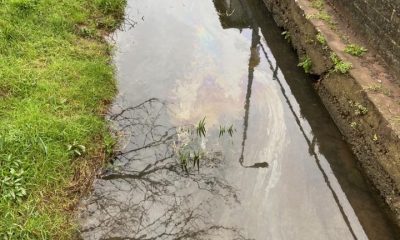







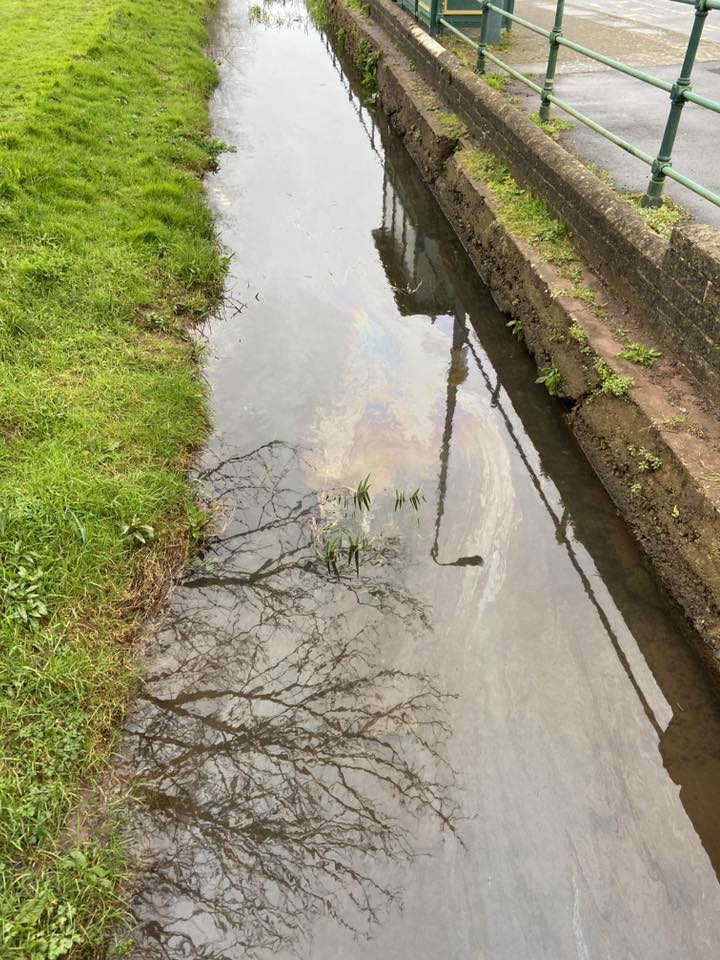
COUNCILLOR Jonathan Grimes, representing Pembroke St Mary South and Monkton, has issued an update following concerns over an oil spill affecting a stream on The Commons and Castle Pond in Pembroke.
Speaking after discussions with Natural Resources Wales, Cllr Grimes confirmed that response teams have been on site throughout the day working to contain the pollution and identify its source.
According to the latest update:
• The pollution has begun to subside, with the oil slick now breaking up
• Monitoring will continue over the weekend and into next week
• Forecast rain is expected to help disperse the remaining contamination
• The substance is believed to be domestic heating oil (kerosene), pending confirmation
• Investigators believe they have identified the source area and are taking steps to prevent further incidents
Cllr Grimes said he would continue to provide updates as more information becomes available.

The incident has sparked concern among residents, particularly over the potential impact on wildlife and the environment. Some have called for further action, including opening the sea gate to help flush the affected water.

A MULTI-MILLION pound housing and care development in Haverfordwest has officially moved into the construction phase, with groundworks now underway at the Tŷ Haverfordia site.
Contractor Wynne Construction has begun work on the scheme at the former Haverfordia House site, marking the milestone with a turf-cutting ceremony attended by project partners and local representatives.

The development will provide 26 sheltered apartments for people aged over fifty-five, alongside a purpose-built twelve-bed reablement centre aimed at supporting residents returning home from hospital and regaining independence.
The project is being delivered in partnership with Pembrokeshire County Council and is expected to play an important role in easing pressure on local health and social care services.
Developers say they will work closely with local suppliers and businesses during the build to maximise benefits to the regional economy.

Measures have also been put in place to minimise disruption during construction, including maintaining pedestrian access and ensuring parking arrangements remain in place for nearby facilities.
Once complete, the scheme is expected to provide modern, high-quality accommodation tailored to the needs of older residents, while helping to free up hospital capacity across west Wales.

A PROGRAMME designed to support farming families in planning for the future is helping to break down one of agriculture’s most sensitive issues – succession.
Farm inheritance and succession planning returned to the spotlight in 2024 following UK Government reforms to inheritance tax (IHT), prompting renewed concern across the industry.
In response, Agrisgôp leader Elaine Rees Jones brought together farming families in the Welshpool area to take part in a structured programme aimed at addressing the issue head-on.
Agrisgôp, a fully funded management development initiative, encourages farmers to work collaboratively, building confidence and business skills through action learning.
Two distinct groups emerged: one made up of parents seeking to plan the future of their farms, and another of younger family members exploring how to take on responsibility and transfer knowledge from the previous generation.

A key theme identified early on was the importance of communication between generations.
Elaine said: “The meetings have offered the opportunity to gain professional and peer advice, time away from the farm to assess situations, and a safe, confidential space for discussion.
“Group members have shared concerns and apprehensions while getting to grips with the scale of the challenge, and have begun to develop action plans.
“The honesty and openness shown has been incredibly humbling.”

For many participants, the programme has provided the confidence to begin formal discussions with professional advisers.
One farming couple, currently working through the process of passing assets to their two sons, said the experience had been invaluable.
“It has made us tackle things properly. We had already started looking at succession before the Rachel Reeves budget, so this wasn’t a knee-jerk reaction.

“It’s a complicated process with no easy answers, and every farm is different. But Agrisgôp has helped us go into meetings with solicitors and accountants informed, rather than just accepting advice blindly.”
Another participant described succession planning as “mind-blowing” before joining the group, adding that expert input had highlighted the importance of early preparation.
The programme included a recent panel session in Welshpool, where professionals returned to answer questions from participants, alongside one-to-one sessions to clarify individual plans.
Specialist advice was provided on legal, financial, and land valuation matters, with a clear message emerging on the importance of having a valid will in place.
Angharad Hird, of Lanyon Bowdler Solicitors, warned that failing to make a will can have serious consequences, highlighting a case where a young farmer died unexpectedly. Under intestacy rules, his estate was divided between his wife and children in a way that may not have reflected the family’s wishes.
Financial planning was also a major focus. From April 2027, unused pension funds will be included within estates for IHT purposes, potentially attracting tax of up to 40%.
Emma Hall, a chartered financial planner, said some clients are already restructuring their finances to mitigate future liabilities, including placing assets into trusts or converting pension funds into income-generating annuities.
Land and property valuation was another key consideration. Richard Corbett, of Roger Parry & Partners, stressed that valuations must reflect current market conditions at the time of assessment, while also taking into account factors such as shared ownership or rights of way.
Accountant Sion Roberts highlighted the importance of setting emotion aside when making decisions.
“There is no one-size-fits-all solution,” he said. “Each farm is different, so it’s vital to understand your priorities and get the right advice.”
The issue of care fees and asset transfers was also raised, with warnings about the risks of deliberately reducing assets to avoid future costs.
Alongside Agrisgôp, Farming Connect’s Succession Pathway offers structured support for families navigating the process. This includes business reviews, facilitated family meetings, bespoke planning, and access to specialist legal services.
Organisers say early planning is crucial to securing both family relationships and the long-term future of farm businesses.
Farmers interested in accessing support can contact Farming Connect on 03456 000 813 or visit their website for further information.



News47 minutes ago
Plaid Cymru launches bid to lead next Welsh Government
Party positions itself as ‘government-in-waiting’ ahead of May election PLAID CYMRU has formally launched its campaign for the 2026 Senedd...


Crime2 hours ago
Police appeal after attempted child abduction in Haverfordwest
DYFED-POWYS POLICE has launched an appeal for witnesses following a reported attempted abduction of a 12-year-old girl in Haverfordwest. The...


Crime1 day ago
Gunshot fired by police during incident in Milford Haven
A POLICE officer discharged a firearm during an incident in Milford Haven on Saturday evening (March 28), prompting an investigation...


Community2 days ago
Three Amigos Easter Run roars through Pembrokeshire
MOTORCYCLE enthusiasts turned out in force today (Saturday, March 28) as the popular Three Amigos Easter Run returned to the...


Education3 days ago
Ysgol Henry Tudor reassures parents over Sikh ceremonial kirpan
School says religious item worn by pupil is secured, symbolic and non-functional YSGOL HENRY TUDOR has moved to reassure parents...


Crime4 days ago
Teen jailed after starting fire while others slept
Fire set in shared home left sleeping residents at risk and caused £130,000 damage A TEENAGER who started a fire...


Health4 days ago
GP crisis driving NHS pressure in Wales, Senedd report warns
Falling GP numbers and funding gaps blamed for worsening hospital delays THE NHS crisis highlighted earlier this week is being...


News5 days ago
Reform reveals west Wales candidates for Senedd battle
Monkton councillor tops Pembrokeshire list as party confirms Carmarthenshire names and includes Haverfordwest councillor in unwinnable Swansea spot REFORM UK...


Health5 days ago
Clash over Withybush Hospital services as Paul Davies challenges First Minister
A HEATED exchange in the Senedd has laid bare growing tensions over the future of hospital services in west Wales....


Crime6 days ago
Police stop car in Pennar as three arrested in drugs investigation
Suspected drug driver report leads to major police response and multiple arrests DRAMATIC scenes were reported in Pennar on Monday...
-

 Business6 days ago
Taxi fare shock in Milford Haven as drivers switch to meters
-

 News5 days ago
Welsh Government outlines progress on flood resilience plans
-

 Health6 days ago
Average of 18 deaths a week in Wales linked to A&E delays, figures reveal
-

 Community4 days ago
Hero female officer keeps job after sexual touching finding
-
Education3 days ago
Ysgol Henry Tudor reassures parents over Sikh ceremonial kirpan
-
Crime6 days ago
Police stop car in Pennar as three arrested in drugs investigation
-
 Business4 days ago
Popular Italian restaurant hit with £278,000 tax bill plus £186,000 fine
-

 Community6 days ago
Calls to block Withyhedge landfill expansion amid ‘worst in Wales’ claims