


News
Clean up follows train derailment, as police rule out foul play

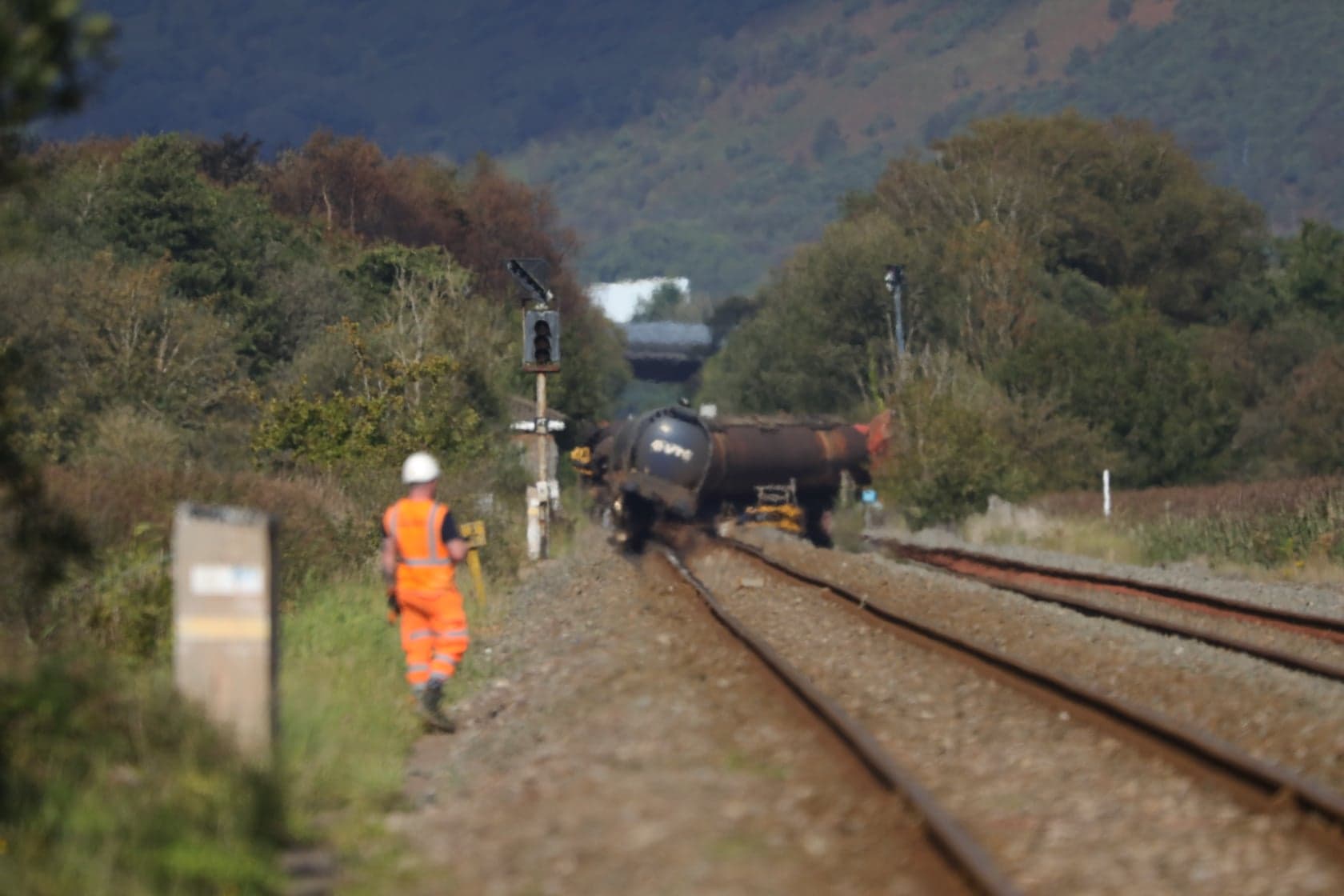
NATURAL RESOURCES WALES have been dealing with the diesel spilled as a result of the train derailment and fire in Carmarthenshire.
The work comes as British Transport Police said they did not suspect that criminality is a reason for the incident.
Ten wagons, each containing 75 tonnes of diesel, derailed and spilled oil into the Loughor Estuary near Llanelli in Carmarthenshire on Wednesday night (Aug 26).
The cargo train was travelling from an oil terminal in Milford Haven to Reading.

Undamaged wagons were being removed today (Photo D Harries/Herald)
STATEMENT FROM NRW

Work is continuing to recover the diesel from the derailed wagons and the spilled diesel. Trenches have been dug to intercept the diesel and vacuuming and skimming operations are taking place.
Monitoring of local watercourses continues, with booms and absorbent pads being used and regularly replaced to contain as much of the diesel as possible. These techniques are proved to be working well and are removing a considerable quantity of diesel from the water courses.
Network Rail is arranging for a crane to be delivered to the site on Monday evening (31 August) to start removing the wagons from Tuesday (1 September).
Monitoring teams continue to carry out daily surveys around the Loughor Estuary, including around the local fisheries and bathing water sites.
Please report sightings of oil pollution around the estuary to us by calling 03000 65 3000. If you come across any contaminated birds or animals, call RSPCA Cymru on 0300 1234 999.
Diesel is no longer confined to the upper reaches of the estuary (around the Loughor Bridge and upstream) and has been observed at many locations as far as Crofty.
The map shows the observed presence of diesel in the Loughor Estuary on 29 August 2020. The estuary is a very dynamic system influenced constantly by tide and wind, and will influence the movement of the diesel.

The Maritime and Coastguard Agency has also undertaken aerial surveys to aid the monitoring of the pollution.
The Environment Group set up in response to the incident will support and advise the response units on the identification and priorities for clean-up in the wider estuary.
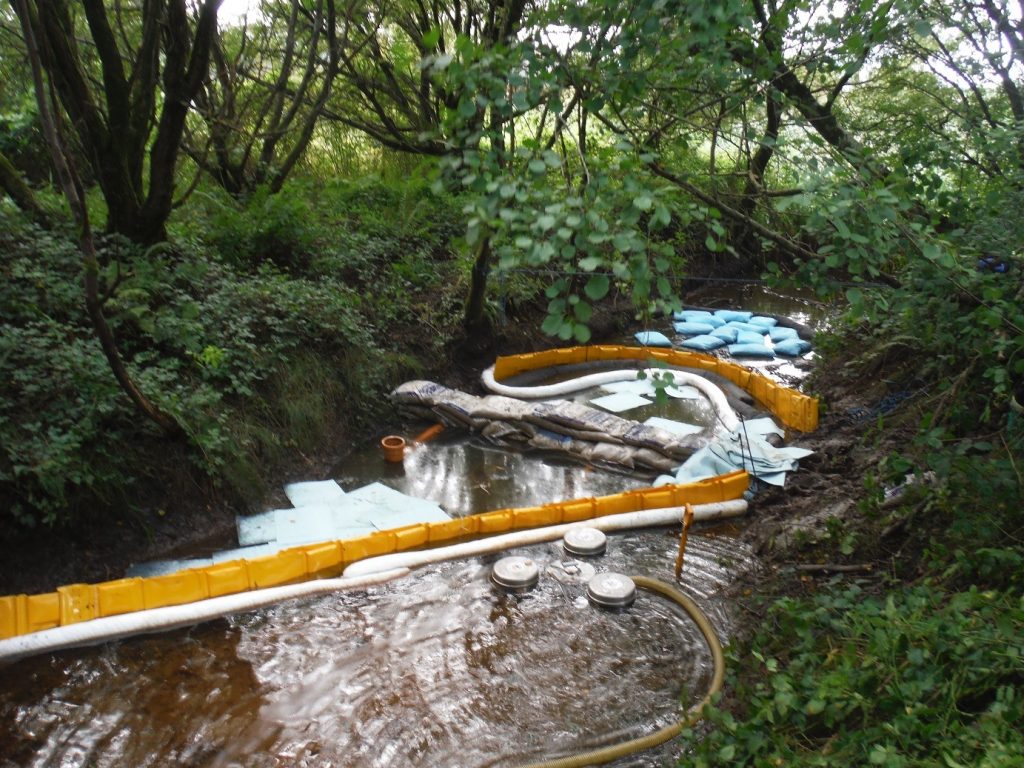
Steps are being taken to prevent diesel entering waterways (Pic NRW)
CRIMINALITY NOT SUSPECTED
Detective Chief Inspector Paul Langley from British Transport Police said: “Thanks to the efforts of our officers and our colleagues from across the emergency services in making the scene safe at Llangennech, we have been able to conduct an initial investigation into this incident.
“Our initial findings are that the derailment is not believed to have been caused by criminal activity.
“We are therefore handing primacy of the scene to the Office of Rail and Road so that it can carry out its own specialist investigation.
“I would like to once again thank our officers for their efforts during this challenging incident, and I am grateful to all of our partners for their help and support in ensuring the safety of the local community.”
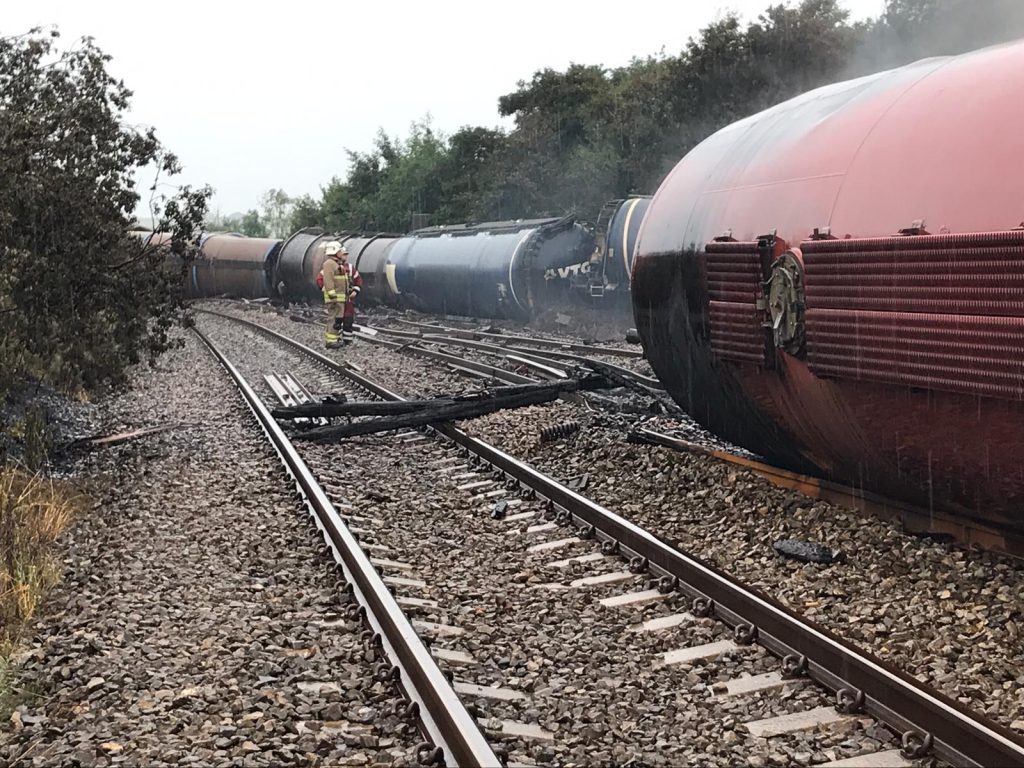
Ten carriages derailed, each containing 75,000 litres of diesel fuel. Three caught fire (Pic D Harries/Herald)

This map from Natural Resources Wales shows the extent of the pollution from the accident (Source: NRW handout)
FROM OUR PHOTOGRAPHER, DARREN HARRIES
On Sunday (Aug 30), we visited parts of the Loughor estuary to find the strong smell of fuel in the air and oil slicks in the rock pools and rivers, from the train incident further up the estuary in Llangennech.
The area around the bridges and car park by Loughor Boating Club and Loughor Inshore Rescue, and surrounding area smells so bad,
‘We had to leave from feeling ill and getting a headache from the diesel fumes.
This may have been down to the wind direction, but it was unpleasant and something to be aware of if visiting the area.
We also noticed that Swansea Council has acted quickly and placed information signs around the area of ‘Notice Of Temporary Closure Of Production Area, signs had be dated on the 27th August.
But a fishermen did attempt to fish, the fuel filled river, but he found it impossible as his line and tackle, including his rod were covered from diesel.
We did not see any information signs on Llanelli side, so it may have been the case of the angler not being aware of the hazard in the estuary, despite the overwhelming smell.
From visiting Llangennech the day after the train wreck and seeing the area of the derailment, I could smell the diesel in the marsh and the river, as it entered the estuary.
Today’s visit to Llangennech, we seen Network Rail were back at work and an Oil Spill Response Company, turn up including a Specialist Security company.
Things are starting to happen.
We did see a post over Facebook, someone had taken a photo of a dead bird in the area, thought to be down to the spill.
Residents in Machynys and other parts of Llanelli can also smell the fumes.
The local cockle beds are closed, putting the cocklers and shellfish gathering on hold, along with fishermen.
The environmental impact on the estuary is not yet known, It’s doubtful that this diesel spill will have no good outcome for our wildlife and fish including the winter visiting birds that use the Loughor estuary and the Llanelli Wetlands.












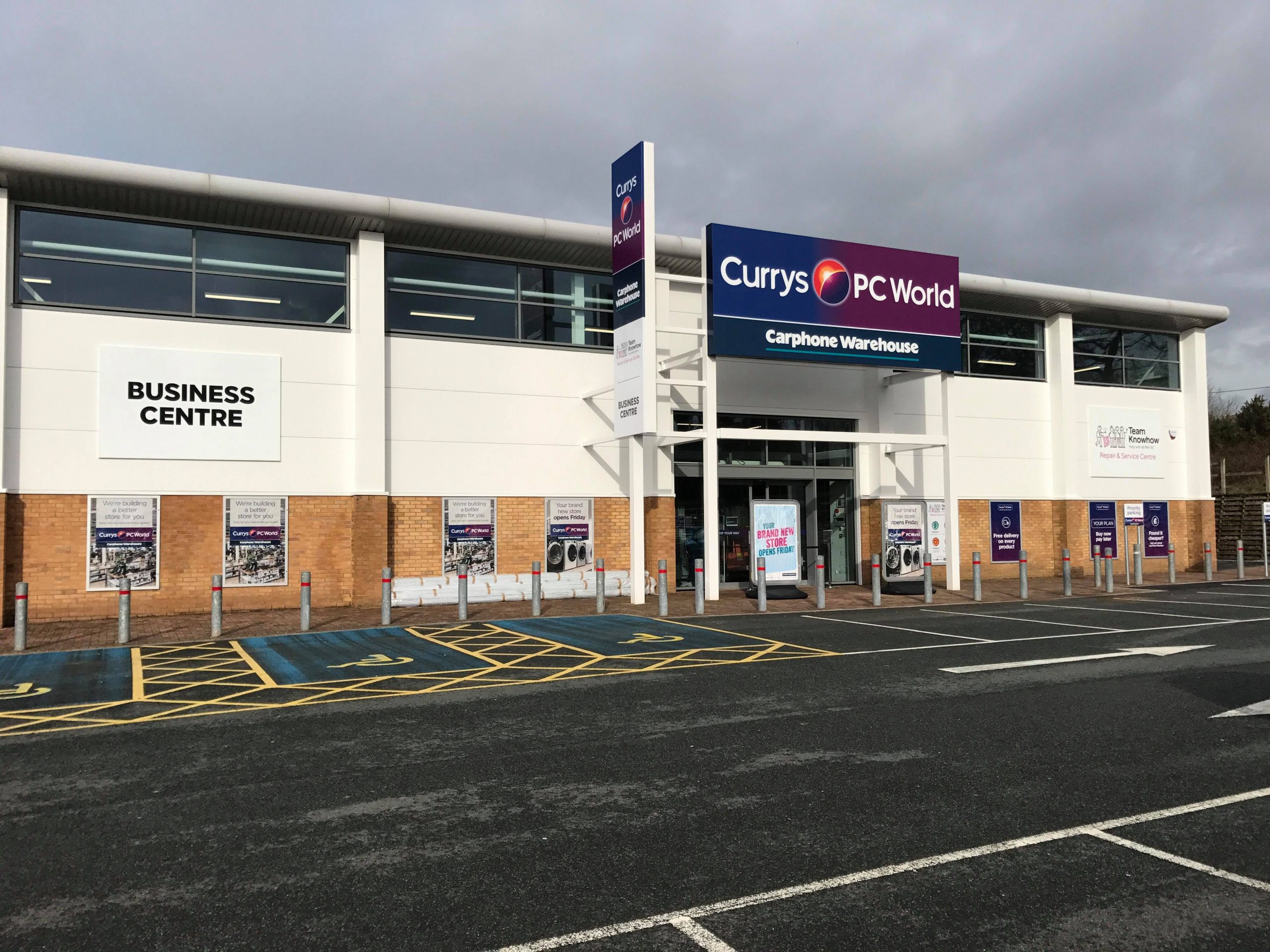
Defendant remanded in custody as court hears allegations spanning Wales and South West England
A MAN accused of carrying out a series of high-value thefts from Currys stores across Wales and South West England has appeared before magistrates in connection with an alleged offence in Haverfordwest.
Ilia Patchkoria, aged 27, of no fixed abode, appeared before Llanelli Magistrates’ Court facing multiple theft allegations involving electrical goods worth tens of thousands of pounds.
Among the charges is an allegation that Patchkoria stole items worth £1,525 from the Currys store in Haverfordwest on May 23 this year.
The court heard that the Haverfordwest incident forms part of a wider series of alleged offences said to have taken place at Currys stores across Wales and England.
Other charges relate to alleged thefts at stores in Carmarthen, Barnstaple, Plymouth, Truro, Penzance and Torquay. The total value of the goods involved in the various allegations runs into many thousands of pounds.
According to the court register, the largest single alleged theft took place at the Carmarthen branch, where goods valued at more than £7,600 are said to have been taken.
Patchkoria indicated guilty pleas to some matters before the court. Magistrates ordered that he be remanded in custody while proceedings continue.
The case has been adjourned until July 2, when it is due to return before Llanelli Magistrates’ Court.
It is not yet known precisely what items were allegedly taken from the Haverfordwest store, although Currys outlets typically stock a range of high-value electrical goods including laptops, mobile phones, gaming consoles and household technology.
No verdicts have been reached in relation to the outstanding allegations.
The Herald has approached Currys for comment on the alleged Haverfordwest theft and to establish whether the incident caused any disruption to customers or store operations.
Photo caption: Currys in Haverfordwest was among several stores allegedly targeted in a cross-country theft spree (Pic: Herald).


FAMILY REMEMBERS “KIND AND LOVING” CALLUM HANSON
THE FAMILY of a 22-year-old man from Haverfordwest who died following a road traffic collision have paid tribute to their “kind and loving” son, brother and grandson.
Callum Hanson sadly passed away in hospital on Wednesday (Jun 17) after a collision on the A4075 near Cross Hands, Pembrokeshire.
In a tribute released through Dyfed-Powys Police, his family said Callum lived life to the fullest despite his own personal challenges.
They said he was a deeply caring person who had spent the last month looking after his grandad, who also recently passed away.
Callum had a passion for gaming and motorbikes, and was training to become a mechanic at college.
He will be remembered by his mum Joanne, dad Carl, sister Kacey, nan Heather, girlfriend Emily, and his wider family and friends.
The family have asked for privacy at this difficult time.
Police are continuing to appeal for witnesses. Officers want to hear from anyone who was travelling on the A4075 between Canaston Bridge and Yerbeston at around 6:15pm on Wednesday (Jun 17).
Anyone with information can contact Dyfed-Powys Police online, by emailing [email protected], or by calling 101, quoting reference 362 of June 17.

INSOLVENCY figures fell in May, but businesses across Wales remain under serious financial pressure, according to restructuring specialists.
Official figures show there were 1,868 corporate insolvencies in May 2026, down 10.5% from April and 16.3% lower than in May last year.
Andy McGill, restructuring and insolvency partner at Azets, which has offices in Cardiff, Swansea and St Asaph, said the fall was welcome but should not be mistaken for a sign that firms are out of difficulty.
He said: “Directors running out of fight, firepower and finance is still a problem, and creditors remain willing to turn to the courts to recover monies owed — and neither of these are going to change in the short term.
“The reality is that despite the fall in insolvencies compared to last month and last May, numbers are still high and businesses are still struggling, with many facing an uncertain future.”
Mr McGill said firms were being hit by a combination of geopolitical uncertainty, rising costs, political instability, a lack of affordable finance and creditors chasing overdue debts.
He added: “Unless the climate becomes easier and some way is found of lightening the cost load on businesses, it’s likely demand for advice and support will remain high in the coming weeks and months.”
Cost pressures continue
BUSINESSES are also facing rising employment costs, higher business rates and renewed pressure from energy bills.
Mr McGill said many firms were being “sandwiched” between their own higher costs and customers cutting back on spending.
He said the hospitality, retail and construction sectors remained among the hardest hit.
He added: “The fact that several household names have entered restructuring or insolvency processes recently shows the strain on the restaurant sector is becoming unbearable as the double blow of increased expenses and cautious consumers continues to affect it.
“Despite a rise in footfall and sales, retailers continue to be crushed by costs.”
He also pointed to the planned restructuring of TG Jones as evidence that even long-established high street names were not immune from financial distress.
Construction firms under strain
THE construction industry continues to face pressure from rising labour costs, higher material prices and late payment.
Mr McGill said tight margins and cashflow difficulties were pushing more firms towards financial distress.
He said: “Our advice to anyone who is worried about their business is to pick up the phone and speak to an adviser.
“It’s incredibly hard to voice your concerns about your finances, but the earlier you do, the more potential solutions you have open to you and the more time you have to consider how you move forward.”



News19 hours ago
Tragic tribute paid to Haverfordwest man after A4075 collision
FAMILY REMEMBERS “KIND AND LOVING” CALLUM HANSON THE FAMILY of a 22-year-old man from Haverfordwest who died following a road...

News2 days ago
Motorcyclist, 22, dies in A4075 crash in Pembrokeshire
A 22-year-old woman remains in hospital after two-vehicle collision A MOTORCYCLIST has died following a serious two-vehicle crash on the...

Community2 days ago
Why police will be visiting every home in Pembrokeshire
New operation aims to knock on more than 257,000 doors across Dyfed-Powys over the next three years DYFED-POWYS POLICE has...


Crime2 days ago
Prisons at breaking point: MPs warn Wales is paying the price of a failing system
Frozen healthcare budgets, overcrowded jails, homelessness on release and mounting pressure on staff are undermining rehabilitation across Wales, according to...


News3 days ago
Brexit at 10: How Britain was sold a dream that cost us dearly
A decade after the referendum, the promised benefits remain hard to find while the economic costs are increasingly difficult to...


Crime3 days ago
Worcestershire man jailed after violent attack on woman in Tenby
Defendant was already serving a suspended sentence when serious assault took place A WORCESTERSHIRE man has been jailed for more...


Climate3 days ago
Offshore wind ‘could bring new generation of jobs to Milford Haven’
Pembrokeshire ports and Celtic Sea projects placed at centre of Wales’ green energy ambitions MILFORD HAVEN and Pembroke Dock could...

Community4 days ago
Police officer hailed hero after midnight sea rescue in Milford Haven
PC swam 100 metres offshore to save distressed woman heard calling for help in darkness A DYFED-POWYS POLICE officer has...


Local Government4 days ago
Security privately arranged by Mayor at Beating of the Bounds
HAVERFORDWEST TOWN COUNCIL has confirmed that security personnel seen at this year’s Beating of the Bounds were privately arranged and...

Business5 days ago
Celtic Freeport five-year plan puts Milford Haven at centre of green energy future
Strategy promises investment, skilled jobs and new supply chains, but major barriers remain over grid connections, planning and delivery THE...
-

 Community6 days ago
Pembrokeshire Chess Club crowned Welsh champions
-

 Crime2 days ago
Milford Haven man jailed for breaching domestic violence protection order
-
Local Government4 days ago
Security privately arranged by Mayor at Beating of the Bounds
-
 News2 days ago
Crash on Freeman’s Way causes school-run chaos across Haverfordwest
-

 Crime3 days ago
Man wanted by court after failing to attend hearing over alleged shop thefts
-

 Crime3 days ago
Man jailed after admitting strangulation and assaults
-
 Crime3 days ago
Man banned from roads after drink-driving offence
-
 Crime3 days ago
Man sentenced over stalking campaign and lock knife offence