


Farming
FUW focuses on mental health

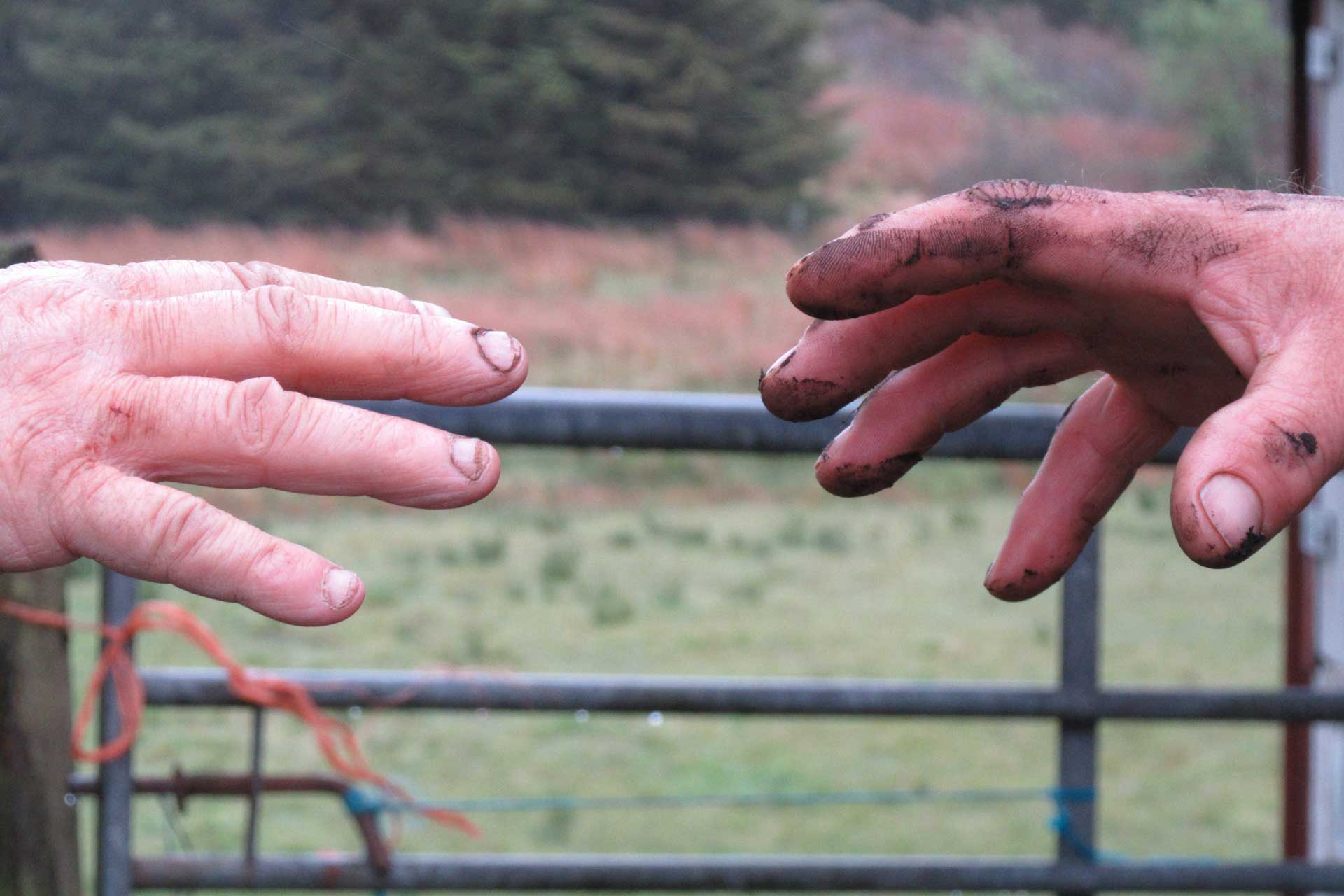
THE FARMERS’ UNION OF WALES made a commitment at the Royal Welsh Show last year to continue raising awareness of mental health problems in rural communities and in line with that commitment is continuing the conversation about the wider issues surrounding mental health in rural areas at this year’s Royal Welsh Show.
Hosting a dedicated seminar on Thursday, July 26, at 11am at the FUW pavilion, the Union looks forward to hearing from Alzheimer’s Society Cymru, The Farming Community Network and DPJ Foundation.
Speaking ahead of the event, FUW President Glyn Roberts said: “Mental health – good or bad – has affected us all at some point in our lives. Standing by the commitment we made at the Show last year, I’m pleased to see the excellent line-up of speakers we have with us once again.
“They will be discussing a variety of issues and look at solutions that are available to those who have suffered, are suffering or are supporting someone close to them who is affected by mental health issues, may that be depression, anxiety, Alzheimer’s or any other form of poor mental health. I therefore hope that many of you will be able to join us on the day.”
The discussions are chaired by Lilwen Joynson, Agrisgop leader, who said: “I appreciate that for many farmers, rural businesses and families having a chat about being stressed out and what to do and where to go for help, sits below the to do list of a busy rural enterprise.

“The thing is, if we don’t talk we don’t support and we end up with problems and an industry that isn’t facing up to the reality of how mental health affects us all.
“I want you to think right now of one person who is affected with stress, anxiety or depression it could even be you. Where do they go for support? Very often nowhere and that’s why we have been known to be an industry that shuts up and puts up. We have an industry that thinks that a person is soft if we are feeling depressed; we all know that well-oiled phrase “pull yourself together”.
“That’s why as a working practitioner I am keen to push forward and pull together and talk about mental health – let’s take the stigma out of mental health in farming. And I hope to see many of you at the seminar.”
David Williams, Wales Regional Director for The Farming Community Network, who manages a group of 40 Welsh volunteers and is the FCN’s lead contact with the Welsh Government on farming-related issues said:

“It is very easy to underestimate just how important the mind is when it comes to farming. Along with the body, it is, without doubt, the best bit of kit a farmer can have.
“However, if your mind and body are not well-maintained, the consequences can be disastrous. There is a significant amount of stress and anxiety in farming at present. Concerns about the unpredictable weather, animal disease, support payments and the impact of Brexit are weighing on the minds of many farmers throughout Wales.
“Coupled with the loneliness and isolation that comes with farming means that farmers and agricultural workers are highly susceptible to poor mental wellbeing. Failing to deal with poor mental wellbeing could lead to all sorts of issues. It could lead to the farm running inefficiently, a serious injury, relationship breakdowns, poor physical health and, even worse, it could lead to suicide.

“Thankfully, the stigma surrounding mental wellbeing in farming is slowly reducing, thanks to the incredible support services that are now available to the farming community. One of the aims of the FUW’s “Let’s Talk” seminar, is to help farmers better understand mental health, identify poor mental wellbeing in both themselves and their loved ones and signpost them to the most appropriate support services for their situation.
“I would encourage anyone who has a passion for rural life and wants to support the farming community to attend this seminar at the FUW pavilion.”
Emma Picton-Jones, who set up the DPJ Foundation after her husband took his own life July 2016, will provide an update on the work of the foundation, which aims to support people in agriculture and in the agricultural community by reducing the stigma that surrounds mental health and supporting them by signposting them to support systems that are available.
She said: “We have set up a talking therapies service specifically for people in the rural communities, men in particular who struggle with their mental health and we are currently running a pilot year in West Wales and have taken on on average 1 client per week for each week we have been running. That just shows how important mental health support is in our communities and I hope many of you can join us for this seminar at the Royal Welsh Show to explore what help is available.”
Sue Phelps, Alzheimer’s Society Cymru Country Director, said: “Alzheimer’s Society Cymru estimate that there are 17,000 people affected by dementia living in rural communities across Wales. They face a specific set of challenges and barriers; these include access to specialist support, peer support and a lack of awareness and understanding of dementia within the community.
“Loneliness is a real problem for people with dementia. Alzheimer’s Society research states that a third of people report to have lost friends since their diagnosis. Two thirds of people with dementia remain in their communities, but many feel trapped in their own homes – with almost one in 10 only leaving the house once a month. Carers are also more likely to feel isolated and unsupported.
“Our Side by Side service supports those affected by dementia to remain part of their community and continue to do the things they love. This can help to reduce feelings of isolation and loneliness which can lead to depression and other mental health related issues. We are particularly keen to recruit volunteers from the Welsh speaking and farming community to Side by Side to help us to keep connected with people living with dementia.
“Alzheimer’s Society Cymru will continue to shine a light on the needs of people affected by dementia in rural Wales, and will be keeping a close eye on the implementation of the Welsh Government’s National Dementia Action Plan, to make sure people in those communities receive the care and support that they are entitled to receive.”













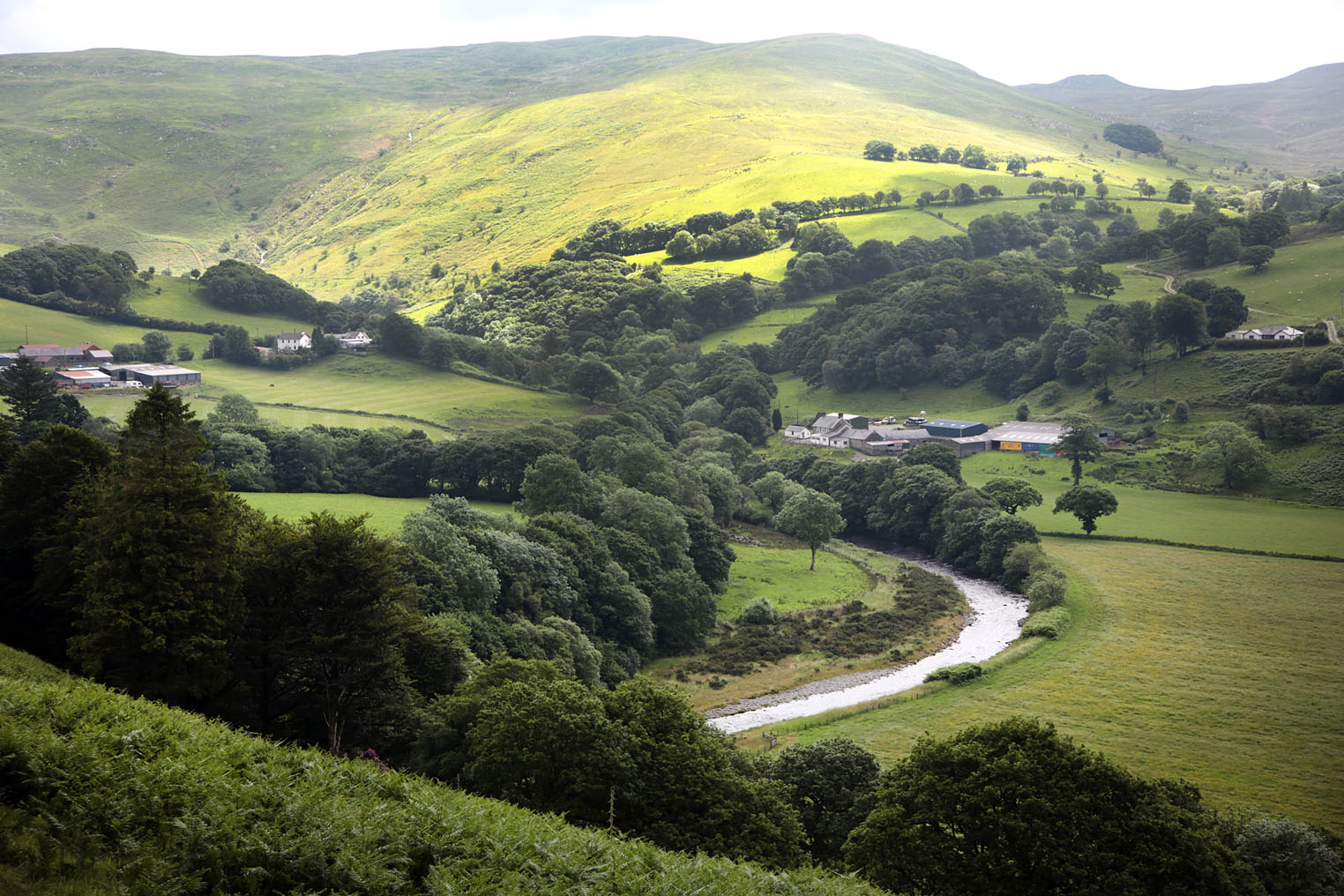
Final year of BPS as transition to Sustainable Farming Scheme begins
The WELSH Government says more than ninety-five per cent of farm businesses have now received their full or balance payment under the final year of the Basic Payment Scheme (BPS), ahead of the introduction of the new Sustainable Farming Scheme (SFS) in 2026.
Announcing the update on Friday (Dec 12), Deputy First Minister and Cabinet Secretary for Climate Change and Rural Affairs, Huw Irranca-Davies, confirmed that over 15,400 Welsh farm businesses have been paid £68.7m. This comes on top of the £160m issued in BPS advance payments since 14 October.
Final round of BPS payments
The Basic Payment Scheme, which has been the backbone of farm support in Wales for a decade, provides direct income support to help farmers plan and manage their businesses. BPS 2025 marks the last year in which full BPS payments will be made before the scheme begins to be phased out.
The Cabinet Secretary said officials would “continue to process the outstanding BPS 2025 claims as soon as possible,” adding that all but the most complex cases should be completed by 30 June 2026.
Payments issued today represent the main balance due to farmers following earlier advances, giving many businesses the cash flow they need during the quieter winter period—traditionally a challenging time in the agricultural calendar.
Shift to Sustainable Farming Scheme in 2026
From 1 January 2026, the Welsh Government will begin rolling out the Sustainable Farming Scheme, a major reform to how agricultural support is delivered. The SFS will reward farmers for environmental outcomes such as habitat management, carbon reduction and biodiversity improvements, alongside continued food production.
The government has argued that the new scheme is essential to meeting Wales’ climate and nature targets while ensuring long-term resilience in the sector. However, the transition has been closely watched by farming unions, who have raised concerns about the administrative burden, income stability, and the speed at which BPS is being phased out.
Mr Irranca-Davies reaffirmed the government’s stance, saying: “This government is steadfastly committed to supporting Welsh farmers to sustainably produce quality food. This is demonstrated today in our payment of the BPS 2025 balance payments and will continue throughout the transition period.”
Sector reaction
Farming unions are expected to scrutinise the detail of today’s announcement, particularly around remaining unpaid cases. Last year, late payments led to frustration in parts of the sector, with unions calling for greater certainty as the industry faces rising input costs, supply chain pressures and continued market volatility.
The move to the SFS remains one of the most significant agricultural policy changes in Wales since devolution. Ministers insist the shift is designed to support both food production and environmental stewardship, while critics warn the transition must not undermine farm viability—especially for family-run livestock farms that dominate rural areas such as Pembrokeshire, Ceredigion and Carmarthenshire.
What happens next
Farmers still awaiting their BPS 2025 balance will continue to be processed “as soon as possible”, the Welsh Government said. Officials will also publish updated guidance on the Sustainable Farming Scheme ahead of its launch.
The coming year will therefore become a pivotal moment for Welsh agriculture, as the long-standing BPS framework—which provided over £200m annually to Welsh farmers—makes way for a new results-based model that will shape the industry for decades to come.

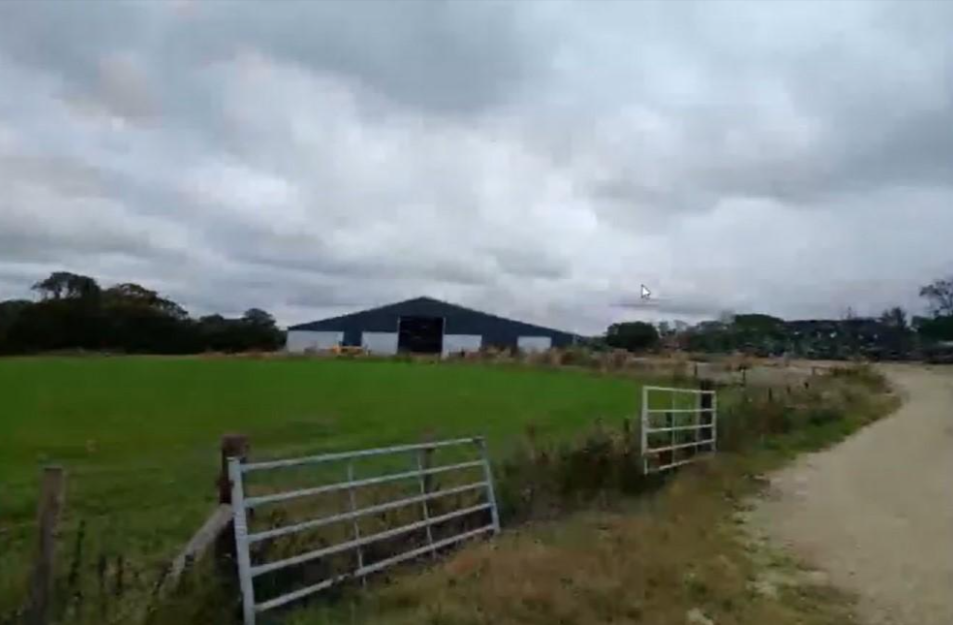
A PEMBROKESHIRE farmer “jumped the gun” in his enthusiasm to build a new cattle shed which includes ‘robot slurry scrapers’ that have been causing a noise nuisance for neighbours, county planners heard.
In a retrospective application recommended for approval at the December meeting of Pembrokeshire County Council’s planning committee, Aled Jenkins sought permission for a replacement cattle housing and silage clamp at Upper Ty Rhos, Wolfscastle.
An officer report said Upper Ty Rhos consists of a herd of 630 youngstock beef cattle, the applicant seeking permission for the replacement 100-metre-long cattle housing building.
It said the building benefits from a robotic scraping system to internally clean it to improve animal welfare and efficiency.
However, the slurry scraper system in operation has been found to constitute a statutory noise nuisance.
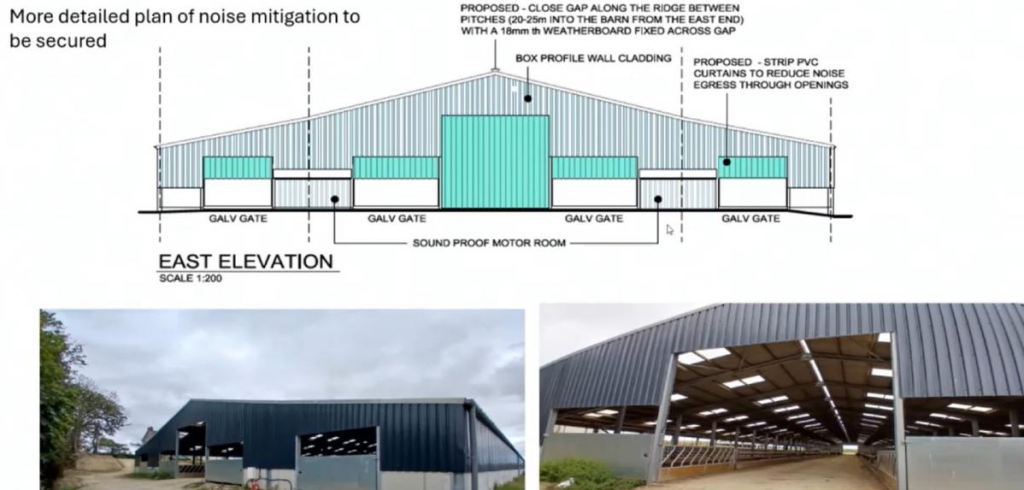
“The introduction of the slurry scraper system has resulted in a new noise source to the locality that is having a significant detrimental impact upon local amenity. The nuisance noise is directly associated with the extended hours of operation of the slurry scraper system and the noise created by the two motors powering the system including the drive mechanism that moves the scraper through the building to remove slurry produced by the housed cattle.
“To further exacerbate the situation, the building has open voids to the eastern gable end, which is within close proximity to the neighbouring property resulting in the building being acoustically weak.
“An acoustic report has been submitted with mitigation methods provided including relocating motors and associated equipment into external enclosures, reduction of noise egress through openings by installing hit-and-miss louvres and/or PVC strip curtains and consideration of blocking the gap between roof pitches along the ridge of the building.”
Three letters of concern were received from members of the public raising concerns including visual and environmental impact, noise issues and a potential for the herd size to increase.

Speaking at the meeting, neighbour Dr Andrew Williams, who stressed he was not seeking to have the shed removed, raised concerns about the noise from the ‘robot scrapers,’ exacerbated by cattle being concentrated in the immediate area from the wider farm complex.
Agent Wyn Harries addressed concerns about the retrospective nature was a result of over-enthusiasm by his client who “jumped the gun”.
He said there was now a scheme that was “fully worked through,” dealing with noise and other issues.

Members backed approval, which includes noise mitigation to address the impact of the robot scrapers; one member, Cllr Tony Wilcox, abstaining on the grounds of the retrospective native of the building “the size of a football field”.
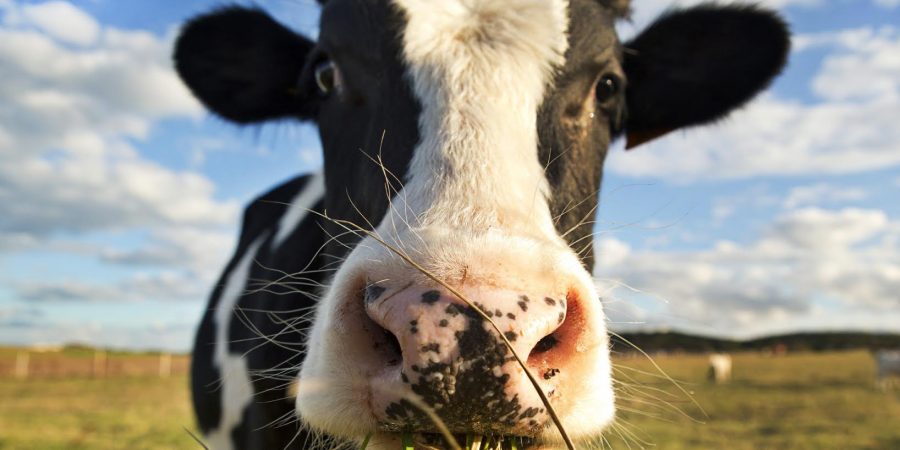
THE FARMER’s UNION OF WALES has sounded the alarm over a sharp and sustained collapse in dairy prices, warning that the situation is placing intolerable pressure on family farms already grappling with regulatory change, rising costs and wider economic uncertainty.
The Union convened an emergency meeting of its Animal Health and Dairy Committee last week to assess the scale of the crisis. Representatives from across Wales reported widespread anxiety, with many members seeing milk prices fall dramatically through the autumn. Processors are now signalling further cuts in early 2026, while commodity markets offer little sign of stability heading into spring.
Farmers, fearful of jeopardising commercial relationships, have approached the FUW confidentially to express grave concern about projected milk payments for the coming months. Many say the offers being made will fall far below the cost of production.
Average milk prices are forecast at just 30–35 pence per litre, against estimated production costs of 39–44 pence per litre (Kite Consulting). On current trajectories, the FUW warns a typical Welsh dairy farm could lose thousands of pounds per month for as long as the downturn persists.
Following its committee meeting, the Union raised the matter directly with Deputy First Minister Huw Irranca-Davies MS during talks in Cardiff on Wednesday, December 3. Officials stressed the immediate threat facing family-run dairy farms and called for urgent consideration of government support to prevent long-term damage to the sector.
Gerwyn Williams, Chair of the FUW Animal Health and Dairy Committee, said the pace of the price crash was “unprecedented”.
“Farmers are facing an impossible situation where input costs remain high while the value of their product plummets. The viability of many family farms is now at serious risk. We need immediate assurances that this crisis is being treated with the urgency it deserves.
“Some can weather a short storm, but rumours that this could continue into summer 2026 will see businesses shut. These modest family farms have already invested heavily to meet regulatory requirements. Cuts on this scale will severely impact their ability to service repayments.”
FUW Deputy President Dai Miles warned that the consequences extend far beyond farm gates.
“Dairy farming underpins thousands of jobs in Wales and is central to the economic, social and environmental fabric of rural communities. When prices fall this sharply, it isn’t just farmers who suffer — local businesses, services and entire communities feel the impact.
“We have made it clear to the Deputy First Minister that government must work with the industry to provide immediate stability and a long-term resilience plan.”
The FUW says it will continue to work with the Welsh Government, processors and supply-chain partners to seek solutions and secure fair, sustainable prices for producers.


Amber weather warning as ‘danger to life’ rain set to hit Pembrokeshire
Dyfed-Powys Police and council teams prepare as Monday deluge expected COMMUNITIES across Pembrokeshire are being urged to brace for severe...


Former Army Cadet leader sentenced for child abuse image offences
Judge condemns “horribly abused” victims as Carmarthen man admits offences A FORMER Army Cadet instructor from Carmarthen has been sentenced...


Trefin dog case ends in forfeiture order after protection notice breach
Village protest followed months of complaints about barking A WOMAN from north Pembrokeshire has been fined £1,000 and ordered to...


Man spared jail after baseball bat incident in Milford Haven
Judge says offence was so serious only a prison sentence was justified A 44-YEAR-OLD has been given a suspended prison sentence after...


Rural cannabis factory exposed after five-year operation in Carmarthenshire
Family-run drugs enterprise brought in millions before police raid during lockdown A FAMILY who relocated from England to a remote...

Senedd rejects calls to ‘eliminate’ rates for small businesses
A CONSERVATIVE call to abolish rates for all small businesses in Wales has been voted down by the Senedd amid...


Christmas song pokes fun at Haverfordwest’s ‘Instagram-friendly’ bridge
Rock track raises money for charity while giving a gentle dig to the council A BRAND-NEW Christmas rock song by...


Police reassure community after school lockdown incident in Carmarthen
DYFED-POWYS POLICE have issued reassurance to the community after Ysgol Bro Myrddin in Carmarthen was placed into a precautionary lockdown on...


Councillors call for urgent review as flooding hits coastal communities
Motion demands assessment of drainage infrastructure after Castle Pond overflow A MOTION on emergency flooding concerns was brought before Pembrokeshire...


Phillips found guilty of raping baby in “worst case” judge has ever dealt with
Baby’s mother cleared as judge says case “shaken me to my core” CHRISTOPHER PHILLIPS has been found guilty of the...
-
Crime5 days ago
Phillips found guilty of raping baby in “worst case” judge has ever dealt with
-
 Crime4 days ago
Kilgetty scaffolder sentenced after driving with cocaine and in system
-

 Crime4 days ago
Housing site director sentenced after failing to provide breath sample following crash
-

 Crime4 days ago
Motorist banned for three years after driving with cannabis in system
-

 Education3 days ago
Teaching assistant struck off after asking pupil for photos of her body
-

 News6 days ago
Jury retires tomorrow in harrowing Baby C rape trial
-
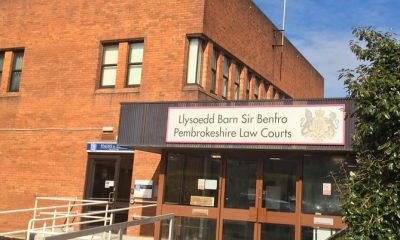
 Crime4 days ago
Milford Haven pensioner denies exposure charges
-
Crime22 hours ago
Man spared jail after baseball bat incident in Milford Haven