


News
Welsh Democracy at risk unless changes made, warns Constitutional Commission


THIS WEEK the Independent Commission on the Constitutional Future of Wales released its long-awaited final report, concluding a two-year national conversation on Wales’ governance and future prospects. The report, co-chaired by Professor Laura McAllister and Dr Rowan Williams, presents a stark warning: urgent changes to Welsh devolution are necessary to avert its collapse.
Established in 2021, the 11-member Commission boasts diverse backgrounds, offering a rich tapestry of expertise and political views. Its extensive engagement efforts – including surveys, roadshows, and a Community Engagement Fund – have echoed the voices of thousands across Wales. The Commission’s interim report, published in December 2022, highlighted significant governance issues within the Union, deeming the ‘status quo’ an unstable foundation for Wales’ prosperity.

The final report, underpinned by this comprehensive public dialogue, deems all three previously outlined constitutional options for Wales – independence, federalism, and enhanced devolution – as viable. However, it stresses the necessity of immediate changes to safeguard current devolutionary arrangements. Key among these are the devolution of justice, policing, and rail infrastructure, alongside major financial reforms to maximize Welsh value for money.
Additionally, the report calls for legislated protections for inter-governmental relations, ensuring efficient collaboration and public interest delivery. The three constitutional options offer distinct paths: enhanced devolution promises economic stability without fundamental shifts; a federal UK presents a balanced, accountable ‘middle way’; while independence carries the greatest economic risks but also the potential for significant, long-term benefits.
Professor McAllister emphasizes the timeliness of this national conversation, noting the transformative changes in Welsh governance over the past quarter-century and the pressing need for responsive reforms. Dr Rowan Williams highlights the importance of this grassroots engagement, urging the continuation of this national dialogue beyond the Commission’s lifespan to foster a robust democratic culture in Wales.


Responses to the report vary across the political spectrum. Labour’s Shadow Secretary of State for Wales, Jo Stevens, acknowledges the report’s significance, reiterating Labour’s commitment to devolution. Jane Dodds MS, Leader of the Welsh Liberal Democrats, criticizes the status quo’s inadequacy, advocating for pragmatic reform and localized power distribution.
Conversely, Darren Millar MS, Shadow Minister for the Constitution, critiques the report as a diversion from pressing issues, arguing for a focus on public services over constitutional debates. YesCymru welcomes the report, viewing it as a stepping stone towards independence, stressing the need for Welsh control over its destiny.
Plaid Cymru, via Rhun ap Iorwerth MS, plans to respond to the report at a forthcoming Aberystwyth University event, reflecting on its implications for Welsh independence.
In summary, the Commission’s final report ignites a vital conversation on Wales’ constitutional future, offering a foundation for imminent, impactful change. It underscores the need for a balanced, informed dialogue to shape the path ahead, ensuring that Welsh democracy not only survives but thrives in the coming years.



LABOUR SAYS MINISTERS MUST EXPLAIN COST AND TIMETABLE FOR PYLON PLANS
PLAID CYMRU’S approach to energy infrastructure has come under scrutiny after Energy Minister Adam Price was challenged over plans to reduce the use of overhead pylons in Wales.
Mr Price defended the Welsh Government’s position during an appearance on BBC Radio Wales’ Sunday Supplement, arguing that communities must have greater confidence in how major grid projects are handled.
Plaid Cymru has pledged to give communities a stronger voice over energy developments and to look more closely at alternatives to overhead transmission lines, including underground cabling where possible.
The issue has become increasingly sensitive in rural parts of Wales, where proposed pylon routes linked to renewable energy schemes have raised concerns about landscape impact, tourism and local consultation.
However, Welsh Labour said the minister had failed to explain when any restriction on pylons would take effect, or who would pay the additional cost of placing cables underground.
A Welsh Labour spokesperson said: “Adam Price keeps saying how clear their manifesto was and yet he won’t say when they’re banning pylons. They won’t say who is paying for the extra cost of undergrounding cables.
“Without certainty, companies won’t invest. That’s thousands of clean, green energy jobs at risk. Plaid need more than a plan to have a plan.”
Labour said the Welsh Government must now set out how its policy would work in practice, including whether it amounts to an outright ban, what exemptions would apply, and how any extra costs would be funded.
The debate highlights the challenge facing ministers as Wales seeks to expand renewable energy generation while addressing public opposition to large-scale grid infrastructure.

HORSES, STALLS AND FAMILY CROWDS RETURN TO MONKTON
FAMILIES, horse owners and visitors turned out in force for Pembroke Fair on Saturday (May 23), with many praising the event as one of the best organised in recent years.
Held at the Community Centre Field in Monkton, the annual fair brought together horse owners, traders and local families for a traditional day centred around horses, ponies, stalls and socialising.
Coloured cobs, heavy horses, ponies and horse-drawn traps attracted attention throughout the day, with many visitors gathering around the field to watch the animals being shown and led around the site.
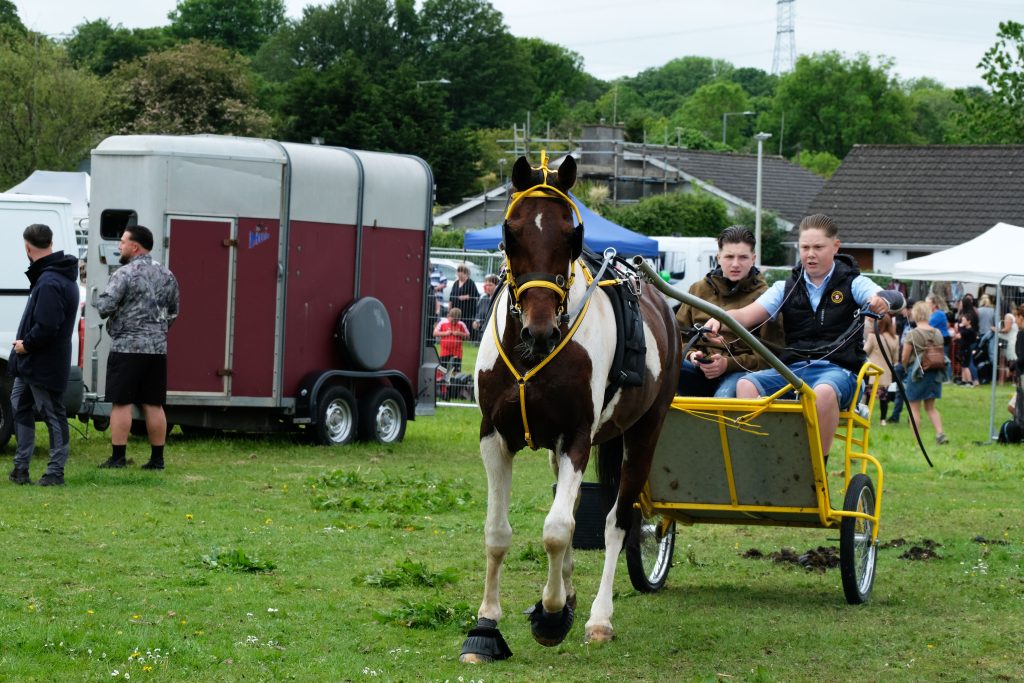


A variety of stalls selling everything from clothing and ornaments to tack and second-hand goods helped create a lively market atmosphere, while food vendors kept visitors fed throughout the day.
Despite overcast conditions at times, the event remained busy, with many attendees staying for several hours to enjoy the traditional fair atmosphere.
Community members later took to social media to praise the smooth running of the event, with several publicly thanking organiser Charlie Price for his efforts in bringing the fair together.
Comments described the day as “well organised” and praised the welcoming atmosphere, with many saying it was encouraging to see a long-standing local tradition continuing to thrive.
The fair once again brought together members of the travelling community, local residents and horse enthusiasts from across west Wales.






A horse drive was also due to take place on Sunday (May 24), continuing the weekend’s celebrations.
Photo captions:
Traditional gathering: Horses, ponies, horse-drawn carts and market stalls drew crowds to Pembroke Fair in Monkton on Saturday (Pic: Herald).

A HEALTH board has been criticised by Audit Wales after GP contracts worth more than £10m were awarded without sufficient due diligence checks.
Aneurin Bevan University Health Board allowed a GP partnership associated with eHarley Street Primary Care Solutions to take on eight GP contracts in south-east Wales, with a combined annual value of around £10.1m.
Audit Wales said the board should have carried out greater scrutiny before approving the arrangements, including checks on financial resilience, workforce plans, business risks and the partnership’s ability to manage several practices at once.
However, the watchdog found no evidence of fraud and noted the board was dealing with significant pressure in general practice, including vacant contracts and limited interest from other bidders.
The report said weaknesses in governance and scrutiny contributed to later disruption and uncertainty for patients and staff when problems emerged.
Concerns included financial and workforce pressures, unpaid invoices, and issues relating to tax and pension payments. Some contracts were later handed back, requiring the health board to step in to protect services.
Natasha Asghar MS, Welsh Conservative Shadow Cabinet Minister for Health and Social Care, said the findings were “deeply concerning”.
She said: “Patients and staff were left facing disruption and uncertainty because proper scrutiny was not carried out before these contracts were awarded.
“The Welsh Conservatives believe lessons must be learned to ensure robust checks are in place, protect frontline services and restore confidence in primary care across Wales.”
Aneurin Bevan University Health Board accepted the recommendations and said it had already strengthened its processes.
Audit Wales said the case highlighted the need for stronger checks before GP contracts are transferred, particularly when a single partnership is taking on multiple practices in a short period.



Business14 hours ago
Plaid energy policy challenged by Labour after Adam Price interview
LABOUR SAYS MINISTERS MUST EXPLAIN COST AND TIMETABLE FOR PYLON PLANS PLAID CYMRU’S approach to energy infrastructure has come under...


Community14 hours ago
Pembroke Fair praised as well-organised community event
HORSES, STALLS AND FAMILY CROWDS RETURN TO MONKTON FAMILIES, horse owners and visitors turned out in force for Pembroke Fair...

Local Government3 days ago
Youngest mayor in century takes office in Haverfordwest
Randell Izaiah Thomas-Turner makes history as town’s first millennial mayor and first from a diverse background HAVERFORDWEST has welcomed a...


Community3 days ago
Pembroke Fair set to return after last year’s success
STALL HOLDERS INVITED AS HORSE DRIVE PLANNED PEMBROKE Fair is set to return this weekend following the success of last...


Crime3 days ago
Neyland man accused of running over traffic worker’s foot
Jury hears conflicting accounts over roadworks incident in Milford Haven A NEYLAND man has appeared before Swansea Crown Court accused...

Community3 days ago
New pilot boat Llanion dedicated at emotional Milford Haven ceremony
Vessel dedicated at Mackerel Quay as Port marks major investment in safety and resilience MILFORD HAVEN’S new state-of-the-art pilot vessel...


Local Government4 days ago
Police and GoSafe to target speeding in Newport and Dinas
RESIDENTS’ concerns over speeding and anti-social driving have prompted planned enforcement action in the Newport and Dinas areas. Dyfed-Powys Police...


Community5 days ago
Safety first as Milford Haven’s new pilot boat marks end of troubled chapter
Gary Solomon, who was aboard St Davids during the 2016 collision, helped shape new self-righting vessel Llanion from conception to...


Crime5 days ago
Cocaine courier caught with £15,000 haul in Pembroke Dock
Defendant transported high-purity drugs from Cardiff to Pembrokeshire for £210 A PEMBROKESHIRE man caught transporting more than £15,000 of high-purity...


News5 days ago
Car bursts into flames near Redberth Croft as road closed after incident
Nobody injured after vehicle fire near A477 prompts emergency response A CAR was destroyed by fire near the entrance to...
-

 News2 days ago
Watchdog criticises health board over £10m GP contract checks
-

 Crime4 days ago
Farm owner in court after 26 dogs removed over welfare concerns
-

 News3 days ago
Paul Davies meets Openreach Cymru at the Senedd to discuss Full Fibre rollout
-

 Crime5 days ago
Tree surgeon sentenced for failing to provide breath test
-

 Crime5 days ago
Pembrokeshire teenager admits driving almost four times over drug-drive limit
-

 News5 days ago
Milford man admits handling stolen goods from three local properties
-

 Crime6 days ago
Builder jailed for £82,000 fraud affecting 18 victims
-

 Crime3 days ago
Milford Haven man admits affray after alleged pub incident