


Health
Generous local grant funds specialist bed for bereaved parents at Glangwili Hospital

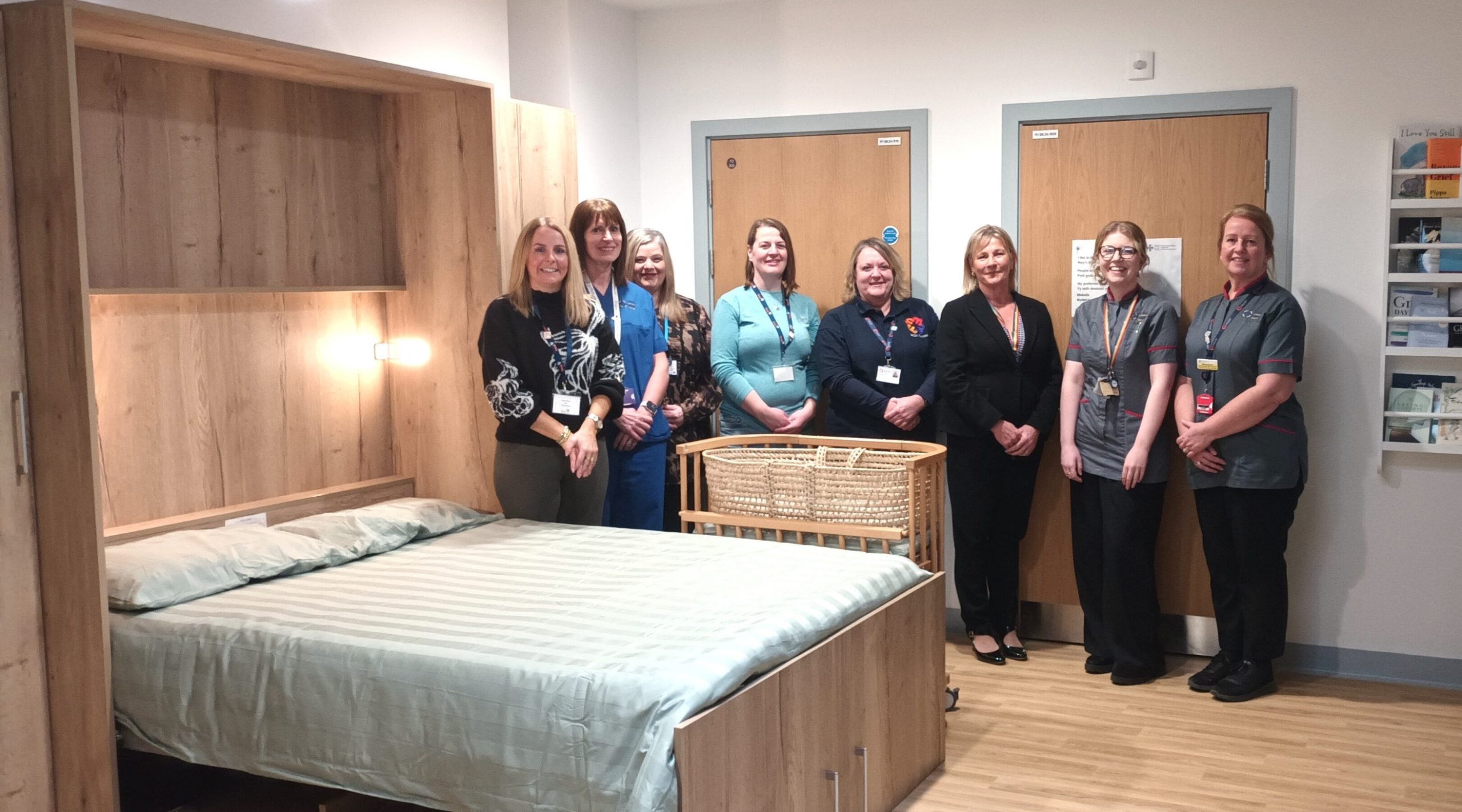
A GENEROUS grant from a volunteer-led local group, part of Sands, has funded a bespoke pull-down double bed for the bereavement room on the labour ward at Glangwili Hospital.
The specialist fitted bed, which cost more than £16,000, has transformed the bereavement room into a more family-focused space, allowing parents to remain close and support one another at an incredibly difficult time.
The bereavement room forms part of the hospital’s newly built Labour Suite and is fully self-contained, with a kitchenette, small dining area and ensuite bathroom. Until now, however, the room only included a birthing bed and a single sofa bed, meaning partners were unable to rest together.
Feedback gathered from bereaved families through Sands and local parent support groups highlighted the importance of physical closeness following the loss of a baby. Parents described how being able to lie together, rather than apart, can provide comfort, reassurance and a sense of shared support during the early stages of grief.
The funds for the bed were raised by Carmarthenshire & Pembrokeshire Sands volunteers Hayley Vallance, Astra Shipton and Sioned Twose, who organised a burlesque-inspired charity event, Zoo-la-la, at Manor House Wildlife Park in September 2025. The event raised more than £20,000.

The volunteer-led Carmarthenshire & Pembrokeshire Sands group supports anyone affected by pregnancy loss or the death of a baby across the two counties.
Alison Jones, Clinical and Operational Lead Midwife, said: “The loss of a baby is a devastating experience, and the environment in which families grieve can make a real difference.
“This bespoke bed allows parents to be physically close, to hold each other and to share their grief in a private, dignified space. It will have a profound impact, and we are incredibly grateful to Carmarthenshire & Pembrokeshire Sands for making this possible.”
Hayley Vallance and Astra Shipton, volunteers with Carmarthenshire & Pembrokeshire Sands, said:
“Our fundraising is in memory of George, Owen and all the babies gone too soon, and to help raise awareness of the vital support provided by Sands and the NHS to families when they need it most.

“We hope this specialist bed will bring comfort and dignity to parents during the hardest moments of their lives. Couples deserve to be together at such times, and we are honoured to have supported such a meaningful improvement in care for our community.”
Jen Coates, Director of Bereavement Support, Community and Volunteering at Sands, said:
“We are extremely grateful to Hayley, Astra and Sioned for their dedication and hard work supporting bereaved families in Carmarthenshire and Pembrokeshire.
“By fundraising for this bed at Glangwili Hospital, our volunteers have made a lasting and meaningful difference to the experience of families at an unimaginably difficult time.”




A GROWING debate over assisted dying has moved to the forefront of Welsh politics, as more than 250 doctors, nurses and healthcare professionals urge the Senedd to reject plans that would allow terminally ill adults to seek medical assistance to end their lives.
The intervention comes ahead of a crucial vote on Tuesday (Jan 20), when Members of the Senedd will be asked whether Wales should give legislative consent to the Terminally Ill Adults (End of Life) Bill, legislation currently progressing through Westminster but with direct implications for devolved health services in Wales.
The Bill, which applies to mentally competent adults diagnosed with a terminal illness and given six months or less to live, has been promoted by its supporters as a compassionate option for those facing unbearable suffering. However, critics argue that it risks placing vulnerable people under subtle pressure to end their lives and could fundamentally alter the relationship between patients and clinicians.
In an open letter, more than 250 healthcare professionals working across Wales have expressed “serious concerns” about the proposals, warning that the legislation could undermine patient safety, suicide prevention efforts and confidence in end-of-life care.
The signatories include over 120 doctors alongside nurses, specialist nurses, physiotherapists, occupational therapists, pharmacists, paramedics, radiographers and medical managers, many of whom work in frontline roles within NHS Wales.
They stress that their opposition is not rooted in ideology but in the practical operation of the law within an already stretched health system.
Dr Sarah Davies, a respiratory physician based in north Wales, said the forthcoming vote should not be seen as a general endorsement or rejection of assisted dying in principle.
She said: “It is vital that our elected representatives understand that this vote concerns the specific details of this proposed legislation and how it will operate. It is not a general vote on assisted suicide.”
One of the central concerns raised is access to palliative and hospice care. Palliative care physician Dr Victoria Wheatley warned that many patients in Wales are currently unable to access specialist end-of-life support.
She said: “People living in around a quarter of Wales cannot access a hospice bed. That means they do not have real choice. Funding a state-sponsored assisted dying service without first ensuring comprehensive palliative care is not the right approach for Wales.”
Mental health specialists have also voiced alarm. Consultant psychiatrist Dr Stuart Porter said the Bill could undermine Wales’ Suicide Prevention and Self-Harm Delivery Plan for 2025–2028 and place psychiatrists in an ethically conflicted position.
He warned that the Mental Capacity Act was never designed to assess decisions around assisted dying and said the proposed role for psychiatrists is not supported by the Royal College of Psychiatrists.

Senior figures in Welsh medicine have also joined the call. Former Chief Medical Officer for Wales Dame Deirdre Hine is among the signatories, citing concerns about unintended consequences and the potential impact on disabled people, homeless individuals and others who may already feel marginalised.
Professor Hope-Gill has raised additional constitutional concerns, warning that the Bill relies heavily on so-called “Henry VIII powers”, allowing key aspects of the system to be altered later through secondary legislation with limited scrutiny.
The clinicians also point to cross-border complexities. More than 13,300 Welsh residents are registered with GP practices in England, while over 21,100 English residents are registered with GPs in Wales, raising questions about jurisdiction, oversight and consistency of safeguards.
Supporters of assisted dying argue that strict safeguards would be built into the law and that similar systems already operate in countries such as Canada and parts of Europe. Campaigners say the legislation would offer dignity and autonomy to those facing intolerable suffering at the end of life.
Several Senedd Members have previously indicated that the issue is one of conscience rather than party politics, and the forthcoming vote is expected to cut across traditional political lines.
In their concluding statement, the healthcare professionals said the Bill risks undermining devolved decision-making in healthcare and creating inequality in access to care, urging Members of the Senedd to withhold legislative consent.
Support and help
This article discusses issues relating to suicide. Anyone who may be struggling or feeling distressed can seek confidential support from the Samaritans on 116 123, or from CALM on 0800 58 58 58. Support is available 24 hours a day.
A SAME-DAY urgent care service in Cardigan will open this weekend to help relieve pressure on local hospitals.
The Same Day Urgent Care (SDUC) service at Cardigan Integrated Care Centre (SA43 1JX) will be open on Saturday, January 10, and Sunday, January 11, between 9:00am and 6:30pm, supporting services across the Hywel Dda University Health Board area.
The service brings together urgent primary care, minor injuries treatment, and some same-day urgent care in one location, led by experienced advanced urgent care practitioners.
Patients are asked not to attend without an appointment and should first phone 01239 807019 to speak with a triage nurse, who will assess their needs and arrange an appropriate appointment time.
Andrew Carruthers, Chief Operating Officer at Hywel Dda University Health Board, said:
“Our hospitals are currently dealing with significant demand, which is leading to long waits in our emergency departments.

“The Same Day Urgent Care service in Cardigan is an excellent alternative for people who need treatment over the weekend.
“I’d like to thank the service for working quickly to extend their opening hours this weekend. This will provide important support for our wider healthcare system. I’d also like to thank our community for helping us to help you by choosing the right service in the right place.”
X-ray facilities will not be available this weekend. However, patients are still encouraged to phone the triage service on 01239 807019 for advice and guidance.
Health services remain under pressure due to increased demand. By choosing the most appropriate service, patients can help ensure NHS resources are used responsibly and that staff are able to care for those most in need.

Anyone unsure which service they need for an illness or injury can visit:
https://hduhb.nhs.wales/help-us-help-you
Further information and directions for Cardigan’s Same Day Urgent Care service are available at:
https://hduhb.nhs.wales/healthcare/hospitals-and-centres/same-day-urgent-care/
In a life-threatening emergency, always dial 999.



A PUBLIC consultation which could lead to the ending of an air quality management scheme in Pembroke and Haverfordwest, brought in after high levels of pollution were recorded back in 2012, is expected to be backed by senior councillors.
At the Pembrokeshire County Council Cabinet meeting of January 12, members are recommended to support a six-week public consultation on the proposal to revoke the Haverfordwest and Pembroke Air Quality Management Areas (AQMAs).
A report for members ahead of the meeting says: “In 2012, Pembrokeshire County Council identified that concentrations of nitrogen dioxide (NO₂) were exceeding the national annual mean objective within certain areas of Pembroke (specifically along Main Street) and within sections of Haverfordwest’s main commercial streets.
“The elevated concentrations were attributed primarily to road traffic emissions, particularly in narrow streets where vehicle emissions were less effectively dispersed. Although the number of exceedances was limited, the council had a statutory duty under Part IV of the Environment Act 1995 to take action to achieve and maintain compliance with national air quality objectives.
“Consequently, as a precautionary measure, Pembrokeshire County Council formally designated these areas as Air Quality Management Areas (AQMAs).”
It added: “To support the AQMA designations, a comprehensive local monitoring network was established, comprising 48 diffusion tube monitoring stations across both Haverfordwest and Pembroke. Each diffusion tube is tested and replaced on a monthly basis, providing a continuous dataset on ambient nitrogen dioxide (NO₂) concentrations to track progress and assess the effectiveness of implemented measures.
“Over several years, measured NO₂ levels have shown a consistent downward trend, reflecting the effectiveness of local emission reduction measures and broader improvements in vehicle technology and fleet composition.”
It says monitoring over the last three years has shown levels to be below national objective and precautionary threshold levels, adding: “On the basis of this sustained compliance and the clear evidence of air quality improvement, Pembrokeshire County Council proposes to revoke both the Haverfordwest and Pembroke AQMAs.”
It stressed: “Although the statutory Air Quality Management Area (AQMA) designations for Haverfordwest and Pembroke have been proposed for revocation; Pembrokeshire County Council will continue to undertake air quality monitoring to ensure that standards are consistently maintained and that public health remains protected.
“A revised monitoring network will be implemented, retaining a limited number of diffusion tubes strategically located at key points within both areas. These diffusion tubes will provide ongoing indicative data to confirm continued compliance with national air quality objectives and to help identify any emerging trends or localised increases in pollutant concentrations that may require further investigation or intervention.”
It says a reduction in the number of monitoring locations, from 48 to 10, is projected to generate an annual cost saving of approximately £1,900 in laboratory analysis fees, as well as freeing up officer capacity through decreased requirements for routine site visits, data processing, and statutory reporting.
Cabinet members are also asked to back that, following consideration of the consultation responses, the decision is delegated to the Head of Housing and Public Protection following discussion with the Cabinet Member for Regulatory Services.



Search of River Teifi continues as police scale back multi-agency response
Family kept informed as officers urge public to avoid unsafe independent searches A POLICE search of the River Teifi in Cardigan will continue over...


Man pleads guilty after £150k drugs haul found in Pembroke traffic stop
Routine police check led to discovery of cocaine and cannabis in car boot A MAN has pleaded guilty after a...


Council refuses to reveal cost of replacing roof on nine-year-old Tenby school
A primary school built in 2016 is facing a full roof replacement after years of leaks and structural deterioration —...


Council re-approves £14.3m contract for Haverfordia House redevelopment after costs rise
Delays, inflation and expired contractor pricing blamed as scheme timetable slips to 2027 PEMBROKESHIRE COUNTY COUNCIL has re-approved a £14.3m...


Storm Goretti causes widespread disruption across Pembrokeshire
SEVERE winter weather brought by Storm Goretti caused widespread disruption across Pembrokeshire on Thursday evening ( Jan 8 ), with...
Community joins police effort as search continues for man missing in River Teifi
A CO-ORDINATED land search involving police and local volunteers is taking place today (Thursday, Jan 8) as efforts continue to...


Petition launched after second Pembrokeshire blood biker dies in line of duty
A PETITION calling for blood bikers to be allowed to use green emergency lights has been launched following the death...


Reform UK complains to BBC over Caerphilly debate audience
Party questions impartiality after audience member who challenged candidate later selected as Plaid Cymru councillor REFORM UK has complained to...

Milford Haven publican remanded in custody over cocaine supply allegation
A MILFORD HAVEN publican has been remanded in custody after denying being concerned in the supply of cocaine. Daniel Booth...


Seal pup who swam 120km in four days now recovering at RSPCA wildlife centre
A grey seal pup found underweight and dehydrated in St Brides Bay has been taken into specialist care after making...
-

 Crime7 days ago
Former carpenter jailed for sexual and physical abuse of children
-

 Crime6 days ago
Pembrokeshire stalker to be sentenced after two-year campaign of harassment
-
Crime3 days ago
Man pleads guilty after £150k drugs haul found in Pembroke traffic stop
-

 Crime6 days ago
Jury sworn as judge considers whether Tenby baby death trial can proceed
-

 Crime6 days ago
Prolific shoplifter jailed after stealing nearly £300 of goods from Cardigan store
-
 Crime6 days ago
Pembroke Dock motorist elects Crown Court trial over serious injury collision
-

 Crime6 days ago
Motorist given interim ban after crash leaves passenger with serious neck injury
-

 Crime4 days ago
Haverfordwest woman fined after admitting assault offence