


News
Company at forefront of stress breakthrough



Directors: Dr Frederic Boy and Sian Roderick
A WHITLAND company could join the fight against stress and mood swings, following research by Swansea University Doctors.
Magstim, which has been at the cutting edge of transcranial magnetic stimulation (TMS) for many years, could find themselves developing research recently carried out at the University of Swansea.
Brain scientists and psychologists at the university are developing a new technique which can reduce the impact of stress on mood and help improve your emotional wellbeing.
Dr Frederic Boy, who works at both the College of Human and Health Science and the School of Management at the university, is leading the research. And his work is already receiving international interest in the short period since his paper was published in scientific journal Frontiers in Psychology.
Dr Boy said: “When facing stressful events, the frontal regions of the brain are particularly active and constantly appraise the positive or negative emotions which are generated, and that will, in turn, shape how we react to situations.

“Over time, the negative impact of stressors build up and the physical and emotional wellbeing may be compromised. We asked ourselves – can the impact of stress on the brain of a non-depressed individual be reduced?”
Along with fellow academic Sian Roderick, new brain science research employing weak electrical impulses to stimulate the frontal cortex by placing electrodes on the top of the head has been developed.
And if this sounds like a intimidating process, Sian says the technique is actually very simple and the stimulation is very subtle. She said: “We don’t want anyone to think this is like electrical treatments used in the past. The volunteers were all very relaxed with the process and the stimulation lasts for a very short period and feels like a much weaker version of a TENS machine, for example.”
Dr Boy added: “Advances in transcranial electrical stimulation techniques mean we are able to investigate different clinical and nonclinical people and specific areas of the human brain and see how those regions regulate people’s behaviour.

“What was clear is that the way people behave results from a complex interaction between a number of genetic, social and environmental factors.”
The scientists studied 66 healthy young women, with no history of psychiatric disorders or substance dependence. The volunteers filled in questionnaires, which helped assess different aspects of their current mood, the building bricks of the emotional and physical wellbeing. They underwent a course of 12 min-a-day brain electrical stimulations sessions for five days. A total of 22 individuals received an ineffective, but realistic, placebo stimulation, while the 44 others were administered a real, active stimulation.
Dr Boy explained: “This technique employs electrical power that is more than a thousand times lower than the one used by an energy saving light bulb, and result in a feeble tingling lasting a few seconds in the first instants of the stimulation session.”

Over the duration of the research, the team found that those volunteers who received the active stimulation gradually reported having experienced less negative mood states in the past day. On the contrary, participants in the placebo group did not report notable changes in mood.
“This type of treatment has been accredited by the NHS to be used to treat depression last August. We have shown that weak electric stimulation is also effective to improve the mood of those who are not depressed, but are still affected by the consequence of a stressful, restless and demanding lifestyle,” added Dr Boy, who is Head of Translational and Consumer Neuroscience in the Department of Psychology.
“This technique is based on robust scientific research and we hope it will be developed to create an over-thecounter device which can be used to improve mood and lower stress.”
With the recent statistics showing that more and more young people, are turning to medicating their emotional wellbeing – the number of young people in the UK prescribed anti-depressants increased by more than 50% between 2005 and 2012, according to the new study – could Dr Boy’s research lead to a reduction in this worrying trend?
“Yes, we are hopeful this research can assist in the treatment of low mood without having to resort to medication. “As well as the possible side effects this type of treatment can have on the patient, prescribing drugs in the first instance is a huge drain on the NHS. We are aiming to align our work with the Prudent Healthcare agenda set out by the Health Minister.
“As a university we are excited to be part of ARCH (A Regional Collaboration for Health).
“The ARCH partners are working to use innovation and research to drive health service improvements and we believe this research could be a part of this transformational approach.
“We hope that in developing a device which people can choose to use we are also empowering the population to take responsibility for their own health and wellbeing.”
Dr Boy and Sian Roderick are both directors of the emerging life science firm Neurotheraputics, and are hopeful their research can be developed by West Wales medical devices firm Magstim.
The Whitland-based company, who pioneer and manufacture non-invasive magnetic stimulation devices, say they are excited by the research.
Charles Hounsell, Magstim product specialist, said: “Magstim is delighted to explore opportunities with Swansea University to expand our understanding of therapeutic techniques using neurostimulation devices.
“The field of non-invasive brain stimulation is expanding rapidly and we are hugely excited about the potential benefits of Transcranial Magnetic Stimulation (TMS). We look forward to discussing this research further with Dr Boy and his team.”



Missing vessel recovered near shore after coastguard confirms it had been reported lost days earlier
ST DAVIDS RNLI launched on Easter Monday after an upturned kayak was spotted drifting east of Solva Harbour.
The all-weather lifeboat, Norah Wortley, was requested to launch at 11:04am on Monday (Apr 6) after the vessel was seen floating in the water.
Heading into a strong south-easterly wind, the Tamar-class lifeboat made directly for Aber-west. Members of HM Coastguard St Davids Cliff Rescue Team assisted from the clifftop, helping to guide the volunteer crew to the kayak.

As the vessel was lying close to the shore, the lifeboat’s daughter boat was launched to recover it and bring it aboard the Norah Wortley.
Photographs of the kayak were then sent to HM Coastguard in Milford Haven, which confirmed it had been reported missing from Porthclais several days earlier.
That meant there was no need for a shoreline search for the owner.
The kayak was taken to Solva Harbour, where it was handed over to HM Coastguard and secured on the quay wall. The lifeboat returned to station at about 12:30pm.
St Davids RNLI Coxswain Will Chant said: “The timely reporting of a missing kayak by the owner potentially saved an unnecessary search operation. Thank you to members of St Davids Coastguard team for their assistance during this shout.”
Picture caption:
Easter Monday shout: St Davids RNLI recovers a drifting kayak off Solva after it was reported missing days earlier (Pics: RNLI)
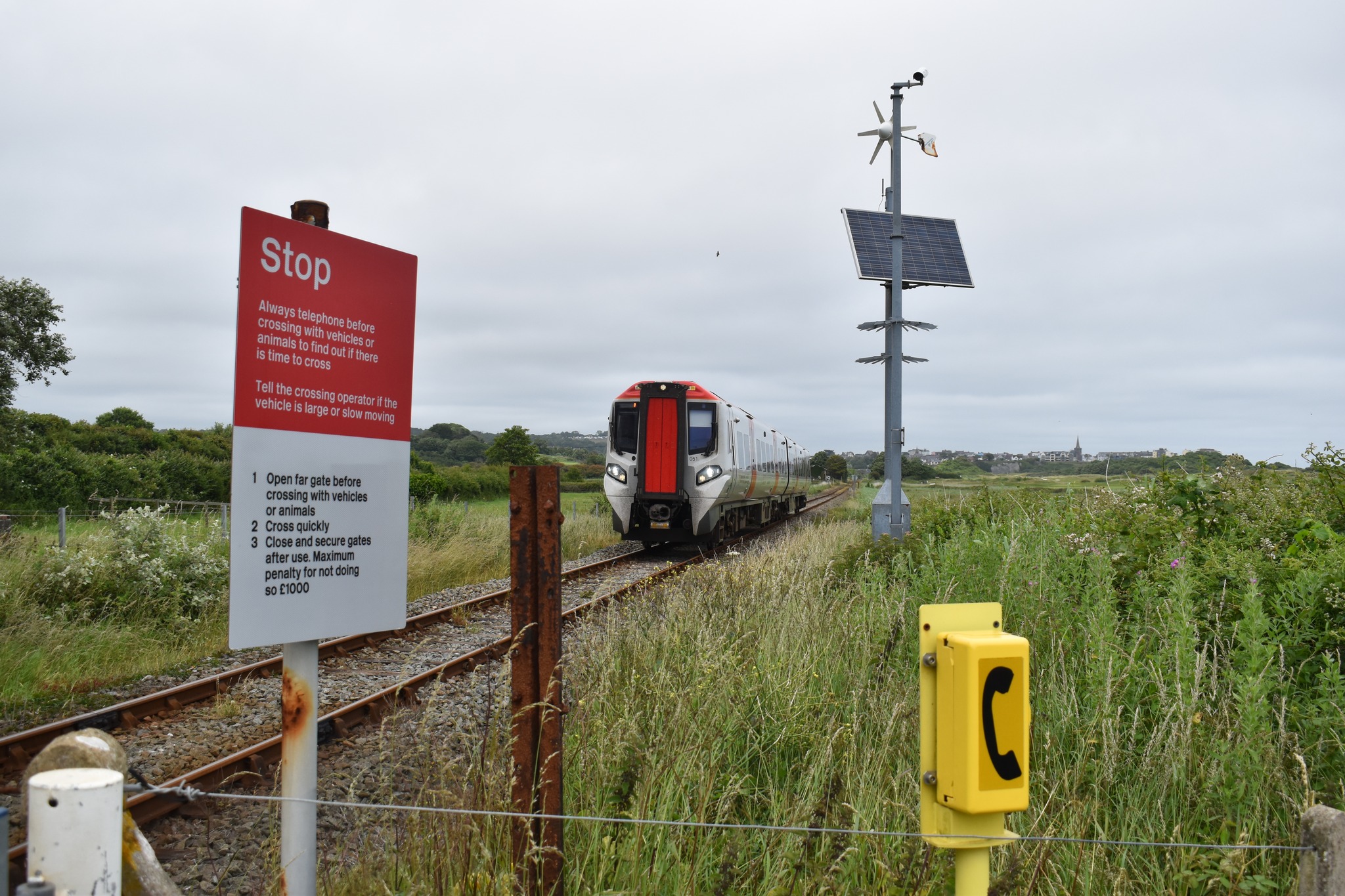
New analysis links worsening disruption to heavier rainfall and repeated trouble spots on the network
RAIL passengers in Wales are facing growing delays and cancellations as flooding increasingly hits the network, according to new analysis based on Network Rail data.
Figures obtained through the Freedom of Information Act suggest flood-related disruption affecting services in Wales has risen by around 256 per cent compared with the mid-2010s.
Between 2022 and 23 December 2025, services affecting passengers in Wales generated an average of around 2,366 passenger delay minutes a year due to flooding. That compares with an average of 664 a year between 2014 and 2017.
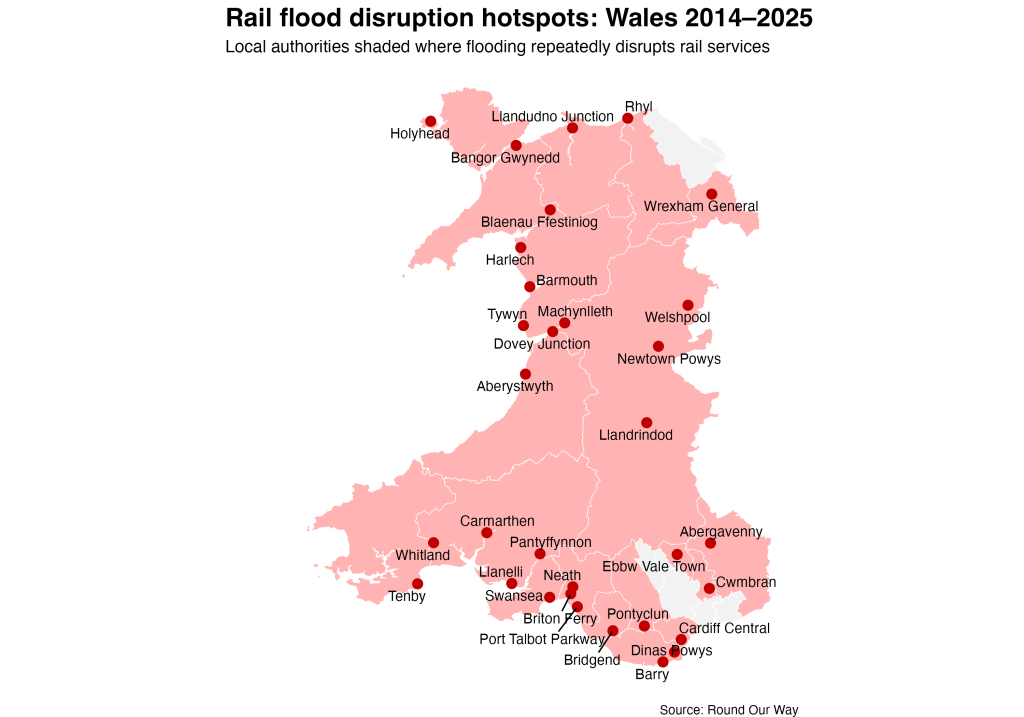
The analysis, carried out by climate not-for-profit Round Our Way, says train operators serving towns and cities across Wales, including Great Western Railway, CrossCountry, Transport for Wales and Avanti West Coast, have all been affected.
The worst disruption has been concentrated around a number of repeat trouble spots on the rail network, including Machynlleth, Cardiff Central, Bridgend, Bangor and Pontyclun, where flooding has repeatedly interrupted services.
Round Our Way said its analysis of Network Rail cancellation data suggests flood-related disruption is placing increasing strain on the rail network as periods of extreme rainfall become more common.
The group said the figures show not only more major disruption events, but also a worsening day-to-day baseline, with even quieter periods now causing more passenger delay than in previous years.
Gemma Plumb, a meteorologist at Weather Change, said: “It’s clear that train users are seeing more and more disruption to their journeys as a result of heavy rain and flooding, which is hugely frustrating for people who rely on the train network to get around.
“We know that climate change is leading to more extreme weather, including more intense rainfall. This is because a warmer atmosphere can hold more moisture, so when it rains, it rains more.”
Sofie Jenkinson, co-director at Round Our Way, said the rail network appeared to be under “persistent weather stress” as climate change began to have more regular effects.
She said: “This causes significantly more delays to train passengers. But it is also a problem for rail operators, particularly the large inter-city train operators running services into regions of the country that are worst hit by flooding, like the South West, Scotland and Wales.
“The significant rise in delays shows the increased impact of extreme weather caused by climate change, raising concerns about safety beneath the surface of our creaking rail infrastructure for passengers and operators alike.”

Round Our Way said Britain was not adequately prepared for the effects of climate change on everyday infrastructure and called for long-term investment to make the rail network more resilient.
The group pointed to wider warnings from climate experts that rising global temperatures are likely to increase the intensity of rainfall, putting more pressure on ageing transport systems.
Network Rail data used in the study covers the period from 1 April 2014 to 23 December 2025 and relates to incidents classed as flood-related disruption.
A train is recorded as cancelled if it fails to stop at one or more planned stations. Full cancellations are classed as trains that completed less than half of their intended journey, while part cancellations are those that ran at least half, but not the full route, or missed one or more planned stops.

Johnston forecourt hits 194.9p while wide price gaps and rush to fill up pile pressure on motorists across the county
DIESEL prices in Pembrokeshire are edging dangerously close to £2 a litre, with the BP forecourt in Johnston on the A4076 displaying 194.9p per litre.
The latest surge has sparked a rush at some filling stations across the county, as motorists hunt for pumps that have not yet caught up with the steep increases. The Herald understands some forecourts have temporarily run dry as drivers fill up early to avoid paying even more, rather than because of any wider supply issue. That picture fits with national comments from the AA, which said it had seen no evidence of widespread shortages or any increase in breakdowns caused by vehicles running out of fuel.
Pictures sent to The Herald show just how sharply prices now vary across Pembrokeshire.
At Johnston, diesel was 194.9p per litre and petrol 157.9p. At Robeston Wathen, diesel was 187.9p and petrol 155.9p. At Square and Compass, diesel was 183.7p and unleaded 151.7p. In Milford Haven, the Gulf station on North Road was displaying diesel at 179.7p and petrol at 148.7p, while Tesco Milford Haven showed diesel at 181.9p and unleaded at 149.9p. In St Davids, Ocean Haze was also showing diesel at 187.9p, with petrol at 155.9p.
Based on those prices, there is a 15.2p-per-litre gap between the highest and lowest diesel prices pictured — a difference of more than £9 on a 60-litre fill.

The local spike reflects a sharp rise across the UK. RAC data showed average petrol prices reached 152.01p a litre on March 30 — the highest level in 28 months — while diesel climbed to 181.2p, its highest point since December 2022. The RAC said that, compared with the start of the Iran conflict, it was costing £10.55 more to fill a typical family petrol car and £21.35 more for a comparable diesel vehicle.
RAC head of policy Simon Williams said the “financial strain” on motorists “continues to build”, while RAC Foundation director Steve Gooding warned prices at the pumps appeared to be on a “one way trajectory”.
The AA’s latest weekly update, based on government data, put average UK petrol at 148.78p a litre and diesel at 176.42p, up from 144.16p and 166.88p the previous week.
The pressure is being felt well beyond private motorists. In West Wales, the wider rural economy is especially exposed because so many people rely on vehicles for work, deliveries and day-to-day life.

The Farmers’ Union of Wales said rising fuel and heating oil prices were placing “additional pressure on rural communities” and increasing the risk of theft. In a March statement, the union said red diesel had risen from about 67p a litre in February to around 109p in mid-March, while heating oil had in many cases more than doubled from around 60p to about £1.30 a litre. It also noted that 74 per cent of homes in Ceredigion are off the gas grid, leaving many households particularly vulnerable to sudden price shocks.
The haulage sector has also warned of the knock-on effect. Swansea Bay News reported that Llanelli-based Owens Group said soaring diesel costs had added around £64,000 a week to its fuel bill. Founder Huw Owen said: “We felt it as a company straight away. With a fleet our size, we burn a tanker of fuel a day. We used to order fuel a week or even a fortnight in advance — now we’re negotiating prices day by day.”
The same report quoted Road Haulage Association representative Geraint Davies warning that higher transport costs would feed through into prices more widely because “everything we buy is moved by road at some point.”
For households, tradespeople, delivery drivers and rural businesses in Pembrokeshire, the latest rise is another heavy blow. In a county where so many people depend on their vehicles every day, sharp increases at the pumps are felt quickly and widely.
One thing is clear: drivers are shopping around harder than ever, and when prices are moving this fast, delaying a fill-up by even a day can come at a cost.
Photo caption:
Johnston prices: Diesel reached 194.9p per litre at the BP forecourt on the A4076 (Pic: Herald)



Charity13 minutes ago
St Davids RNLI launches on Easter Monday after drifting kayak spotted off Solva
Missing vessel recovered near shore after coastguard confirms it had been reported lost days earlier ST DAVIDS RNLI launched on...


News3 hours ago
Diesel nears £2 a litre in Pembrokeshire as drivers scramble for cheaper fuel
Johnston forecourt hits 194.9p while wide price gaps and rush to fill up pile pressure on motorists across the county...


News23 hours ago
St Davids Cathedral marked Easter Sunday with full day of worship
FROM dawn vigil to choral evensong, the cathedral welcomed worshippers for one of the most important days in the Christian...


Crime1 day ago
Neyland man spared immediate jail over aggravated vehicle taking
Defendant given a suspended prison sentence after magistrates heard the offence was serious enough to cross the custody threshold KRISTIAN...


Health2 days ago
Crumbling NHS faces £1bn repairs bill in Wales
Senedd election promises collide with the harsh reality of ageing hospitals, fire safety concerns and a maintenance crisis stretching across...


News2 days ago
Emergency services respond to incident in Haverfordwest town centre
EMERGENCY SERVICES were called to an incident in Haverfordwest town centre on Saturday morning (Apr 4), with police and ambulance...

News2 days ago
Teenager intervenes after bridge incident
A TEENAGER was left shaken after stepping in to help a young woman in distress on Clay Lanes bridge in...


Crime4 days ago
Driver spared jail after crash killed young couple
A PEMBROKE DOCK driver who caused the deaths of a young couple in a road crash has been given a...


Entertainment4 days ago
BBC unveils major new Welsh dramas with Tenby set for prime-time spotlight
New crime series Old Town Murders and supernatural thriller The Witch Farm will both be filmed and set in Wales...


Health4 days ago
No jobs for new paramedics in Wales as graduates told to apply for technician roles
Students trained at public expense urged to take lower-grade jobs as anger grows over NHS workforce planning NEWLY qualified paramedics...
-

 News3 days ago
Accommodation providers in Wales will be required to register under new law
-
 Business6 days ago
Fishguard to Wexford rail tunnel plan backed by Elon Musk firm
-

 Entertainment4 days ago
From Milford Haven to the world: The story of The Evolution Experience
-
Entertainment4 days ago
BBC unveils major new Welsh dramas with Tenby set for prime-time spotlight
-

 Charity7 days ago
RSPCA calls for stronger animal welfare measures as Welsh Labour launches manifesto
-

 News7 days ago
Labour promises 48-hour GP access as manifesto faces questions over delivery
-

 Crime6 days ago
Driver trapped after crash while nearly four times over drink-drive limit
-

 Business6 days ago
Refusal over Pembrokeshire shepherd hut let goes to appeal