


News
Council tax to rise 9.75% for residents in Carmarthenshire


Plaid Cymru blames Welsh Government funding and NI hike
PLAID CYMRU on Carmarthenshire County Council has blamed inadequate Welsh Government funding and the Labour Chancellor’s National Insurance hike for creating a multi-million-pound shortfall in the council’s budget for 2025/26—forcing an increase in Council Tax of 9.75%.
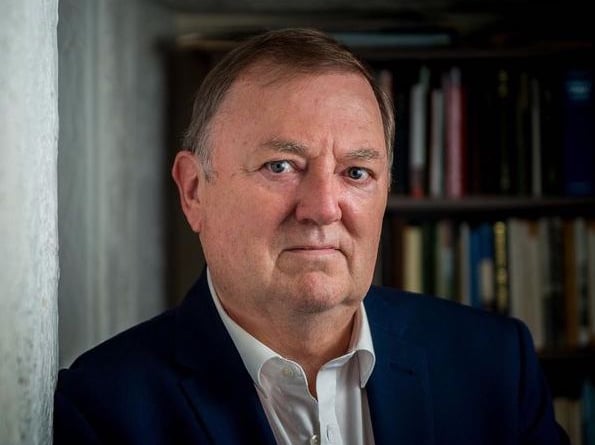
Cabinet Member for Resources, Cllr Alun Lenny, said: “In my experience, this year is even worse than all those years of Tory austerity. Due to inflation, pay settlements, and growing demand, we needed an extra £55m to fund essential services like social care and education, but received just £25m in annual grants from the Labour Welsh Government. We’ve had to fill the gap with efficiencies and a far higher Council Tax rise than any of us would like.”
Cllr Lenny said only 16% of the council’s income comes from Council Tax, with each 1% rise generating £1m. He added that the council had initially anticipated a 4-5% rise, but the National Insurance changes introduced by Labour Chancellor Rachel Reeves would leave the council £4m out of pocket.
“The Labour Chancellor’s action has also hit local businesses hard, with lower-paid workers in retail and hospitality particularly worried about their jobs,” he said.

Cllr Lenny also criticised the disparity in UK Government funding, highlighting that councils in England are receiving extra money through the £4.7bn Local Transport Fund. He said Herefordshire—a county with a similar population and highways network to Carmarthenshire—was getting an extra £102m over the next seven years.
“That scale of spending on roads is something we can only dream about, and shows that we in Wales are the poor relatives when it comes to UK Government funding,” he said.
He also slammed Westminster’s refusal to allocate consequential funding from the HS2 railway development in England, stating that Plaid Cymru estimates Carmarthenshire’s share should be around £250m—enough to solve its budget issues overnight.
Why are council tax rises happening across Wales?
Carmarthenshire is not alone in facing a sharp increase in Council Tax, with many Welsh councils struggling to balance their budgets. Several key factors are driving these rises:
- Funding shortfalls for local authorities: Despite an additional £253m allocated to local councils in the Welsh Government’s draft budget, the Welsh Local Government Association has identified a shortfall of £560m. This leaves councils unable to meet rising demands without increasing taxes, cutting services, or making job reductions. For example, Wrexham Council is considering tax hikes of up to 15% to address these challenges.
- Inflation and service pressures: Councils are dealing with significant inflationary pressures and increased demand for public services, particularly in social care and education. These factors have exacerbated financial strains, forcing councils to consider tax increases to maintain service levels.
- Outdated tax system: Council tax in Wales is based on property values from 2003, making it increasingly outdated and regressive. This system creates disparities between councils and households, as property values and local needs have changed significantly over the last two decades.
- Delays in tax reforms: The Welsh Government had planned to reform council tax by revaluing properties and introducing new tax bands to make the system fairer. However, this has now been postponed until 2028, meaning councils must continue relying on an outdated system to generate revenue.
- Limited fiscal devolution: Welsh councils rely heavily on central government grants, restricting their ability to raise local revenue and adapt taxation to local needs. This dependency leaves them vulnerable to funding shortfalls when government grants fall short of rising costs.
Public concerns and Welsh Government response
Public opposition to rising Council Tax bills has been growing. A petition has been launched calling for Welsh councils to be limited to a maximum annual increase of 2% from April 2025. Meanwhile, Labour’s stance on Council Tax has shifted, with UK Labour ruling out changes to Council Tax bands. This contradicts the Welsh Labour government’s previous plans, creating a potential policy divide between Cardiff and Westminster.
A Welsh Government spokesperson said local authorities in Wales receive significantly more funding per capita than those in England and that difficult financial choices stem from wider economic factors, not just Labour policy.
A Welsh Labour source added: “We are committed to supporting councils, but the economic reality is that years of Tory austerity, inflationary pressures, and high interest rates have made local government funding more challenging.”

Carmarthenshire Council’s position
Despite financial pressures, Carmarthenshire County Council has committed to continued investment in education, housing, and adult and children’s services. Following public consultation, the council has scrapped plans to close public toilets unless asset transferred, will only increase car parking charges in line with inflation, and will invest more in highways, gully cleaning, and flood prevention.
As the Welsh Government finalises its budget, Plaid Cymru has pledged to lobby for fairer funding up until the last moment.


£15m investment will support Year 7 and 8 pupils in Universal Credit households from September
THE WELSH GOVERNMENT has confirmed an additional £15m investment to begin expanding free school meals for eligible secondary school pupils.
The funding will support plans to extend free school meal entitlement to secondary pupils whose households receive Universal Credit, removing the current household income threshold.
At present, secondary school pupils can only receive free school meals if their family receives Universal Credit and household earnings are below £7,400, excluding benefits.
From September, parents of pupils in Years 7 and 8 are expected to be able to apply under the new scheme, regardless of household income, provided the family receives Universal Credit.
The £15m package forms part of the Welsh Government’s supplementary budget for 2026-27.
It will include £10m in capital funding for school kitchens and dining areas, alongside £5m in revenue funding to help introduce the expanded scheme.
The move follows the previous roll-out of free school meals to all primary school children in Wales, which was delivered as part of the former co-operation agreement between the Welsh Government and Plaid Cymru.
Cabinet Minister for Education and Welsh Language, Anna Brychan, said the funding marked “the first step” in extending free school meals to more secondary pupils.
She said: “This work is about removing barriers to learning and supporting wellbeing.
“We know that access to nutritious food improves concentration, attainment and overall health.
“Building on the success of universal primary free school meals, we will ensure that as children move into secondary education those who need it most will continue to receive the support they need to thrive.”
First Minister Rhun ap Iorwerth said extending eligibility to more families on Universal Credit was part of wider efforts to tackle child poverty.
He said: “Starting this work is a key aspect of our 100 Day Plan and beyond — taking practical action by putting money back into families’ pockets and ensuring every young person has the opportunity to succeed, regardless of their background.”
Further details on the roll-out are expected to be announced in due course.

Giant puppet begins historic journey marking 850 years since the first Eisteddfod
MIST swirled around St Davids Cathedral on Friday evening as a giant Lord Rhys puppet emerged from the fog to begin a journey celebrating 850 years since the first recorded Eisteddfod.
Accompanied by traditional musicians and followed by crowds of spectators, the towering figure cut an imposing sight against the backdrop of the ancient cathedral.
The procession marked the start of Taith yr Arglwydd Rhys (The Journey of Lord Rhys), a cultural pilgrimage retracing the legacy of the Welsh prince whose gathering of poets and musicians at Cardigan Castle in 1176 is widely regarded as the first recorded Eisteddfod.
As fog drifted across the city and church towers faded into the background, the scene felt more like a chapter from Welsh folklore than a modern-day celebration.
The giant puppet, accompanied by fellow performers and musicians, travelled from St Davids Cathedral to Oriel y Parc before beginning a wider journey through west Wales.
The travelling celebration will visit communities across Pembrokeshire and Ceredigion before culminating in Cardigan, where Lord Rhys originally staged his famous cultural gathering eight and a half centuries ago.
Video and photographs shared by DrifterStDavids captured the remarkable atmosphere, with many describing the spectacle as one of the most memorable cultural events seen in St Davids for years.
Photo caption: Lord Rhys emerges from the mist outside St Davids Cathedral as celebrations begin to mark the 850th anniversary of the first recorded Eisteddfod
(Pic: SmallWorld – Video: Drifter St Davids)
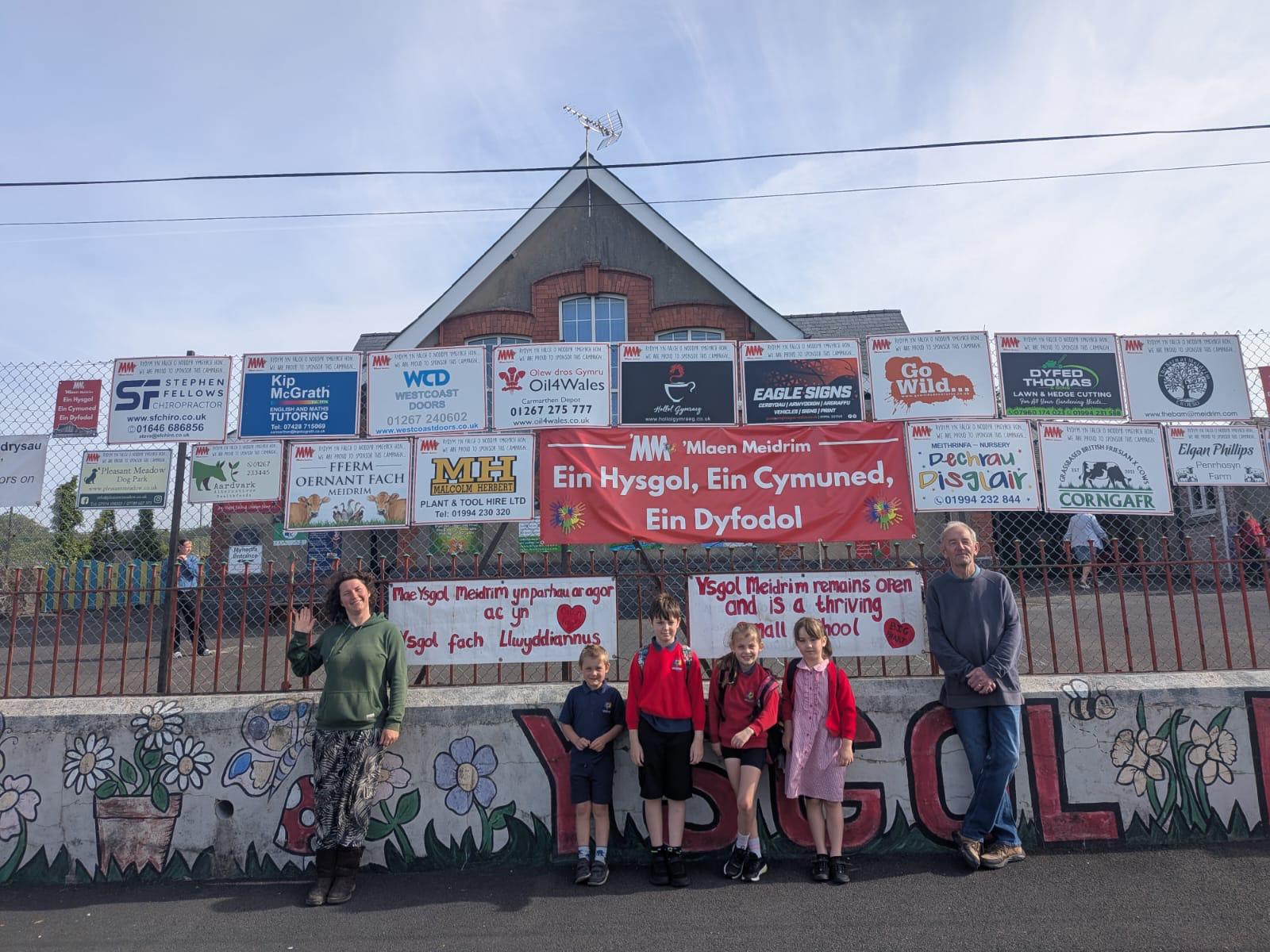
Campaigners say Carmarthenshire must properly consider alternatives after judge’s ruling and last-minute amendment to statutory notice.
A HIGH COURT judge has warned Carmarthenshire County Council that alternative proposals to closing Ysgol Meidrim must be given proper and conscientious consideration before any final decision is made.
The ruling follows a judicial review challenge brought by parent Leia Perry over the council’s decision to consult on the future of the Welsh-medium rural primary school.
Although the High Court did not halt the closure process, campaigners say the judgment raises serious questions about the way the council has handled the matter.
Ysgol Meidrim, near St Clears, currently has around 30 pupils and has been earmarked for closure, with children expected to transfer to other schools from January 2027.
But the school community has mounted a determined campaign to keep it open, arguing that the school remains central to the future of the village, the Welsh language and rural life in the area.
The judgment, handed down by His Honour Judge Jarman KC, found that the challenge should be allowed to proceed, but ultimately dismissed it on the basis that the council still has an opportunity to properly consider alternatives during the ongoing process.
However, the judge made clear that those alternatives must now be considered conscientiously.
Campaigners say this is a significant warning to the council.
Ffred Ffransis, speaking on behalf of Cymdeithas yr Iaith in Carmarthenshire, said the organisation was not a party to the legal action, but understood why a parent of a child with severe medical needs had taken the case.
He said: “The judge criticised the lack of clear communication from the council and that governors had the impression that the council had not yet seriously considered alternatives to closure of Ysgol Meidrim, but found that the evidence did not yet reach the high threshold for legal intervention.
“He has warned the council that they must give conscientious consideration to the alternative proposals drawn up by governors.”
The governors’ proposals include developing the school as part of a wider community hub and exploring federation options rather than closure.

Cymdeithas yr Iaith said the council now had two choices: to press ahead regardless, or to withdraw the closure notice and enter into genuine discussions with governors over their plans.
Mr Ffransis added: “The council must at least demonstrate a new open attitude during the objections period to discussing the alternative proposals.”
The row has deepened after Carmarthenshire County Council was forced to withdraw and reissue its closure notice just three days after it was first published.
According to Cymdeithas yr Iaith, the original notice, issued on June 16, listed nearby Ysgol Bancyfelin as one of three receiving schools. The notice was then withdrawn after it emerged that Ysgol Bancyfelin was already over capacity.
A revised closure notice has now been issued, with the objection period extended until July 17.
The campaign group said this raised further concerns about the way the process was being handled.
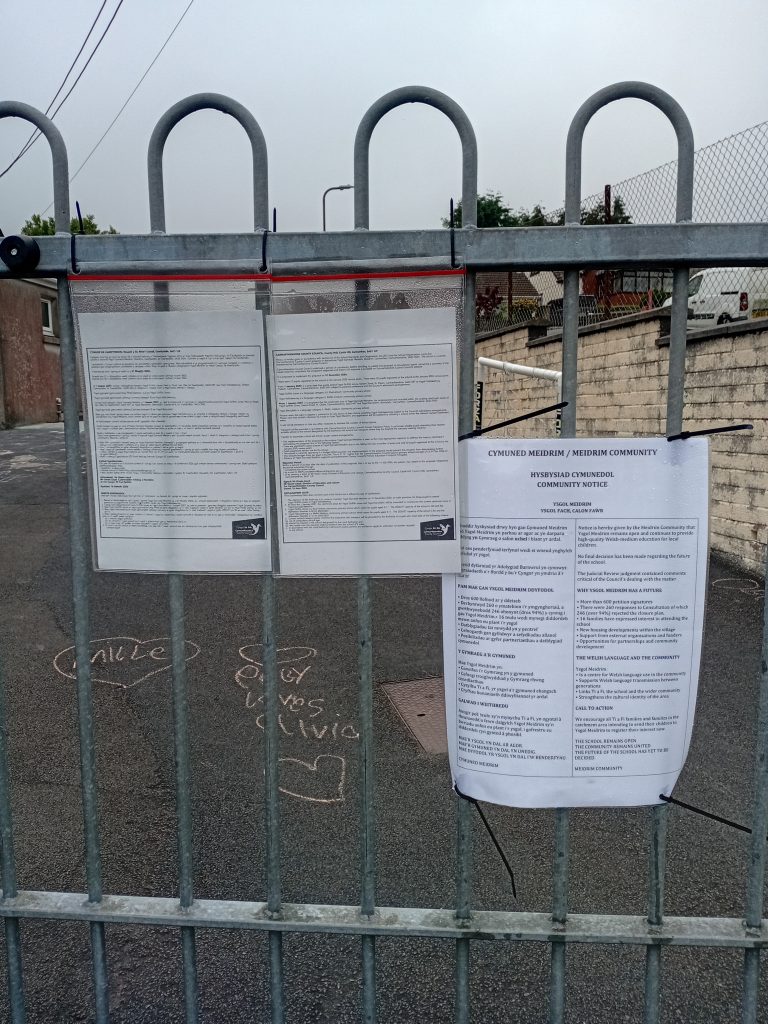
Notices have also been placed at the school gates by supporters, making clear that Ysgol Meidrim remains open and encouraging parents to register children there.
One notice states that the judicial review judgment was critical of the council’s handling of the matter and that the future of the school has not yet been decided.
The campaign has attracted wider attention because of the Welsh Government’s presumption against closing rural schools.
Under the School Organisation Code, councils must carefully consider all reasonable alternatives before deciding to close a rural school, including federation and wider community use.
Campaigners argue that Ysgol Meidrim is not simply an education issue, but a question about the survival of Welsh-speaking rural communities.
The council has previously cited low pupil numbers, surplus places, budget pressures and curriculum challenges as reasons for proposing closure.
But opponents say the financial savings are small compared with the impact on the village and its Welsh-medium provision.



Community50 minutes ago
Lord Rhys emerges from the mist in St Davids
Giant puppet begins historic journey marking 850 years since the first Eisteddfod MIST swirled around St Davids Cathedral on Friday...


News23 hours ago
Tragic tribute paid to Haverfordwest man after A4075 collision
FAMILY REMEMBERS “KIND AND LOVING” CALLUM HANSON THE FAMILY of a 22-year-old man from Haverfordwest who died following a road...

News2 days ago
Motorcyclist, 22, dies in A4075 crash in Pembrokeshire
A 22-year-old woman remains in hospital after two-vehicle collision A MOTORCYCLIST has died following a serious two-vehicle crash on the...

Community2 days ago
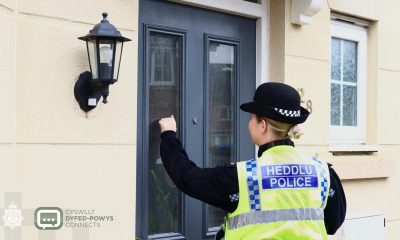
Why police will be visiting every home in Pembrokeshire
New operation aims to knock on more than 257,000 doors across Dyfed-Powys over the next three years DYFED-POWYS POLICE has...


Crime2 days ago
Prisons at breaking point: MPs warn Wales is paying the price of a failing system
Frozen healthcare budgets, overcrowded jails, homelessness on release and mounting pressure on staff are undermining rehabilitation across Wales, according to...


News3 days ago
Brexit at 10: How Britain was sold a dream that cost us dearly
A decade after the referendum, the promised benefits remain hard to find while the economic costs are increasingly difficult to...


Crime3 days ago
Worcestershire man jailed after violent attack on woman in Tenby
Defendant was already serving a suspended sentence when serious assault took place A WORCESTERSHIRE man has been jailed for more...


Climate3 days ago
Offshore wind ‘could bring new generation of jobs to Milford Haven’
Pembrokeshire ports and Celtic Sea projects placed at centre of Wales’ green energy ambitions MILFORD HAVEN and Pembroke Dock could...


Community4 days ago
Police officer hailed hero after midnight sea rescue in Milford Haven
PC swam 100 metres offshore to save distressed woman heard calling for help in darkness A DYFED-POWYS POLICE officer has...


Local Government4 days ago
Security privately arranged by Mayor at Beating of the Bounds
HAVERFORDWEST TOWN COUNCIL has confirmed that security personnel seen at this year’s Beating of the Bounds were privately arranged and...
-

 Community6 days ago
Pembrokeshire Chess Club crowned Welsh champions
-

 Crime2 days ago
Milford Haven man jailed for breaching domestic violence protection order
-
Local Government4 days ago
Security privately arranged by Mayor at Beating of the Bounds
-

 News2 days ago
Crash on Freeman’s Way causes school-run chaos across Haverfordwest
-

 Crime4 days ago
Man wanted by court after failing to attend hearing over alleged shop thefts
-

 Crime4 days ago
Man jailed after admitting strangulation and assaults
-
 Crime4 days ago
Man banned from roads after drink-driving offence
-

 Crime4 days ago
Man sentenced over stalking campaign and lock knife offence