


Health
Simon Hart: Covid rules should have been uniform across UK


FORMER Welsh Secretary Simon Hart has argued that Covid-19 restrictions should have been consistent across the UK, rather than varying between the four nations. The former Carmarthen West and South Pembrokeshire MP, who served as Secretary of State for Wales from 2019 to 2022, said political influences shaped decision-making rather than purely focusing on disease control.
Speaking in an interview, Hart reflected on the challenges of navigating the pandemic and expressed concern over the fragmented approach taken by devolved governments, which he believes led to confusion and unnecessary complexity for residents.
A fractured response
“I just didn’t feel that decisions were being made purely on the basis of disease control and risk management,” Hart said, referencing the differing rules on mask mandates, lockdowns, and social distancing in Wales and England.
One example he cited was the stark contrast in restrictions when travelling between the two nations. Passengers crossing the Severn Tunnel by train were met with announcements informing them of different masking rules on either side of the border, which Hart believes highlighted an unnecessary and avoidable division in public messaging.
Politics at play?

According to Hart, decision-making at the time was not just about public health but also about politics. “More and more, as we went through the pandemic, I came to the conclusion that there was a lot of politics in the decision-making,” he said.

He suggested that some ministers in Cardiff deliberately sought to highlight differences with Westminster, creating friction between governments and undermining confidence in the UK’s pandemic response.
Lessons for the future
The former Chief Whip, who recently published his book Ungovernable: The Political Diaries of a Chief Whip, said his experiences during the pandemic serve as a reminder of the difficulties faced by politicians, health officials, and the public alike.
With restrictions lasting more than two years, Hart argues that greater UK-wide coordination could have reduced confusion and made public health messaging more effective. He believes that if a similar crisis were to happen again, a more unified approach should be considered to avoid unnecessary political and logistical complications.
Hart’s comments reignite the debate over whether the UK’s devolved system helped or hindered the response to the Covid-19 pandemic. While the Welsh Government has yet to respond to his claims, the discussion continues over whether differing approaches were necessary to address local needs or whether they simply sowed division in a time of national crisis.


MORE people in Wales recognise alcohol as addictive than anywhere else in Britain, new research has found, but health experts are warning that awareness alone may not be enough to prevent harmful drinking habits.
The findings come ahead of the busy summer period, when pubs, beer gardens, festivals, barbecues and outdoor events often lead to increased alcohol consumption.
According to YouGov data, 86% of people in Wales describe alcohol as addictive — the highest figure recorded across Britain and above the national average of 78%.
Only 14% of Welsh respondents said alcohol was either “not very addictive” or “not addictive at all”.
By comparison, London recorded the lowest level of awareness, with 69% of respondents recognising alcohol as addictive.
Health professionals say the results show that while many people understand the risks, regular drinking can still become habitual, particularly during periods of increased socialising.
Official figures suggest adults consume an average of 10.7 litres of pure alcohol per person each year, equivalent to around 21 UK units per week. That is around nine pints of beer or seven large glasses of wine, and is significantly above the recommended maximum of 14 units a week.
Nearly one in five adults are also said to drink at hazardous levels or above, with men more than twice as likely as women to fall into that category.
Dr Karen Faulkner, Associate Medical Director at Panthera Clinic, said alcohol occupied a “unique place” in British culture because it was both legal and socially encouraged.
She said: “What’s particularly interesting is that most people understand alcohol can be addictive, yet many still underestimate how easily regular drinking can become habitual. Dependence often develops gradually and doesn’t always fit the stereotypes people associate with addiction.
“During the summer months, drinking can become even more normalised through holidays, beer gardens, barbecues, festivals and sporting events.
“The challenge isn’t necessarily a lack of awareness about alcohol’s risks. It’s recognising when a socially accepted habit has crossed the line into something that’s beginning to have a negative impact on your health, wellbeing or daily life.”

Dr Faulkner said people wanting to cut back should consider planning alcohol-free days, alternating alcoholic drinks with water or soft drinks, setting limits before social events, and keeping track of their weekly intake.
She also urged people to watch for signs that alcohol may be becoming more important than intended, including finding it difficult to relax, socialise or enjoy an event without drinking.
Panthera Clinic has launched a free online Alcohol Health Calculator to help people assess how their drinking habits may be affecting their health and wellbeing.
Dr Faulkner added that low and no-alcohol alternatives had become more widely available, making it easier for people to reduce their intake while still taking part in social occasions.

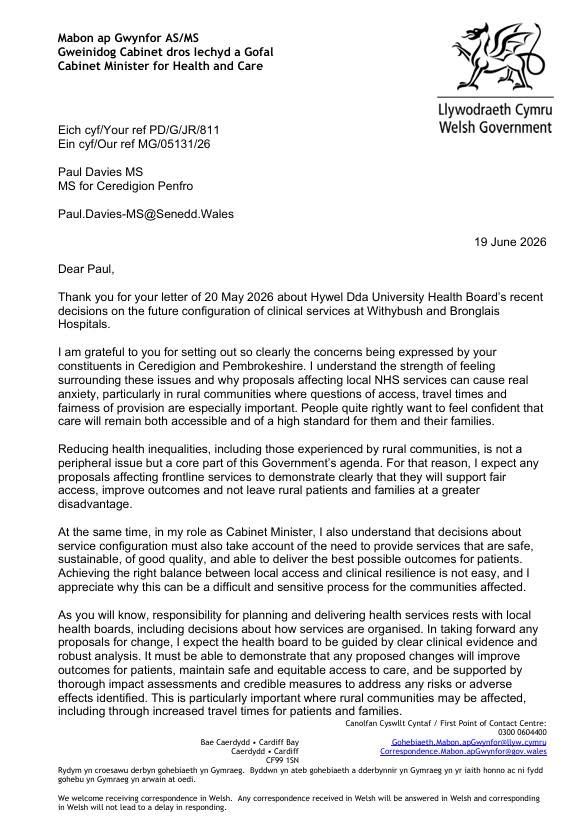
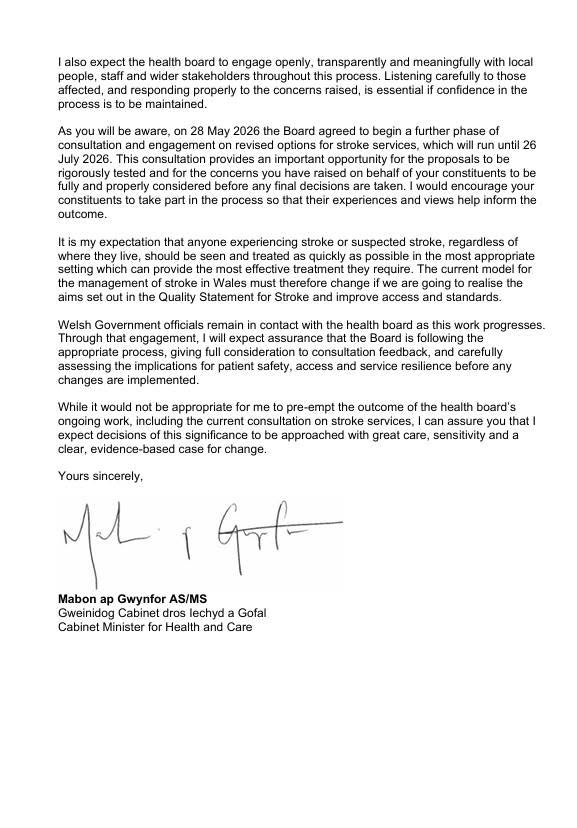
Health Minister tells Paul Davies MS that decisions remain a matter for Hywel Dda University Health Board
THE WELSH GOVERNMENT has declined to intervene in controversial plans affecting services at Withybush and Bronglais hospitals, prompting fresh criticism from local Senedd Member Paul Davies.
In a letter dated June 19, Health and Care Cabinet Secretary Mabon ap Gwynfor said responsibility for planning and delivering NHS services rests with local health boards and confirmed that Hywel Dda University Health Board should continue its consultation process on proposed service changes.
The response follows concerns raised by Mr Davies on behalf of constituents in Pembrokeshire and Ceredigion over the future configuration of clinical services, including stroke care.
While acknowledging strong public concern about access to healthcare in rural communities, the Minister stopped short of offering any commitment to block or reverse the Health Board’s proposals.
Instead, he stressed that any changes must be supported by robust evidence, maintain patient safety and demonstrate improved outcomes.
The Minister wrote: “Responsibility for planning and delivering health services rests with local health boards, including decisions about how services are organised.”
He added that proposals must improve outcomes for patients, maintain safe and equitable access to care and be supported by thorough impact assessments.
Paul Davies MS described the response as disappointing.
Posting the letter on social media, he said: “This letter tells me that the Welsh Government is not going to stand in the way of the Health Board’s plans.”
He added that he would raise the issue in the Senedd chamber next week and continue pressing ministers to intervene.
The exchange comes as Hywel Dda University Health Board continues a public consultation on proposed changes to stroke services across west Wales.
The consultation, which opened on May 28, is due to run until July 26.

In his response, the Minister stated that anyone suffering a stroke should receive treatment “as quickly as possible in the most appropriate setting” and said the current model of stroke care in Wales must evolve if national standards are to be achieved.
The comments are likely to fuel concern among campaigners opposed to the proposed changes, who fear services could become increasingly centralised and further away from rural communities in Pembrokeshire and Ceredigion.

PATIENTS are facing some of the worst medicine shortages ever seen in the UK, with pharmacists warning the situation now poses a serious risk to safety.
The National Pharmacy Association said shortages affecting commonly used medicines are becoming more frequent, lasting longer, and causing increasing disruption for patients, GP surgeries and pharmacies.
The warning comes as Serious Shortage Protocols for Creon, used by people with pancreatic cancer and cystic fibrosis to help digest food, have been in place since May 2024 and have now been extended until July 10, 2026.
HRT treatment Estradot has also been under a Serious Shortage Protocol since December 2024, with the current extension also running until July 10.
Patients travelling between pharmacies
A survey by the National Pharmacy Association found that 98 per cent of pharmacies had encountered patients who had visited several pharmacies in one day to find a prescription.
It also found that 96 per cent of pharmacies believed the current situation posed a serious risk to patient safety, while 89 per cent said they had been unable to dispense a medicine at least once a day because of supply problems.
Some pharmacy teams have also faced anger and abuse from patients unable to obtain medication.
Olivier Picard, Chair of the National Pharmacy Association, said: “Medicine shortages are becoming more frequent, lasting longer and causing increasing disruption for patients.
“These shortages are some of most severe the UK has experienced.
“It is deeply distressing to find patients who have travelled from pharmacy to pharmacy to find the medicines they need without success.”
Calls for urgent taskforce
The NPA is calling on the government to convene an emergency taskforce involving manufacturers, wholesalers, clinicians and pharmacists.
It also wants changes to rules which currently stop pharmacists from making simple substitutions, such as changing a tablet to a capsule or a cream to an ointment, even where a safe alternative is available.

Professor Victoria Tzortziou Brown, President of the Royal College of GPs, said medicine shortages were frustrating for patients, GPs and pharmacists, and added pressure to already stretched services.
She said the College supported pharmacists being able to make limited changes to prescriptions where a medicine is unavailable and a safe alternative exists.
She added: “The most important thing is that patients are able to access the medication they need safely and without delay.”
The Cystic Fibrosis Trust and Pancreatic Cancer UK have also raised concerns about the impact of shortages of pancreatic enzyme replacement therapy, including Creon, on people who rely on the medication to digest food, maintain weight and stay well enough for treatment.



News2 hours ago
Long Course Weekend set to bring thousands to Pembrokeshire
Three days of swimming, cycling and running will once again transform Tenby into one of the UK’s biggest endurance sporting...


Community8 hours ago
The gentle giant behind the tattoos
Pembrokeshire security worker Josh Davies praised for professionalism, kindness and proving first impressions can be wrong JOSH Davies is hard...


Charity1 day ago
Toy Story fans fill charity toy box at Haverfordwest cinema
Donations pour in for SNAP Specialist Play as families embrace Toy Story 5 launch A TOY STORY-themed charity appeal at...


Community2 days ago
Lord Rhys emerges from the mist in St Davids
Giant puppet begins historic journey marking 850 years since the first Eisteddfod MIST swirled around St Davids Cathedral on Friday...


News2 days ago
Tragic tribute paid to Haverfordwest man after A4075 collision
FAMILY REMEMBERS “KIND AND LOVING” CALLUM HANSON THE FAMILY of a 22-year-old man from Haverfordwest who died following a road...


News3 days ago
Motorcyclist, 22, dies in A4075 crash in Pembrokeshire
A 22-year-old woman remains in hospital after two-vehicle collision A MOTORCYCLIST has died following a serious two-vehicle crash on the...


Community3 days ago
Why police will be visiting every home in Pembrokeshire
New operation aims to knock on more than 257,000 doors across Dyfed-Powys over the next three years DYFED-POWYS POLICE has...


Crime4 days ago
Prisons at breaking point: MPs warn Wales is paying the price of a failing system
Frozen healthcare budgets, overcrowded jails, homelessness on release and mounting pressure on staff are undermining rehabilitation across Wales, according to...


News4 days ago
Brexit at 10: How Britain was sold a dream that cost us dearly
A decade after the referendum, the promised benefits remain hard to find while the economic costs are increasingly difficult to...


Crime4 days ago
Worcestershire man jailed after violent attack on woman in Tenby
Defendant was already serving a suspended sentence when serious assault took place A WORCESTERSHIRE man has been jailed for more...
-

 Crime4 days ago
Milford Haven man jailed for breaching domestic violence protection order
-

 Local Government5 days ago
Security privately arranged by Mayor at Beating of the Bounds
-

 News3 days ago
Crash on Freeman’s Way causes school-run chaos across Haverfordwest
-

 Crime5 days ago
Man wanted by court after failing to attend hearing over alleged shop thefts
-
 Crime5 days ago
Man banned from roads after drink-driving offence
-

 Crime5 days ago
Man jailed after admitting strangulation and assaults
-

 Crime5 days ago
Drug trafficker must repay £33,000 after court rules he made nearly £500,000
-

 Crime5 days ago
Man sentenced over stalking campaign and lock knife offence