


Education
Welsh scientists to explore why Everest glacier is warming


A TEAM of researchers is making final preparations for a trip to Mount Everest in Nepal next month to explore why the ice on one of the mountain’s most iconic glaciers is so close to the melting point.
The expedition will take them into the Western Cwm, where they believe that intense radiation from the sun is melting the snow even when air temperatures are below freezing.
As the meltwater refreezes it can warm the snow by several degrees, creating glacier ice that is much closer to the melting point than has previously been realised.
If they are right, this is a process that may also be happening on other glaciers across the Himalaya, whose meltwater sustains many millions of people below.
The researchers from Aberystwyth University and the University of Leeds will be operating at over six kilometres above sea level and half a kilometre above Everest Base Camp, where they will drill into the glacier and use the boreholes to record ice temperatures.

They will have to negotiate the Khumbu Icefall – regarded as one of the most demanding sections of the South Col route to Everest’s summit – while their equipment is transported by helicopter.
Once settled on the glacier, the team will be camping on ice with nighttime temperatures dipping below -10 °C.
The Everest researchers hope their work will give them a new understanding of processes and changes that are relevant for all glaciers in similar settings world-wide and indicate the extent to which other glaciers within the Himalayas may also contain unexpectedly warm ice.
Professor Bryn Hubbard from Aberystwyth University’s Department of Geography and Earth Sciences said:
“It may surprise many that snow could be melting at sub-freezing air temperatures high up within Everest’s Western Cwm, but the possibility needs to be investigated and measured. These temperature measurements will improve computer models that are used to predict future changes in glacier extent and water supply – particularly important in this heavily-populated and water-stressed region.
“For this project, we will build on Aberystwyth University’s expertise in borehole drilling and sensor development to record ice temperatures deeper into the ice and at higher elevations than ever before attempted. Since, at these elevations, we can no longer rely on power from combustion motors, we plan to use energy from solar, battery and propane to drill boreholes some tens of metres into the ice.
“We also plan to use satellites to send real-time data back from the Western Cwm directly to our computers in the UK, reducing the number of future trips required to download data and service the equipment.”

Professor Duncan Quincey from the School of Geography at the University of Leeds, who is leading the team, said:
“This trip will be the most physically and logistically demanding expedition I’ve ever been part of, and the unknowns are plentiful – we’re worried about whether our equipment will work at such high elevations, and if it does work whether we will be able to collect and export our data effectively.
“Although we have worked at and around base camp on half a dozen occasions previously, this is the first time we have continued up-glacier and above the icefall. This means we’re exploring new ground, and only a handful of scientists have walked this path before us. If we manage to capture any data, then they will be genuinely the first of their kind.”
The new project follows previous findings by the researchers which showed that the temperature of the ice in the lower parts of Khumbu Glacier is warmer than would be expected given the local air temperature.
Glaciers in the highest mountains of the planet are an extremely important source of water, with millions of people – including many in Nepal, Bhutan, India, Pakistan and Afghanistan – depending on Himalayan runoff.
Changes in the rate of glacier thawing would threaten this water supply, which is routinely used for irrigation, sanitation and hydropower purposes, particularly in the mountain foothills.
The United Nations General Assembly has already proclaimed 2025 as the International Year of Glaciers’ Preservation to raise awareness about the vital role glaciers, snow and ice play in the climate system and water cycle, as well as the far-reaching impacts of rapid glacial melt.
And today UNESCO (the United Nations Educational, Scientific and Cultural Organisation) prepares to mark the very first World Day for Glaciers, which is to be marked annually on 21 March.
The project is funded by the Natural Environment Research Council and is a collaboration between academics from the University of Leeds, Aberystwyth University, the University of Bergen (Norway) and Uppsala University (Sweden).


£15m investment will support Year 7 and 8 pupils in Universal Credit households from September
THE WELSH GOVERNMENT has confirmed an additional £15m investment to begin expanding free school meals for eligible secondary school pupils.
The funding will support plans to extend free school meal entitlement to secondary pupils whose households receive Universal Credit, removing the current household income threshold.
At present, secondary school pupils can only receive free school meals if their family receives Universal Credit and household earnings are below £7,400, excluding benefits.
From September, parents of pupils in Years 7 and 8 are expected to be able to apply under the new scheme, regardless of household income, provided the family receives Universal Credit.
The £15m package forms part of the Welsh Government’s supplementary budget for 2026-27.
It will include £10m in capital funding for school kitchens and dining areas, alongside £5m in revenue funding to help introduce the expanded scheme.
The move follows the previous roll-out of free school meals to all primary school children in Wales, which was delivered as part of the former co-operation agreement between the Welsh Government and Plaid Cymru.
Cabinet Minister for Education and Welsh Language, Anna Brychan, said the funding marked “the first step” in extending free school meals to more secondary pupils.
She said: “This work is about removing barriers to learning and supporting wellbeing.
“We know that access to nutritious food improves concentration, attainment and overall health.
“Building on the success of universal primary free school meals, we will ensure that as children move into secondary education those who need it most will continue to receive the support they need to thrive.”
First Minister Rhun ap Iorwerth said extending eligibility to more families on Universal Credit was part of wider efforts to tackle child poverty.

He said: “Starting this work is a key aspect of our 100 Day Plan and beyond — taking practical action by putting money back into families’ pockets and ensuring every young person has the opportunity to succeed, regardless of their background.”
Further details on the roll-out are expected to be announced in due course.
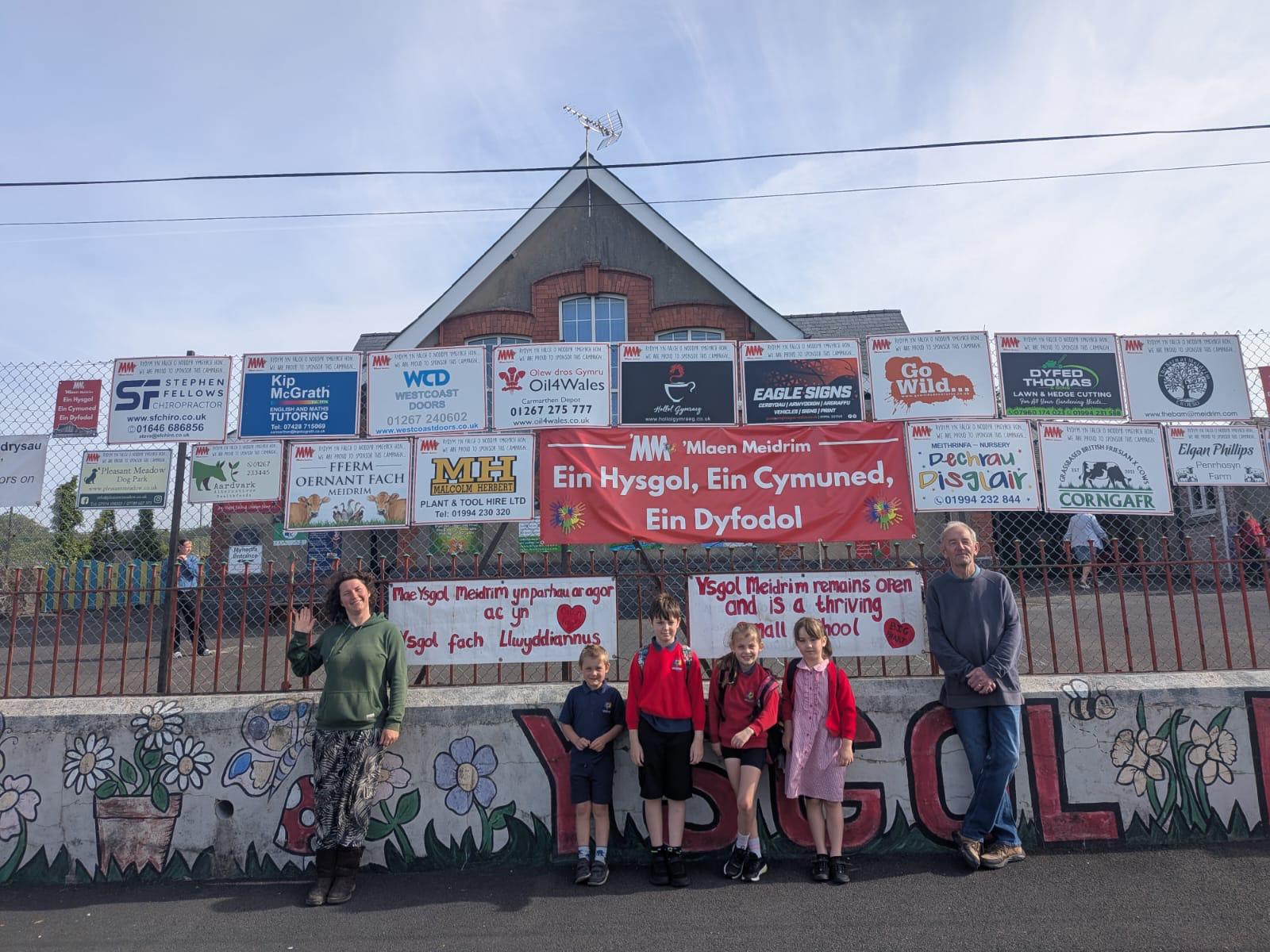
Campaigners say Carmarthenshire must properly consider alternatives after judge’s ruling and last-minute amendment to statutory notice.
A HIGH COURT judge has warned Carmarthenshire County Council that alternative proposals to closing Ysgol Meidrim must be given proper and conscientious consideration before any final decision is made.
The ruling follows a judicial review challenge brought by parent Leia Perry over the council’s decision to consult on the future of the Welsh-medium rural primary school.
Although the High Court did not halt the closure process, campaigners say the judgment raises serious questions about the way the council has handled the matter.
Ysgol Meidrim, near St Clears, currently has around 30 pupils and has been earmarked for closure, with children expected to transfer to other schools from January 2027.
But the school community has mounted a determined campaign to keep it open, arguing that the school remains central to the future of the village, the Welsh language and rural life in the area.
The judgment, handed down by His Honour Judge Jarman KC, found that the challenge should be allowed to proceed, but ultimately dismissed it on the basis that the council still has an opportunity to properly consider alternatives during the ongoing process.
However, the judge made clear that those alternatives must now be considered conscientiously.
Campaigners say this is a significant warning to the council.
Ffred Ffransis, speaking on behalf of Cymdeithas yr Iaith in Carmarthenshire, said the organisation was not a party to the legal action, but understood why a parent of a child with severe medical needs had taken the case.
He said: “The judge criticised the lack of clear communication from the council and that governors had the impression that the council had not yet seriously considered alternatives to closure of Ysgol Meidrim, but found that the evidence did not yet reach the high threshold for legal intervention.
“He has warned the council that they must give conscientious consideration to the alternative proposals drawn up by governors.”
The governors’ proposals include developing the school as part of a wider community hub and exploring federation options rather than closure.

Cymdeithas yr Iaith said the council now had two choices: to press ahead regardless, or to withdraw the closure notice and enter into genuine discussions with governors over their plans.
Mr Ffransis added: “The council must at least demonstrate a new open attitude during the objections period to discussing the alternative proposals.”
The row has deepened after Carmarthenshire County Council was forced to withdraw and reissue its closure notice just three days after it was first published.
According to Cymdeithas yr Iaith, the original notice, issued on June 16, listed nearby Ysgol Bancyfelin as one of three receiving schools. The notice was then withdrawn after it emerged that Ysgol Bancyfelin was already over capacity.
A revised closure notice has now been issued, with the objection period extended until July 17.
The campaign group said this raised further concerns about the way the process was being handled.
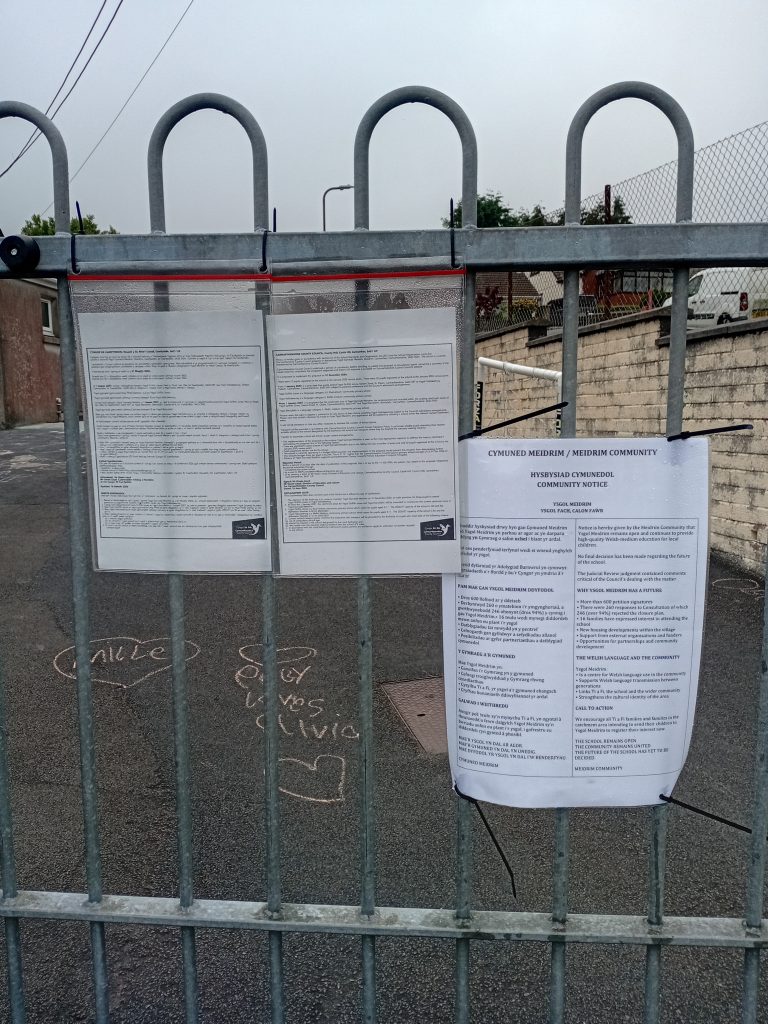
Notices have also been placed at the school gates by supporters, making clear that Ysgol Meidrim remains open and encouraging parents to register children there.
One notice states that the judicial review judgment was critical of the council’s handling of the matter and that the future of the school has not yet been decided.
The campaign has attracted wider attention because of the Welsh Government’s presumption against closing rural schools.
Under the School Organisation Code, councils must carefully consider all reasonable alternatives before deciding to close a rural school, including federation and wider community use.
Campaigners argue that Ysgol Meidrim is not simply an education issue, but a question about the survival of Welsh-speaking rural communities.
The council has previously cited low pupil numbers, surplus places, budget pressures and curriculum challenges as reasons for proposing closure.
But opponents say the financial savings are small compared with the impact on the village and its Welsh-medium provision.

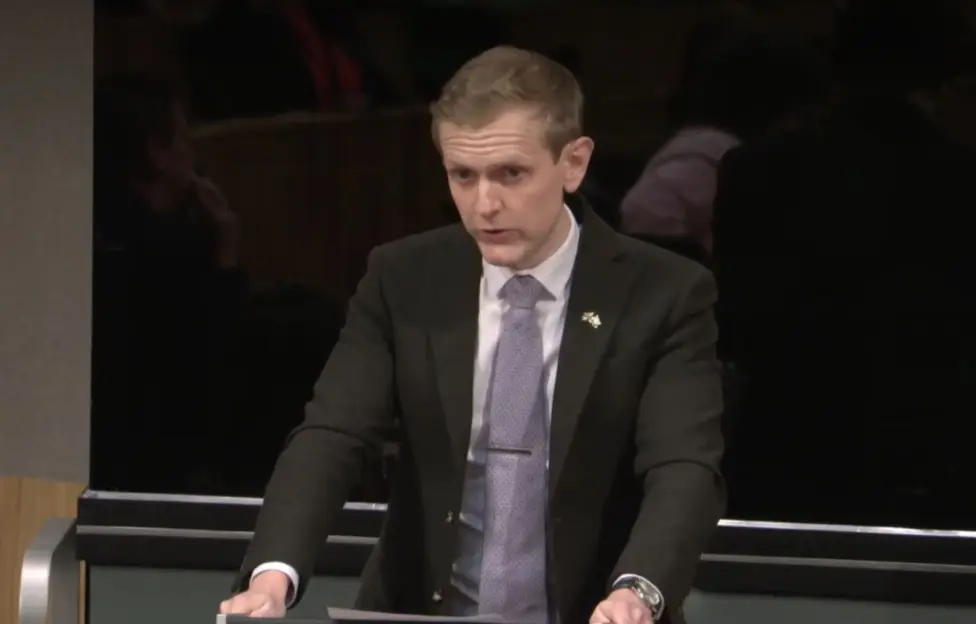
COMMENTS made by a Reform MS led to a walkout in the Senedd during a debate on the Welsh Government’s international spending.
A Reform motion, calling for an end to all Welsh Government international spending, was rejected by Senedd Members on Wednesday June 17.
Wednesday’s plenary opened with Llywydd Huw Irranca-Davies reminding members to mind their language and tone when contributing, following clashes between Reform UK’s Joe Martin and the First Minister in Tuesday’s proceedings.
Mr Irranca-Davies said: “Robust disagreement is part of democratic debate, but it must always be grounded in respect and we must avoid using language that has the potential to inflame debate or to increase tensions.”
The debate was opened by Reform’s shadow minister for finance and government efficiency, Cai Parry-Jones, but it was the contribution made by Caerdydd Penarth MS Joe Martin which sparked the most controversy.

Announcing to his colleagues that he had “good news”, Mr Martin began his statement by sharing that he had “found the £9 million” needed for Plaid’s “childcare idea”.
However, Mr Martin then added that the “bad news” was to get the money the government would have to stop funding “some of the most pointless schemes known to man”.
One example Mr Martin gave of these so-called “pointless schemes” was a beekeeping scheme in Uganda designed to advance gender equality.
The scheme, run by Bees for Development and their partner organisation, The Uganda National Apiculture Development Organisation, aimed to enhance women’s economic empowerment through beekeeping.
It challenged gender norms in the industry, increasing the visibility of women in technical and policy leaderships roles.
Mr Martin then suggested Wales had won the “Who can find the stupidest use of taxpayer money?” competition because of a scheme supporting tree planting in Uganda.
He said: “We actually asked some Ugandan people what they thought about Wales’s scheme to send them money for trees and they said, ‘Why are you sending us money for trees?’

“We then asked the same question to some Welsh students who had been through our underfunded education system, but we didn’t get a reply because we had e-mailed them and they couldn’t read.”
Mr Martin went on to criticise the money spent on mini embassies abroad.
He said: “In India, one of the functions of those mini embassies is to recruit nurses to come and work in our NHS, which is great because it means that the Welsh people who would have otherwise become nurses can instead go on universal credit.”
The Reform MS then added: “I have enquired as to why we can’t just have an enormous pit where we burn all the money, but apparently that’s not compliant with net zero.”
At this point in Mr Martin’s statement Plaid Cymru’s Zaynub Akbar, of Caerdydd Ffynnon Taf, announced she was going to leave the Siambr.
She said: “I don’t accept any of this and I don’t want to be a part of it, so I’ll be leaving the chamber.”

She was followed by numerous other Senedd Members, including Trefnydd and chief whip Heledd Fychan.
Mr Martin was then reminded by the Llywydd of Senedd rules, which mandate respect in the chamber, before he could continue his contribution.
He concluded his speech to the Senedd by saying: “In Westminster, the Tory party doubled foreign aid whilst imposing austerity. There are now only seven of them in this chamber. The same fate awaits any party that insults taxpayers by frittering money overseas on feel-good vanity projects.
“So, I want to encourage the Party of Wales to be nationalist, to put Wales first. Spend your constituents’ money on your constituents. That way, when someone is lying in a hospital corridor and they ask you, ‘are you really the Party of Wales?’, you’ll be able to say ‘yes’.”
At the end of the debate, the Llywydd directly addressed Mr Martin calling for him to “reflect” on his remarks and contributions, noting that it was “not in line with [his] expectations”.
Mr Irranca-Davies described it as “particularly disappointing” given the comments he made at the beginning of plenary.
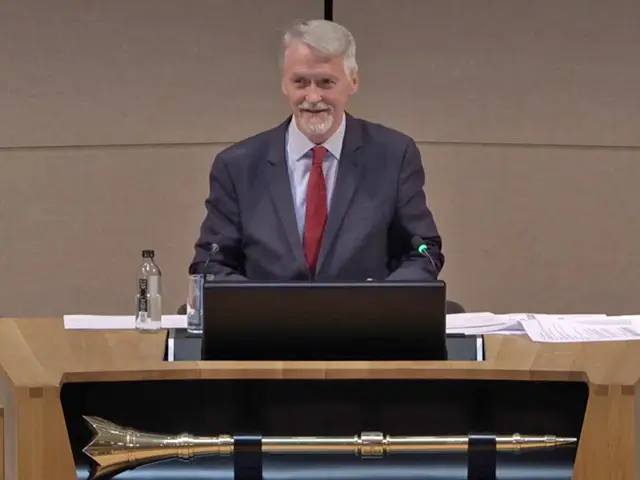
He said: “Going forward, I think we all need to reflect on this and make sure that we comply with our conduct within this chamber and the way we comport ourselves in light of my remarks.”
Welsh Conservative leader Darren Millar expressed his support for the Reform-backed motion, saying it is a debate about where responsibilities lie.
He said: “It’s very clear that foreign relations, international development are matters for the UK Government, not the Welsh Government, and as a result of that, I believe that we respect devolution and can expect respect for devolution back when we respect the boundaries of our legislative competence and the competence of the Welsh Government’s position as well.”

Mr Millar highlighted that his party has continuously argued against the development of “mini embassies” and “overseas offices”.
The Conservative leader did clarify however that he is not “anti-international aid”, and noted the “generous” nature of the people of Wales.
But he added: “I do not believe that when people are dying waiting for ambulances, when we’re at the bottom of the educational tree as far as the league table of the United Kingdom is concerned, and when our road infrastructure isn’t working, our transport infrastructure is creaking, that it’s right to spend those millions of pounds on those things, when the Welsh Government should be focused on the things for which it is responsible.”
Taking an intervention from Labour’s Huw Thomas, Mr Millar was questioned on whether he recognises that the majority of international spending is on economic development for Wales.

Mr Millar once again referred to the role of the UK Government, noting that it is their responsibility to bring inward investment to the UK as a whole.
He said: “We will always want to be an internationalist country, looking out and seeking to influence the world, but we do that as part of the United Kingdom, an integral part of the United Kingdom.
“And I’m proud to be a member not only of the Welsh Conservative Party, but of the Conservative and Unionist Party, and I believe in the union of the United Kingdom, and that these foreign relationships and international development are done better as a United Kingdom as a whole.”
Plaid Cymru’s Gwyn Williams shared a notably different perspective to that of his Conservative and Reform colleagues.
Prior to being elected to the Senedd, Dr Williams was a consultant ophthalmologist specialising in retina care at Swansea Bay University Health Board.

Speaking as someone who has worked within the Welsh NHS Dr Williams said: “Wales has long been a country that looks beyond our own horizons, looking to make a difference in the world and help where we can, but also we rely on help coming in to us as well.
“Many, many healthcare workers, of course, come from abroad, especially here in Wales, and every hospital in the country would crumble if all the international workers went home.”
He continued: “In Singleton Hospital in Swansea, in the eye department, I am the only Welsh-speaking, Welsh-origin consultant there, and much as I like to convince myself that I can do the work of ten people, I cannot, especially now because I am here.
“Chronic shortages in these sectors increase hospital discharge delays, reduce bed availability and create bottlenecks across the healthcare system.
“At a time when the NHS is struggling, we need the support from abroad as well, though we also, of course, need to grow our own ability.”
Concluding his statement Dr Williams said: “This whole debate tries to position international investment and domestic investment as a zero-sum game. It isn’t.
“Looking outwards does not come at the expense of looking inwards. I suggest that such a simplistic outlook condescends to the people of Wales and stymies science.”

The cabinet minister for government effectiveness, Dafydd Trystan Davies, called for reflection on the tone of the debate, suggesting that the “standard of this debate [had] descended to the level of a public house, not of a national Senedd”.
He said: “My friend the leader of the Welsh Conservatives made a speech, and I disagree with more or less all of it, and yet it was conducted properly and in line with the standing orders and the procedures of this Senedd.
“I think we should all take our duties properly as parliamentarians, whatever views we agree or disagree on.”
Dr Trystan Davies highlighted that international spending makes up just 0.03% of the Welsh Government’s overall budget, which he described as a “small contribution” to “building our prosperity, protecting our public services, strengthening our culture, and promoting our values”.
He said: “Our international work turns that belief into action, creating jobs and investment, exports and partnerships, life-changing experiences for students, new colleagues for our NHS and enabling communities in Wales and beyond to learn from one another.
“When Wales works internationally, Welsh people benefit. Our businesses reach new markets, universities build global partnerships, young people return home with skills and confidence, and Wales’s reputation grows.
“We should be proud of that, not in a narrow way, not with our backs turned to others, but proud to be generous and outward-looking, proud to share, proud to learn – internationalist, not isolationist.”
The motion to end all Welsh Government international spending, tabled in the name of Blaenau Gwent Caerffili Rhymni’s Reform MS Llŷr Powell, was rejected by the Senedd with 37 members for and 48 against.
The Siambr then agreed Plaid Cymru minister Heledd Fychan’s amendment, which proposed the Senedd “regrets Reform UK’s isolationist approach to Wales’s place in the world” and “celebrates Wales’ reputation as an internationalist, tolerant and outward-looking nation open for business, which is enhanced by its international engagement, including spending.”
The amended motion was agreed with 48 in favour and 37 against.



Community2 hours ago
The gentle giant behind the tattoos
Pembrokeshire security worker Josh Davies praised for professionalism, kindness and proving first impressions can be wrong JOSH Davies is hard...


Charity1 day ago
Toy Story fans fill charity toy box at Haverfordwest cinema
Donations pour in for SNAP Specialist Play as families embrace Toy Story 5 launch A TOY STORY-themed charity appeal at...


Community1 day ago
Lord Rhys emerges from the mist in St Davids
Giant puppet begins historic journey marking 850 years since the first Eisteddfod MIST swirled around St Davids Cathedral on Friday...


News2 days ago
Tragic tribute paid to Haverfordwest man after A4075 collision
FAMILY REMEMBERS “KIND AND LOVING” CALLUM HANSON THE FAMILY of a 22-year-old man from Haverfordwest who died following a road...


News3 days ago
Motorcyclist, 22, dies in A4075 crash in Pembrokeshire
A 22-year-old woman remains in hospital after two-vehicle collision A MOTORCYCLIST has died following a serious two-vehicle crash on the...


Community3 days ago
Why police will be visiting every home in Pembrokeshire
New operation aims to knock on more than 257,000 doors across Dyfed-Powys over the next three years DYFED-POWYS POLICE has...


Crime3 days ago
Prisons at breaking point: MPs warn Wales is paying the price of a failing system
Frozen healthcare budgets, overcrowded jails, homelessness on release and mounting pressure on staff are undermining rehabilitation across Wales, according to...


News4 days ago
Brexit at 10: How Britain was sold a dream that cost us dearly
A decade after the referendum, the promised benefits remain hard to find while the economic costs are increasingly difficult to...


Crime4 days ago
Worcestershire man jailed after violent attack on woman in Tenby
Defendant was already serving a suspended sentence when serious assault took place A WORCESTERSHIRE man has been jailed for more...


Climate4 days ago
Offshore wind ‘could bring new generation of jobs to Milford Haven’
Pembrokeshire ports and Celtic Sea projects placed at centre of Wales’ green energy ambitions MILFORD HAVEN and Pembroke Dock could...
-
 Community7 days ago
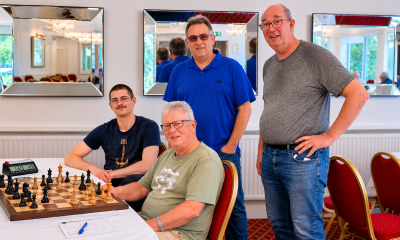
Pembrokeshire Chess Club crowned Welsh champions
-

 Crime3 days ago
Milford Haven man jailed for breaching domestic violence protection order
-

 Local Government5 days ago
Security privately arranged by Mayor at Beating of the Bounds
-

 News3 days ago
Crash on Freeman’s Way causes school-run chaos across Haverfordwest
-

 Crime5 days ago
Man wanted by court after failing to attend hearing over alleged shop thefts
-
 Crime5 days ago
Man banned from roads after drink-driving offence
-

 Crime5 days ago
Man jailed after admitting strangulation and assaults
-

 Crime5 days ago
Drug trafficker must repay £33,000 after court rules he made nearly £500,000