


News
Campaign spending rules updated ahead of next Senedd election


NEW rules on how much political candidates and parties can spend during Senedd elections have been announced by the Welsh Government.
Cabinet Secretary for Housing and Local Government, Jayne Bryant MS, issued a written statement on Thursday (Apr 17), confirming that campaign expenditure limits are being revised ahead of the next Senedd election in 2026.
The changes come as Wales prepares to implement a new electoral system, with the existing limits considered no longer suitable due to the move away from multi-member regions and single-seat constituencies.
The proposed limit for individual candidates will be set at £52,500. This figure is recommended by the Electoral Commission and will be formalised in the forthcoming Conduct Order, which will establish the rules for how Senedd elections are run. This same amount will also apply to a party list consisting of just one candidate, ensuring fairness across the board.
For registered political parties, spending limits will be revised under draft regulations that are expected to be introduced in the Senedd during the Summer term. These will fall under the Political Parties, Elections and Referendums Act 2000.

Under the proposals, a party list with one candidate will also be capped at £52,500. However, this amount will increase by £3,500 for every additional candidate on the list, up to a maximum of £70,000 for parties with six or more candidates.
The Electoral Commission has given its support in principle to the new limits, although formal consent can only be granted once the full regulations are completed.
Both the Conduct Order and the draft expenditure regulations will be laid before the Senedd alongside explanatory memoranda, detailing how the new limits were established.
Ms Bryant said she welcomed further scrutiny of the proposals when Member


FATHER’S DAY celebrations were interrupted for several Tenby RNLI crew members on Sunday afternoon (Jun 21) after a five-metre RIB suffered engine failure off Broadhaven South and began drifting dangerously towards rocks.
The casualty vessel issued a Pan Pan call, prompting a Coastguard tasking to Tenby Lifeboats.
Among those responding were Coxswain Gary and his son Eddie, who still managed to spend part of Father’s Day together — although not quite in the way they may have planned.
The lifeboat was quickly launched and made best speed to the reported position, around nine miles west of Tenby Lifeboat Station.

When the crew arrived on scene, the engine of the casualty vessel had been restarted. However, with those on board concerned it could fail again, the Coxswain decided to escort the RIB back towards the entrance of the Milford Haven Waterway.
Once at the mouth of the waterway, the occupants were confident they could safely continue to their mooring without further assistance.
The lifeboat was then stood down and returned to station, arriving back at 5:50pm.

Health Minister tells Paul Davies MS that decisions remain a matter for Hywel Dda University Health Board
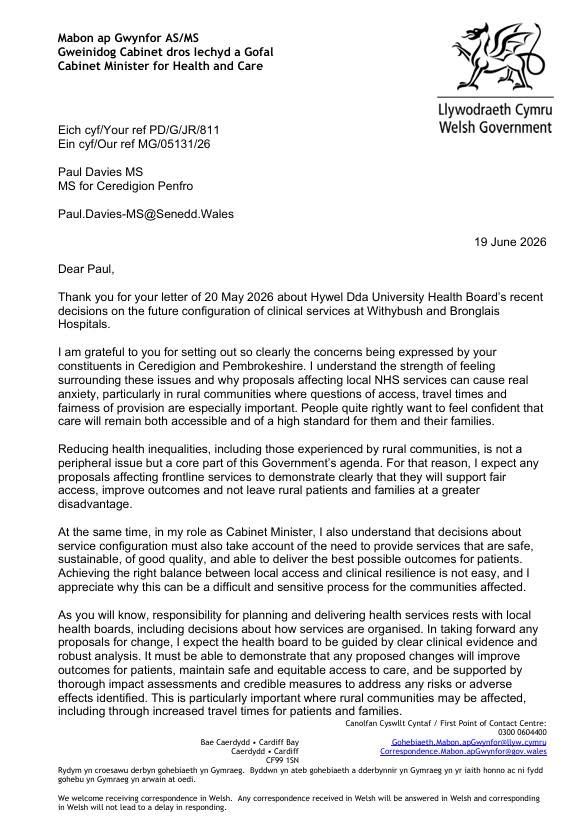
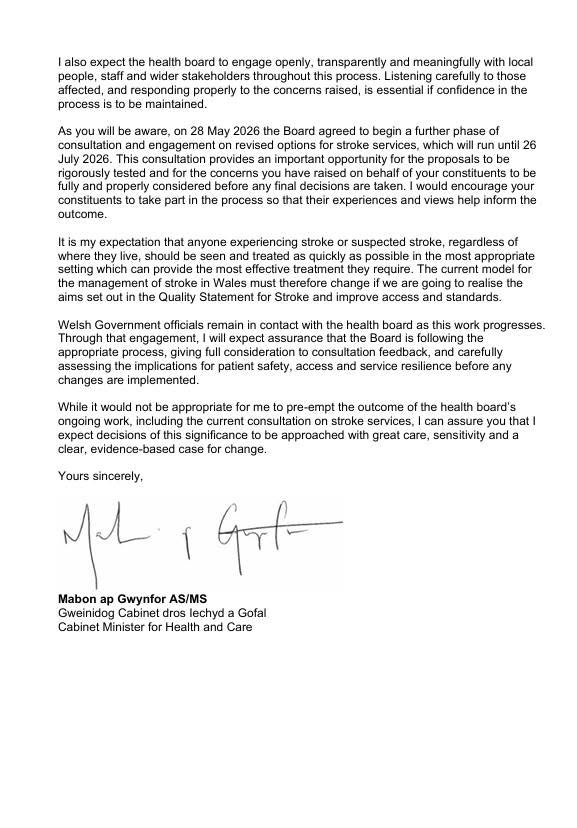
THE WELSH GOVERNMENT has declined to intervene in controversial plans affecting services at Withybush and Bronglais hospitals, prompting fresh criticism from local Senedd Member Paul Davies.
In a letter dated June 19, Health and Care Cabinet Secretary Mabon ap Gwynfor said responsibility for planning and delivering NHS services rests with local health boards and confirmed that Hywel Dda University Health Board should continue its consultation process on proposed service changes.
The response follows concerns raised by Mr Davies on behalf of constituents in Pembrokeshire and Ceredigion over the future configuration of clinical services, including stroke care.
While acknowledging strong public concern about access to healthcare in rural communities, the Minister stopped short of offering any commitment to block or reverse the Health Board’s proposals.
Instead, he stressed that any changes must be supported by robust evidence, maintain patient safety and demonstrate improved outcomes.
The Minister wrote: “Responsibility for planning and delivering health services rests with local health boards, including decisions about how services are organised.”
He added that proposals must improve outcomes for patients, maintain safe and equitable access to care and be supported by thorough impact assessments.
Paul Davies MS described the response as disappointing.
Posting the letter on social media, he said: “This letter tells me that the Welsh Government is not going to stand in the way of the Health Board’s plans.”
He added that he would raise the issue in the Senedd chamber next week and continue pressing ministers to intervene.
The exchange comes as Hywel Dda University Health Board continues a public consultation on proposed changes to stroke services across west Wales.
The consultation, which opened on May 28, is due to run until July 26.

In his response, the Minister stated that anyone suffering a stroke should receive treatment “as quickly as possible in the most appropriate setting” and said the current model of stroke care in Wales must evolve if national standards are to be achieved.
The comments are likely to fuel concern among campaigners opposed to the proposed changes, who fear services could become increasingly centralised and further away from rural communities in Pembrokeshire and Ceredigion.

SCHOOLS across Wales are to receive statutory guidance on restricting pupils’ mobile phone use during the school day, the Welsh Government has announced.
The move follows a consultation and a workforce survey which found strong support for national direction on the issue.
Although most schools already have mobile phone policies, the survey found there was no consistent approach across Wales. It also found that 82% of respondents supported statutory restrictions.

The new guidance for local authorities and schools will set out clearer expectations on how phones should be used during the school day. It will be evaluated over the school year, with ministers leaving open the option of strengthening the rules further if required.
Cabinet Minister for Education and Welsh Language, Anna Brychan said: “Our 100-day plan was clear that we would act, and I have listened to the calls for stronger clarity on this issue.
“This is why the government will publish statutory guidance to provide clear national expectations on how mobile phones are used in schools.
“I want to be clear: as Cabinet Minister, I fully support — and strongly encourage — headteachers to introduce clear and robust restrictions on mobile phone use during the school day, up to and including a full restriction across the school site.
“I am mindful some children will always need exceptions, for medical reasons for example.
“By consulting on guidance at the start of the school year I am giving schools the clarity they want quickly, and creating a safer learning environment by reducing distractions now.”
The Welsh Government said it would also consider the implications of UK Government plans for new restrictions on under-16s’ access to social media.
Ms Brychan said ministers were committed to protecting young people online and would work with school leaders and partners across the education system in Wales as the proposals develop.
The announcement came as the Education Minister set out wider priorities for the sector, including raising standards, strengthening Welsh language provision, improving skills and creating what she described as a system that works for everyone.

The Welsh Government said it would develop a new Foundational Literacy and Numeracy Plan before the end of the summer and review the curriculum.
Other priorities include reducing workload for education staff, expanding Welsh-medium education, ensuring learners have more opportunities to use Welsh beyond the classroom, and reviewing how universities are funded.
Ms Brychan added: “Education is the key to unleashing our nation’s potential and there is no shortage of talent, energy and innovation in Wales.
“If we want to unlock this potential and build a stronger Wales, we need a stronger education system.
“We will raise standards, strengthen the Welsh language, develop skills and build a system that works.
“By working together, we can provide opportunity, ambition and excellence for all learners, in all parts of Wales and support the workforce that makes it possible.
“This Government has made education a priority because the future of Wales depends on it.”



Community5 hours ago
The gentle giant behind the tattoos
Pembrokeshire security worker Josh Davies praised for professionalism, kindness and proving first impressions can be wrong JOSH Davies is hard...


Charity1 day ago
Toy Story fans fill charity toy box at Haverfordwest cinema
Donations pour in for SNAP Specialist Play as families embrace Toy Story 5 launch A TOY STORY-themed charity appeal at...


Community1 day ago
Lord Rhys emerges from the mist in St Davids
Giant puppet begins historic journey marking 850 years since the first Eisteddfod MIST swirled around St Davids Cathedral on Friday...


News2 days ago
Tragic tribute paid to Haverfordwest man after A4075 collision
FAMILY REMEMBERS “KIND AND LOVING” CALLUM HANSON THE FAMILY of a 22-year-old man from Haverfordwest who died following a road...


News3 days ago
Motorcyclist, 22, dies in A4075 crash in Pembrokeshire
A 22-year-old woman remains in hospital after two-vehicle collision A MOTORCYCLIST has died following a serious two-vehicle crash on the...


Community3 days ago
Why police will be visiting every home in Pembrokeshire
New operation aims to knock on more than 257,000 doors across Dyfed-Powys over the next three years DYFED-POWYS POLICE has...


Crime3 days ago
Prisons at breaking point: MPs warn Wales is paying the price of a failing system
Frozen healthcare budgets, overcrowded jails, homelessness on release and mounting pressure on staff are undermining rehabilitation across Wales, according to...


News4 days ago
Brexit at 10: How Britain was sold a dream that cost us dearly
A decade after the referendum, the promised benefits remain hard to find while the economic costs are increasingly difficult to...


Crime4 days ago
Worcestershire man jailed after violent attack on woman in Tenby
Defendant was already serving a suspended sentence when serious assault took place A WORCESTERSHIRE man has been jailed for more...


Climate4 days ago
Offshore wind ‘could bring new generation of jobs to Milford Haven’
Pembrokeshire ports and Celtic Sea projects placed at centre of Wales’ green energy ambitions MILFORD HAVEN and Pembroke Dock could...
-

 Crime4 days ago
Milford Haven man jailed for breaching domestic violence protection order
-

 Local Government5 days ago
Security privately arranged by Mayor at Beating of the Bounds
-

 News3 days ago
Crash on Freeman’s Way causes school-run chaos across Haverfordwest
-

 Crime5 days ago
Man wanted by court after failing to attend hearing over alleged shop thefts
-
 Crime5 days ago
Man banned from roads after drink-driving offence
-

 Crime5 days ago
Man jailed after admitting strangulation and assaults
-

 Crime5 days ago
Drug trafficker must repay £33,000 after court rules he made nearly £500,000
-

 Crime5 days ago
Man sentenced over stalking campaign and lock knife offence