


Wartime lifeboat heroes of Wales remembered on VE Day anniversary


Welsh RNLI crews braved mines, storms and enemy fire to save lives at sea
AS the country marks the 80th anniversary of VE Day, the Royal National Lifeboat Institution (RNLI) is paying tribute to the bravery of its volunteer crews in Wales who served during the Second World War. From the storm-lashed coasts of Anglesey to the exposed lifeboat stations of Pembrokeshire and Gower, Welsh RNLI crews launched into perilous seas to save lives, often under enemy threat.
Between 1939 and 1945, lifeboats from stations across Wales were launched repeatedly to respond to wartime emergencies. Despite limited resources, ageing equipment and extreme danger, the RNLI never stopped saving lives. During the two World Wars combined, lifeboats around the UK and Ireland launched 5,478 times and rescued nearly 11,700 people.
A significant number of those launches came from Welsh waters.
One of the most remarkable Welsh rescues of the Second World War came in January 1940, when Moelfre Lifeboat Station, on the east coast of Anglesey, responded to a mayday from the SS Gleneden of Glasgow. The vessel was in trouble during a fierce northeasterly gale and very rough seas. The volunteer lifeboat crew, battling bitter cold and towering waves, managed to save all 60 crew members aboard the stricken ship. For their actions, Coxswain John Matthews was awarded the Silver Medal for gallantry, and Motor Mechanic Robert Williams received the Bronze Medal.
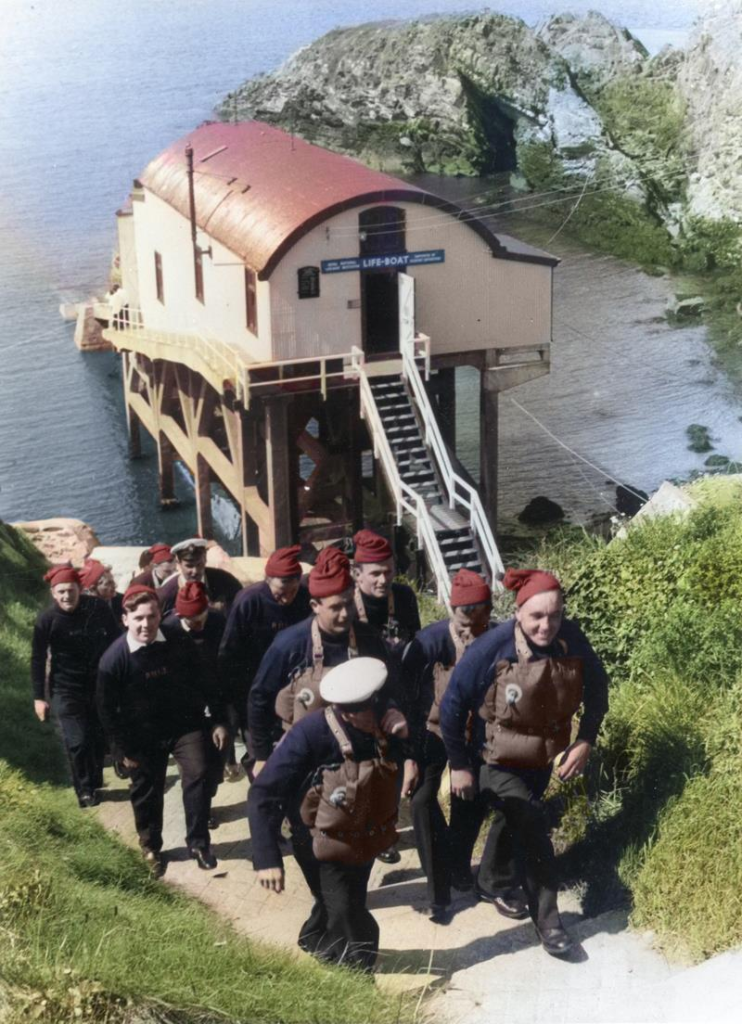
In December 1944, as the war was drawing to a close, another Welsh lifeboat launched into danger. The Mumbles lifeboat, Edward, Prince of Wales, responded to distress signals from the Canadian cargo vessel Chebogue, which had broken her back in hurricane-force winds off the South Wales coast. In a night-time rescue carried out under extraordinary conditions, the Mumbles crew saved 42 lives.
These heroic missions were carried out not by trained naval personnel, but by local men—fishermen, harbour workers, and retirees—who volunteered their time and risked their lives. With many young men serving on the front lines, lifeboat crews in Wales were often made up of older volunteers, with some in their fifties, sixties and even seventies stepping up to fill the gaps.
Wartime conditions made the work of the RNLI even more dangerous. Lifeboat stations were occasionally damaged or destroyed in air raids. In all, 40 RNLI crew members across the UK and Ireland died during the war, including those who were machine-gunned by enemy aircraft, blown up by floating mines, or lost during stormy rescues. Seven lifeboats were lost in action.
Although most of the RNLI’s wartime launches were in response to vessels in distress, the crews often found themselves navigating minefields, dodging enemy fire, and recovering the dead as well as the living. One Welsh example came from Courtmacsherry, across the water from Pembrokeshire, where 14 volunteers rowed 12 miles through calm seas without wind, only to find they were too late. Undeterred, they recovered the bodies and brought them home so that loved ones could bury them with dignity.
Wales also played its part in one of the most famous operations of the war—Dunkirk. In May 1940, 19 RNLI lifeboats were part of the fleet of civilian vessels known as the Little Ships that crossed the English Channel to rescue British troops stranded on the beaches of northern France. Lifeboats from Ramsgate and Margate were operated by RNLI crews who brought with them unfamiliar equipment such as steel helmets, gas masks, and extra supplies. They worked for over 30 hours amid wreckage, gunfire and strong currents. Although not from Wales, the spirit of this operation mirrored the courage shown by lifeboatmen in Welsh waters throughout the war.
To mark this VE Day anniversary, the RNLI is calling on the public to help uncover more stories connected to lifeboat stations in Wales during the war. A grant from The National Lottery Heritage Fund has made it possible for the charity to launch a new project: RNLI 1939–45: Stories of Courage. The project aims to record and preserve these memories before they are lost to time.
Hayley Whiting, RNLI Heritage Archive and Research Manager, said: “Our Welsh lifeboat crews experienced some of the most difficult years in the charity’s history. Lifeboats were damaged, lifeboat stations were hit, and lives were lost. But their determination never wavered. As we reflect on VE Day, we remember not just those who served on the front lines, but those who braved the storms at home to bring others back to safety.”
The Pembrokeshire Herald’s coverage of the VE Day 80 commemorations are kindly sponsored by PMR




Helen Jenner, a teacher, Welsh speaker and mother of two, will join Dan Thomas in leading the party’s campaign
REFORM Wales leader Dan Thomas has announced Helen Jenner as the party’s new deputy leader as it steps up preparations for the Senedd election on Thursday, May 7.
Jenner, who tops Reform’s regional list in Bangor Conwy Mon, was born in Neath and raised on Ynys Mon. She is a teacher by profession, a Welsh speaker, and a mother of two.
Announcing the appointment, Mr Thomas said the party wanted to draw on the strengths of its members as it heads into the election campaign.
He said: “Reform Wales is a team.
“And like every team, we need to draw on the skills and attributes of all of our members to get results.

“That’s why I’m excited to announce that Helen Jenner will join me in leading Reform into the Senedd election in May.”
Ms Jenner said Wales was at a “crossroads” and claimed Reform was the only party offering “ambitious, credible solutions” to the problems facing the country.
She said: “Wales is at a crossroads, and Reform is the only party offering ambitious, credible solutions to the problems the people of Wales face.
“As a proud Welsh woman, I believe the only party prepared to put our country first is Reform.

“I’m honoured to join Dan and our hard working members in this fight for a fairer, more prosperous Wales.
“Vote Reform on May 7 for the real change Wales deserves.”
The announcement comes as parties across Wales continue to unveil candidates and campaign teams ahead of the 2026 Senedd election.


Report finds a third of reception-age children are above a healthy weight as activity levels fall sharply in teenage years
A THIRD of children aged four and five in West Wales are above a healthy weight, according to new research which warns that too many young people are heading towards a future of preventable ill health.
The findings are included in a new State of the Region report commissioned by Activate West Wales, covering Pembrokeshire, Carmarthenshire, Swansea and Neath Port Talbot.
The report found that fewer than one in four primary school children across the region are achieving the recommended 60 minutes of physical activity each day. By secondary school age, that figure drops to just 19 per cent.
Researchers also identified a clear gap between boys and girls, with boys significantly more active. Between 22 and 24 per cent of boys meet the daily activity target, compared with just 13 to 14 per cent of girls.
Sedentary behaviour was also found to be high across the region, with children in some areas spending seven or more hours inactive on weekdays. Swansea and Neath Port Talbot recorded levels above the Wales average, while girls were found to be more sedentary than boys in all four local authority areas.

The report brings together data from a range of sources to highlight patterns, inequalities and areas where more targeted action could improve health and wellbeing through sport and physical activity.
There were some more positive findings. Children and young people in West Wales were found to be taking part in organised sport three times a week at a higher rate than the Wales average.
However, girls’ participation remained lower than boys in every local authority area.
The review also looked at demand for different activities. Children and young people with disabilities highlighted interest in weightlifting, tennis and archery, while those without disabilities most commonly chose swimming, football and cycling.

Dr Susan Barnes, chair of Activate West Wales, said: “This first State of the Region review gives us the most comprehensive picture to date of sport, physical activity and health across West Wales.
“The evidence in the report presents a clear and uncomfortable truth: unless we act decisively now, too many people across our regional footprint will face a future marked by preventable ill health, widening inequality, and diminished opportunity.
“Without intervention, today’s inactive child is highly likely to become tomorrow’s unhealthy adult.”

Jamie Rewbridge, chief executive of Activate West Wales, said tackling the problem would require long-term action across government, councils, health boards, schools, businesses, clubs and community groups.
He said: “This report is not an end point, but a starting line for lasting change.”

Change to HMRC rules will affect employees who pay their own homeworking costs, while firms can still reimburse staff tax-free
Employees in Wales who claim tax relief for extra household costs while working from home will lose that support from Monday (April 6), as new HMRC rules come into force at the start of the 2026-27 tax year.
The change removes the process that allowed eligible employees to claim income tax relief directly from HMRC for additional homeworking expenses, such as heating, electricity and business phone calls, when those costs were not reimbursed by their employer. Under the previous system, most claimants could use a flat rate of £6 a week without providing receipts.
The relief was widened during the coronavirus pandemic to cover employees who had to work from home because of public health restrictions rather than because of their specific employment duties. The Government announced in last year’s Budget that this tax relief would be removed from April 6, 2026.
Azets, the accountancy and business advisory firm, said the end of the relief could leave some workers out of pocket if they are still covering homeworking costs themselves. The firm said basic rate taxpayers could lose relief worth about £62 a year, while higher rate taxpayers could lose around £124. Those figures are based on tax relief on £6 a week, rather than a direct cash payment.
Clair Williams, Head of Employment Tax at Azets, said employers may now face questions from staff about whether homeworking costs should be reimbursed instead.
However, employers are still able to reimburse eligible homeworking expenses without charging income tax or National Insurance under existing HMRC rules.
HMRC guidance states that tax relief for working from home applies where an employee has to work from home, for example because their employer does not have an office, rather than simply choosing to do so. Employees can also still make claims for earlier eligible tax years, subject to the normal deadlines.
The Treasury says the measure will save money over the coming years, as ministers tighten the rules around homeworking expenses and bring to an end the broader relief that was introduced during the pandemic.



Health2 hours ago
No jobs for new paramedics in Wales as graduates told to apply for technician roles
Students trained at public expense urged to take lower-grade jobs as anger grows over NHS workforce planning NEWLY qualified paramedics...


News22 hours ago
Health minister refuses to act on Withybush despite 15,000-signature petition
Senedd pressure grows as Welsh Government declines to intervene over surgery fears THE WELSH GOVERNMENT has refused to step in...


Business2 days ago
Fishguard to Wexford rail tunnel plan backed by Elon Musk firm
Six-hour London to Dublin service proposed in £32bn project ahead of Senedd election PLANS for a rail tunnel linking west...


Charity2 days ago
Milford Haven charity honoured with King’s Award for voluntary service
A PEMBROKESHIRE charity supporting vulnerable young people has received one of the highest honours in the UK for voluntary work....


News3 days ago
Plaid Cymru launches bid to lead next Welsh Government
Party positions itself as ‘government-in-waiting’ ahead of May election PLAID CYMRU has formally launched its campaign for the 2026 Senedd...


Crime3 days ago
Police appeal after attempted child abduction in Haverfordwest
DYFED-POWYS POLICE has launched an appeal for witnesses following a reported attempted abduction of a 12-year-old girl in Haverfordwest. The...


Crime4 days ago
Gunshot fired by police during incident in Milford Haven
A POLICE officer discharged a firearm during an incident in Milford Haven on Saturday evening (March 28), prompting an investigation...


Community5 days ago
Three Amigos Easter Run roars through Pembrokeshire
MOTORCYCLE enthusiasts turned out in force today (Saturday, March 28) as the popular Three Amigos Easter Run returned to the...


Education6 days ago
Ysgol Henry Tudor reassures parents over Sikh ceremonial kirpan
School says religious item worn by pupil is secured, symbolic and non-functional YSGOL HENRY TUDOR has moved to reassure parents...


Crime7 days ago
Teen jailed after starting fire while others slept
Fire set in shared home left sleeping residents at risk and caused £130,000 damage A TEENAGER who started a fire...
-

 Community7 days ago
Hero female officer keeps job after sexual touching finding
-
Education6 days ago
Ysgol Henry Tudor reassures parents over Sikh ceremonial kirpan
-

 Business7 days ago
Popular Italian restaurant hit with £278,000 tax bill plus £186,000 fine
-
 Climate7 days ago
Port Talbot confirmed as ‘cornerstone’ for wind — questions remain for Milford Haven
-

 Crime6 days ago
Taylor wins appeal as Crown Court quashes ‘no insurance’ conviction
-

 News7 days ago
Tenby waterman riding high in global hydrofoil rankings
-

 Crime6 days ago
Appeal dismissed in blood sample case after court rejects PTSD defence
-
Crime7 days ago
Teen jailed after starting fire while others slept