


Business
Post-Brexit lending to rural SMEs slumps, new study reveals


Regional inequality deepens as small firms in rural and export-reliant areas suffer finance contraction
A NEW academic study has revealed a sharp decline in lending to small and medium-sized enterprises (SMEs) in rural and peripheral areas of the UK following the Brexit vote—worsening already entrenched regional inequalities.
The research, conducted by Bangor University and the University of Liverpool, shows a 4.8% annual contraction in SME lending in the years after the Brexit referendum compared to similar European economies. The findings have been published in the Journal of Rural Studies.
The decline was particularly pronounced during key Brexit milestones—such as the triggering of Article 50 and the passage of the EU Withdrawal Bill—highlighting the prolonged uncertainty caused by the UK’s departure from the EU.
Researchers used detailed postcode-level data from UK Finance to assess the geographic impact, marking the first such study to link Brexit with regional disparities in SME lending. The analysis found that peripheral and rural Local Authority Districts, as well as regions with high EU export dependency, experienced disproportionately severe reductions in credit access.
In 2016, 2017, and 2018, these areas saw lending shrink by 5.15%, 3.28%, and 1.97%, respectively.

The five worst-affected Local Authority Districts in 2016–2017 were: Derbyshire Dales, Hambleton, Mid Suffolk, Stratford-on-Avon, and Dumfries and Galloway.
Cem Soner, Doctoral Researcher at Bangor Business School, said:
“The initial fallout of Brexit—such as currency drops and market instability—was immediate. But our research shows the longer-term damage, especially to local economies dependent on EU trade. The evidence underscores the need for region-specific policies to help SMEs in these vulnerable areas recover.”
Professor Rasha Alsakka, who leads the Credit Risk Research Group at Bangor Business School’s Institute of European Finance, added:
“SMEs are the backbone of the UK economy, especially in rural regions. If the government is serious about levelling up, it must act on this data to ensure that all areas have fair access to finance.”
Dr Noemi Mantovan, Senior Lecturer in Economics at the University of Liverpool, said that access to finance is critical for SME resilience:
“Despite being smaller and often perceived as riskier, rural SMEs can be just as innovative and successful as urban ones. Ensuring they can secure loans is vital for job creation and sustainable economic growth.”

The full study can be accessed here: ScienceDirect – Journal of Rural Studies



A CALL for works to Tenby’s listed building sailing club to improve energy efficiency for the community organisation has been given the go-ahead.
In an application to Pembrokeshire Coast National Park, Harrison Richards of Tenby Sailing Club sought permission for replacing 24 timber windows at the Grade-II-listed Tenby Sailing Club, Penniless Cove Hill, with new Accoya timber double-glazed units.
The application added: “An energy survey conducted by Dragon Energy Consultants highlighted the existing single glazing and rotten window frames as a significant contributor to the club’s energy consumption.
“Tenby Sailing Club is a community organisation which seeks to organise activities year-round but faces significant energy costs being housed in a historic building. The current windows are beyond repair, with cracked glazing, decay, water ingress, and poor energy efficiency.
“The two windows at balcony level are not included, as they were previously replaced and remain in good condition. All new units will replicate the existing profiles, dimensions, glazing patterns, and overall appearance, ensuring no visual change to the building’s character.

“The neighbouring three-storey harbour stores occupied by Tenby Sea Cadets have previously replaced the building’s windows with double glazing. This like-for-like replacement in appearance will improve durability, weather resistance, and thermal performance while preserving the special architectural and historic interest of the listed building.”
An officer report recommending approval said: “The Sailing Club was built as a warehouse c. 1825, abutting the C17 sluice. Originally wine stores, it was later used by the local fishermen for stores and is now the home to Tenby Sailing Club, established in 1936.”
It said no adverse comments to the proposals had been received.
It added: “The proposal is to replace the majority (24 total) of windows in painted timber, double-glazed with face-mounted glazing bars of traditional scale and profile. Whilst a modern practice of glazing, the proposal involves no loss of historic fabric, provides an obvious visual improvement and addresses concerns as to heating costs.”

It finished: “The scheme is considered to be in keeping with the character of the listed building, and its setting in terms of design and form. As such, the application can be supported subject to conditions.”
The application was conditionally approved by planners.

TAXI passengers in Milford Haven are facing a sudden jump in fares, as drivers increasingly switch on their meters and charge full council-approved rates.
One Herald reader said a short return trip from Milford Haven to Neyland cost £30 — around double what he expected to pay.
But drivers insist the prices are not new — they are simply the official tariff now being applied.
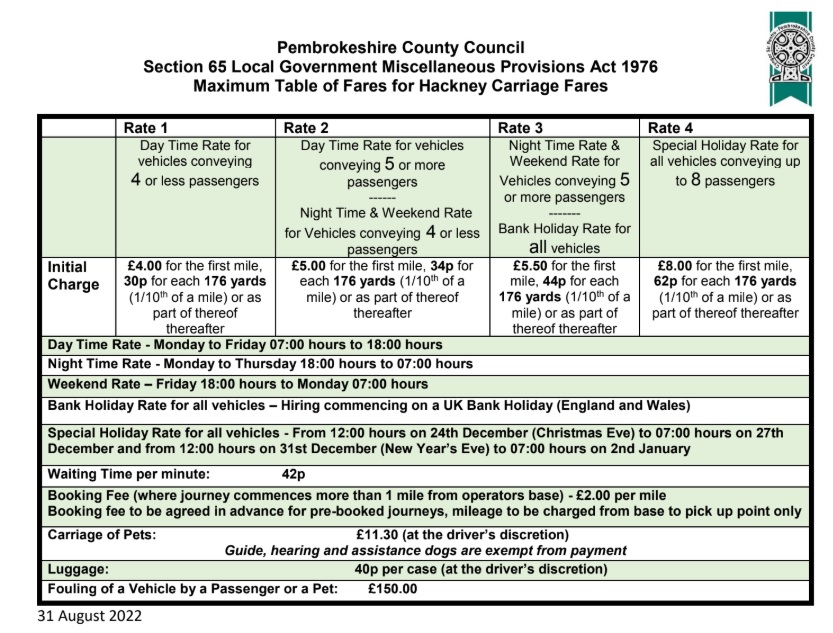
Under Pembrokeshire County Council rules, the standard daytime fare starts at £4 for the first mile (£5 after 6pm), rising by around £3 per mile thereafter. Waiting time is also charged, meaning even short return journeys can quickly add up.
Higher rates apply in the evenings, at weekends and on bank holidays.

End of the £3 taxi
Milford Haven has long been known for cheap taxis, with short in-town journeys often costing as little as £3 — far below official rates.
That was down to competition, older vehicles, and the need to keep prices low in a town where many rely on affordable transport.
Drivers say those days are now over.
One local driver told The Herald: “People got used to cheap fares, but that was never the real price. Now we have to use the meter or we’re losing money.”
Fuel costs biting
Most taxis run on diesel, now around 170p per litre locally. For drivers covering long distances each day, the increase has hit hard.
Global tensions in the Middle East have pushed up oil prices, feeding directly into higher fuel costs in the UK.
With fare increases requiring a lengthy council process, many drivers say they have no option but to charge the full tariff.

Vulnerable hit hardest
The change is being felt most by those who rely on taxis the most.
Elderly residents, people on low incomes and those without access to a car are now facing higher everyday travel costs.
There has been no recent increase in Pembrokeshire’s official taxi fares, which have remained broadly unchanged since 2022.
The difference is simple: drivers are now charging them.
As one put it: “We’re not putting prices up — we’re just finally charging what we’re supposed to be charging.”

CARDIFF AIRPORT is preparing for a busy Easter getaway, with more than 46,000 passengers expected to travel through the airport over the holiday period.
The figure represents an 18% increase compared to the same period last year, reflecting growing demand for both sunshine destinations and European city breaks.
The busiest routes this Easter are set to be Alicante, Dublin and Málaga, with flights operated by airlines including Ryanair, Vueling and TUI Airways.
Travellers heading for warmer weather can also take advantage of direct flights to the Canary Islands, including Tenerife, Lanzarote, Gran Canaria and Fuerteventura, alongside popular destinations such as Faro and Palma.
The airport says the increase builds on a strong start to 2026, with passenger numbers continuing to rise.
Chief executive Jon Bridge said the airport is approaching the one million passenger mark and expects the summer season to be its busiest since the pandemic.
He said: “It’s been an incredibly positive start to the year, and we’re looking forward to welcoming more passengers over the Easter period.
“Our teams are working hard to ensure travellers can start their holidays smoothly.”
Passengers travelling over Easter are being advised to allow extra time for their journey and check with airlines for the latest updates.
A total of 46,158 passengers are expected to pass through the airport between March 27 and April 12, with arrivals and departures almost evenly split.
Cardiff Airport said it continues to expand its range of destinations, including the addition of a direct service to Toronto, as it looks to strengthen its role in connecting Wales to international travel.



News9 hours ago
Reform reveals west Wales candidates for Senedd battle
Monkton councillor tops Pembrokeshire list as party confirms Carmarthenshire names and includes Haverfordwest councillor in unwinnable Swansea spot REFORM UK...


Health16 hours ago
Clash over Withybush Hospital services as Paul Davies challenges First Minister
A HEATED exchange in the Senedd has laid bare growing tensions over the future of hospital services in west Wales....


Crime1 day ago
Police stop car in Pennar as three arrested in drugs investigation
Suspected drug driver report leads to major police response and multiple arrests DRAMATIC scenes were reported in Pennar on Monday...


Business2 days ago
New pilot vessel Llanion arrives at Milford Haven
State-of-the-art 22-metre craft marks reset after £3.6m pilot boat controversy THE PORT OF MILFORD HAVEN has taken delivery of a...


Community2 days ago
Sycamore Gap legacy tree to take root in Pembrokeshire landscapes
A SAPLING grown from the famous Sycamore Gap tree is set to become part of Wales’ protected landscapes — with...


Business3 days ago
Could Primark be coming to Haverfordwest? Major retailer in talks for former Wilko site
Council confirms advanced discussions as speculation grows over high street boost HAVERFORDWEST could soon see a major high street revival,...


Business3 days ago
Rail investment ‘could unlock 40,000 jobs and £11bn for Wales’ says new report
RAILWAY stations across Wales could help unlock around 40,000 jobs and more than £11 billion for the economy by 2036,...


Local Government3 days ago
Milford Haven set for £200m investment with schools, leisure centre and rail upgrade
Council outlines major plans for town with backing from Welsh Government MILFORD HAVEN is set for a major transformation with...


Community3 days ago
Broad Haven volunteers secure ‘national asset’ status for nature reserve
A SMALL stretch of woodland and former opencast coal mine has been transformed into a nationally recognised biodiversity site, in...


Entertainment4 days ago
Tenby steams up in spectacular style as crowds flock to festival
Colourful parade, towering creations and Victorian flair bring town centre to life TENBY was transformed into a vibrant Victorian fantasy...
-

 Health7 days ago
NHS waiting list falls — but cancer delays and diagnostic backlog worsen
-

 Crime7 days ago
Illegal workers found at Cardigan takeaway after immigration raid
-

 Crime6 days ago
Pembroke man remanded in custody over knife threat, assault and damage allegations
-

 Crime5 days ago
Broad Haven man remanded in custody over sexual harm prevention order breach
-

 Education6 days ago
Milford Haven school plans unveiled but funding not yet secured
-

 News6 days ago
Council unveils plans for new state-of-the-art secondary school in Milford Haven
-

 Crime5 days ago
Publican jailed for six years for supplying cocaine and cannabis
-

 Farming6 days ago
£3 million secured to continue Welsh sheep genetics programme