


Politics
Two-year gap for ex-politicians on conduct committee too short, watchdog warns


THE SENEDD’S standards commissioner has warned a proposed two-year “cooling-off” period for former politicians to sit as “lay” members of a conduct committee is too short.
Douglas Bain gave evidence on Tuesday November 11 on the accountability bill which would create a Senedd “recall” system, allowing voters to remove politicians between elections.
Mr Bain welcomed plans to appoint “lay” members for the first time to the standards committee, which makes sanctions recommendations based on his investigations.
He told Senedd Members: “There must always be a perception that members are entirely marking their own homework and I think the inclusion of independent, suitably qualified members will guard against that, at least to some extent.”
But he expressed concerns about former Senedd Members being eligible to join the committee only two years after standing down or not being returned at an election.

Giving evidence to a newly formed Senedd accountability committee, set up to scrutinise the bill, he said: “I recommended that the period should be four years.
“I think there could well be, after just two years, individuals who had worked closely with the member whose conduct was being considered.
“Even if they were totally unbiased in their approach, I think it sends the wrong signal to the public who might perceive that they had some sort of interest in the matter.”
Mr Bain added: “My own view is a period of four years would remove any reasonable concerns that the person might have inside knowledge of the case under investigation.”
He suggested there would be “no realistic risk” of a conflict of interest after four years and “of course, if there was a conflict it would be up to the member to recuse themselves anyway”.
Meriel Singleton – clerk of the standards committee, which made recommendations to the Welsh Government on accountability, echoed the commissioner’s concerns.
“The committee is of the view that it should be longer than two years,” she said. “But, at the moment, it’s in line with what the standards commissioner’s qualification is.”

Hannah Blythyn, who chairs the committee, added: “If you change one, you change both.”
Under the bill, recall would be subject to a Senedd vote or automatically triggered in the case of a politician receiving a custodial or suspended sentence of 12 months or less. Sentences of more than 12 months already lead to disqualification.
Mr Bain was against other misconduct, such as harassment, automatically triggering recall.
“I think it would send entirely the wrong message,” he told Senedd Members. “Each case has to be looked at on its individual facts and an appropriate penalty or sanction imposed.”
On moving the threshold to six months, as proposed in Scotland, he said sentences for “almost identical offences vary widely from court to court and judge to judge”.
He told the accountability committee: “Whatever period is imposed is going to be arbitrary.”
Asked about appeals dragging on for months, Mr Bain said: “You can’t discount the possibility that the member concerned might attempt and might be successful in spinning out the process. We’ve certainly seen that in relation to the complaints process.”
He added: “Those of you who were here in the fifth Senedd will recall the very unsavoury tactics from a member which avoided any sanction being imposed on him.”
Mr Bain, who is barred from commenting on open cases, warned the rules governing his office are “well past their sell-by date” and out of kilter with Westminster. “What the public expects and are entitled to has moved on,” he said.
The commissioner said he would envisage new “own-initiative” powers being rarely used to launch investigations without first requiring a complaint as in other parliaments.
He said: “In the seven years of working in the Senedd, I can think of only two occasions on which I would have considered using this power had it been available.
“Both of these were alleged misconduct that had been widely reported… and I think it sends the wrong signal to the public when they read of that and no action is taken…
“Much to my surprise not a single person made a complaint about either of the incidents, perhaps assuming someone else was going to do that. The result was that – as far as the public was concerned – the Senedd condoned what had happened.”
Huw Williams, the Senedd’s chief legal adviser, backed the commissioner’s calls to introduce a new offence, saying: “As a result of experience in an earlier case, we think it would be useful to introduce a formal offence of obstructing the commissioner in his work.
“And there is a reported case where there was an attempt to interfere with witnesses.”



WELSH LABOUR has called on the Plaid Cymru Government to set out whether it will act on a Senedd vote backing the creation of a new negotiating body for school support staff.
The proposed School Support Staff Negotiating Body would provide a national forum for discussing pay, terms and conditions for workers such as teaching assistants, caretakers, cleaners, cooks, administrative staff and lunchtime supervisors.
Supporters say the body is needed to address long-standing inconsistencies in pay and conditions across Wales, including concerns over term-time-only contracts, limited career progression and the lack of a dedicated national bargaining structure for non-teaching school staff.
The issue was raised in the Senedd by Welsh Labour’s Huw Thomas following the passing of an Opposition Day motion last week. The motion, tabled by Labour, secured cross-party support and called for progress on establishing a Welsh SSSNB.
During questions to the Cabinet Minister for Effectiveness and the Constitution, Mr Thomas pressed the Welsh Government on whether work had begun on legislation.
He asked: “Can you confirm that as the Cabinet Minister responsible for the legislative agenda, you are respecting the Senedd’s wishes and have begun preparing legislation for a School Support Staff Negotiating Body?”
Welsh Labour says the proposal would bring Wales into line with England, where legislation has already been taken forward to create a School Support Staff Negotiating Body for workers in state-funded schools.
The policy was also a Welsh Labour manifesto pledge and has been backed by trade unions including UNISON and GMB, which have campaigned for better recognition, fairer pay and clearer career structures for school support staff.
Labour argues that support staff play a vital role in the day-to-day running of schools and in supporting pupils’ learning, wellbeing and safety, but that their pay and conditions have not always reflected the importance of their work.
Mr Thomas, Welsh Labour’s spokesperson for Finance, Democracy, Citizenship and the Welsh Language, also pressed ministers for assurances that manifesto commitments would appear in the Programme for Government in the form originally promised.
Labour said the Plaid Cymru Cabinet Minister declined to give an unambiguous commitment that all manifesto pledges would be carried forward.
However, Opposition Day motions passed by the Senedd do not in themselves create legislation. They place political pressure on ministers to respond, but the Welsh Government is not automatically required to introduce a Bill.

Any new negotiating body would also require detailed work on funding, the role of local authorities, union representation, school budgets and how national terms would interact with existing council and school employment arrangements.
Welsh Labour says ministers must now provide a timetable for legislation and explain how they intend to work with unions, councils, schools and support staff on the creation of the body.

PLANS for new guidance on mobile phone use in Welsh schools have sparked a political row, after Labour accused Plaid Cymru of sending mixed messages over whether phones could be banned during the school day.
Education Minister Anna Brychan has announced that the Welsh Government will bring forward guidance aimed at restricting pupils’ use of mobile phones in schools.
The guidance is expected to set out what schools should consider when managing phone use, amid growing concern about distraction in classrooms, behaviour, social media use, and the impact of smartphones on pupils’ wellbeing.
The move could lead to tighter rules across Wales, although the question of whether there should be a national ban — or whether individual schools should retain flexibility — remains politically sensitive.
Welsh Labour said schools needed clarity, claiming the guidance had originally been commissioned while Labour was in government.
A Welsh Labour spokesperson said: “Schools need clear guidance on what is expected of them when it comes to the use of mobile phones. We commissioned this guidance when we were in government.
“Just a few weeks ago the First Minister seemed to rule out banning phones in schools, but today the Education Minister has been clear that could still be an option. Schools need clarity.
“What’s important is that schools and unions are engaged with and the school workforce is supported in these decisions.”
The row comes as ministers face pressure to address the growing role of smartphones in young people’s lives, both inside and outside school.
Supporters of tougher restrictions argue that phones are a major source of distraction and can contribute to bullying, anxiety and poor concentration.
Others have warned that schools need clear, practical rules that staff can enforce, with proper engagement with teachers, unions, pupils and parents.
The debate now centres on whether Wales should move towards a national ban, or leave individual schools to decide how far restrictions should go.



RHUN AP IORWERTH fielded questions on housing shortages, the Armed Forces, and the Nation of Sanctuary as he returned for his third First Minister’s Questions today.
The First Minister defended his new government’s work so far as he faced Senedd colleagues in the Siambr.
The First Minister clashed once again with opposition leader Dan Thomas, this time over the causes of the housing shortage.
Reform’s Welsh leader quizzed his Plaid Cymru counterpart on how the government planned to address Wales’ housing problems.
Mr Thomas said: “It is a fact that a lack of house building and uncontrolled immigration has led to a housing shortage across the UK.”
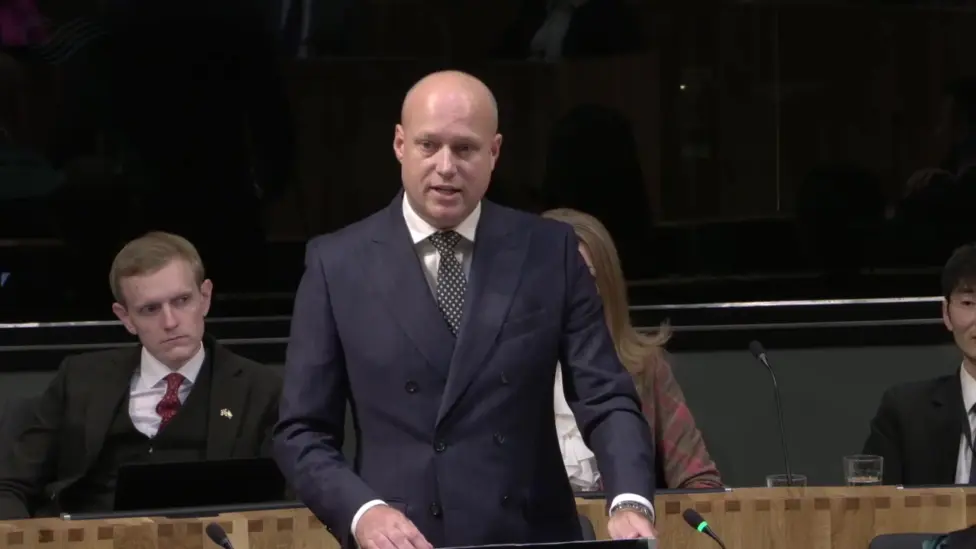
He welcomed Plaid’s promise to deliver 20,000 new homes by 2030 but said: “To deliver at that scale, we’re going to need radical reform of the planning system, we’re going to need ministerial intervention when councils do not deliver the number of homes that their communities need, and we need government and local government to work in partnership with house builders to leverage the billions of pounds that are needed to deliver 20,000 new homes.”
Acknowledging the “very real” housing problems found across Wales, Mr ap Iorwerth insisted these shortages are not driven by immigration.
He accused Mr Thomas of attempting to “create division”, arguing the government must focus on “practical solutions to the practical problem that we face”.
Mr Thomas said nobody is “blaming immigrants” but instead are “blaming uncontrolled and unplanned immigration”, which he described as having a “ripple effect” across the UK.
The opposition leader also questioned the First Minister on houses of multiple occupation (HMOs) which he described as a “big problem” across Wales, suggesting this too was caused, in part, by “uncontrolled immigration”.
Mr Thomas said HMOs are “changing the character” of streets across Wales and said: “Large companies are buying up family homes and turning them into HMOs, and people are not happy with this.”
Describing Mr Thomas as “again seeking to blame”, the First Minister said: “The leader of the opposition says he’s not blaming immigrants whilst then progressing to blame immigrants for the situation.
“He will have to forgive me for always focusing on the practical answers that are needed to the very real problems that we face, and that is a lack of social housing, which is why this government is getting on with building more social housing.”
The First Minister also clashed with another Reform member – Caerdydd Penarth MS Joe Martin.
Mr Martin questioned Mr ap Iorwerth about the “potential risks to public safety” due to the Nation of Sanctuary scheme.
The scheme, introduced in 2019, sets out how the Welsh Government can support refugees and asylum seekers in Wales.
It includes, but is not limited to: making sure refugees can find new accommodation when they leave asylum accommodation; helping refugee or asylum seeker survivors of domestic abuse to get support; and promoting an understanding of Welsh culture and heritage amongst asylum seekers.
Mr Martin said defenders of the scheme would say that it has primarily been used to support Ukrainian refugees but then added he did not know why it was “necessary” to spend additional money “over and above” what Westminster already spends to help Ukrainian families.
Mr Martin continued: “You won’t find anyone seriously contending that they’re the reason the scheme should be scrapped.
“But that’s because, so far, there have been zero instances of Ukrainian refugees trying to behead people in the streets. The same cannot be said for Sudanese asylum seekers.”
His comments were met with with disapproval from members from other parties.
Noting that it seemed the Siambr would “have to get used to this kind of contribution”, the First Minister accused Mr Martin of attempting “to drive wedges between communities”.
He said: “The Nation of Sanctuary policy did house mostly Ukrainian refugees.
“I understand the difficulty that the member has in addressing that issue given the fact that the former leader of Reform in Wales [Nathan Gill] is currently serving a lengthy jail term for taking money from the Russians, and one of the first calls made by their finance spokesperson was to tear down the Ukraine flag flying outside our Senedd.
“Let’s focus here on what unites us. Let’s focus on the leadership that’s incumbent on all of us to show in order to create cohesion between communities.”
The First Minister also noted that June 16 marks the tenth anniversary of the murder of Labour MP Jo Cox. Mr ap Iorwerth said the Senedd’s focus should be on “finding ways of getting over divisions rather than trying to create them”.
Interim Labour leader, Ken Skates, pressed the First Minister on finances, referring to a report by the Institute for Fiscal Studies which, prior to the election, said Plaid Cymru’s promises would require tax increases or cuts to services.
Mr Skates called on the First Minister to share if the Institute was right and, if necessary, to share what cuts will be made.
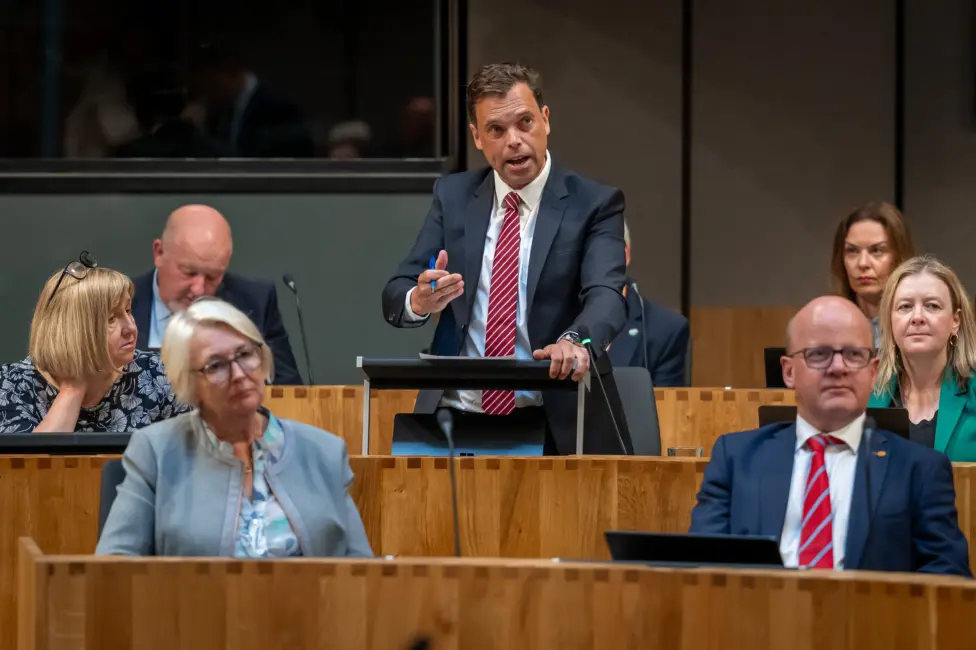
Pledging to “roll [their] sleeves up”, Mr ap Iorweth said his government will find “innovative ways” to “deliver what the people of Wales said they wanted us to.”
He also drew attention to the £55 million announced on June 16 to start delivering Plaid’s childcare offer across Wales.
Mr ap Iorwerth added: “We did more in 27 days as a government than the previous Labour administration did in 27 years.”
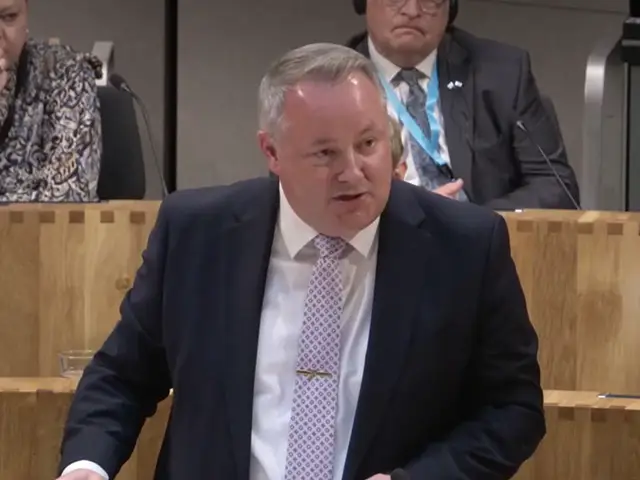
Leader of the Welsh Conservatives, Darren Millar, pressed Mr ap Iorwerth on whether he agreed that a strong defence industry in Wales is “essential” to the economy in a time when “war has returned to Europe”.
Mr Millar also called on the First Minister to pay tribute to the Armed Forces and the Welsh workers who provide them with the resources they need.
Revealing one of his first visits as First Minister was to see Rhondda-based Valley Veterans, Mr ap Iorwerth agreed with the Conservative leader noting the “very important part” the defence sector plays within the Welsh economy.
He added: “I absolutely understand that the changing face of international threats means that we need to make sure that we have the conventional forces in place that are able to stand up to that.
“At the same time, this is a government that will make sure that the ethical engagement around defence is as strong as it can possibly be. I think those are the kinds of assurances that the people of Wales want.”



Community5 hours ago
Police officer hailed hero after midnight sea rescue in Milford Haven
PC swam 100 metres offshore to save distressed woman heard calling for help in darkness A DYFED-POWYS POLICE officer has...


Local Government11 hours ago
Security privately arranged by Mayor at Beating of the Bounds
HAVERFORDWEST TOWN COUNCIL has confirmed that security personnel seen at this year’s Beating of the Bounds were privately arranged and...


Business2 days ago
Celtic Freeport five-year plan puts Milford Haven at centre of green energy future
Strategy promises investment, skilled jobs and new supply chains, but major barriers remain over grid connections, planning and delivery THE...


Education2 days ago
Closure of Ysgol Clydau approved after emotional council debate
COUNCILLORS WARNED RURAL COMMUNITIES WILL REMEMBER DECISION PEMBROKESHIRE councillors have voted to close Ysgol Clydau following an emotional debate over...


Education2 days ago
Manorbier school closure process to continue after narrow council vote
Questions remain over insurance, rebuilding costs and possible legal action by Diocese PEMBROKESHIRE councillors have voted to press ahead with...


Community2 days ago
The father, son and daughter lifeguard trio saving lives in Pembrokeshire
A FATHER, son and daughter are preparing to help keep beachgoers safe on the Pembrokeshire coast this summer as part...


Community2 days ago
Beating of the Bounds brings music, boats and tradition to Haverfordwest
CENTURIES-OLD CEREMONY DRAWS FAMILIES TO THE RIVERSIDE HAVERFORDWEST’S historic Beating of the Bounds returned on Sunday (Jun 14), with boats,...


Community2 days ago
Milford Haven School pupil praised after stepping in during real-life emergency
A YEAR 11 pupil at Milford Haven School has been praised after putting his first aid training into action to...


Community3 days ago
River festival brings crowds to Haverfordwest
A CELEBRATION of the River Cleddau brought crowds into Haverfordwest on Saturday (June 13) as the town’s River Festival returned...


Charity3 days ago
Voices at the Castle hailed as unforgettable night after weather setback
Russell Watson headlines spectacular charity concert at Pembroke Castle A SPECTACULAR evening of live music at Pembroke Castle has been...
-

 Community2 days ago
Pembrokeshire Chess Club crowned Welsh champions
-

 Crime5 days ago
Pembroke Dock teenager sentenced over train strangulation attack
-

 Education4 days ago
Diocese threatens legal action as Manorbier school closure battle intensifies
-

 Crime6 days ago
Man accused of six rapes including alleged Haverfordwest offence
-
Local Government11 hours ago
Security privately arranged by Mayor at Beating of the Bounds
-

 Local Government5 days ago
Taxi suspended after county-wide licensing checks
-

 Crime6 days ago
Brothers found guilty of causing death of Welsh dad in ‘reckless’ race
-

 Crime5 days ago
Currys worker denies stealing £2,500 of store stock