


Charity
Mid and West Wales volunteers recognised for supporting St John’s lifesaving vision

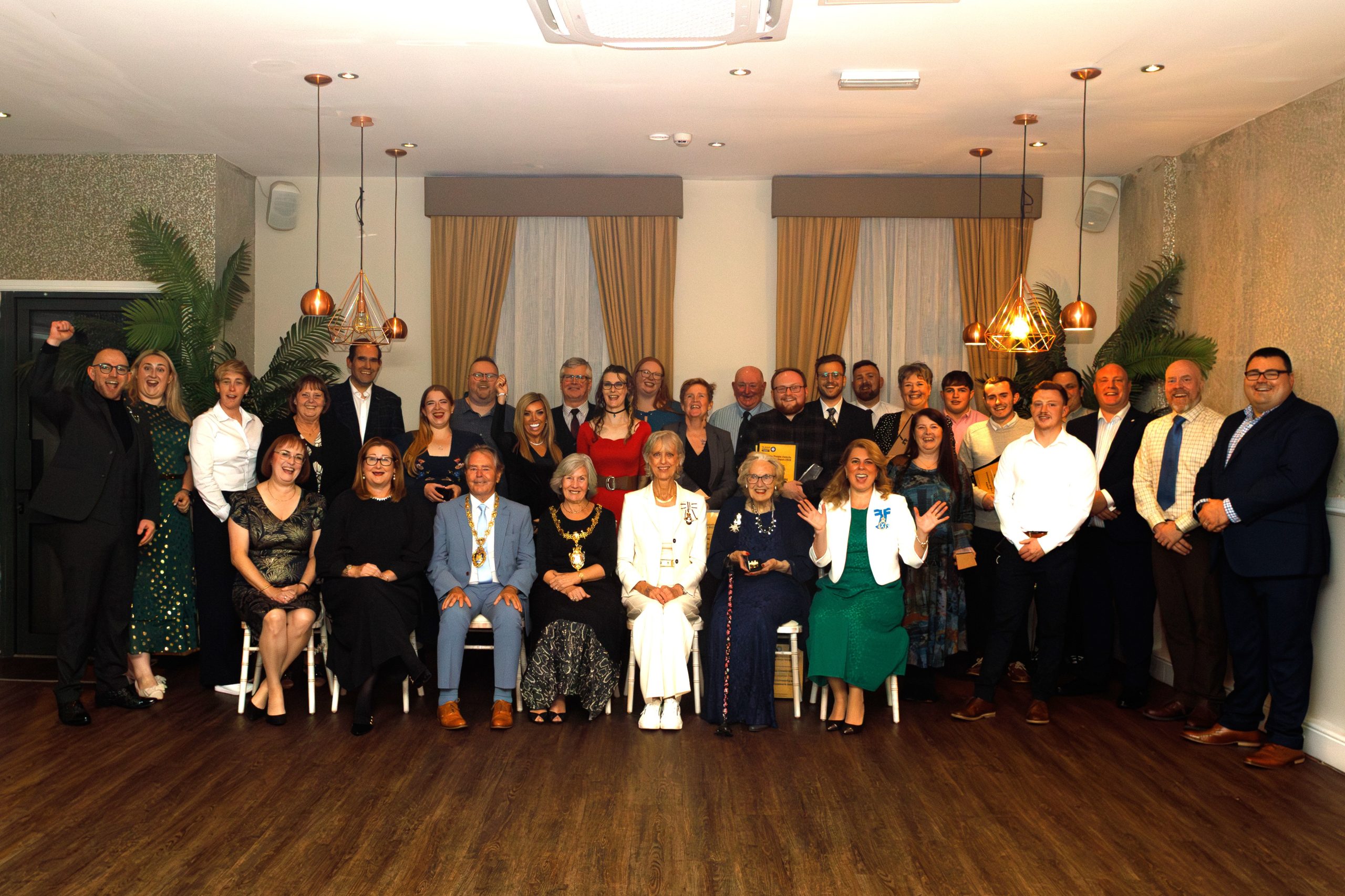
A VOLUNTEER who has dedicated 60 years to volunteering with St John Ambulance Cymru was among those recognised at the charity’s Mid and West Wales Regional Awards for 2025.
The ceremony, which was recently held in Swansea, saw a range of volunteers and staff receive awards and commendations for their work in a range of fields from responding to emergencies to securing funds from trusts and foundations to support the charity’s work.
St John Ambulance Cymru’s Assistant Chief Commissioner (Mid and West Wales), Beth Francis OStJ said: “This ceremony gave us a valuable opportunity to come together to celebrate the great work of St John People from across our Mid and West Wales counties of Dyfed, West Glamorgan and Powys and all they have contributed to their communities.
“The number and quality of the nominations we received was a reminder of the positive impact the charity has on a daily basis, and I know the panel had a difficult task in choosing the winners from the strong list of contenders.”
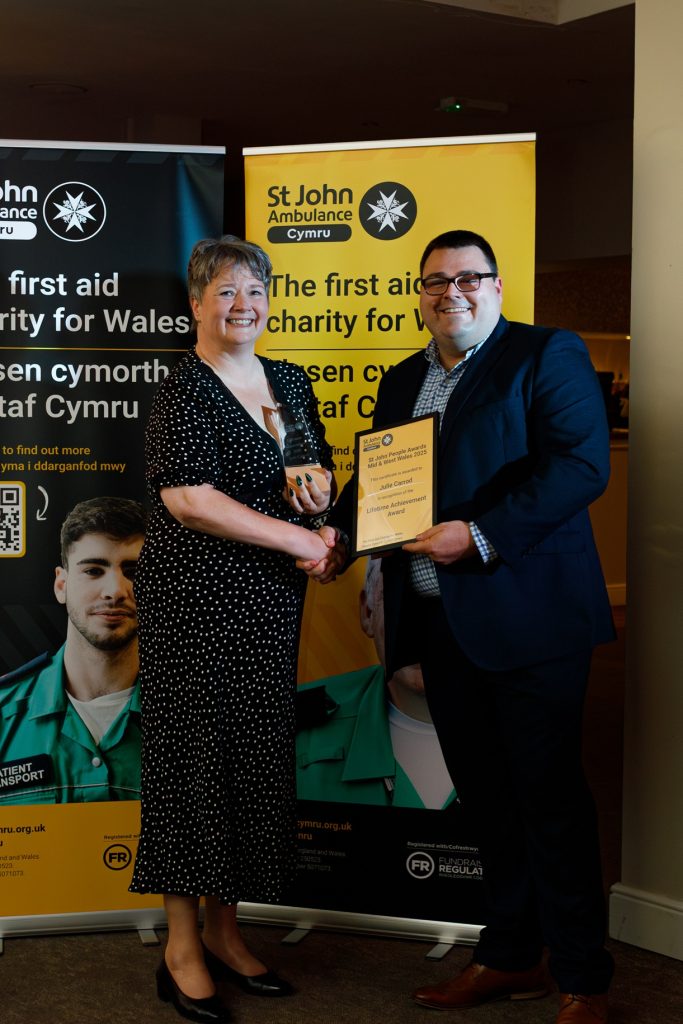
Eunice O’Hara received an Ultra Long Service Medal and 2 Gilt Bars for her 60 years of dedicated service as part of St John Ambulance Cymru’s Fishguard and Haverfordwest Divisions.

Her long and distinguished career as a volunteer and fundraiser saw her become an Officer of the Order of St John, as well as a member of the Gorsedd of the Bards with the title Eunice Urdd Sant Ioan (Eunice of St John) to signify her synonymity with the charity she has dedicated so much effort to supporting.
Another significant award presented during the ceremony was the Gerallt Davies MBE CStJ Memorial Award, presented in memory of the former paramedic and National Paramedic Officer for St John Ambulance Cymru, who sadly died in 2020.
The cup is awarded to a St John Person who is active, dedicated, professional and aims to maintain and develop the highest standards whilst engaging and leading their colleagues. It is judged by an independent panel made up of external partners and members of Gerallt’s family.
The runner up, who received commendation for their impact was Gwion Morgan of Dyfed County, while the winner was Sam Davies, Operations Manager for Dyfed County, who also scooped the Volunteer of the Year Award.
There was also a Lifetime Achievement Award for Will Wall of the Abertawe Division in West Glamorgan, who has been a devoted member since 1988. In this time he supported events at Swansea’s Vetch Field for other three decades and has subsequently been on duty to support 200 games at the Swansea.com Stadium, as well as other events across the county.
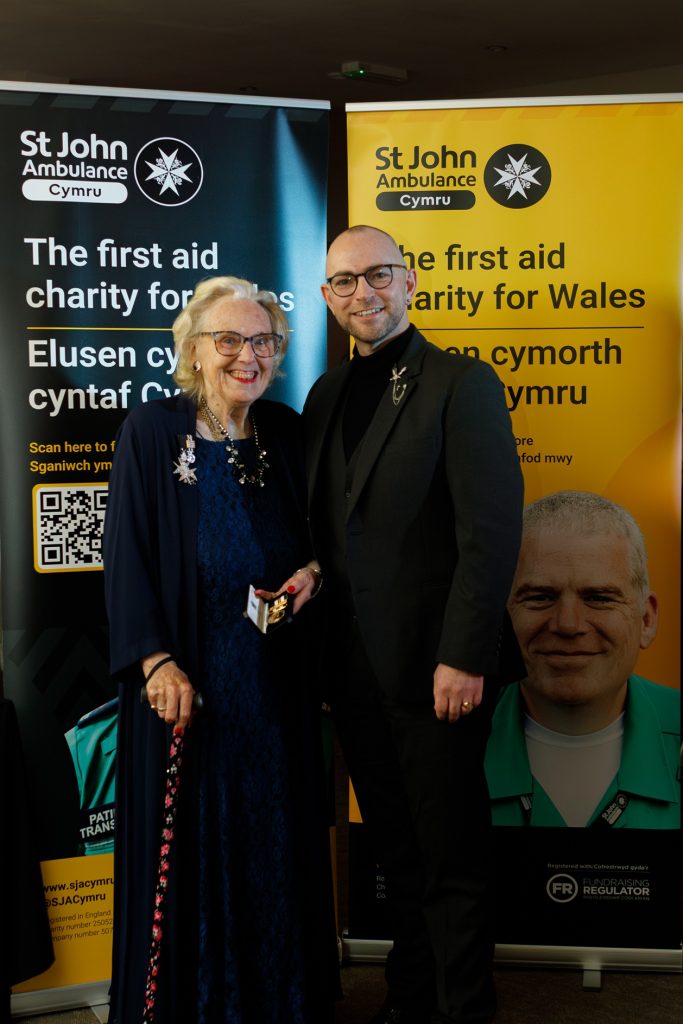
Julie Carrod was the other recipient of the Lifetime Achievement Award, having dedicated almost 30 years of service to St John Ambulance Cymru in a range of roles including first responder, County Training Manager and Deputy Commissioner in Powys.
To find out more about St John Ambulance Cymru and to sign-up to volunteer with the charity, visit www.sjacymru.org.uk.


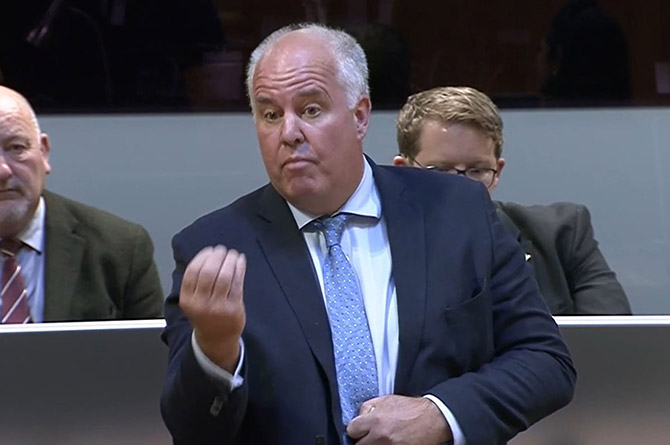
MINISTERS are facing calls to explain what checks were in place after the Ministry of Defence confirmed that an Afghan national resettled in the Vale of Glamorgan was convicted of a sexual offence.
Conservative Senedd Member Andrew RT Davies said the case raises “serious questions” for authorities after months of correspondence about the use of the Holiday Inn Express in Rhoose as temporary accommodation under Afghan resettlement arrangements.
The issue was first raised by Mr Davies in August last year, after he met Ministry of Defence officials about the decision to house Afghan families at the hotel.
Following that meeting, he asked whether anyone housed in the Vale of Glamorgan under Afghan resettlement schemes had been charged with or convicted of sex offences or other crimes.
Delayed response
The Home Office initially refused to provide the information, saying it would exceed the cost limit for Freedom of Information requests because thousands of Afghan national records would have to be checked.
However, the Ministry of Defence has now confirmed that it holds information relating to ten cases in which a person relocated to the UK under the Afghan Relocations and Assistance Policy or Afghan Response Route later committed a criminal offence.
Of those ten cases, five people were resettled under ARAP, three under ARR, while the MOD said it did not hold information on which route applied to the remaining two.
The department also confirmed that one person was based in the Vale of Glamorgan at the time the offence was committed and had been convicted of a sexual offence.
The MOD said the individual is no longer part of the Afghan Resettlement Programme.
A further two of the ten cases related to sexual offences, bringing the total number of sexual offence cases held by the MOD to three.
‘Public safety implications’
Mr Davies said: “It’s disgraceful that the Government failed to provide this information for so long.
“After authorities chose to use the Holiday Inn Express in Rhoose for temporary accommodation, I asked them to confirm if any individuals relocated under various Afghan resettlement schemes were convicted of sex offences.
“But they failed to answer the request repeatedly.
“Now it has confirmed an Afghan resettled in the Vale of Glamorgan was convicted of a sex crime, the Government has serious questions to answer.
“There are public safety implications that must be addressed.”
MOD caveat
In its response, the Ministry of Defence stressed that its figures should not be treated as a complete picture.
The department said that once an eligible person is resettled in the UK, integration and ongoing support becomes the responsibility of the relevant local authority.
It added that the MOD does not routinely collect data on people once they begin the resettlement and integration process.
The MOD also said it does not hold information on the specific category of sexual offences committed.
Mr Davies has previously raised concerns from residents about whether statements made about those housed at the hotel accurately reflected the schemes under which they had been resettled.
He said constituents deserved transparency over both the resettlement process and any public safety issues arising from it.

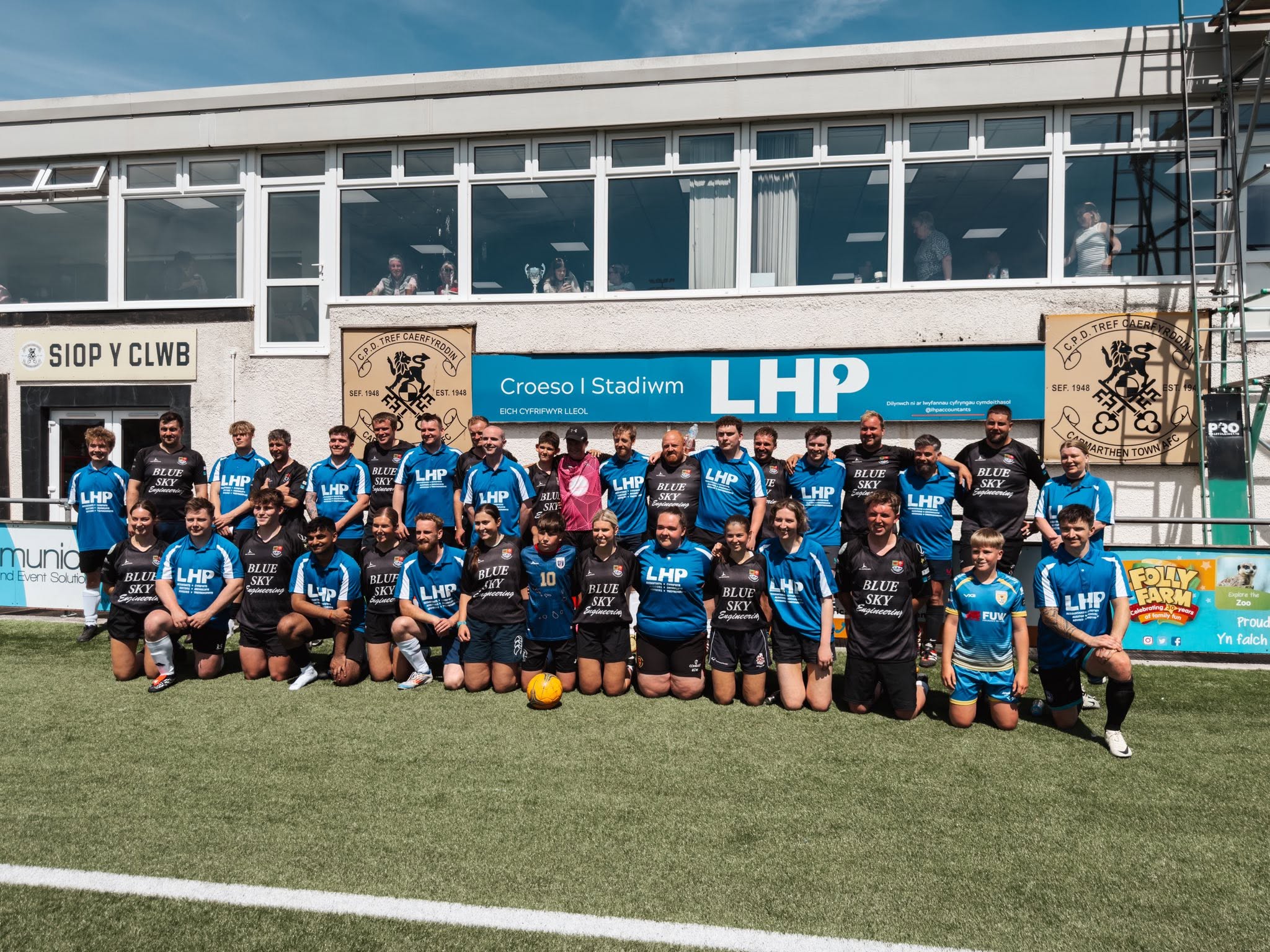
A CHARITY football event held at Carmarthen Town AFC has raised £10,025 for two key services at Glangwili Hospital.
The event, organised by LHP Accountants, took place on Saturday and raised money for the Chemotherapy Unit and the Special Care Baby Unit through Hywel Dda Health Charities.
Organisers said they had been “absolutely overwhelmed” by the support shown on the day, thanking everyone who played, donated, sponsored, volunteered, bought raffle tickets, bid in the auction or attended the event.
They said: “This achievement belongs to every single person who supported us. Thank you for helping us make a real difference.”
The event was also filmed by S4C’s Heno, with coverage due to air tonight between 7:00pm and 7:30pm.

Caption:
Players and supporters at Carmarthen Town AFC helped raise £10,025 for Hywel Dda Health Charities.

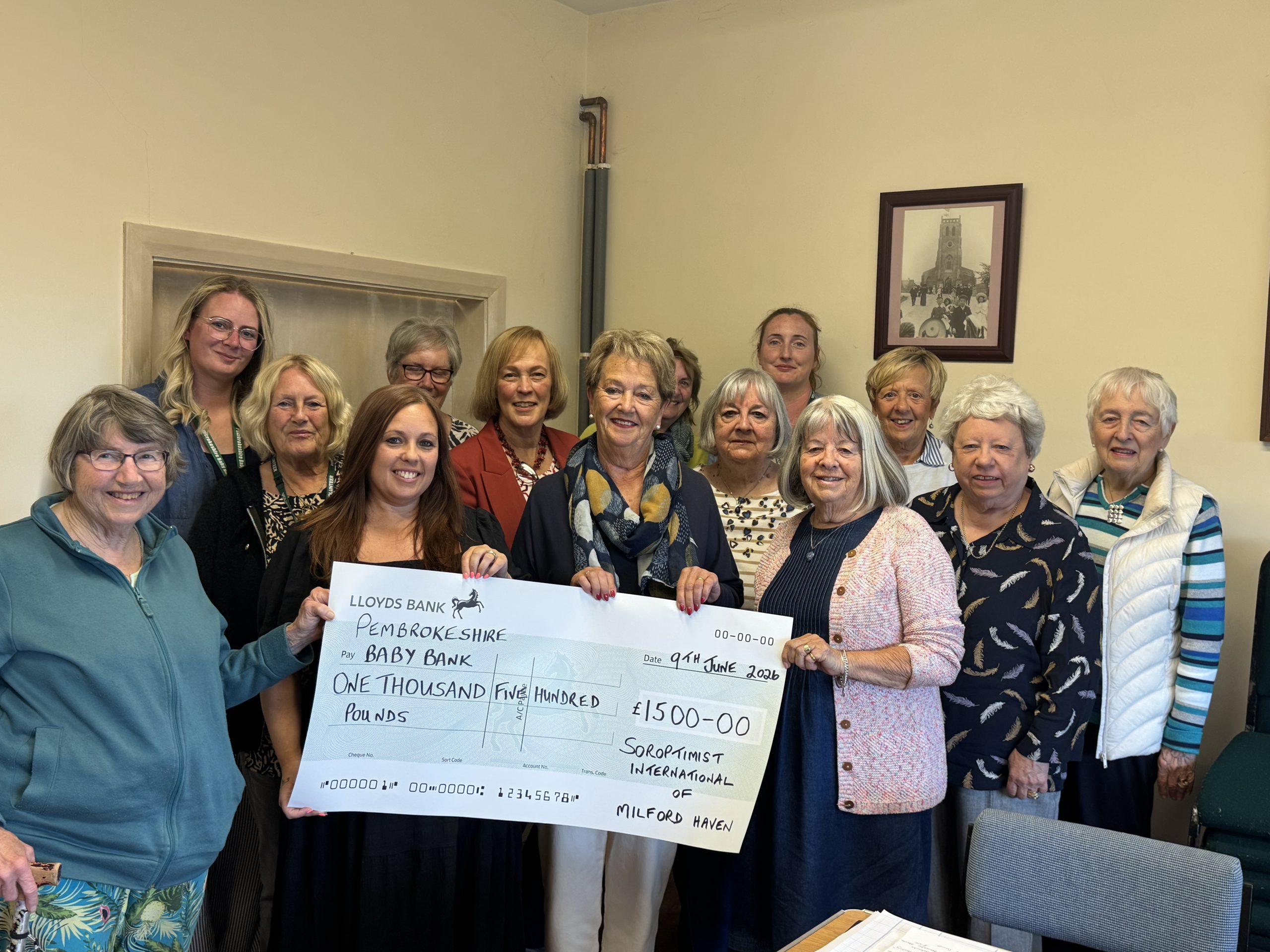
MEMBERS of Soroptimists International Milford Haven have raised £1,500 for Pembrokeshire Baby Bank, the charity chosen by president Heather Pippen as her Charity of the Year for 2025/26.
A series of fundraising events were organised throughout the year, including a successful fashion event held at Image by Vanessa on Milford Marina.
The funds raised will help support the vital work carried out by the Pembrokeshire Baby Bank, which provides essential items to local families facing financial hardship.
A cheque for £1,500 was formally presented to volunteers from the Pembrokeshire Baby Bank during one of the Soroptimists’ business meetings.
Founded in 2019, Pembrokeshire Baby Bank supports families across the county who are experiencing financial difficulties. The charity accepts referrals from professionals and provides assistance to any eligible family living in Pembrokeshire, without discrimination.
Many of the items distributed to families are donated by members of the local community, while additional supplies are purchased using funds raised through donations and fundraising activities.


Community1 hour ago
Police officer hailed hero after midnight sea rescue in Milford Haven
PC swam 100 metres offshore to save distressed woman heard calling for help in darkness A DYFED-POWYS POLICE officer has...


Local Government7 hours ago
Security privately arranged by Mayor at Beating of the Bounds
HAVERFORDWEST TOWN COUNCIL has confirmed that security personnel seen at this year’s Beating of the Bounds were privately arranged and...


Business1 day ago
Celtic Freeport five-year plan puts Milford Haven at centre of green energy future
Strategy promises investment, skilled jobs and new supply chains, but major barriers remain over grid connections, planning and delivery THE...


Education1 day ago
Closure of Ysgol Clydau approved after emotional council debate
COUNCILLORS WARNED RURAL COMMUNITIES WILL REMEMBER DECISION PEMBROKESHIRE councillors have voted to close Ysgol Clydau following an emotional debate over...


Education1 day ago
Manorbier school closure process to continue after narrow council vote
Questions remain over insurance, rebuilding costs and possible legal action by Diocese PEMBROKESHIRE councillors have voted to press ahead with...

Community2 days ago
The father, son and daughter lifeguard trio saving lives in Pembrokeshire
A FATHER, son and daughter are preparing to help keep beachgoers safe on the Pembrokeshire coast this summer as part...

Community2 days ago
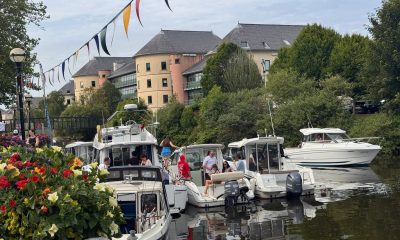
Beating of the Bounds brings music, boats and tradition to Haverfordwest
CENTURIES-OLD CEREMONY DRAWS FAMILIES TO THE RIVERSIDE HAVERFORDWEST’S historic Beating of the Bounds returned on Sunday (Jun 14), with boats,...


Community2 days ago
Milford Haven School pupil praised after stepping in during real-life emergency
A YEAR 11 pupil at Milford Haven School has been praised after putting his first aid training into action to...


Community2 days ago
River festival brings crowds to Haverfordwest
A CELEBRATION of the River Cleddau brought crowds into Haverfordwest on Saturday (June 13) as the town’s River Festival returned...


Charity2 days ago
Voices at the Castle hailed as unforgettable night after weather setback
Russell Watson headlines spectacular charity concert at Pembroke Castle A SPECTACULAR evening of live music at Pembroke Castle has been...
-

 Community2 days ago
Pembrokeshire Chess Club crowned Welsh champions
-

 Crime5 days ago
Pembroke Dock teenager sentenced over train strangulation attack
-

 Education4 days ago
Diocese threatens legal action as Manorbier school closure battle intensifies
-

 Crime5 days ago
Man accused of six rapes including alleged Haverfordwest offence
-
Local Government7 hours ago
Security privately arranged by Mayor at Beating of the Bounds
-

 Local Government4 days ago
Taxi suspended after county-wide licensing checks
-

 Crime5 days ago
Brothers found guilty of causing death of Welsh dad in ‘reckless’ race
-

 Crime5 days ago
Currys worker denies stealing £2,500 of store stock