


News
Call for Welsh public to help shape next chapter of Future Generations Act


PEOPLE across Wales should be involved in shaping the next phase of the Well-being of Future Generations Act, according to a new Senedd committee report examining how the landmark law is working in practice.
The report, published by the Senedd’s Equality and Social Justice Committee, follows a post-legislative review of the Well-being of Future Generations (Wales) Act 2015. The legislation requires public bodies to consider the long-term impact of their decisions on the environment, society, culture and the economy.
The cross-party committee – including members from Welsh Labour, Plaid Cymru, the Welsh Conservatives and the Welsh Liberal Democrats – assessed how the Act is being implemented and where improvements may be needed.
The Future Generations Commissioner for Wales, Derek Walker, welcomed the report and its recommendation that communities across the country should help shape how the law develops in the years ahead.
The Act itself was originally developed following a national conversation in 2014 known as “The Wales We Want”, in which more than 5,000 people contributed ideas about the country’s long-term priorities.

The committee’s review comes shortly after the publication of the Future Generations Report 2025, a five-year assessment by the Commissioner examining progress towards Wales’ national well-being goals. The report highlighted areas where further work is needed, including environmental protection, economic resilience, tackling health inequalities and supporting Welsh culture.
Mr Walker said the Senedd committee’s findings reinforced the need for the legislation to evolve.
“Today’s cross-party report from the Senedd’s Social Justice Committee is an important moment for the future of the Well-being of Future Generations Act,” he said.
“It is encouraging to see politicians from across parties recognising both the progress the Act has helped to drive and the need to strengthen it for the years ahead.”
He said the committee had echoed several recommendations from his own report, including the need for a formal review of the law and renewed public engagement.
“If the Act is to remain relevant and capable of meeting the challenges Wales faces, it must continue to evolve and be backed by the legal strength required to deliver real change,” he added.
The Commissioner also highlighted the role his office plays in helping public bodies apply the Act in practice, promoting long-term planning, prevention and collaboration when decisions are made.

The legislation has influenced decisions across a range of sectors, including transport planning, education policy and community-led projects.
However, Mr Walker said further progress will depend on continued public involvement.
“Just as thousands helped shape the Act more than a decade ago, it will be crucial for people across Wales to help inform how it develops in the future,” he said.
The Commissioner has also proposed that the Senedd establish a “Committee for the Future” to ensure long-term thinking is embedded in Welsh policymaking.
His Future Generations Report 2025 set out 50 recommendations aimed at strengthening how the Act is implemented across Wales.


HAVERFORDWEST TOWN COUNCIL has confirmed that security personnel seen at this year’s Beating of the Bounds were privately arranged and paid for by the town’s Mayor.
The council issued a statement on Tuesday (June 16) following queries about the presence of security staff at the civic event.
It confirmed that the arrangements were made by the Mayor and Admiral of the Port, Councillor Randell Thomas-Turner, and were not commissioned by the council.
The statement said the decision was taken by the Mayor as a personal precaution in response to safety concerns connected with his role as a councillor.
NO SPECIFIC THREAT
The council stressed that the presence of security personnel should not be interpreted as an indication of any specific threat to the event, participants, or members of the public.
It added that the event “proceeded safely and successfully” and that there were no incidents of concern during the day.
The Beating of the Bounds is one of Haverfordwest’s oldest civic traditions, with the Mayor and Sheriff travelling to the White Stone, the historic boundary marker of the Port of Haverfordwest, to reaffirm the ancient boundaries and rights of the town.
Hundreds of people attended this year’s event, which included a flotilla, music, entertainment, stalls and family activities along the riverside.
COUNCIL CONDEMNS ABUSE
In its statement, the council said it remained committed to ensuring civic events were “welcoming, inclusive and family-friendly” occasions.
It said appropriate planning and risk management arrangements were undertaken for all public events so residents and visitors could attend with confidence.
The council added: “While the security arrangements were a personal matter for the Mayor, the council recognises the importance of supporting the wellbeing and safety of all elected members and staff.
“The council condemns all forms of abuse, intimidation and threatening behaviour directed towards those serving their communities.

“Respectful public discourse is fundamental to local democracy, but there is no place for conduct that seeks to harass, threaten or intimidate others.”
The council thanked everyone who attended and contributed to what it described as another successful Beating of the Bounds, celebrating Haverfordwest’s history, traditions and community spirit.

NEW roofs, structural upgrades and solar panels have been installed across three residential blocks at Fleming Crescent as part of a major housing improvement scheme.
Pembrokeshire County Council said the project has delivered safer, warmer and more energy-efficient homes for residents, with the full replacement of roofs serving 54 flats.
The works also included structural improvements designed to support the long-term performance of the buildings, alongside the installation of solar panels to help improve energy efficiency, reduce carbon emissions and lower energy costs for tenants.

The council received a funding contribution from the Welsh Government through the Optimised Retrofit Programme, which supports energy-efficiency improvements alongside wider investment works.
The scheme was completed on schedule, with W B Griffiths & Son Ltd appointed as the main contractor.
Cabinet Member for Housing, Cllr Michelle Bateman said: “Delivering a project of this scale on schedule is a significant achievement.
“The new roofs and external upgrades will help reduce future maintenance issues and improve the long-term resilience of the buildings, while the solar panels form an important part of our wider decarbonisation programme.
“By working closely with W B Griffiths & Son Ltd, we have delivered high-quality improvements that will benefit tenants both now and in the future.
“Pembrokeshire County Council continues to invest in housing improvements across the county, ensuring homes remain safe, modern, energy efficient and fit for the future.”
The project has also received national recognition after being shortlisted for a Constructing Excellence in Wales Award.
Neil Griffiths, Managing Director of W B Griffiths & Son Ltd, said: “We are proud to have delivered this important project at Fleming Crescent to a high standard and within the agreed timescales.
“The combination of full roof replacement and solar panel installation will provide long-term value, improve the performance of the buildings and support better outcomes for residents.

“It has been a pleasure to work in partnership with Pembrokeshire County Council on this scheme.”
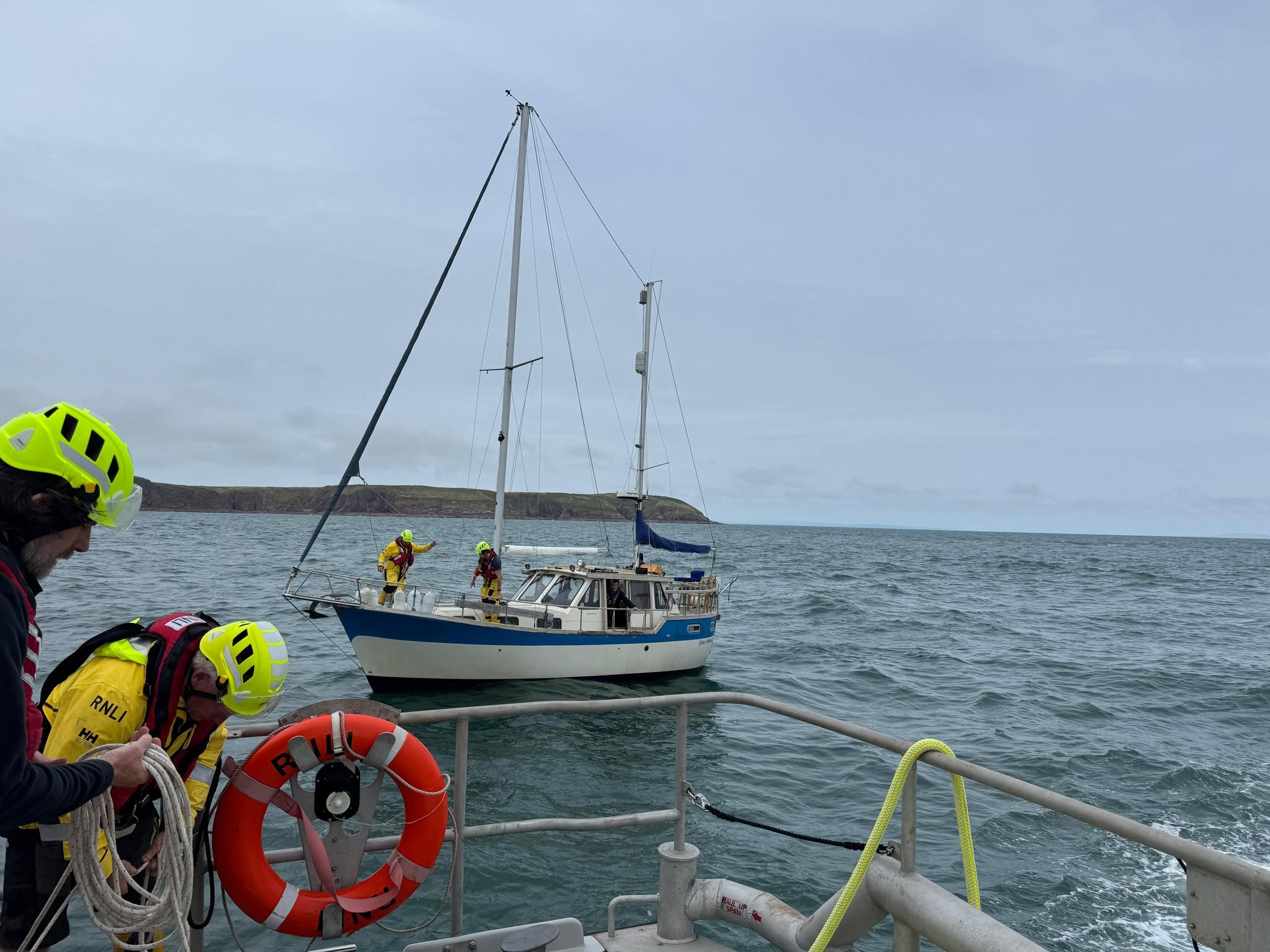
A YACHT was towed back to Tenby after its skipper became unwell off Caldey Island.
Tenby’s all-weather lifeboat was requested to launch at 1:40pm on Monday (Jun 15), after the coastguard received a call from the occupants of a yacht reporting that the skipper had become ill around one mile south of Caldey Island.
The volunteer crew quickly made their way to the vessel, which had three people and a dog on board.
Once alongside, the lifeboat crew discovered that the skipper was suffering badly from seasickness and that the other two people on board were unable to sail the yacht themselves.
After a full assessment by the coxswain, it was decided that the safest course of action was to tow the yacht back to Tenby. The vessel was drifting with the tide towards Caldey Island and was also considered a potential navigational hazard to other boats.
Two lifeboat crew members were placed aboard the yacht to help set up the tow and to monitor the unwell skipper during the journey back.
After a tow of around an hour, the yacht was placed on the lifeboat mooring in the calmer waters of North Bay.
The lifeboat then returned to station, arriving back at 3:15pm.



Business1 day ago
Celtic Freeport five-year plan puts Milford Haven at centre of green energy future
Strategy promises investment, skilled jobs and new supply chains, but major barriers remain over grid connections, planning and delivery THE...


Education1 day ago
Closure of Ysgol Clydau approved after emotional council debate
COUNCILLORS WARNED RURAL COMMUNITIES WILL REMEMBER DECISION PEMBROKESHIRE councillors have voted to close Ysgol Clydau following an emotional debate over...


Education1 day ago
Manorbier school closure process to continue after narrow council vote
Questions remain over insurance, rebuilding costs and possible legal action by Diocese PEMBROKESHIRE councillors have voted to press ahead with...

Community1 day ago
The father, son and daughter lifeguard trio saving lives in Pembrokeshire
A FATHER, son and daughter are preparing to help keep beachgoers safe on the Pembrokeshire coast this summer as part...

Community2 days ago
Beating of the Bounds brings music, boats and tradition to Haverfordwest
CENTURIES-OLD CEREMONY DRAWS FAMILIES TO THE RIVERSIDE HAVERFORDWEST’S historic Beating of the Bounds returned on Sunday (Jun 14), with boats,...


Community2 days ago
Milford Haven School pupil praised after stepping in during real-life emergency
A YEAR 11 pupil at Milford Haven School has been praised after putting his first aid training into action to...


Community2 days ago
River festival brings crowds to Haverfordwest
A CELEBRATION of the River Cleddau brought crowds into Haverfordwest on Saturday (June 13) as the town’s River Festival returned...


Charity2 days ago
Voices at the Castle hailed as unforgettable night after weather setback
Russell Watson headlines spectacular charity concert at Pembroke Castle A SPECTACULAR evening of live music at Pembroke Castle has been...


Local Government3 days ago
Council admits 74 rights of way complaints remain unresolved
Key post vacant since February as walker raises safety concerns over paths near Llanteg and Amroth PEMBROKESHIRE COUNTY COUNCIL has...


Education4 days ago
Diocese threatens legal action as Manorbier school closure battle intensifies
Church says council could face judicial review over fire-hit school A BITTER row over the future of Manorbier Church in...
-

 Community2 days ago
Pembrokeshire Chess Club crowned Welsh champions
-
Education4 days ago
Diocese threatens legal action as Manorbier school closure battle intensifies
-

 Crime7 days ago
Haverfordwest pair accused of £80,000 rogue trading frauds
-

 Crime5 days ago
Man accused of six rapes including alleged Haverfordwest offence
-

 Crime5 days ago
Pembroke Dock teenager sentenced over train strangulation attack
-

 Local Government4 days ago
Taxi suspended after county-wide licensing checks
-

 Crime4 days ago
Currys worker denies stealing £2,500 of store stock
-

 Crime5 days ago
Brothers found guilty of causing death of Welsh dad in ‘reckless’ race