


Ministry of Defence
Could Milford Haven be a target? Are we exposed as UK relies on US for missile defence?


Cold War fears resurface as Iran’s reach grows and Britain admits it has no independent shield
PEMBROKESHIRE has long been considered a strategic target — and during the Cold War, the county’s energy infrastructure and Atlantic access placed it firmly on the radar of military planners.
Today, those same strengths are raising uncomfortable questions once again.
As tensions rise following Iran’s attempted strike on a UK–US base at Diego Garcia on Saturday (March 21), the debate has shifted sharply: not whether Britain is under immediate threat — but whether it would be protected if that ever changed.

Strategic target
Milford Haven is home to some of the UK’s most critical energy assets, including major LNG terminals and oil infrastructure that supply a significant share of the nation’s gas.
In strategic terms, such facilities would rank among the most valuable economic targets in any high-level conflict.

For many in Pembrokeshire, that reality is nothing new. During the Cold War, the area was widely regarded as a potential target due to its importance to Britain’s energy security.
Lessons from Diego Garcia
The attempted strike on Diego Garcia has become a defining moment in the current crisis.
The joint UK–US base is a heavily defended military installation, supported by advanced radar systems and US naval assets. Reports indicate that one of the incoming missiles was intercepted before it could reach its target, while another failed.
But that success raises a more troubling question.
If a missile can be intercepted over a fortified base in the Indian Ocean, what happens when the target is a civilian energy hub in west Wales?

No shield over Britain
The UK has no dedicated system to intercept long-range ballistic missiles over its own territory.
While RAF Fylingdales provides early warning and tracking, it cannot stop an incoming threat.

Britain’s air defence network is designed to deal with aircraft, drones and cruise missiles — not high-speed ballistic weapons travelling through space.
In practical terms, if a missile were ever heading toward a location such as Milford Haven, there is no British-operated system that could reliably stop it at the last moment.
Reliance on the United States
Instead, any interception attempt would fall to the United States and wider NATO systems.
These include:
- Aegis Ashore missile defence bases in Eastern Europe
- US Navy warships equipped with SM-3 interceptors
- Integrated NATO tracking and command networks
These systems are capable of striking a missile in space during its midcourse phase — but only if the missile passes within range.
If it does not, there may be no interception at all.
Even when an attempt is made, success is not guaranteed. Analysts estimate that such systems have a probability of success of between 50 and 80 per cent under test conditions, meaning multiple interceptors are often fired at a single target to improve the odds.
Europe now “within range”
The debate has intensified following warnings from Israel that Iran’s latest missiles could reach far beyond the Middle East.
Israeli officials have claimed that the system used in the Diego Garcia attempt was a two-stage ballistic missile with a range of around 4,000 km — potentially placing parts of Europe within reach.
Cities such as London, Paris and Berlin have been cited as falling within the outer limits of that range, although experts stress that range on paper does not necessarily translate into reliable, repeatable strike capability.
Experts divided
Defence analysts remain split.
Some say the attempted long-range strike marks a clear step forward in Iran’s capabilities, moving the threat from theoretical to credible.
Others caution that Iran’s operational missile arsenal has historically been limited to around 2,000 km, suggesting that any longer-range capability may still be experimental rather than deployable.
UK Government response
Ministers have sought to calm fears, insisting there is no current evidence that Iran has either the intent or the capability to strike the UK mainland.
At the same time, the government has condemned Iran’s actions as “reckless” and emphasised that Britain will work with allies to protect its interests.
That response reflects a broader reality.
Deterrence, not defence
Britain’s primary protection is not interception — it is deterrence.
Any successful strike on UK soil would almost certainly trigger a major NATO response, making such an attack extraordinarily risky for any adversary.
But deterrence does not eliminate vulnerability.
The bottom line
Pembrokeshire’s strategic importance has not changed — but the conversation around long-range threats has.
The UK can detect a missile. It can track it. It can coordinate with allies and attempt an interception at distance.
But when it comes to stopping it over Britain itself, there is no independent shield — only reliance on US and NATO systems being in the right place at the right time.
For communities built around critical infrastructure like Milford Haven, that raises a stark and uncomfortable question:
If the unthinkable ever became reality, who — if anyone — would be able to stop it?


Flag-raising forms part of national show of support for service personnel, veterans, reservists and families
LANDMARC Support Services has raised the Armed Forces Day flag at Castlemartin Training Area to mark Armed Forces Week 2026.
The event, held in partnership with the Defence Infrastructure Organisation, formed part of a national celebration across the Defence Training Estate, with flags being flown at military training establishments across the UK.
Landmarc said the gesture was intended to show appreciation for serving personnel, veterans, reservists, military families and the wider Armed Forces community.
The company works with the Ministry of Defence and DIO to manage and operate the Defence Training Estate, providing training support, rural land maintenance and facilities management to help military personnel train effectively.

Support for veterans
Landmarc has also highlighted its work supporting service leavers as they move into civilian employment.
The company recently held a careers event called Landmarc Pathways: From Service to Second Career, offering service leavers guidance, networking opportunities and information about career routes within Landmarc and beyond.
It said it plans to continue running careers-focused initiatives for members of the Armed Forces community.
Landmarc has also been nominated three times at this year’s British Forces in Business Awards, which recognise former military personnel in second careers and employers who support veterans.
The company has expanded its partnership with X-Forces Enterprise by extending its Guaranteed Interview Scheme for veterans, reservists and military spouses and partners to include the Cadets in Enterprise programme.
The scheme forms part of Landmarc’s commitment to the Armed Forces Covenant, which it re-signed in 2024 after achieving the Defence Employer Recognition Scheme Gold Award.
‘Proud to show support’
Mark Neill, Managing Director at Landmarc, said: “Our recent careers event enabled us to provide practical support to service personnel and veterans preparing for the transition into civilian employment.
“Understanding how to translate military skills for civilian roles, build professional networks and explore new career pathways can make a significant difference to achieving a successful transition.

“As a veteran myself, I know first-hand how important Armed Forces Week is in recognising the contribution of those who serve, as well as the wider Armed Forces community, and we are proud to show our support during this special week.”
Brigadier Hatcher, DIO’s Head of Overseas and Training Region, added: “Armed Forces Week provides an important opportunity to recognise and thank the people who serve as well as their families, veterans and reservists.
“It’s fantastic to see the public, businesses, and fellow service members come together in support. Alongside our colleagues at Landmarc, we are proud to raise the flag at sites across the UK to honour their contribution.”
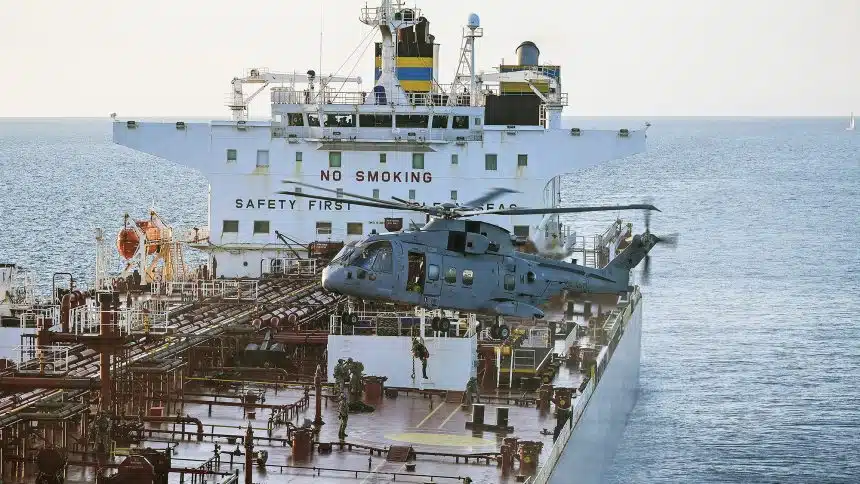
Sanctioned vessel boarded in first UK-led operation of its kind as Britain targets Moscow’s oil revenues
ROYAL MARINE COMMANDOS have boarded and seized a sanctioned Russian-linked oil tanker in the English Channel in a major UK-led military operation targeting Moscow’s so-called “shadow fleet”.
The vessel, named Smyrtos, was intercepted in the early hours of Sunday morning (Jun 14) as it attempted to pass through the Channel.
The six-hour operation involved Royal Marines, officers from the National Crime Agency, HMS Sutherland, HMS Ledbury, RAF P-8 maritime surveillance aircraft, and helicopters including Chinooks, Merlin Mk4s and Wildcats.
The tanker, which has been linked to Russia’s efforts to evade international oil sanctions, is now being held and monitored off the south coast of England while investigations continue.
The Prime Minister, Sir Keir Starmer, said he had directed British forces to intercept the vessel, describing the operation as another blow to Russia’s war economy.
He said: “This successful operation delivers yet another blow to Russia and reminds those fuelling Putin’s war in Ukraine that we will not let them hide.”
The Ministry of Defence said it was the first UK-led operation of its kind against a Russian shadow fleet vessel.

The Smyrtos was reportedly sailing under a Cameroonian flag, although shipping reports say questions had already been raised over its registry status.
The tanker had travelled from Ust-Luga in Russia and was understood to be heading towards Port Said in Egypt. Some reports said it was carrying hundreds of thousands of barrels of Russian crude oil.
The “shadow fleet” is the name given to a network of ageing and often obscurely owned tankers used to move Russian oil around the world despite sanctions imposed after the invasion of Ukraine.
Western governments say the fleet helps generate billions of pounds for Vladimir Putin’s war machine.
Defence Secretary Dan Jarvis praised those involved in the operation, saying missions of this kind required “skill, professionalism and courage”.

Ukraine’s President Volodymyr Zelenskyy thanked the UK for taking action, and called for European countries to go further by passing laws allowing not only detention of suspect vessels but the confiscation of their cargoes.
The operation was carried out in coordination with French authorities and marks a significant escalation in Britain’s enforcement of sanctions at sea.
Officials said the vessel would be monitored for environmental and safety concerns while the investigation continues.
Photo caption: Royal Marines board the tanker Smyrtos during the UK-led operation in the English Channel (Pic: Ministry of Defence / UK Defence Journal).
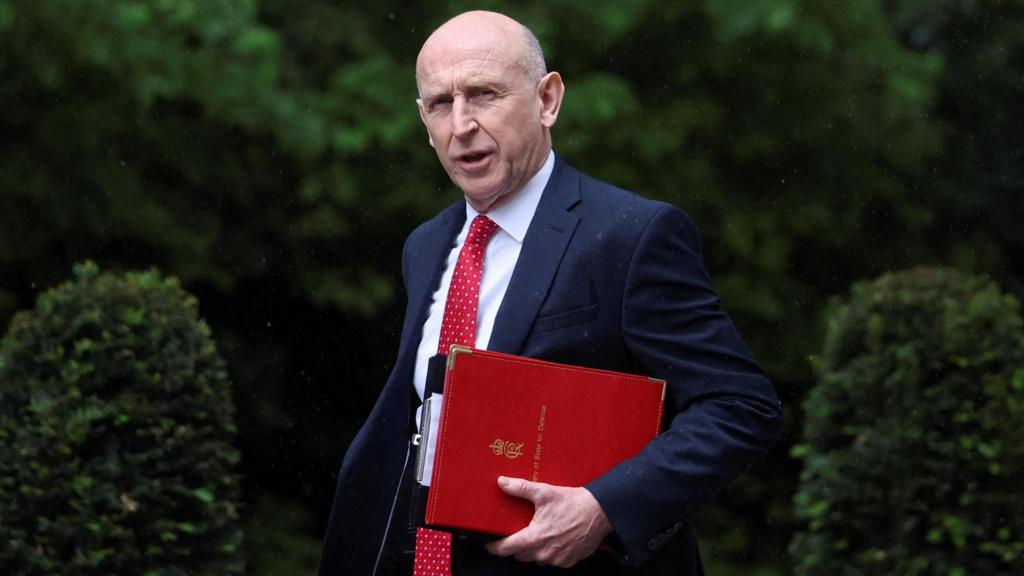
DEFENCE SECRETARY John Healey has resigned in a major blow to Sir Keir Starmer, warning that the Government’s defence spending plans risk leaving Britain less safe at a time of growing international danger.
In a sharply worded resignation letter to the Prime Minister, Mr Healey said he could no longer support the Government’s Defence Investment Plan, arguing that the financial settlement failed to provide the Armed Forces with the resources needed to meet the threats facing the UK.
His departure is one of the most serious resignations of Sir Keir’s premiership and comes ahead of the expected publication of the long-delayed defence plan, which is intended to set out how Britain will rebuild military capability, improve readiness and respond to growing threats from Russia, instability in the Middle East, and wider global insecurity.
The row centres on the pace and scale of defence spending. Sir Keir has pledged to increase defence spending to 2.5% of GDP by 2027 and 3% by 2034, but Mr Healey had pushed for a faster rise, arguing that the pressure on the Armed Forces is immediate and cannot be pushed into the next decade.
The former Defence Secretary is understood to have wanted a stronger commitment to reach 3% by 2030, amid warnings that the Army, Navy and RAF face major gaps in equipment, personnel and readiness.
In his letter, Mr Healey criticised both Number 10 and the Treasury, saying the Prime Minister had been unable, and the Treasury unwilling, to provide the funding needed. He warned that the proposed settlement would force unacceptable choices, including risks to operational readiness and the safety of service personnel.
A resignation with real force
Cabinet resignations are not unusual in Westminster, but this one is different.
Mr Healey was not regarded as a loose cannon or serial rebel. He was seen as a loyal, experienced and serious figure, closely associated with Labour’s attempt to present itself as a responsible party of government on defence and national security.
That is why his resignation is so damaging.
He is not leaving over a personal scandal, a reshuffle grievance, or a minor policy disagreement. He is leaving while accusing the Government of failing to fund the defence of the country properly.
For any Prime Minister, that is a dangerous charge. For Sir Keir Starmer, who has repeatedly sought to present Labour as strong on national security, it is politically explosive.
The timing is also significant. Britain is preparing for a NATO summit next month, Ukraine remains at war with Russia, tensions in the Middle East remain high, and European countries are under growing pressure to take more responsibility for their own defence as US priorities shift.

Mr Healey’s resignation turns what had been a technical dispute between departments into a full political crisis.
The Treasury problem
At the heart of the row is a familiar Whitehall battle: the Ministry of Defence says the threats are growing and the money must follow; the Treasury says the public finances are already under severe pressure.
Rachel Reeves faces demands from every direction. The NHS, schools, local government, welfare, transport and energy all want more money. Defence is now making the same argument, but with one added warning: delay could have consequences not only for public services, but for national security.
That makes the politics difficult. Spending more on defence means either higher taxes, more borrowing, or cuts elsewhere.
But Mr Healey’s argument is that Britain no longer has the luxury of treating defence as something that can be fixed later. His central message is that the threat is now, but the money is being pushed too far into the future.
That “backloading” of funds is likely to become one of the key phrases in the argument. In simple terms, it means promising more money later while leaving the Armed Forces short in the immediate years ahead.
Why the military will be watching closely
The resignation also raises deeper questions about military confidence in the Government’s plans.
Reports that senior military figures have raised concerns about the funding settlement will add to the pressure on Downing Street. If service chiefs believe the money does not match the commitments being made, the issue becomes more than a political row. It becomes a question of whether ministers are asking the Armed Forces to do more than they are properly equipped to deliver.
The UK already has major defence pressures. The Army has shrunk significantly over recent decades. The Royal Navy faces demands across the Atlantic, the High North, the Gulf and Indo-Pacific. The RAF must maintain air defence, support NATO and contribute to operations overseas. Meanwhile, stockpiles, drones, air defence systems, cyber capability and industrial production have all become more urgent because of the war in Ukraine.
Ukraine has shown that modern war burns through equipment, ammunition and technology at a frightening rate. It has also shown that countries which enter a crisis with hollowed-out forces quickly discover that rebuilding military strength cannot be done overnight.
That is the deeper warning behind Mr Healey’s resignation.
Political reaction
The Conservatives are expected to seize on the resignation as proof that Labour cannot be trusted on defence. They will argue that if the Defence Secretary himself believes the Government is underfunding the military, the Prime Minister has a serious credibility problem.
Reform UK is also likely to attack Sir Keir from the right, claiming the Government is failing to protect the country while spending money on other priorities.
The Liberal Democrats may press for clarity on whether the Government’s commitments to NATO, Ukraine and UK defence can still be met.
Within Labour, the reaction may be more complicated. Some MPs will sympathise with Mr Healey’s warning, particularly those concerned about Russia and NATO. Others will worry that increasing defence spending faster could mean less money for public services and social programmes.
That internal tension could become difficult for Sir Keir. Labour came to power promising stability, competence and discipline. A Defence Secretary resigning over national security funding cuts directly against that image.
What Downing Street will say
The Prime Minister is likely to insist that the Government remains committed to the strongest possible defence of the UK and to meeting its spending targets.
Downing Street will argue that defence spending is rising, that the Government has already made major commitments, and that any plan must be financially credible.
It will also stress continued support for Ukraine and Britain’s role in NATO.
But that may not be enough to kill the story.
The problem for Sir Keir is that Mr Healey’s resignation letter gives the opposition a simple line of attack: if the Government’s own Defence Secretary says the plan is not good enough, why should the public believe it is?
What happens next
Sir Keir will now need to appoint a new Defence Secretary quickly. The replacement will face an immediate and difficult task: defend a Defence Investment Plan that helped drive out their predecessor.
That is not an easy starting point.
The new minister will have to reassure the Armed Forces, the defence industry, NATO allies and MPs that Britain’s defence plans remain credible.
They will also have to answer a blunt question: has the Government matched its military promises with the money required to deliver them?
This resignation will not disappear quickly. It goes to the centre of one of the biggest questions facing the UK: whether the country is prepared for the world it now lives in, rather than the safer world it wishes still existed.
For Sir Keir Starmer, the danger is clear. A Prime Minister can survive many rows over spending. But when a Defence Secretary resigns saying the country is being left less safe, the argument becomes far more serious.



Community3 hours ago
Manorbier fire scandal: Council’s payout just £63,777 after school destroyed
PEMBROKESHIRE COUNTY COUNCIL has accepted an insurance settlement which leaves it with just £63,777.07 after the catastrophic fire which destroyed...


News11 hours ago
Bus overturns in major incident near Kidwelly
All passengers rescued as emergency services remain at scene A BUS overturned on the A484 between Kidwelly and Ferryside on...


Community1 day ago
Tenby Summer Spectacular cancelled amid council row over harbour access
Organisers say popular charity events cannot safely go ahead without clear powers to control crowds TENBY ROUND TABLE has announced...


News2 days ago
Motorcyclist dies after four-vehicle crash on A40 in Carmarthenshire
A MOTORCYCLIST has died following a four-vehicle collision on the A40 between St Clears and Whitland. Dyfed-Powys Police said the...


News2 days ago
Rhun ap Iorwerth urges new deal for Wales after Starmer quits
First Minister says next Prime Minister must focus on greater powers, fair funding and respect for Wales’ democratic mandate FIRST...


News2 days ago
How Labour’s landslide victory unravelled in just two years
Prime Minister announces resignation after losing support within his own party as Andy Burnham emerges as overwhelming favourite to take...


News2 days ago
Long Course Weekend set to bring thousands to Pembrokeshire
Three days of swimming, cycling and running will once again transform Tenby into one of the UK’s biggest endurance sporting...


Community2 days ago
The gentle giant behind the tattoos
Pembrokeshire security worker Josh Davies praised for professionalism, kindness and proving first impressions can be wrong JOSH Davies is hard...


Charity3 days ago
Toy Story fans fill charity toy box at Haverfordwest cinema
Donations pour in for SNAP Specialist Play as families embrace Toy Story 5 launch A TOY STORY-themed charity appeal at...


Community4 days ago
Lord Rhys emerges from the mist in St Davids
Giant puppet begins historic journey marking 850 years since the first Eisteddfod MIST swirled around St Davids Cathedral on Friday...
-

 Crime6 days ago
Milford Haven man jailed for breaching domestic violence protection order
-

 News6 days ago
Crash on Freeman’s Way causes school-run chaos across Haverfordwest
-

 Health4 days ago
Woman jailed assaults on police, harassment and XL Bully possession
-

 Crime3 days ago
Milford Haven woman spared jail despite string of shop thefts
-
Community2 days ago
The gentle giant behind the tattoos
-

 Crime6 days ago
Portfield Gate man faces careless driving allegation after Tufton crash
-

 Local Government5 days ago
Pembrokeshire faces accessible housing shortage as 403 people wait for homes
-

 News6 days ago
Brexit at 10: How Britain was sold a dream that cost us dearly