


News
Swansea University academic awarded for exceptional research into volcanoes


THE GEOLOGICAL SOCIETY OF LONDON awarded Dr Emma Watts, a Post-doctoral Researcher in Tephrochronology in the Department of Geography at Swansea University, a prestigious medal in recognition of outstanding research.
Dr Watts’ work focuses on reconstructing the eruptive histories of volcanoes using a combination of proximal and distal field data, tephrochronology, geochemistry and Geographic Information Systems (GIS). Dr Watts’ research helps scientists better understand past volcanic activity, improve knowledge of how volcanic systems evolve over time, and how plate tectonics influences these volcanic processes.
The President’s Awards recognise early-career geoscientists who demonstrate exceptional promise and are considered to have the potential to become future leaders in their field.
Dr Emma Watts will receive the award at a formal presentation ceremony at Burlington House in London on 17 June 2026 as part of the Society’s annual President’s Day celebrations.
On receiving the Medal, Dr Watts said: “Winning a President’s Award as a volcanologist is something I’m deeply honoured by. Our field relies so much on collaboration, persistence, and a shared fascination with how volcanoes shape the Earth. Being recognised by the Geological Society of London connects my work to a long tradition of scientists who have advanced our understanding of these powerful systems.”

“This award reflects not just my own efforts, but the guidance of mentors, the support of colleagues, and the collective work that goes into every dataset, field campaign, and model. It’s a reminder of why I chose volcanology in the first place and a motivation to keep contributing to the science and community with integrity, curiosity, and enthusiasm.”
The President’s Awards were established in 1980 by Professor Perce Allen and are awarded annually at the discretion of the incumbent President of the Geological Society. Each award is valued at £250.
Founded in 1807, the Geological Society of London is the UK’s national society for geoscience and one of the oldest geological societies in the world. It represents a global community of more than 12,000 Earth scientists, including geologists, geophysicists, and planetary geoscientists.
The Society aims to advance and share knowledge of planet Earth and beyond for the benefit of humanity. It does this by supporting Earth scientists, growing interest in the natural world, and connecting science, the profession and society.


HUNDREDS of thousands of young people are being urged to check whether they are entitled to forgotten savings held in Child Trust Fund accounts.
The UK Government has launched a new drive to reunite young adults with more than £1.6bn in unclaimed savings, with more than 750,000 matured accounts still unclaimed.
Child Trust Funds were set up for children born between September 1, 2002, and January 2, 2011, with Government payments made into accounts to give young people a financial asset when they reached adulthood.
Around 6.3 million accounts were opened, mostly by parents or guardians, with some set up directly by HMRC where no account was opened.
The average unclaimed account is worth around £2,200.
Economic Secretary to the Treasury Rachel Blake MP has now convened a new Child Trust Fund Taskforce, bringing together government and providers to improve tracing and encourage more young people to access their money.
Members include OneFamily, Coutts, Nationwide, HSBC UK, Pilling, The Coventry, Sheffield Mutual, Unity Mutual, Forester, Healthy Investments and The Share Foundation.
Ms Blake said: “Too many young people are missing out simply because they are not aware of where their Child Trust Fund is or how to access it.
“We are acting to fix that by bringing government and industry together, improving coordination and making it easier for people to find and claim what’s rightfully theirs.”
HMRC chief executive JP Marks said many young people had an average of £2,200 waiting to be claimed.
He said: “This is their money, and we want to do all we can to help them find and access it.
“If you think you have one, you can use the Find my Child Trust Fund tool on GOV.UK to find out where your account is held.”

Accounts began maturing on September 1, 2020, when the oldest eligible young people turned 18.
Anyone born between September 1, 2002, and January 2, 2011, can search for their account for free on GOV.UK using their National Insurance number.
Those aged 18 or over can access the funds immediately.


VOTERS in Pembroke Dock’s Market Ward will head to the polls on Thursday, July 9, to elect a new county councillor, with seven candidates standing.
The by-election has attracted candidates from across the political spectrum, alongside three independents, with priorities including healthcare, education, regeneration, cleaner streets, social care and community services.
Independent Hayley Wood says her campaign is centred on listening to residents and ensuring their concerns are represented. She has pledged to support community groups and volunteers, improve transparency and accountability, protect local services, including healthcare, and work collaboratively for the benefit of Pembroke Dock.
She has also highlighted dog fouling as a priority, calling for targeted patrols, mobile CCTV in problem areas and closer working with residents to identify hotspots.
Independent Paul Haywood Dowson is highlighting what he describes as a strong record of campaigning on local issues. He says he helped defeat proposals for a waste storage site at Pembroke Port, opposed plans for a fuel tanker depot on Criterion Way, tackled problems linked to a rogue landlord at the former Coronation School and Commercial Row, worked to remove fly-tipping and overflowing bins, and campaigned on issues surrounding Penally Camp.
Independent Claire Francis-Boswell is focusing on community involvement and volunteering. She says she has worked alongside organisations including Pater Hall Community Trust, Pembrokeshire Pride, Pennar Hall, Friends of Pembroke Pool, the neighbourhood policing team and the town council.
She highlighted her continued work with Pembroke Dock’s Warm Rooms initiative, describing it as an important source of support for vulnerable and isolated residents. She also says she works with local businesses to promote the town centre, while campaigning on issues including antisocial behaviour, dangerous driving and dog fouling.
Welsh Liberal Democrat candidate Lee Herring has identified cleaner and safer streets as a key priority, including repairing potholes and damaged pavements. He is also calling for greater support for young people, improved healthcare services at Argyle Street Surgery, better standards at Ysgol Harri Tudur and stronger accountability from elected representatives.
Reform UK candidate Ryan Morgan says his experience working in social care and running a business has shaped his priorities. He has pledged to campaign for improved social care provision, support the regeneration of neglected sites and empty properties, and improve additional learning needs provision.
Morgan, who is also a local authority school governor, says his personal experience as the parent of a child with autism has given him first-hand insight into the challenges facing families seeking support.
Plaid Cymru candidate Chloe Louise Richards says her background as a registered nurse and clinical practice educator has equipped her with leadership, communication and problem-solving skills. She also serves as a trade union steward, representing colleagues and negotiating on their behalf.
Richards says she wants to see stronger local services, greater opportunities for residents and businesses, and a council that listens to local people.

Welsh Conservative candidate Jamie Street says being part of an established Conservative group at Pembrokeshire County Council would provide access to experience and support while enabling him to raise local issues effectively.
Street says he wants to challenge what he describes as wasteful council spending, arguing that greater focus should be placed on core services including schools, roads, housing and social care. He has pledged to scrutinise council decisions, ensure value for taxpayers’ money and put Market Ward’s interests first if elected.
The by-election was called following the death of veteran county councillor Brian Hall in April. Cllr Hall had represented Pembroke Dock’s Market Ward since 1996 and served in a number of senior roles during three decades of public service.

A 200-year-old law which criminalised rough sleeping and begging has been repealed in England and Wales.
The Vagrancy Act 1824, long criticised by homelessness charities as outdated and inhumane, was formally repealed today, Monday, June 29.
The change means people can no longer be criminalised simply for sleeping rough or begging, although existing laws remain in place to deal with criminal behaviour or anti-social behaviour where necessary.
Welsh homelessness charity The Wallich welcomed the repeal, describing it as a major step away from punishment and towards support.
Sian Aldridge, Interim Chief Executive at The Wallich, said: “If you are forced to sleep on the streets, you are not a ‘vagrant’, you’re a human being who needs support and love.
“Experiencing homelessness is extremely traumatic and the 200-year-old Vagrancy Act was altogether cruel, inhumane and actively prevented people from breaking repeated cycles of homelessness. It’s been a long fight get it repealed.”
The charity said it had campaigned for years alongside Crisis, Liberty, Shelter Cymru, St Mungo’s, Centrepoint, Cymorth Cymru and Homeless Link for the law to be scrapped.
Ms Aldridge added: “The final repeal of the Vagrancy Act shows that when we speak out together, change is possible. Change that could be transformative to tackling homelessness in Wales.
“We only hope now that policing and local authorities in Wales do not use other means to unnecessarily penalise people for sleeping rough.”
The Wallich said it remained concerned about the use of dispersal orders, public space protection orders and “hostile architecture”, such as anti-sleep benches or doorway spikes, where these are used to move people on rather than address the causes of homelessness.
The repeal comes after years of pressure from charities and campaigners, who argued that criminalising rough sleeping pushed vulnerable people further away from help.
The UK Government said the move marked a shift from punishment to prevention, with ministers saying homelessness should be treated as a social issue requiring support rather than prosecution.



Community1 day ago
Thousands line Cardigan streets for Lord Rhys homecoming parade
THOUSANDS of people lined the streets and quayside in Cardigan on Saturday as the town marked 850 years since Lord...


Crime2 days ago
Dyfed-Powys Police rated only ‘Adequate’ in organised crime inspection
A WATCHDOG has rated Dyfed-Powys Police only “Adequate” in its response to serious and organised crime, despite praise for the...


News2 days ago
Two taken to hospital after aircraft ditches in Cardigan Bay
Coastguard helicopter spotted two casualties after light aircraft came down off west Wales coast TWO people were taken to hospital...


Sport3 days ago
Long Course Weekend gets underway in Tenby as thousands head for county
Three days of swimming, cycling and running begin with The Wales Swim at North Beach THOUSANDS of athletes and supporters...


Climate3 days ago
Welsh waters, Westminster profits: Crown Estate row reignited in Wales
PLAID CYMRU has renewed calls for the Crown Estate to be devolved to Wales after figures showed income linked to...


News3 days ago
Reform MS: ‘I felt like shouting get out of the water’
Paul Marr says children playing in streams at Pembrokeshire beaches deserve better protection from pollution risks REFORM UK MS Paul...


Health4 days ago
Senedd backs call to rule out hospital downgrades after heated NHS debate
Reform UK amendment passes as West Wales hospital fears remain central political issue THE SENEDD has backed a call for...

News4 days ago
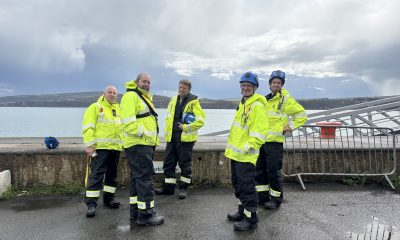
Coastguard callout payments axe sparks fears for coastal communities
VOLUNTEER coastguards across the UK are set to lose callout payments, prompting concern over the future resilience of emergency cover...


Farming4 days ago
Rural Wales ‘left out’ of net zero debate, warns carbon entrepreneur
A WELSH carbon entrepreneur has warned that rural Wales risks being left behind in the national conversation about net zero....


Local Government5 days ago
Tenby Spectacular row continues as organisers say key question remains unanswered
Round Table says legal clarity over pedestrian access is still holding up event plan TENBY ROUND TABLE has welcomed Pembrokeshire...
-

 Crime5 days ago
Milford man threatened to smash parents’ windows, court hears
-

 Crime4 days ago
Police appeal after reported rape at Young Farmers rally
-

 Crime5 days ago
Woman sentenced over neglect of child at Haverfordwest property
-

 Crime5 days ago
Haverfordwest father stole groceries amid cost-of-living struggle
-

 Crime5 days ago
Dock woman given mental health treatment order after supermarket thefts
-

 Crime5 days ago
Grandmother banned after cocaine drug-drive offence
-

 Crime5 days ago
Hakin man stole Tesco goods to fund drink and gambling addictions
-

 Crime6 days ago
Government fraud squad hunts down Covid loan scams