

News
WW2 veteran in helicopter flight to comrade’s funeral


A WORLD WAR TWO veteran took a helicopter flight for a 560 mile round trip from his Pembrokeshire home to a fellow veteran’s funeral.
Ian Kerr-Bonner, 94, from Cresswell Quay, served as a glider pilot in the Second World War, and after breaking both his hips, feared that he would not be able to make it to Kent to pay his respects to his fellow pilot Des Page, a friend of over 70 years.
Yet SSAFA – the Armed Forces charity, formerly known as Soldiers, Sailors, Airmen and Families Association, heard about his predicament, and so arranged the helicopter for him.
Mr Kerr-Bonner said of his journey: “We were going to come by road but we thought it was going to be too long a journey, so they came up with the idea of a helicopter which was wonderful. It was my first time in one.
“It’s sad but worth the journey, they don’t come very often like Des. I never thought he would go first. He was a hero. Des never wavered.”
The late Des Page qualified as a glider pilot at the age of 21, just two months before D-Day. SSAFA caseworker, Annabelle Zoran, secured the funds from the Army Air Corps Veteran’s Association for the Gazelle Squadron to take Mr Kerr-Bonner to Vinters Park Crematorium in Maidstone on June 15.














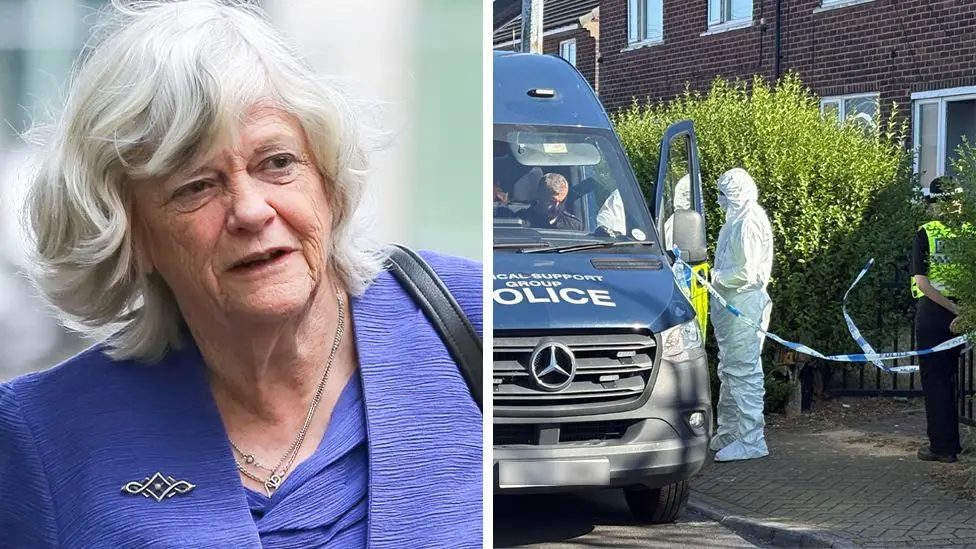
Man, 28, re-arrested under terrorism legislation after new evidence emerges in former minister’s suspected murder
COUNTER-TERRORISM officers have taken control of the investigation into the death of former government minister Ann Widdecombe following the discovery of new information and evidence.
A 28-year-old man from Rotherham, South Yorkshire, who was initially arrested on suspicion of murder on Saturday, has now been re-arrested on suspicion of the commission, preparation or instigation of acts of terrorism.
Police stressed that investigators are continuing to examine several possible lines of enquiry and have not publicly established a motive.
Miss Widdecombe, aged 78, was found dead at her home in Haytor, Devon, after emergency services were called shortly before midday on Thursday, July 9.
Officers said she had suffered serious injuries, prompting the launch of a murder investigation and a major police operation stretching from Devon to South Yorkshire.
The suspect was arrested at an address in Rotherham shortly after 9.00pm on Saturday, July 11. Specialist counter-terrorism officers had already been working alongside Devon and Cornwall Police before formally taking the lead in the case.
Counter Terrorism Policing South East said the change followed developments during what it described as a complex and rapidly moving investigation.
Laurence Taylor, head of National Counter Terrorism Policing, said officers were working urgently to determine what motivated the attack.
He said specialist resources from across the counter-terrorism network were now being deployed and appealed for anyone with relevant information to contact police.
The development represents a significant change from the position outlined by Devon and Cornwall Police over the weekend, when officers said there was nothing at that stage to suggest the death was connected to terrorism or politically motivated.
Police had also urged politicians and members of the public not to speculate while detectives continued their work.
Home Secretary Shabana Mahmood updated MPs in the House of Commons on Monday, confirming that counter-terrorism officers were now leading the investigation.

She said the suspect was not previously known to Prevent, the Government programme intended to identify and support people considered vulnerable to radicalisation.
The Home Secretary described Miss Widdecombe as a forthright and fearless figure and said her death had raised wider questions about the security of politicians and others involved in public life.
She said guidance would be issued to MPs and confirmed that former Lord Chancellor Sir Robert Buckland had been asked to examine lessons arising from the murder of Conservative MP Sir David Amess in 2021.
The Government has also offered Reform UK leader Nigel Farage a meeting with officials responsible for assessing protection for prominent public figures.
Police believe Miss Widdecombe was attacked at around 12.30pm on Wednesday, July 8. Her body was discovered the following morning after concerns were raised about her welfare.
A separate 26-year-old man arrested during the early stages of the investigation was later released and is no longer connected with the enquiry.
Miss Widdecombe served as Conservative MP for Maidstone and later Maidstone and The Weald between 1987 and 2010.
She held several ministerial positions during Sir John Major’s government, including roles at the Home Office, and later became shadow home secretary.
After leaving Westminster, she became widely known for television appearances including Strictly Come Dancing and Celebrity Big Brother.
She returned to frontline politics in 2019 when she joined the Brexit Party and was elected as a member of the European Parliament for South West England. She later became a prominent Reform UK spokeswoman.
Political leaders from across the parties have paid tribute to Miss Widdecombe, while around 40 people attended a vigil near her Dartmoor home on Sunday.
Police continue to appeal for information and have warned that the fact counter-terrorism officers are leading the investigation does not establish any particular ideology, political connection or motive.
No charge has been brought and the investigation remains ongoing.


Ruan Austin was convicted of driving an Audi with nearly three times the legal alcohol limit in his breath
A WARRANT has been issued for the arrest of a Ceredigion man who was found guilty of drink-driving after failing to attend court.
Ruan Austin, aged 49, of Tanlan, Silian, had denied driving an Audi while over the prescribed alcohol limit.
The offence took place on Holyland Road, Pembroke, on May 9.
A breath test showed Austin had 100 microgrammes of alcohol in 100 millilitres of breath. The legal limit is 35 microgrammes.
Austin pleaded not guilty at an earlier hearing on May 26, but was found guilty following a trial at Haverfordwest Magistrates’ Court on Monday, July 13.
The court issued a warrant for his arrest without bail after he failed to appear in answer to his bail.

Cardiff has the largest overall borrowing, while Wrexham records the highest debt per resident among Wales’ 22 principal councils
WELSH local authority bodies are carrying debts of almost £6.7 billion, according to new figures which have prompted warnings about the long-term burden being placed on taxpayers.
Research published by the TaxPayers’ Alliance puts total local authority debt in Wales at £6.698 billion during 2025-26.
The campaign group said that amount was equivalent to nearly 2.94 million average Welsh Band D council tax bills, based on an average annual charge of £2,283.
The figures were compiled from UK Government borrowing and investment data for the final quarter of the financial year.
Wales’ 22 county and county borough councils accounted for around £6.55 billion of the total, with additional borrowing attributed to other local authority bodies.
Cardiff Council recorded the largest debt among Welsh councils at £1.148 billion, followed by Swansea at £629.2 million and Wrexham at £542.5 million.
Carmarthenshire Council had debts of £434.1 million, while Flintshire recorded £362.3 million and Powys £361.9 million.
However, the picture changes when debt is calculated according to population.
Wrexham had the highest council debt per resident in Wales at approximately £3,924, followed by Denbighshire at £3,431 and Merthyr Tydfil at £3,049.
Cardiff’s debt was equivalent to £2,989 per resident, while Powys recorded approximately £2,680 and Swansea £2,504.
What about Pembrokehire?
In Pembrokeshire, the figures show total council debt of £201.794 million, equivalent to approximately £1,605 for every resident.
Of Pembrokeshire’s total, £170.194 million was recorded as borrowing from the Public Works Loan Board, the government body which provides loans to councils and other public organisations.

Pembrokeshire ranked 12th among Wales’ 22 principal councils for total debt and 15th when borrowing was calculated per resident.
The figures do not, however, mean that each household personally owes the amount calculated per resident.
Council borrowing is commonly used to finance long-term capital projects such as schools, council housing, roads, leisure facilities and regeneration schemes.
Under the prudential borrowing framework, Welsh councils are permitted to borrow for capital purposes provided they judge that the repayments are affordable. Welsh Government figures state that authorities can borrow without specific government consent where they can afford to service the debt.
Audit Wales has also stressed that capital spending is essential for providing services, including the construction of schools, improvements to libraries, social care equipment and the maintenance of public buildings.
However, borrowing must eventually be repaid, and interest and repayment costs can place continuing pressure on the annual budgets used to fund frontline services.
Across the UK, local authority debt reached a record £154.6 billion during 2025-26, an increase of £6 billion, or 4.1 per cent, compared with the previous year.
The TaxPayers’ Alliance said council debt had risen by £84.6 billion since 2009-10, representing a cash increase of 121 per cent.
Around £116 billion, or three quarters of the UK total, was borrowed from the Public Works Loan Board.
John O’Connell, chief executive of the TaxPayers’ Alliance, described the level of local authority debt as a “ticking time bomb” and called for councils to bring their borrowing under control.
He said taxpayers ultimately risked being left responsible for obligations accumulated through borrowing, statutory service pressures and, in some parts of the UK, unsuccessful commercial investments.
The figures should nevertheless be treated as a measure of gross borrowing rather than a complete assessment of the financial health of an individual council.
They do not deduct councils’ cash balances or investments, assess the value of assets funded through borrowing, or show the interest rates, repayment dates and annual servicing costs attached to each loan.
A council with substantial borrowing may also hold valuable housing, property and infrastructure assets, while an authority with less debt can still face serious pressure because of falling reserves, rising demand or an ongoing budget deficit.
The findings are likely to increase pressure on Welsh councils to provide clearer information showing what their borrowing has funded, how much taxpayers are paying each year in interest and repayments, and whether those costs remain affordable as spending pressures continue to grow.



Crime3 hours ago
Teenager tells jury he took knife to school to ‘show off’ to friends
Boy accused of attempting to murder Milford Haven teacher says he ‘never wanted to injure’ her A TEENAGE boy accused...


Local Government18 hours ago
Calls grow for independent investigation into Manorbier school closure
Councillor alleges misleading figures, inadequate insurance and poor treatment of staff CALLS for an independent investigation into the controversial closure...


Community24 hours ago
Neyland Carnival hailed a huge success after streets fill with colour and crowds
NEYLAND CARNIVAL organisers have thanked the community, volunteers and local businesses who helped make this year’s event a memorable success....


Community1 day ago
Tenby Summer Spectacular: Anger grows over ‘disaster waiting to happen’ warning
A growing backlash has followed police calls for the event’s licence to be revoked, with supporters questioning why authorities failed...


Charity2 days ago
RSPB secures ‘missing link’ to reconnect wildlife habitats in Carmarthenshire
RSPB CYMRU has purchased a 96-hectare upland site in Carmarthenshire, describing it as a vital step towards reconnecting one of...


Crime3 days ago
Ann Widdecombe: Welsh politicians pay tribute as murder probe launched
Prime Minister Sir Keir Starmer has praised the former minister’s “conviction and dedication”, while political figures in Wales remembered her...


News3 days ago
Solardo pulls out of Haverfordwest show as organisers offer full refunds
Headline act confirms non-appearance as Park House Series announces major event changes DANCE music duo Solardo will no longer perform...


Local Government3 days ago
Conservatives win Pembroke Dock seat as Reform stalls and Dowson polls just 11
Jamie Street takes Market ward with a 43-vote majority as Reform finishes fourth despite its major Senedd breakthrough two months...


Health3 days ago
Hospital ward closed after highly contagious scabies outbreak
Hywel Dda confirms wider rise in cases across Carmarthenshire, Pembrokeshire and Ceredigion as patients and staff are offered treatment A...
Crime4 days ago
Teacher stabbing trial: The first week of evidence
Jury hears accounts of alleged planned classroom attack, teacher’s fear she was dying, and boy’s words after leaving school A...
-

 Farming6 days ago
Pembrokeshire slaughterhouse given urgent improvement rating after audit failure
-

 News6 days ago
From boccia to boxing: ALN multisport events give youngsters chance to try activities
-

 News7 days ago
Large fire breaks out at Impala Terminal in Milford Haven
-

 Entertainment5 days ago
Swing and big band classics heading to Torch Theatre
-

 News6 days ago
Questions raised over Hamilton Accies finances after club’s Haverfordwest friendly
-

 Farming4 days ago
Working Carmarthenshire farm opens gates to visitors with new holiday cottages
-

 Community6 days ago
British Empire Medal ceremony held at County Hall
-

 Crime4 days ago
Greenacres confirms seized dogs are safe as investigation continues