


News
Dosbarth Enfys at Roch Primary School to self-isolate


A CASE of Covid-19 has been confirmed at Roch Primary School.
Pupils in Dosbarth Enfys are asked to stay home and self-isolate as outlined below.
Contacts of the pupil concerned have been asked to self-isolate for 10 days. Parents and carers do not need to contact the school to find out if their child has been affected.
Pembrokeshire County Council, Public Health Wales and Hywel Dda University Health Board are working with the school to ensure that all possible precautionary measures are being taken to minimise risk of transmission of the virus.
Parents/guardians have been given the following advice by Hywel Dda University Health Board:

If a child/parent/household member develops symptoms of Covid-19, the entire household should immediately self-isolate, and book a test for the individual with the symptoms. It is unnecessary to test the entire household if they are not symptomatic.
The Covid-19 symptoms are:
- a new continuous cough
- a high temperature
- loss of or change to sense of smell or taste
Booking a Covid-19 test:
Hywel Dda University Health Board recommends testing only for those with a new continuous cough, a high temperature, or loss of or change in the sense of taste or smell.
If a child does not have symptoms of Covid-19 but has other cold-like symptoms, such as a runny nose, they do not need to be tested and they and you do not need to self-isolate. Your child can go to school if fit to do so.
If a Covid-19 test is required, this should be arranged via the UK Booking Portal, https://gov.wales/apply-coronavirus-test or by ringing 119. Testing is available within Carmarthenshire, Ceredigion and Pembrokeshire or via a home testing kit delivered to and collected from your home. The Covid-19 test is undertaken via a throat swab or combined throat and nose swab.
Self-isolation:

It is essential that people who have Covid-19 symptoms, or who share a household with someone who has symptoms, must self-isolate, even if your symptoms are mild. To protect others, you must not attend school, nursery, other childcare settings, work, or go to or to places like a GP surgery, pharmacy or hospital.
The period of time that people have to self-isolate for coronavirus has now been reduced from 14 days to 10 in Wales (as of 10 December).
The new self-isolation and quarantine advice applies to:
- people who have received a positive test result for Covid-19
- people with symptoms of Covid-19 who are waiting for a test result, or who have not been tested and do not require hospital treatment, who must remain at home for the appropriate self-isolation period
- people living in households with someone who shows symptoms that may be caused by Covid-19 or who has received a positive test result for Covid-19
- close contacts of positive cases of Covid-19
- travellers returning from non-exempt country
If you receive a positive test result, you will be contacted by the Test, Trace, Protect Team who will advise you further.
Self-isolating pupils – how does this affect their households?
If a pupil has been asked by their school to self-isolate because of coming into contact with a confirmed case of Covid-19, his or her household does not need to self-isolate as well – as long as the pupil has no symptoms. Siblings can continue attending school providing they have no symptoms (unless they have also been asked to self-isolate by their school).
However, if the pupil who has been asked to self-isolate does have or develops symptoms of Covid-19, then the entire household must also self-isolate as per the details above (under the sub-heading Self-Isolation).
Non-household members/contacts:
If a person has been in contact with an individual experiencing symptoms, they should carry on as normal until that individual receives their test result. If this is positive, the Test, Trace, Protect Team will contact those people identified as contacts and advise accordingly.


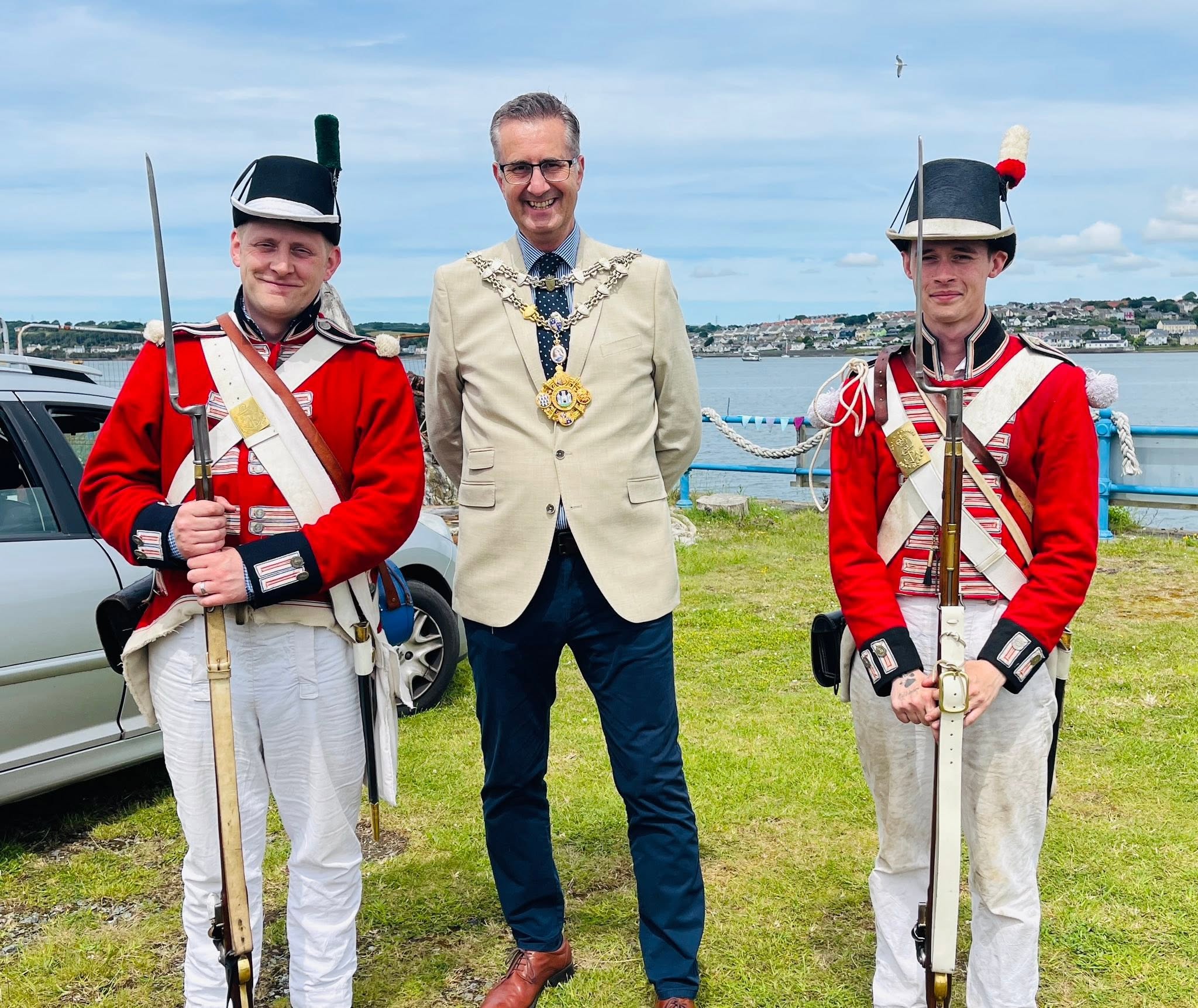
VOLUNTEERS at West Wales Maritime Museum were praised after another successful Pirates Party brought crowds to Pembroke Dock.
The family event was held at Hancock’s Yard, Front Street, on Saturday (Jun 20), with visitors enjoying a day of maritime-themed entertainment, stalls, refreshments and fancy dress.
The museum, run by the West Wales Maritime Heritage Society, hosted the event with the help of volunteers, with activities including a tombola, raffle, barbecue, face painting, children’s games and a prize for the best-dressed pirate.
There was also live entertainment from the Cantabile Singers and the Barti Waves.
One of the highlights of the afternoon was a musket firing display by the H.M.S Wales Re-enactment Group, which drew strong interest from those attending.
County councillor Jonathan Grimes, who represents Pembroke St Mary South and Monkton, was among those who visited the event.
He said it had been “a fantastic afternoon” and praised the volunteers who had worked hard to put on “another brilliant event”.
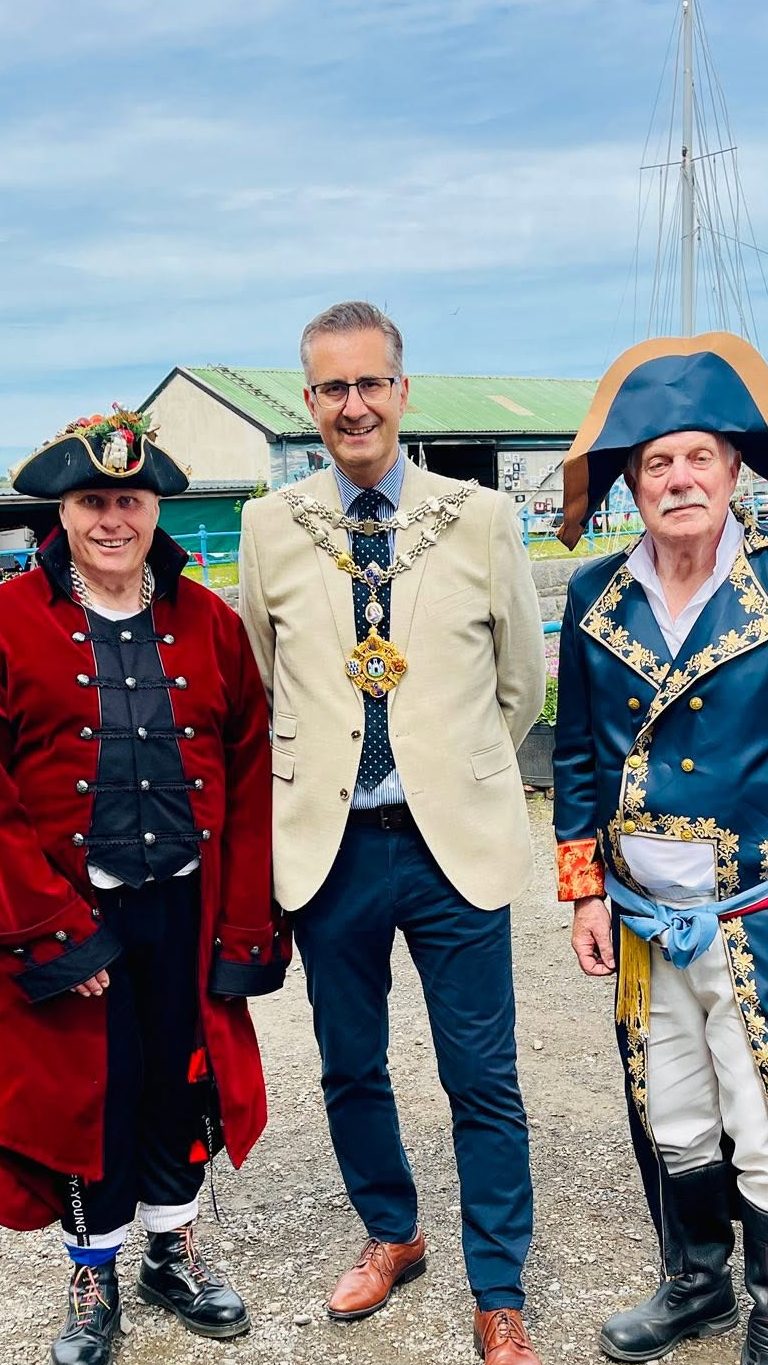
Cllr Grimes said: “There was plenty to see and enjoy, but my personal highlight had to be the musket firing display from the H.M.S Wales Re-enactment Group — a real crowd-pleaser with live firing.
“It was wonderful to see so many people coming along and supporting yet another successful event at the museum.”
He also thanked Peter Kraus and everyone involved for their dedication in bringing the event to life.
The West Wales Maritime Museum is based at the historic Hancock’s Yard and is run by volunteers who work to preserve Pembroke Dock’s maritime heritage.
The society restores and maintains classic boats, operates a museum of maritime artefacts and offers visitors a chance to learn more about the town’s long connection with the sea.
The museum has become an increasingly popular community venue, with events such as the Pirates Party helping to bring families into the town while celebrating Pembroke Dock’s seafaring past.
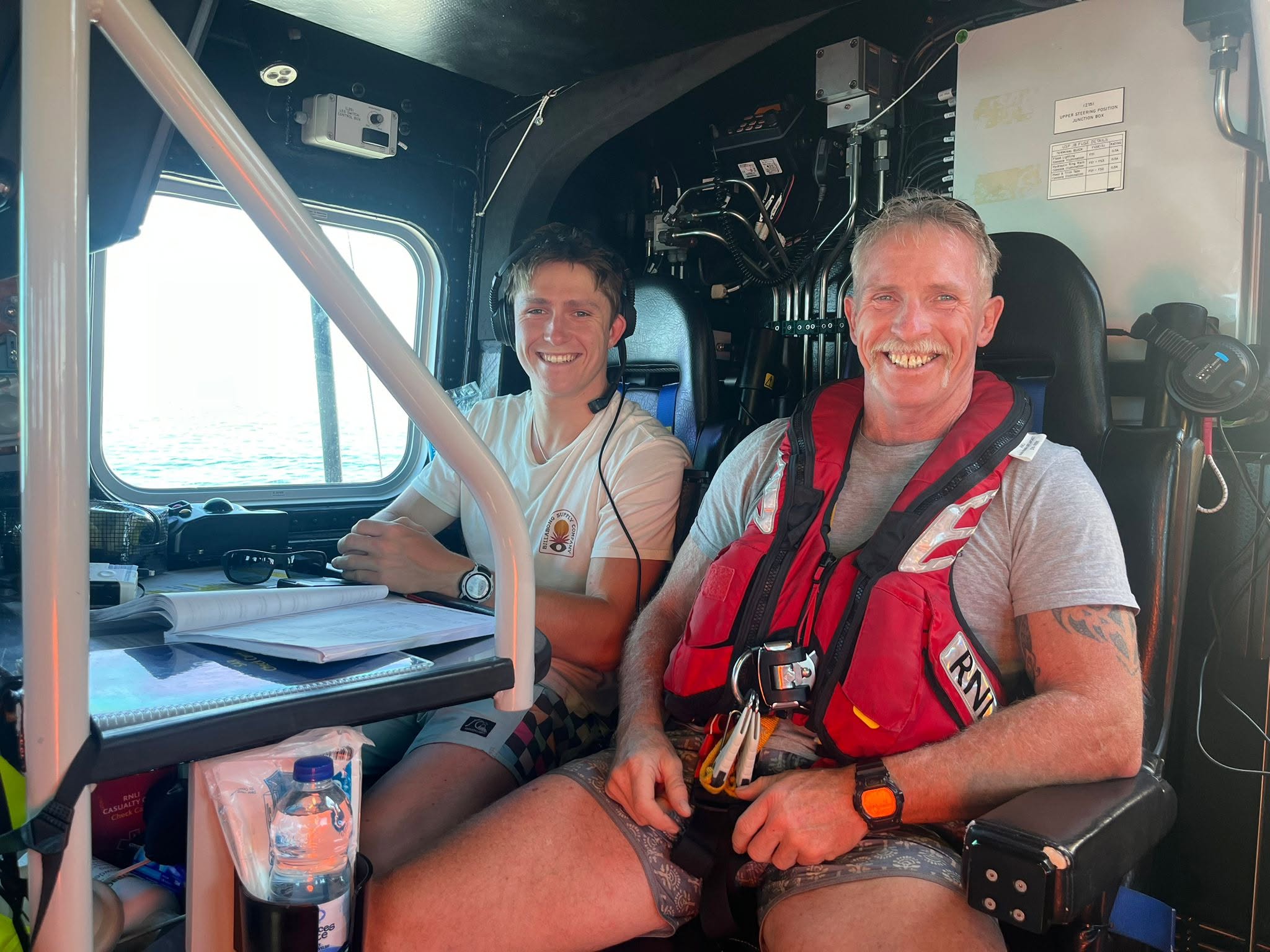
FATHER’S DAY celebrations were interrupted for several Tenby RNLI crew members on Sunday afternoon (Jun 21) after a five-metre RIB suffered engine failure off Broadhaven South and began drifting dangerously towards rocks.
The casualty vessel issued a Pan Pan call, prompting a Coastguard tasking to Tenby Lifeboats.
Among those responding were Coxswain Gary and his son Eddie, who still managed to spend part of Father’s Day together — although not quite in the way they may have planned.
The lifeboat was quickly launched and made best speed to the reported position, around nine miles west of Tenby Lifeboat Station.

When the crew arrived on scene, the engine of the casualty vessel had been restarted. However, with those on board concerned it could fail again, the Coxswain decided to escort the RIB back towards the entrance of the Milford Haven Waterway.
Once at the mouth of the waterway, the occupants were confident they could safely continue to their mooring without further assistance.
The lifeboat was then stood down and returned to station, arriving back at 5:50pm.

Health Minister tells Paul Davies MS that decisions remain a matter for Hywel Dda University Health Board
THE WELSH GOVERNMENT has declined to intervene in controversial plans affecting services at Withybush and Bronglais hospitals, prompting fresh criticism from local Senedd Member Paul Davies.
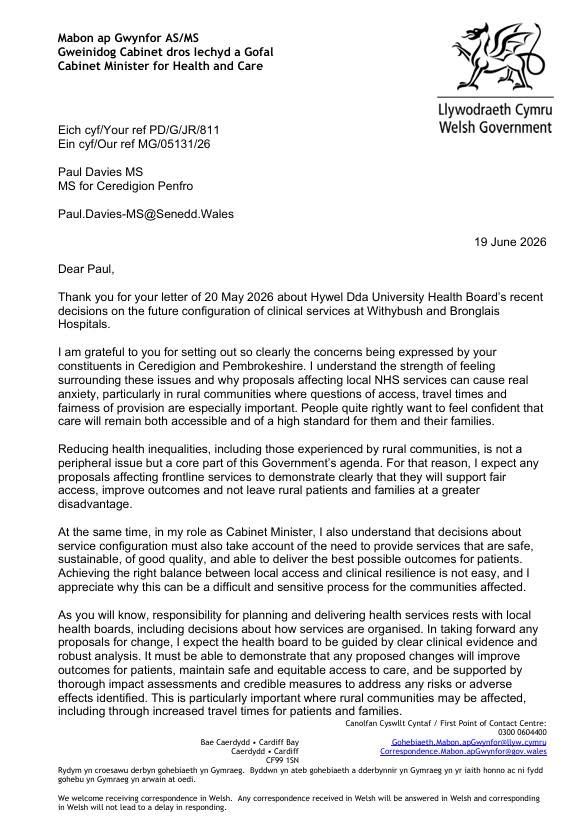
In a letter dated June 19, Health and Care Cabinet Secretary Mabon ap Gwynfor said responsibility for planning and delivering NHS services rests with local health boards and confirmed that Hywel Dda University Health Board should continue its consultation process on proposed service changes.
The response follows concerns raised by Mr Davies on behalf of constituents in Pembrokeshire and Ceredigion over the future configuration of clinical services, including stroke care.
While acknowledging strong public concern about access to healthcare in rural communities, the Minister stopped short of offering any commitment to block or reverse the Health Board’s proposals.
Instead, he stressed that any changes must be supported by robust evidence, maintain patient safety and demonstrate improved outcomes.
The Minister wrote: “Responsibility for planning and delivering health services rests with local health boards, including decisions about how services are organised.”
He added that proposals must improve outcomes for patients, maintain safe and equitable access to care and be supported by thorough impact assessments.
Paul Davies MS described the response as disappointing.
Posting the letter on social media, he said: “This letter tells me that the Welsh Government is not going to stand in the way of the Health Board’s plans.”
He added that he would raise the issue in the Senedd chamber next week and continue pressing ministers to intervene.
The exchange comes as Hywel Dda University Health Board continues a public consultation on proposed changes to stroke services across west Wales.
The consultation, which opened on May 28, is due to run until July 26.

In his response, the Minister stated that anyone suffering a stroke should receive treatment “as quickly as possible in the most appropriate setting” and said the current model of stroke care in Wales must evolve if national standards are to be achieved.
The comments are likely to fuel concern among campaigners opposed to the proposed changes, who fear services could become increasingly centralised and further away from rural communities in Pembrokeshire and Ceredigion.



Community5 hours ago
The gentle giant behind the tattoos
Pembrokeshire security worker Josh Davies praised for professionalism, kindness and proving first impressions can be wrong JOSH Davies is hard...


Charity1 day ago
Toy Story fans fill charity toy box at Haverfordwest cinema
Donations pour in for SNAP Specialist Play as families embrace Toy Story 5 launch A TOY STORY-themed charity appeal at...


Community1 day ago
Lord Rhys emerges from the mist in St Davids
Giant puppet begins historic journey marking 850 years since the first Eisteddfod MIST swirled around St Davids Cathedral on Friday...


News2 days ago
Tragic tribute paid to Haverfordwest man after A4075 collision
FAMILY REMEMBERS “KIND AND LOVING” CALLUM HANSON THE FAMILY of a 22-year-old man from Haverfordwest who died following a road...

News3 days ago
Motorcyclist, 22, dies in A4075 crash in Pembrokeshire
A 22-year-old woman remains in hospital after two-vehicle collision A MOTORCYCLIST has died following a serious two-vehicle crash on the...

Community3 days ago
Why police will be visiting every home in Pembrokeshire
New operation aims to knock on more than 257,000 doors across Dyfed-Powys over the next three years DYFED-POWYS POLICE has...


Crime3 days ago
Prisons at breaking point: MPs warn Wales is paying the price of a failing system
Frozen healthcare budgets, overcrowded jails, homelessness on release and mounting pressure on staff are undermining rehabilitation across Wales, according to...


News4 days ago
Brexit at 10: How Britain was sold a dream that cost us dearly
A decade after the referendum, the promised benefits remain hard to find while the economic costs are increasingly difficult to...


Crime4 days ago
Worcestershire man jailed after violent attack on woman in Tenby
Defendant was already serving a suspended sentence when serious assault took place A WORCESTERSHIRE man has been jailed for more...


Climate4 days ago
Offshore wind ‘could bring new generation of jobs to Milford Haven’
Pembrokeshire ports and Celtic Sea projects placed at centre of Wales’ green energy ambitions MILFORD HAVEN and Pembroke Dock could...
-

 Crime4 days ago
Milford Haven man jailed for breaching domestic violence protection order
-

 Local Government5 days ago
Security privately arranged by Mayor at Beating of the Bounds
-

 News3 days ago
Crash on Freeman’s Way causes school-run chaos across Haverfordwest
-

 Crime5 days ago
Man wanted by court after failing to attend hearing over alleged shop thefts
-
 Crime5 days ago
Man banned from roads after drink-driving offence
-

 Crime5 days ago
Man jailed after admitting strangulation and assaults
-
 Crime5 days ago
Drug trafficker must repay £33,000 after court rules he made nearly £500,000
-

 Crime5 days ago
Man sentenced over stalking campaign and lock knife offence