


Education
We Swim Wild brings micro plastic research to the Pembrokeshire Coast

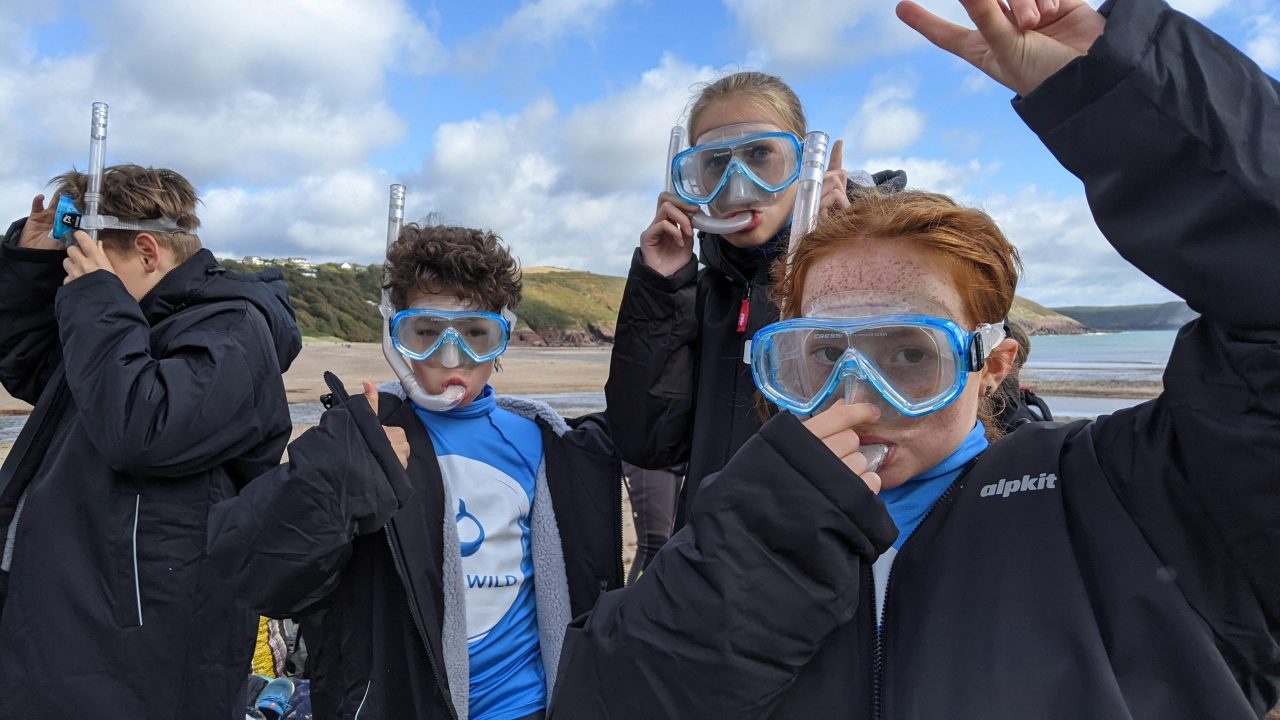
THE PILOT session of Pobl Dwr was filmed for an upcoming episode of ITV’s Coast and Country series with Sean Fletcher and pupils from Castle School in Haverfordwest explored marine and environmental issues affecting the waterways in Wales.
A pupil from Castle School said “I found 22 pieces of microplastics in one cup of sea water”.
Created by the Wales non profit We Swim Wild, Pobl Dwr has made children aware of the microplastic pollution crisis, while giving them a chance to explore the beautiful coastline and deepen their connection with the ocean environment.
We Swim Wild aims to educate and empower the younger generation on environmental action and micro plastic pollution.
A pupil from Castle School described their experience as “the biggest eye opener ever”.

The project gives pupils an opportunity to learn about the marine life on our coasts through an immersive snorkeling programme, wellbeing activities such as breathwork and meditation, citizen science microplastic analysis that actually feeds into We Swim Wilds national microplastic database with Bangor University.
We Swim Wild founder Laura Owen Sanderson says “ We have been highlighting the issue of microplastics for the last few years, through adventure activism campaigns and U.K wide citizen science projects to map for microplastics.
The education programme gives young people the opportunity to experience the magic of wild waters safely, equips them with the skills and tools to analyse water for silent contaminates and the opportunity to see the scale of the problem in real time”.
The project in Pembrokeshire is in collaboration with The Big Retreat Community, the non profit arm of The Big Retreat Festival in Pembrokeshire, one of the top adventure and wellbeing festivals in the UK.
Festival founder Amber Lort-Phillips says “Wellbeing in nature is at the heart of everything we do. As a result of the pandemic, we know that young peoples’ mental health has suffered significantly. We want to give them the skills to improve their own mental and physical health whilst learning how to protect the planet for generations to come, and there is no better place to do it than in our home, the Pembrokeshire Coast National Park.”
“Plastic can commonly be found in our water, soil and air,” explains Laura. “Crucially, we now know it is in our bodies as we breathe in, eat and drink plastic particles every day. As plastic production grows, so does our exposure. There is growing concern that it may be harming our health.”
Laura adds “We know that the presence of microplastic and nano plastic in our bodies can’t break down and is associated with chronic disease and pressure on our immune systems, such as arthritis, diabetes and cardiovascular disease. The truth is there is currently not enough money invested in Plastic research and its impact on our health. Our citizen science campaigns and education programme go some way towards mapping current UK levels for this emergent contaminate”.

We Swims Wild’s ultimate goal is to get the UK government to start testing regularly for microplastic levels as an emergent contaminate and to put greater restrictions on plastic production and its use.
A group of MP’s including MP Mike Penning has also called on the chancellor to commit to a £15 million fund to examine the potential health impacts of plastic.
The Pembrokeshire project has been sponsored by the National Lottery community fund. We Swim Wild will be bringing this programme to coastal communities across Wales over the coming months.













Union says Welsh Government has funded repairs, meals and swimming lessons but failed to address one of the biggest pressures facing schools
SCHOOL leaders have welcomed extra Welsh Government funding for repairs, free school meals and swimming lessons — but warned that pupils with additional learning needs have been overlooked.
The criticism came after the Welsh Government set out its supplementary budget for 2026-27, including £40m for school buildings and repairs, £15m to expand free school meals in secondary schools, and £2m for swimming lessons.
Laura Doel, national secretary of school leaders’ union NAHT Cymru, said the extra capital funding for school buildings was welcome and would “go some way to plugging the gap”.
She also welcomed the expansion of free school meals, saying no child should go hungry because of their parents’ financial circumstances.
But Ms Doel said the “significant omission” was the lack of additional funding for ALN provision.
She said: “It beggars belief that of money that has come to Wales thanks to investment into additional needs in England, not a penny has gone to support pupils with ALN in Wales.
“We have seen local authorities, directors of education and the profession united on the need for significant investment in supporting our most vulnerable learners, but this government has chosen to ignore the pleas for support.
“It calls into question whether education is a key priority for this government.”
ALN pressure
Additional learning needs provision has become one of the major pressures facing schools and councils across Wales, with rising demand for specialist support, assessments, staffing and placements.
School leaders argue that without dedicated funding, already stretched school budgets are being forced to absorb costs which can affect support for both ALN pupils and the wider school community.
The Welsh Government says the supplementary budget is designed to support key priorities, including public services, schools, health and the cost of living.
But NAHT Cymru said the absence of new ALN money was difficult to justify at a time when schools are repeatedly warning that vulnerable learners need more support.

The Herald has asked the Welsh Government how much of the school buildings funding will come to west Wales and why no specific additional allocation has been made for ALN provision.

PEMBROKESHIRE parents are being urged to check school messages as neighbouring Carmarthenshire prepares to close all secondary schools on Wednesday and Thursday because of extreme heat.
The move in Carmarthenshire has raised questions across west Wales about whether schools in Pembrokeshire could also be affected as temperatures continue to rise.
All secondary schools in Carmarthenshire are set to close for two days, with some primary schools also deciding to shut. There has been no blanket closure decision for primary schools in that county.
In Pembrokeshire, no county-wide secondary school closure announcement has been made at this stage.
Parents should check directly with their child’s school for the latest information, including texts, emails, school apps, websites and social media pages.
The situation may vary from school to school, depending on building conditions, ventilation, classroom temperatures and local circumstances.
The closures in Carmarthenshire come as Wales faces exceptional weather conditions, with concerns about pupil and staff welfare during the heatwave.
Many school buildings, particularly older sites, can become extremely hot during prolonged periods of high temperature.
A Wales-wide picture is now emerging, with schools in several counties considering closures, early finishes or remote learning.
For Pembrokeshire families, the key message is not to assume schools are closed unless official confirmation has been received.
The Herald will continue to monitor updates from Pembrokeshire schools and the county council.


CHURCH education in Pembrokeshire, the birthplace of Wales’s Patron Saint, is under threat from a series of actions by the council which could amount to religious discrimination, the Church in Wales has said.
The Church in Wales has issued a formal notice that it will take legal action against Pembrokeshire County Council if it presses ahead with plans to remove church status from Cilgerran Voluntary Controlled Primary School.
Back in May, the council voted to remove the Voluntary Controlled status of the Welsh-speaking rural school and to establish it as a 3-11 community school despite 97 per cent of the responses to a consultation about its potential discontinuation opposing it.
That consultation followed a review which “considered the extent of surplus school places in the area, set against a significant decline in the pupil population,” the council has previously said.
Hundreds opposed the proposed changes, with a petition on the council’s own website gaining 391 signatures.
During the consultation, 203 responses were received; 97 per cent (197 responses) against the proposal, with just 1.5 per cent (three) in favour.
Earlier this year, councillors heard from vice-chair of the school governors Gary Fieldhouse who said the loss of the Church in Wales status would be “a profound mistake,” the school’s association with the church “not symbolic but fundamental”.
Reverend John Cecil had told councillors the proposals were “fundamentally flawed,” with the school’s land legally in trust as a Church of Wales school, and change “essentially creating a new school with no premises to occupy”.
A letter has now been sent to council officers on behalf of the Diocese of St Davids and the Church in Wales saying that, if the council persists with this course, the Church will take legal action on the grounds of claims of “public misrepresentation and unqualified legal assertions made by Pembrokeshire County Council officers,” and “discrimination against faith schooling”.
The letter also says that, if the council removes VC status from the school, the Church will not make the site available for a successor school, which it says will render “the case on which the proposed removal of VC status is based untenable”.
The legal warning follows Pembrokeshire County Council’s decision earlier this month to close Manorbier Church in Wales Voluntary Controlled School, which was damaged by a fire in 2022.
The church says that despite repeated assurances from Cabinet Members and senior officers that it would be rebuilt, it has been allowed to sit empty while the number of children, forced for years to learn in temporary accommodation, has declined.

A spokesperson for the Church in Wales said: “Pembrokeshire County Council’s behaviour in the case of Manorbier VC School has been utterly unconscionable.
“The council has presided over a catalogue of delay, incompetence and broken promises resulting in the literal destruction of a thriving school which has served its community for more than 150 years.
“Taken together with the gratuitous attack on the church status of Ysgol Cilgerran, this amounts to a targeted assault on the inclusive Christian education which Church in Wales schools have provided to their communities for generations.
“That the council should be pursuing this potentially discriminatory action against Church schools in the county which is the cradle of Christianity in Wales, and which takes pride in being the birthplace and shrine of our nation’s Patron Saint, is a bitter irony.
“We are not prepared to allow it to happen, and we look to the county’s elected representatives to halt this destructive course of action.”
Pembrokeshire County Council has been contacted for a response.



Community4 hours ago
Manorbier fire scandal: Council’s payout just £63,777 after school destroyed
PEMBROKESHIRE COUNTY COUNCIL has accepted an insurance settlement which leaves it with just £63,777.07 after the catastrophic fire which destroyed...


News13 hours ago
Bus overturns in major incident near Kidwelly
All passengers rescued as emergency services remain at scene A BUS overturned on the A484 between Kidwelly and Ferryside on...


Community1 day ago
Tenby Summer Spectacular cancelled amid council row over harbour access
Organisers say popular charity events cannot safely go ahead without clear powers to control crowds TENBY ROUND TABLE has announced...


News2 days ago
Motorcyclist dies after four-vehicle crash on A40 in Carmarthenshire
A MOTORCYCLIST has died following a four-vehicle collision on the A40 between St Clears and Whitland. Dyfed-Powys Police said the...


News2 days ago
Rhun ap Iorwerth urges new deal for Wales after Starmer quits
First Minister says next Prime Minister must focus on greater powers, fair funding and respect for Wales’ democratic mandate FIRST...


News2 days ago
How Labour’s landslide victory unravelled in just two years
Prime Minister announces resignation after losing support within his own party as Andy Burnham emerges as overwhelming favourite to take...


News2 days ago
Long Course Weekend set to bring thousands to Pembrokeshire
Three days of swimming, cycling and running will once again transform Tenby into one of the UK’s biggest endurance sporting...


Community2 days ago
The gentle giant behind the tattoos
Pembrokeshire security worker Josh Davies praised for professionalism, kindness and proving first impressions can be wrong JOSH Davies is hard...


Charity3 days ago
Toy Story fans fill charity toy box at Haverfordwest cinema
Donations pour in for SNAP Specialist Play as families embrace Toy Story 5 launch A TOY STORY-themed charity appeal at...


Community4 days ago
Lord Rhys emerges from the mist in St Davids
Giant puppet begins historic journey marking 850 years since the first Eisteddfod MIST swirled around St Davids Cathedral on Friday...
-

 Crime6 days ago
Milford Haven man jailed for breaching domestic violence protection order
-

 News6 days ago
Crash on Freeman’s Way causes school-run chaos across Haverfordwest
-

 Health4 days ago
Woman jailed assaults on police, harassment and XL Bully possession
-

 Crime3 days ago
Milford Haven woman spared jail despite string of shop thefts
-
Community2 days ago
The gentle giant behind the tattoos
-

 Crime6 days ago
Portfield Gate man faces careless driving allegation after Tufton crash
-

 Local Government5 days ago
Pembrokeshire faces accessible housing shortage as 403 people wait for homes
-

 News6 days ago
Brexit at 10: How Britain was sold a dream that cost us dearly