
Business
Advantages of Dollar-Cost Averaging in Bitcoin Investing


Dollar-cost averaging (DCA) is a disciplined investment strategy that has won recognition amongst Bitcoin traders seeking to mitigate volatility and construct long-term positions in the cryptocurrency market. How Dollar-Cost Averaging Can Benefit Bitcoin Investors showcases the expertise of an investment education firm connecting traders with educational experts. Their insights can help investors understand and implement effective strategies for accumulating Bitcoin over time, mitigating volatility risks through disciplined investment practices.For traders seeking to enhance their investment strategies, Go bitcoin-circuit.live/, an investment education firm connecting traders with educational experts, offers valuable insights on the advantages of dollar-cost averaging in Bitcoin investing.
Understanding Dollar-Cost Averaging (DCA)
Dollar-fee averaging is a systematic funding technique in which investors allocate a fixed quantity of capital to an asset at ordinary periods, irrespective of its price fluctuations. Instead of seeking to time the marketplace to shop for Bitcoin at the bottom fee, DCA entails spreading purchases over time to common out the purchase price.Key Principles of Dollar-Cost Averaging:
Consistency: DCA requires regular and steady investments in Bitcoin, normally on a weekly, biweekly, or month-to-month basis. By making an investment at everyday periods, investors keep away from making emotional choices based on quick-time market actions.
Mitigating Volatility: Bitcoin is known for its price volatility, characterized by great fluctuations within brief durations. DCA helps traders mitigate the effect of price volatility with the aid of averaging out purchase prices over the years, potentially reducing the danger of purchasing at marketplace peaks.
Long-Term Perspective: DCA aligns with an extended-time investment horizon, allowing buyers to accumulate Bitcoin progressively at the same time as profiting from capacity increases within the cryptocurrency market over the years.
Benefits of Dollar-Cost Averaging in Bitcoin Investments
Reduced Timing Risk:
Attempting to time the market to buy Bitcoin at the bottom fee is hard and often ends in neglected possibilities or mistimed investments. DCA eliminates the desire for ideal marketplace timing by spreading purchases across different market conditions.
Lower Average Cost Per Coin:
DCA objectives to lower the common price consistent with Bitcoin bought through the years. By consistently buying Bitcoin regardless of short-term fee fluctuations, traders accumulate more gadgets while expenses decrease and fewer units while fees increase, ultimately attaining a decrease in common value.
Emotional Discipline:
Emotional choice-making can lead to impulsive investment selections based on fear or greed. DCA promotes emotional field through adhering to a predetermined funding plan, decreasing the likelihood of making rash decisions during intervals of market volatility.
Simplified Investment Approach:
Implementing DCA is simple and reachable for traders of all levels. It does not require in-depth technical analysis or marketplace timing talents, making it an ideal strategy for those trying to passively accumulate Bitcoin through the years.
Considerations for Implementing Dollar-Cost Averaging with Bitcoin
Investment Horizon:
DCA is most effective when traders have an extended-term investment horizon. Bitcoin’s charge volatility can result in brief-time period fluctuations; however, an affected person method permits buyers to probably advantage from lengthy-term appreciation.
Financial Commitment:
Determine the amount of capital to allocate regularly to Bitcoin investments based on your economic dreams, threat tolerance, and ordinary funding approach. Consistency in funding contributions is key to maximizing the advantages of DCA.
Market Conditions:
While DCA reduces the impact of short-term market fluctuations, investors must remain knowledgeable about broader market trends. Monitoring Bitcoin’s fee actions and marketplace fundamentals can provide valuable insights for adjusting funding techniques.
Risk Management:
Despite its benefits, DCA does not guarantee profits or safety against losses. Investors should check their risk tolerance and diversify their funding portfolios across distinct asset classes, which include conventional investments, to control typical portfolio hazards efficiently.
Practical Strategies for Implementing Dollar-Cost Averaging
Set a schedule:
Establish an ordinary timetable for getting Bitcoin, which includes weekly or monthly durations. Automating contributions through cryptocurrency exchanges or funding platforms can ensure consistency and streamline the investment process.
Monitor Performance:
Periodically evaluate the performance of your Bitcoin investments and investigate whether modifications in your DCA strategy are vital primarily based on marketplace conditions or modifications in monetary instances.
Rebalance as Needed:
Over time, Bitcoin’s charge actions may additionally cause modifications in portfolio allocation. Consider rebalancing your investment portfolio periodically to maintain preferred asset allocations and danger levels.
Seek education and advice.
Educate yourself about Bitcoin, cryptocurrency markets, and investment strategies via legit resources and educational structures like Immediate Vortex, a funding training firm connecting buyers with educational professionals. Understanding market dynamics and staying knowledgeable can enhance decision-making and self-belief in imposing DCA correctly.
Conclusion
Dollar-value averaging is a disciplined and accessible method for traders looking to construct Bitcoin positions regularly over the years. By mitigating timing threats, decreasing common buy costs, selling emotional discipline, and simplifying funding choices, DCA aligns with long-term investment objectives and chance management ideas. While Bitcoin’s volatility affords demanding situations, DCA affords a strategic framework for collecting Bitcoin while navigating marketplace fluctuations effectively. As buyers embrace virtual property as a part of varied portfolios, leveraging dollar-price averaging can probably optimize lengthy-term funding effects and make a contribution to monetary desires in the evolving cryptocurrency landscape.


A CALL to convert a former Pembrokeshire farmhouse and guesthouse into housing units has been given the go-ahead by county planners.
In an application to Pembrokeshire County Council, Dan Hildebrand, through agent GMW Design, sought approval for the subdivision of Torbant Farmhouse, Croesgoch, near Haverfordwest, to form four residential units.
A supporting statement through Johnston Planning on behalf of the applicant and agent said: “The property has historically been run as a successful guesthouse for a number of years but has recently come under new ownership. The new owner wishes to maximise the potential of the existing residential floor space through the subdivision of this generous property into four units.”
It added: “Whilst the intention is to utilise the subdivided property for residential purposes due regard is given to the 2022 changes to the use class order which in effect created new residential classes for new development in an effort to control unrestricted holiday uses in sensitive locations.
“As such a ‘free use’ is sought within use classes C3 (use as a sole/main residence), C5 (use as otherwise as a sole/main residence) and C6 (use as a commercial short term let).
“These proposed uses, which are considered to be reasonable and to be fully compliant with current planning policy (especially when one has regard to the existing use) will provide the owner with flexibility in terms of proposed occupation. Ensuring full and meaningful use of the property in the future.”
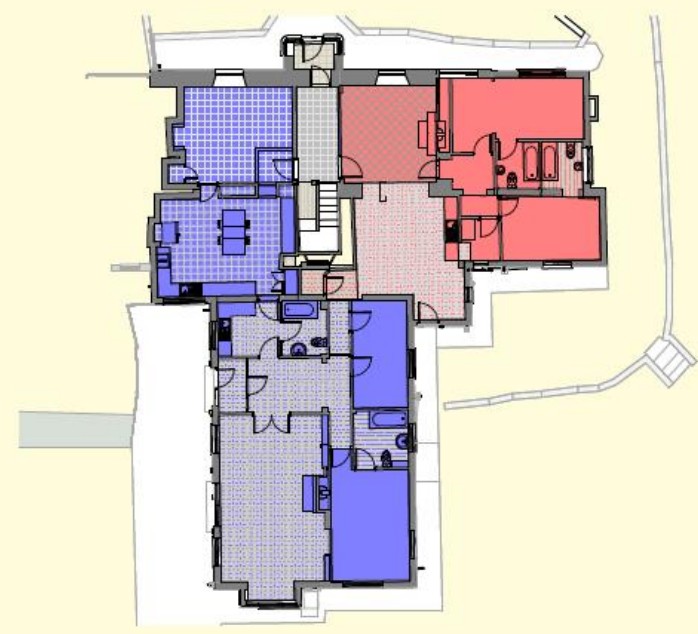
It said the property was once part of Torbant Farm, now been broken up into a number of separate properties, including Torbant Caravan Park immediately to the north.
It added the works to the property “are minimal and will have a negligible impact externally,” adding: “Internally whilst the layout will alter marginally no structural works to the property are proposed.
“In character terms therefore, there will be no discernible physical impact either to the dwelling itself or to the wider locality.”
Six objections to the scheme were received, raising concerns including harm to visual and residential amenity, ecological impact, infrastructure constraints, and claimed inaccuracies in the submitted application, as well as the application overstating available parking space “which would encroach onto shared access areas, causing obstruction and conflict between users”.
An officer report recommending approval said the scheme was amended to move car parking provision within land under the applicant’s control.
It concluded the scheme represented “an efficient use of the existing building stock,” and it “would not result in any external alterations to the host building and would not give rise to unacceptable harm to the character or appearance of the building or its wider rural setting nor the residential amenities of neighbouring occupiers”.
The application was conditionally approved by county planners.

PLANS to convert a former Pembrokeshire town centre social club into council owned social housing have been given the go-ahead.
In an application to Pembrokeshire County Council, the authority itself, through agent KEW Planning, sought a change of use of the former Manchester Club social club, Fulke Street, Milford Haven to seven social rented residential units.
The Manchester Club public house/social club closed in March 2024 due to the cost of operations rising to be more than the monetary value that the club delivered, remaining vacant since this time, and was marketed for sale before an offer from the council was accepted.
The council scheme will provide five one-bed flats, one two-bed, and one studio flat; an amended scheme from discarded initial options which included one for 12 apartments and two studio flats. The scheme revised to restrict proposed alterations to the existing building to a minimum.
The proposal includes the demolition of the single storey garage to the front, and a single-storey extension at the rear, which will allow a communal amenity area.

A supporting statement said: “The vision for this project is to provide social housing to address housing stock shortages and to give a new life to a vacant building in a central location of the town. The property will be rented to mixed aged tenants, with PCC as the corporate landlord.”
An officer report recommending approval said the site had been marketed since 2024 at £170,000, with a £150,000 offer made but was unable to be proceeded with, the price later reduced to £150,000, three offers later received including £140,000 from the council, which was accepted in April 2025.
“For the two years that this property has been marketed the market response to the property has been limited with no viable interest in retaining the building for its existing community facility use,” the report said.
It concluded: “The loss of the former community facility has been robustly justified in accordance [with planning policy], and the scheme would deliver social and economic benefits through the provision of additional housing and the re-use of a vacant building.
“The proposal would enhance the visual appearance of the site, provide an acceptable standard of residential amenity for future occupiers without undue harm to neighbouring properties, and would not give rise to unacceptable impacts in respect of highway safety, drainage, biodiversity or the historic environment.”
The application was conditionally approved.


WALES’ unemployment rate is broadly in line with the UK average, according to the latest labour market figures.
The Welsh Government said figures from the Annual Population Survey showed unemployment among people aged 16 and over in Wales at 4.5%, compared with 4.4% across the UK.
Ministers said Wales’ employment rate was also “relatively close” to its all-time high, but acknowledged that official labour market data should be treated with caution because of continuing concerns over reliability.
The figures come as the newly elected Welsh Government seeks to put productivity at the centre of its economic agenda.
A Welsh Government spokesperson said: “As a newly elected Government we are committed to driving investment, innovation and higher productivity across Wales.
“We have announced a National Productivity Goal to close the gap with the rest of the UK and help unlock the full potential of the Welsh economy.
“By focusing on productivity, we will deliver more jobs, higher pay, stronger businesses and thriving communities.”
The Government says the new goal will help shape the work of its planned Welsh innovation and development agency, including how it supports businesses, develops skills and invests in the wider economy.
However, ministers also said Wales’ labour market appears to be following similar trends to the UK as a whole.
They pointed to ongoing work by the Office for National Statistics to improve the quality of Labour Force Survey data, saying the figures should be read alongside other labour market indicators to get a clearer picture.
The Cabinet Minister for Enterprise, Connectivity and Energy, Adam Price, is seeking a meeting with the ONS to discuss the reliability of labour market data for Wales.


Motorcyclist, 22, dies in A4075 crash in Pembrokeshire
A 22-year-old woman remains in hospital after two-vehicle collision A MOTORCYCLIST has died following a serious two-vehicle crash on the...


Why police will be visiting every home in Pembrokeshire
New operation aims to knock on more than 257,000 doors across Dyfed-Powys over the next three years DYFED-POWYS POLICE has...


Prisons at breaking point: MPs warn Wales is paying the price of a failing system
Frozen healthcare budgets, overcrowded jails, homelessness on release and mounting pressure on staff are undermining rehabilitation across Wales, according to...


Brexit at 10: How Britain was sold a dream that cost us dearly
A decade after the referendum, the promised benefits remain hard to find while the economic costs are increasingly difficult to...


Worcestershire man jailed after violent attack on woman in Tenby
Defendant was already serving a suspended sentence when serious assault took place A WORCESTERSHIRE man has been jailed for more...


Offshore wind ‘could bring new generation of jobs to Milford Haven’
Pembrokeshire ports and Celtic Sea projects placed at centre of Wales’ green energy ambitions MILFORD HAVEN and Pembroke Dock could...


Police officer hailed hero after midnight sea rescue in Milford Haven
PC swam 100 metres offshore to save distressed woman heard calling for help in darkness A DYFED-POWYS POLICE officer has...


Security privately arranged by Mayor at Beating of the Bounds
HAVERFORDWEST TOWN COUNCIL has confirmed that security personnel seen at this year’s Beating of the Bounds were privately arranged and...


Celtic Freeport five-year plan puts Milford Haven at centre of green energy future
Strategy promises investment, skilled jobs and new supply chains, but major barriers remain over grid connections, planning and delivery THE...


Closure of Ysgol Clydau approved after emotional council debate
COUNCILLORS WARNED RURAL COMMUNITIES WILL REMEMBER DECISION PEMBROKESHIRE councillors have voted to close Ysgol Clydau following an emotional debate over...
-

 Community4 days ago
Pembrokeshire Chess Club crowned Welsh champions
-
Local Government2 days ago
Security privately arranged by Mayor at Beating of the Bounds
-

 Crime9 hours ago
Milford Haven man jailed for breaching domestic violence protection order
-

 Education6 days ago
Diocese threatens legal action as Manorbier school closure battle intensifies
-

 Crime2 days ago
Man wanted by court after failing to attend hearing over alleged shop thefts
-

 Local Government6 days ago
Taxi suspended after county-wide licensing checks
-
 Crime2 days ago
Man banned from roads after drink-driving offence
-

 Crime6 days ago
Currys worker denies stealing £2,500 of store stock