


News
MP accuses government of rail funding bias as £6.6bn project excludes Wales


David Chadwick calls for rail powers to be devolved to Wales after confirmation East-West Rail brings no funding uplift
WELSH Liberal Democrat MP David Chadwick has criticised the UK Government after it confirmed that Wales will receive no additional funding from the £6.6 billion East-West Rail scheme, which runs entirely between Oxford and Cambridge in England.
Mr Chadwick uncovered the detail through a written parliamentary question answered by the Parliamentary Under-Secretary of State for Transport, Simon Lightwood. The project has been classified as an “England and Wales” scheme, despite not including any infrastructure in Wales — a classification that prevents Wales from receiving a proportional share of funding through the Barnett formula.

The issue mirrors the controversy over HS2, which was also designated as benefiting both England and Wales, even though the line does not extend into Welsh territory. Independent estimates suggest Wales could have received over £360 million in consequential funding from East-West Rail if it had been classified as “England only.” Broader estimates indicate that similar misclassifications over the past decade may have cost Wales more than £4 billion in potential funding.
In the House of Commons, Mr Chadwick described the decision as “shocking,” and renewed calls for the devolution of full rail infrastructure powers to the Senedd. He argued that only through devolution can Wales prevent future misallocations and ensure investment in local lines such as the Heart of Wales Line.
Speaking after the exchange, Mr Chadwick said: “It is simply indefensible that Wales continues to be frozen out of hundreds of millions in rail funding for projects that do not lay a single centimetre of track in our country. We saw this with HS2, with Northern Powerhouse Rail, and now again with East-West Rail. Time after time, Wales is left behind.”

He added: “Wales must be able to invest properly in its own rail network. That includes delivering serious improvements to the Heart of Wales Line, which has been neglected for decades. This line is a lifeline for rural communities, supporting jobs, education and tourism, and it deserves the same level of ambition and investment as rail services elsewhere in the UK.”
While critics point to a pattern of funding disparities, the UK Government maintains that major rail projects often bring broader economic benefits across the UK, including Wales — for example, through supply chains or job creation. However, Welsh politicians and transport experts have repeatedly argued that these indirect benefits do not match the level of direct investment seen in other parts of the union.
The Welsh Government has long advocated for the devolution of rail infrastructure powers, which are currently reserved to Westminster. It has argued that devolution would enable more targeted investment in Wales’s underfunded network — a view backed by a growing number of transport economists.
Mr Chadwick and the Welsh Liberal Democrats continue to campaign for East-West Rail to be reclassified as an “England only” scheme and for a fair funding settlement that reflects actual geographic delivery. They are also pressing for urgent investment in rural rail services, particularly the Heart of Wales Line, which connects Swansea to Shrewsbury via mid Wales.




Scottish reports of late and short wages add a new and more immediate concern for Bluebirds supporters already watching problems elsewhere in the same football network
REPORTS in Scotland that Hamilton Academical players were paid late, with some allegedly underpaid ahead of the club’s final game of the season, have added to scrutiny around the football network linked to Haverfordwest County AFC chairman Rob Edwards.
The latest claims were reported by Lanarkshire Live Sport and the Daily Record.
The relevance for Pembrokeshire lies in the links between Hamilton and Haverfordwest through Rob Edwards and Morley Sports Management.
Hamilton has previously stated that Morley Sports Management owns 100 per cent of 1874 Holdings Limited, and that 1874 Holdings in turn owns 97.5 per cent of Hamilton Academical FC.
Haverfordwest County has previously said Morley Sports Management has been the business vehicle behind Edwards’ takeover and funding of the Bluebirds since 2020.

Earlier this month, Haverfordwest County A.F.C. Ltd faced an HM Revenue & Customs winding-up petition at the High Court in London. The case was dismissed on April 15, but only after reaching a live hearing at the Rolls Building, with costs ordered against the company.
Separately, 1874 Holdings has faced a winding-up petition in Scotland. Hamilton later issued a statement acknowledging that petition, while saying the claim is disputed and that the company is seeking dismissal.
The latest Scottish wage claims come against a background of previous disciplinary action involving Hamilton. Earlier this year, the club was punished over failures to pay players on time and in full, resulting in a points deduction following an independent disciplinary process. Hamilton acknowledged that outcome in a club statement.
Companies House has also shown 1874 Holdings with overdue accounts and a strike-off notice. Those are separate processes from a winding-up petition, but they add to the list of recent off-field issues involving companies in the same football network.
There are also operational links between the two clubs. Haverfordwest publicly credited chief executive Beccy Nuttall with key work during the club’s licensing process earlier this month, while Hamilton has also announced Rebecca Nuttall in a senior role there.
The timing of the Haverfordwest case also drew attention because the club announced on April 8 that it had secured both its UEFA licence and FAW Tier 1 licence for the 2026-27 season, even though the HMRC petition remained live at that stage and was not disposed of until April 15.
The Herald contacted the Football Association of Wales for comment on the licensing position last week, but had received no response at the time of publication.

The Hamilton wage claims remain reports from Scotland, and there is no suggestion that Haverfordwest County AFC is facing the same issue. However, the developments are likely to be of interest to Bluebirds supporters because they concern companies and senior figures linked to the same wider football operation.

Labour faces historic setback as new modelling points to a hung Senedd
PLAID CYMRU and Reform UK are projected to finish level on seats in Thursday’s (May 7) Senedd election, according to a final poll published just days before voting begins.
The More in Common MRP survey suggests both parties could win 34 seats in the expanded 96-member Senedd, leaving neither close to the 49 needed for an overall majority.
The findings point to a major shift in Welsh politics, with Labour — which has led every Welsh Government since devolution began — forecast to fall to third place.
The poll puts Plaid Cymru on 30% of the vote and Reform UK on 27%. Labour is projected to win 14 seats, with the Conservatives on nine and the Greens on five. The Liberal Democrats are not forecast to win any seats.
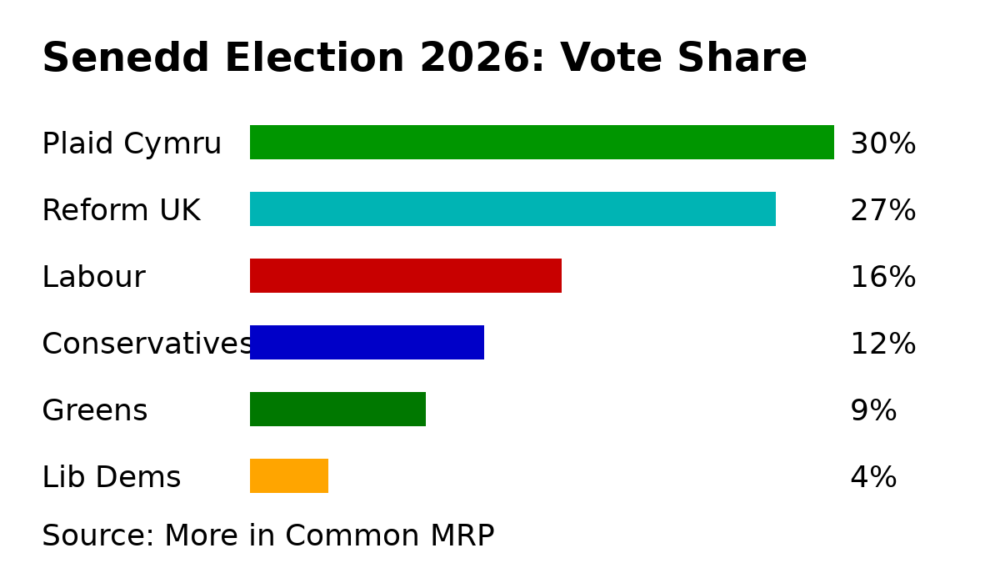
If the figures are borne out, Wales would be left with a hung Senedd and no simple route to forming a government.

A Plaid Cymru–Labour deal would reach 48 seats, one short of a majority. That could leave party leaders facing talks over a minority administration, a confidence-and-supply agreement, or a broader arrangement involving the Greens.
Luke Tryl, executive director of More in Common UK, said: “With less than a week to go, the race has tightened.
“As we saw ahead of the Caerphilly by-election, Labour is being squeezed in the final days as voters rally behind Plaid Cymru as the progressive alternative to Reform.
“After nearly three decades leading the Senedd, Labour could fail to top the poll in any constituency and be pushed into third place.

“For Reform, this would represent an extraordinary breakthrough — going from barely contesting the last Senedd election to being in contention for the highest number of seats.
“But even Rhun ap Iorwerth will not be celebrating yet — the outcome is likely to require complex coalition or confidence-and-supply negotiations.”
The survey was based on responses from 2,159 people across Wales between March and April.

The election is being fought under a new system, with 96 Members elected across 16 larger constituencies. Seats will be allocated using the d’Hondt method, meaning small changes in vote share could affect the final outcome.
More in Common said around one in six seats could be decided by margins of less than 2.5%, with some final seats in constituencies potentially turning on extremely small differences.
The modelling also suggests First Minister Eluned Morgan could be under pressure in the new Ceredigion Penfro constituency, where Labour is projected to finish fourth.
With polling day now close, the final result remains highly uncertain — but the survey suggests Wales could be heading for a Senedd where no party is able to govern alone.

Cross-party backlash as proposal to target Green-voting areas sparks outrage
REFORM UK has been accused of seeking to “punish voters” after unveiling a controversial plan to site migrant detention centres in areas that do not support the party.
The proposal forms part of the party’s pledge to deport “all illegal migrants” in Britain, which would require holding tens of thousands of people at a time in large-scale detention facilities.
In a statement, Reform said the centres would not be located in constituencies where it holds parliamentary seats or controls local councils. Instead, it would prioritise areas represented by the Green Party of England and Wales.
The party said: “If you vote in a Reform council or Reform MP, we guarantee you won’t have a detention centre near you. If you vote Green, there’s a good chance you will.”
Reform argued the approach was an “exercise in democratic consent”, claiming communities that back stricter immigration policies should not bear the burden of enforcement measures.
Political storm
The announcement triggered swift condemnation from across the political spectrum.
Mothin Ali said the policy was “abhorrent” and accused Reform of making inflammatory statements to distract from its wider agenda.
Labour chair Anna Turley described the proposal as “grotesque”, warning it undermined fundamental democratic principles by targeting communities based on how they vote.
Senior figures within the Conservative Party also voiced concern. Leader Kemi Badenoch shared criticism from former minister Simon Clarke, who warned the policy could amount to an abuse of power.
Clarke said deliberately siting facilities in areas based on voting patterns would likely face legal challenge and could be struck down in court, potentially costing taxpayers millions.
Legal and practical doubts
Critics have also raised questions over whether the plan could be implemented in practice.
Large detention centres would require suitable locations, infrastructure, and planning approval, as well as compliance with domestic law and international obligations.

Legal experts have suggested that targeting specific areas for political reasons could be open to challenge, particularly if it is seen as discriminatory or lacking a rational planning basis.
Reform’s defence
Reform has defended the proposal, insisting it is about fairness and accountability.
The party argues that voters who support stricter immigration controls should not be forced to host detention facilities, while those backing more liberal approaches should accept the consequences of their stance.
The policy was also framed as a direct challenge to Zack Polanski, with Reform suggesting Green politicians should “embrace” the idea.
Election backdrop
The row comes just days before local elections, with critics accusing Reform of deliberately provoking controversy to dominate the political agenda.
While the policy may appeal to the party’s core supporters, opponents say it risks alienating mainstream voters by appearing divisive and vindictive.



News2 hours ago
Final poll puts Plaid and Reform level ahead of Senedd vote
Labour faces historic setback as new modelling points to a hung Senedd PLAID CYMRU and Reform UK are projected to...


News23 hours ago
West Wales coracle fishermen raise alarm over suspected sewage pollution
A CENTURIES-old fishing tradition on the River Towy could be under threat after coracle fishermen reported suspected sewage pollution entering...


Community2 days ago
Scooter rally brings colour and nostalgia to Tenby
TENBY is buzzing with the sights and sounds of classic scooters this Bank Holiday weekend as the Welsh National Scooter...


Entertainment2 days ago
Haverfoodfest returns to Haverfordwest town centre today
HAVERFORDWEST town centre is expected to be busy today as Haverfoodfest 2026 returns for a full day of food, drink,...

Crime3 days ago
70-year-old denies assault and restraining order breach
A PENSIONER from Pembroke Dock has denied breaching a restraining order and assaulting another man. Henry Howlett, 70, of Market...


News4 days ago
Conservatives target two seats in new Ceredigion Penfro constituency
Paul Davies and Sam Kurtz say health, farming and transport are key as they seek return to the Senedd CONSERVATIVE...


Community4 days ago
Milford Haven Beer Fest returns to waterfront this May
EVENT WILL FEATURE 34 DRINKS, LIVE MUSIC AND STREET FOOD MILFORD HAVEN is preparing to raise a glass as Beer...


Community5 days ago
Cancer patients targeted with parking fines outside Haverfordwest support centre
Adam’s Bucketful of Hope says vulnerable users, elderly volunteers and charity drivers have paid more than £1,000 after Ateb introduced...


Charity5 days ago
Row erupts at Spitfire museum after Reform poster displayed at charity premises
A HAVERFORDWEST museum has become caught up in a political row after Reform UK campaign material was photographed inside the...


Crime5 days ago
Pembrokeshire man charged with making hundreds of indecent images of children
A PEMBROKESHIRE man has appeared before magistrates charged with making hundreds of indecent images of children. David Lewis, 42, is...
-

 Local Government6 days ago
Fishguard children’s home application is a ‘legal test’, not planning merits decision
-

 Community4 days ago
Dogs removed after welfare concerns at Milford Haven property
-

 Crime6 days ago
Drink-driver hit bicycle and failed to stop
-

 Crime5 days ago
Pembrokeshire hairdresser avoids prison after pub assault
-
Crime5 days ago
Pembrokeshire man charged with making hundreds of indecent images of children
-

 Business5 days ago
Handcrafted garden furniture built to last across Pembrokeshire
-
Charity5 days ago
Row erupts at Spitfire museum after Reform poster displayed at charity premises
-
Community5 days ago
Cancer patients targeted with parking fines outside Haverfordwest support centre