


News
Cabinet approves transport strategy wish list


PEMBROKESHIRE COUNTY COUNCIL’S Cabinet has endorsed a Regional Transport Strategy that relies on Welsh Government funding of £125m over the next five years. However, the plan also relies on the Council spending other money allocated to it by the Welsh Government to pay for the delivery of Welsh Government as well as local priorities.
Based on comparisons between similar projects, the low end of the cost of delivering the Pembrokeshire-only projects will be at least £66m. That suggests that not only will all the projects not come to fruition in the plan period but also indicates that the Welsh Government funding allocation to them underestimates the cost of delivering the majority, if not all, of the projects.
If the strategy’s budget is fantasy, the prospects of delivering all of it are even more fanciful. The projects in the strategy read like a Guardian reader’s wishlist instead of something grounded in local needs.
ACTIVE TRAVEL SCHEMES DOMINATE
The thirty-plus projects located solely in Pembrokeshire include fifteen schemes solely dedicated to active travel or which incorporate active travel as part of them. In context, and based on the cost of delivering similar schemes, the low-end estimate for “active travel” schemes alone is around £22m.

“Active Travel” under the Welsh Government’s Active Travel Act refers to efforts to reduce the use of cars for everyday journeys, such as commuting and education. Active travel schemes create infrastructure which supports walking, cycling, and wheeling (e.g., wheelchairs, mobility scooters).
Those schemes work well in urban areas. However, in rural areas with dispersed working populations, such as Pembrokeshire, their impact is less beneficial. The now-former Welsh Government minister Lee Waters got an earful from Plaid Cymru and fringe environmental groups (mostly funded by the Welsh Government) when he dared say that cars would continue to be the primary mode of transportation in rural Wales. If an MS from Dolgellau can use an e-scooter to get the mile and a half from their taxpayer-funded flat in Cardiff to the Senedd, there’s evidently no reason why commuters between Fishguard and Haverfordwest can’t do the same.
The active travel schemes planned for Pembrokeshire include a Multi-User Route from Narberth to Haverfordwest, an active travel route from Pembroke Dock to Pennar, one from Pembroke to Angle, six schemes in and around Tenby, and an expansion of the County Council’s e-bike scheme.
BIG TICKET SPENDING

The big spending item is the relocation of the A487 at Newgale. That project has been on the cards for fourteen years, if not longer. It forms part of the Welsh Government’s regional transport strategy as a permanent solution to the challenge of coastal erosion and the increased risks of tidal and pluvial flooding, standing against less certain and temporary interventions to hold the existing line. As it is part of the Regional Strategy, it will be predominantly funded by the Welsh Government through project-specific grants, in the same way as the preliminary investigations and public engagement.
The plan will funnel transport funding towards supporting the Celtic Sea Freeport. Its backers hope the Freeport’s economic impact will be positive and spread across the Freeport area. However, the existing transport infrastructure for it is a bad joke. Addressing its shortcomings is a major component of the Regional Transport Strategy.
Setting aside projects scheduled for Neath Port Talbot, millions of pounds are projected to be spent on hydrogen fuel infrastructure and green/blue energy grid improvements. However, one project guaranteed to cause controversy seeks to increase road capacity and flow through Pembroke to support increased traffic from the Celtic Freeport development in the Angle Peninsula. Bearing in mind obvious geographical and logistical constraints and its need to cross conservation areas and sensitive landscapes within the National Park, any road expansion (there’s also an active travel route planned) will likely cause uproar and cost tens of millions to deliver. That is, however, a long-term project.

MORE TRANSPORT HUBS
In the medium term, the Regional Strategy looks at a multi-million-pound project to improve roads between Haverfordwest and Milford Haven. That scheme looks to address congestion between the county town and the centre of Freeport operations in Pembrokeshire. Again, geographical and logistical issues suggest that the project will find it difficult to do much more than put lipstick on a pig. If, however, the scheme manages to resolve the congestion hotspots at Cartlett, Salutation Square (subject to a separate congestion-easing plan), Freemen’s Way, and Johnston as far as the Sunnycroft Roundabout, it will doubtless be welcomed by commuters.
And, if you thought one transport hub was a bad idea, there’s more to come – from the Milford Haven transport interchange to one planned for Pembroke Dock, improved access to Fishguard’s ferry port, and a host of other projects that will connect Pembrokeshire’s public transport network, as the plan puts it poetically “ensuring better multimodal connectivity”.
Given the almost certain budget problems which these projects will encounter and, therefore, cause the County Council when it comes to setting its budgets, ensuring Pembrokeshire gets what it needs to improve the local economy instead of what the Welsh Government thinks it ought to have will be a major source of tension and contention.
If half of the plan is delivered on time, on budget, and within the Welsh Government’s funding envelope, its effects will be limited – as we will all have pigs to fly around on.












WELSH LABOUR has unveiled a pledge to deliver a direct rail service between Milford Haven and London – a move that would transform connectivity for communities across Pembrokeshire.
This commitment builds on £50 million of UK Labour investment to upgrade rail services to Milford Haven.
Work is already underway, in partnership between the Welsh Labour Government and Pembrokeshire County Council, led by Council Leader Paul Miller, to transform Milford Haven railway station into a modern Public Transport Interchange – delivering smoother, better connected and more accessible journeys.
Together, these upgrades will pave the way for direct London services to call at Milford Haven, alongside an hourly service and vital level crossing safety improvements delivered by the UK Labour Government.
First Minister Eluned Morgan said: “This pledge sits alongside a record commitment to rail in Wales – up to £14 billion of investment, new stations and a transformed Metro. But this is about more than just a rail line.
It’s about opening Pembrokeshire up – bringing more people to one of the most beautiful parts of Wales, strengthening our tourism sector and creating new opportunities for local businesses to grow.
“And as we do that, we’re doing it the right way – backing a greener economy, making it easier for people to travel sustainably, and ensuring that growth benefits our communities. This is how we build a stronger future for West Wales – with better connections, more opportunity and an economy that works with our environment, not against it.”
Welsh Labour candidate for Ceredigion Penfro, Marc Tierney added: “A direct train to London from Milford would be a game changer for our communities – boosting tourism, supporting local businesses and making it easier for people to live and work here.
“The work underway to transform Milford Haven station into a modern transport hub, alongside plans for an hourly service, shows what Welsh Labour can deliver when we work in partnership with local authorities – investing in the infrastructure our communities deserve. With new funding from the UK Labour Government and a strong partnership in place, we can now go further.
“Welsh Labour is delivering the investment and the ambition needed to ensure West Wales is at the forefront of modern, connected and accessible transport.”
The pledge forms part of Welsh Labour’s wider plan to modernise public transport, strengthen regional connectivity and ensure no part of Wales is left behind.
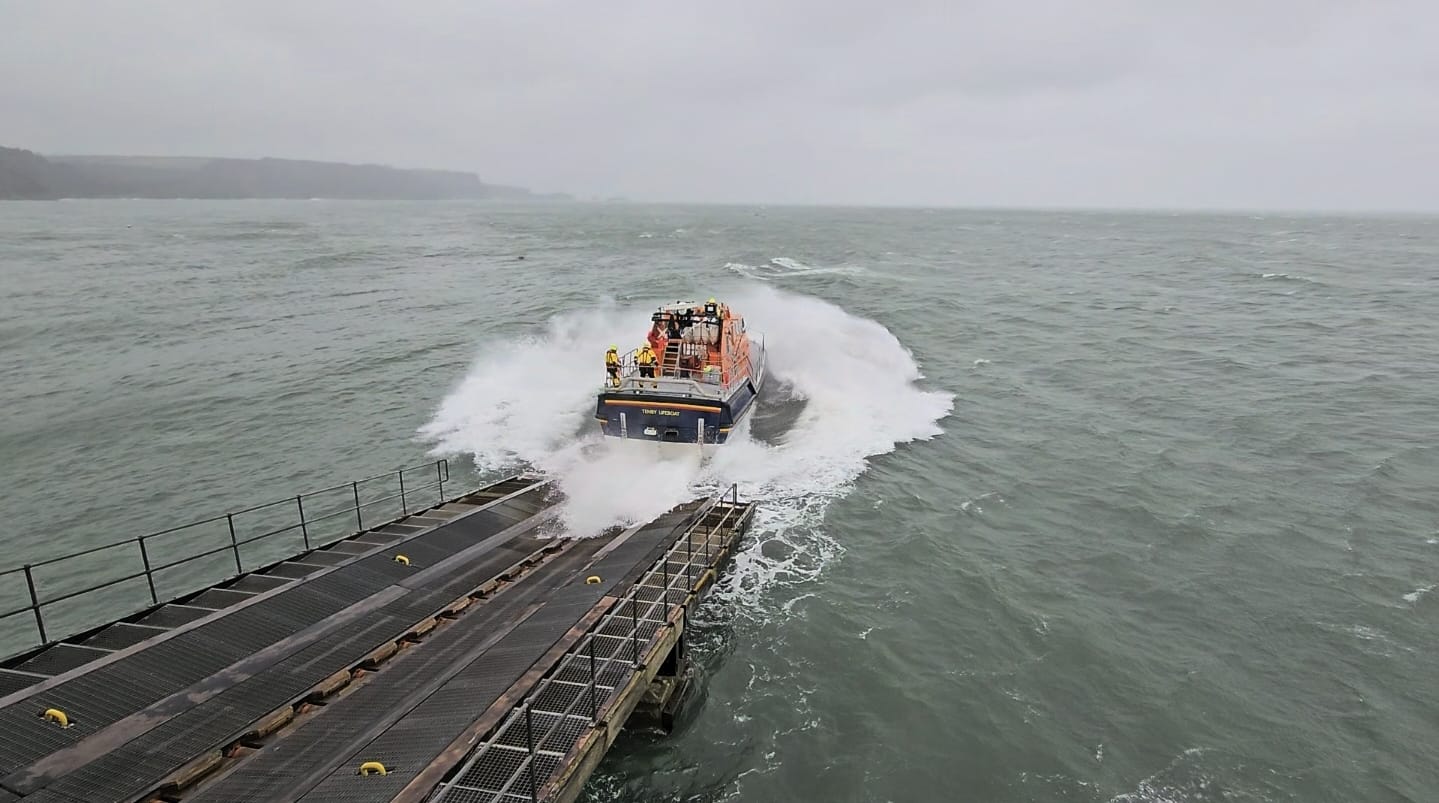
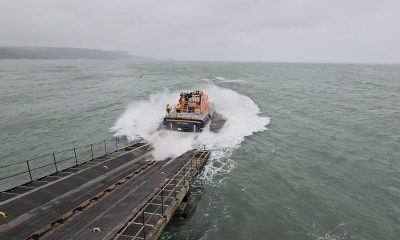
Volunteer RNLI crews dealt with reports of people cut off by the tide, a vessel with engine failure and a possible kitesurfer in difficulty
TENBY lifeboat crews have been called out five times in a week, dealing with a series of incidents around the south Pembrokeshire coast.
The latest launch came just before 5:30pm on Sunday (May 3), when the inshore lifeboat was sent to Monkstone Point following a report that people may have been cut off by the tide.
As the volunteer crew arrived on scene, it was confirmed that the people were fishing and did not require assistance. The lifeboat was stood down and returned to station.
The call-out was the station’s fifth shout of the week.
On Friday (May 1), the all-weather lifeboat launched shortly after 10:00am after the occupants of a 21ft pleasure boat reported engine failure between Lydstep and Giltar.
The lifeboat arrived around ten minutes later and found the vessel at risk of drifting onto rocks. The crew decided the safest option was to tow it back to Saundersfoot.
With the tide out, the vessel was moored in the bay and those on board were taken ashore using the lifeboat’s Y-boat, where they were met by Tenby Coastguard Rescue Team. The lifeboat returned to station at 11:25am.
On Wednesday (Apr 29), the inshore lifeboat was launched shortly after 4:30pm after a report that a kitesurfer appeared to be in difficulty between Tenby and Caldey Island. The crew searched the reported area and extended the search towards Giltar Point, but no one in difficulty was found.
Earlier in the week, both Tenby lifeboats were launched at 6:15pm on Monday (Apr 27) after a report that two people may have been cut off by the tide at Gilman Point, near Pendine.
The all-weather lifeboat arrived first, with choppy conditions slowing the inshore lifeboat. Coastguard rescue team members on the cliffs above directed the crew to two people on rocks.
The Y-boat was launched and the pair confirmed they were in difficulty. They were taken aboard and brought ashore at Pendine, where Coastguards were waiting. The inshore lifeboat also collected the casualties’ bags before returning them ashore.
The busy week came as three Tenby RNLI volunteers — Eddie, Alice and Jack — successfully completed their ALB tier one pass-out on Sunday.

Tenby Lifeboats RNLI congratulated the trio, saying: “Well done guys.”
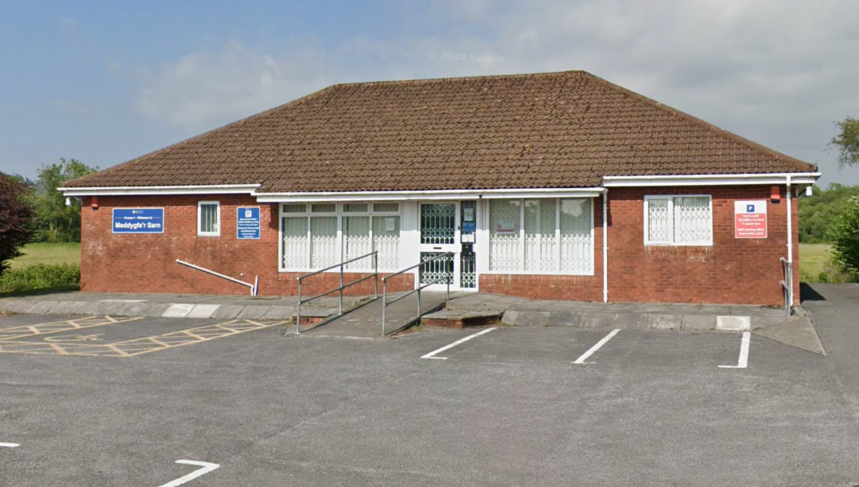
Health board accused of misleading claims over recruitment as pressure mounts ahead of final decision
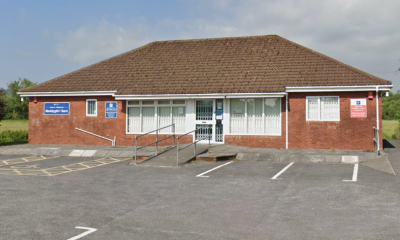
A FREEDOM of Information disclosure has raised serious questions over plans to close Meddygfa’r Sarn in Pontyates, with claims the health board failed to properly attempt to recruit permanent doctors before recommending its shutdown.
The row centres on Hywel Dda University Health Board, which is due to make a final decision on the surgery’s future later this month.
An FOI response reveals that while the board cited a “lack of recruitment interest” in its January report, there is limited evidence of any recent, targeted recruitment campaign specifically aimed at the Pontyates practice.
Instead, the board confirmed that salaried GP roles were advertised in 2020 across its wider portfolio of managed practices — rather than as a focused effort to fill posts at Meddygfa’r Sarn itself. Those vacancies did not result in successful appointments.
‘No real attempt’
Independent Senedd candidate Carl Peters-Bond, who is also a patient at the surgery, has strongly criticised the health board, accusing it of presenting a misleading picture to justify closure.

He said: “They cited a lack of recruitment interest as justification for closing this surgery — but they never actually ran a proper recruitment campaign for it.
“Sending out general adverts years ago is not the same as making a serious, targeted effort to keep a vital community service alive.”
He also raised concerns about the consultation process, claiming it focused on the impact of closure rather than asking whether closure should happen at all.
Fully reliant on locums
The FOI confirms that Meddygfa’r Sarn currently has no salaried GPs and is entirely dependent on locum doctors.

While the health board says this model is unsustainable in the long term, the same disclosure shows several other managed practices across the region also rely heavily on locum staff — some to a significant degree.
Cost data included in the response suggests Meddygfa’r Sarn is not the most expensive practice per patient within the health board’s area.
Alternative options unclear
Another key issue raised by campaigners is the apparent lack of explored alternatives.

The FOI response indicates that the health board does not hold information on alternative local solutions, including potential relocation or different service models within the Pontyates area.
Campaigners argue this suggests closure was considered before all options had been properly examined.
A 52-page independent report submitted as part of the consultation process states that dispersing patients to other surgeries should only be considered as a last resort, after full recruitment efforts and capacity assessments have been carried out.
Health board position
Hywel Dda University Health Board maintains that the surgery, which serves around 4,350 patients, has faced long-standing recruitment difficulties and increasing reliance on temporary staff.
It says a Vacant Practice Panel concluded that dispersing patients to neighbouring surgeries would provide a more sustainable long-term solution.
The board has also acknowledged that transport and access concerns are likely to be a major issue for patients if the closure goes ahead, with a full Equality Impact Assessment expected to be considered before a final decision.
Decision later this month
The future of Meddygfa’r Sarn will be decided at a meeting of Hywel Dda University Health Board on Wednesday (May 28) at Yr Egin in Carmarthen.
With local anger growing and new questions emerging from the FOI disclosure, pressure is mounting on board members to reconsider the proposal.
Campaigners say the case now hinges on a simple question: whether enough was done to save the surgery before moving to close it.


News8 hours ago
West Wales coracle fishermen raise alarm over suspected sewage pollution
A CENTURIES-old fishing tradition on the River Towy could be under threat after coracle fishermen reported suspected sewage pollution entering...


Community2 days ago
Scooter rally brings colour and nostalgia to Tenby
TENBY is buzzing with the sights and sounds of classic scooters this Bank Holiday weekend as the Welsh National Scooter...


Entertainment2 days ago
Haverfoodfest returns to Haverfordwest town centre today
HAVERFORDWEST town centre is expected to be busy today as Haverfoodfest 2026 returns for a full day of food, drink,...

Crime3 days ago
70-year-old denies assault and restraining order breach
A PENSIONER from Pembroke Dock has denied breaching a restraining order and assaulting another man. Henry Howlett, 70, of Market...


News3 days ago
Conservatives target two seats in new Ceredigion Penfro constituency
Paul Davies and Sam Kurtz say health, farming and transport are key as they seek return to the Senedd CONSERVATIVE...


Community4 days ago
Milford Haven Beer Fest returns to waterfront this May
EVENT WILL FEATURE 34 DRINKS, LIVE MUSIC AND STREET FOOD MILFORD HAVEN is preparing to raise a glass as Beer...


Community5 days ago
Cancer patients targeted with parking fines outside Haverfordwest support centre
Adam’s Bucketful of Hope says vulnerable users, elderly volunteers and charity drivers have paid more than £1,000 after Ateb introduced...

Charity5 days ago
Row erupts at Spitfire museum after Reform poster displayed at charity premises
A HAVERFORDWEST museum has become caught up in a political row after Reform UK campaign material was photographed inside the...


Crime5 days ago
Pembrokeshire man charged with making hundreds of indecent images of children
A PEMBROKESHIRE man has appeared before magistrates charged with making hundreds of indecent images of children. David Lewis, 42, is...


Crime6 days ago
Man appears in court charged over death of Blood Bike Wales volunteer
FAMILY WATCHED FROM PUBLIC GALLERY AS CASE SENT TO CROWN COURT A PEMBROKESHIRE man has appeared before magistrates charged with...
-

 Local Government5 days ago
Fishguard children’s home application is a ‘legal test’, not planning merits decision
-

 Community4 days ago
Dogs removed after welfare concerns at Milford Haven property
-

 Crime6 days ago
Drink-driver hit bicycle and failed to stop
-

 News7 days ago
SPECIAL FEATURE: Did Chernobyl affect children in Wales?
-

 Crime5 days ago
Pembrokeshire hairdresser avoids prison after pub assault
-
Crime5 days ago
Pembrokeshire man charged with making hundreds of indecent images of children
-

 Business5 days ago
Handcrafted garden furniture built to last across Pembrokeshire
-

 Sport7 days ago
Neyland make early statement as cricket season begins