


Community
Pembroke Horse Fair to go ahead despite council permission row

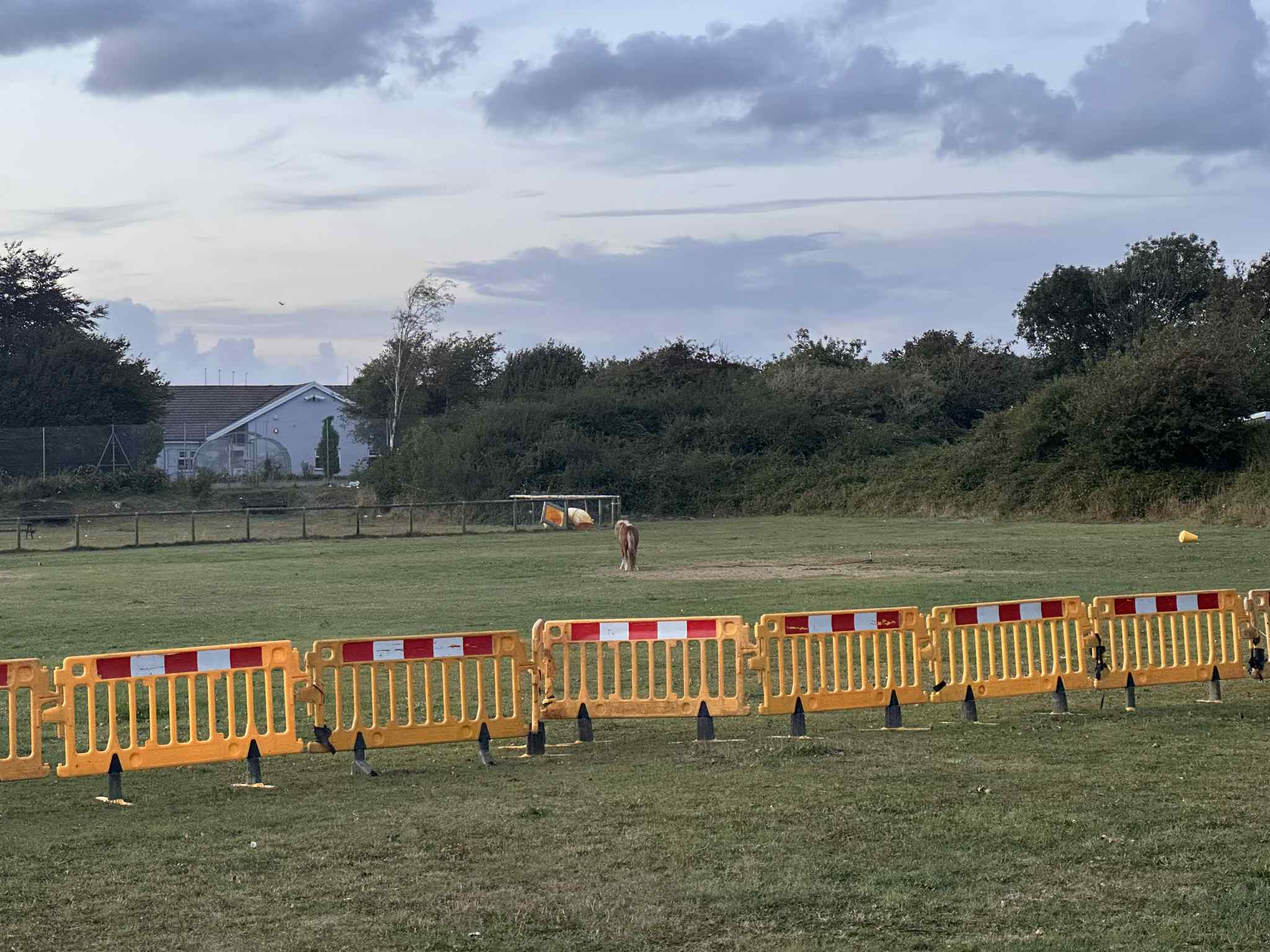
Charlie Price reassures locals at packed public meeting in Monkton, but says: “Not even the Prime Minister himself could stop this event”
A PUBLIC meeting was held at Dezza’s Cabin Community Centre in Monkton on Wednesday evening (Aug 28) as organiser Charlie Price sought to address growing concern about the upcoming Pembroke Horse Fair, due to take place this Saturday (Aug 30).
The meeting followed a press release issued by Pembrokeshire County Council earlier this week which stated that the event had not been granted formal permission. The announcement was picked up by multiple local media outlets and caused unease among residents living near the proposed site, which lies on council-owned land in Monkton.
Welsh Tik-Toker Sophie Julie Valencia, who has over 100,000 followers has been pushing the event for weeks.

Price, who called the meeting to reassure locals, spoke to around 40 people in attendance. The event began at 7:15pm after a brief delay while attendees waited for a police representative who ultimately did not arrive. Local councillor Jonathan Grimes also did not attend, having previously sent apologies due to a diary clash related to candidate selection for the upcoming Senedd elections.
Addressing this, Price expressed frustration at the councillor’s absence: “He is our councillor and he is paid to represent us,” he said. He then quipped: “I will stand for council and take his seat if he doesn’t help the community.”

Despite the uncertainty around permissions, Price was adamant that the council had been actively assisting with preparations: “Why do you think the council have been here in their trucks, helping us this morning?” he said, gesturing towards the double doors of the community hall. He explained that fencing had been delivered and installed on the site, and that he had held multiple meetings with council representatives in recent weeks.

Police and safety arrangements
Price also addressed policing and public safety, stating that he had met with a high-ranking officer who confirmed that police were aware the event was going ahead and were cooperating. “They’ve said they’re willing to work with us, and we’ve got stewards and marshals in place,” he said. Several of the marshals were present at the meeting.
He further confirmed that there would be no road closures and that access to local roads — including Back Lane — would be maintained throughout. Emergency vehicle access had also been considered, he added.
Parking would be available for a £5 fee, with all proceeds going to charity. The event is covered by public liability insurance through Dezza’s Cabin.

Family-friendly event, not-for-profit
Price was keen to stress that the fair is not a commercial venture: “This isn’t for personal profit — it’s a charity event for the community,” he said. He added that around 100 horses were expected, along with a variety of stalls, children’s activities such as bouncy castles and face painting, and food vendors. “There’ll be no alcohol on site — I want this to be a family event,” he said.
Price said the fair would run from 9:00am to 6:00pm on Saturday, with some people arriving the day before to set up. He gave a personal assurance that the site would be cleared by Sunday: “I need the field back for my horses,” he joked, drawing laughter from those present.
Mayor invited to open the event
At the close of the meeting, Price told the room he had invited the Mayor of Pembroke to open the fair. “He said he would have loved to but he has a family engagement party to attend on the same day,” Price explained.

“We are looking for someone to open the event,” he said.
Community support
Many locals who attended left reassured by the open and direct approach. Price had already been knocking on doors earlier in the week to speak with residents face-to-face and address concerns. The event ended with a round of applause and a sense of cautious optimism that the fair would proceed smoothly.
Price closed the meeting by expressing his hopes for the future: “This isn’t just for the travelling community — it’s for Monkton. Monkton is a strong community where everyone supports each other,” he said. “I want this to be an annual event. I want to see it grow and bring everyone together.”
Council statement
In a statement on Tuesday, Pembrokeshire County Council said: “We are aware of the proposed horse fair to be run on August 30 at Monkton.
“No permission has been granted for this event to take place on Council land.
“We have written to the organiser setting out our concerns and making clear that they must ensure any event is managed safely and responsibly.
“We will monitor the situation closely and work with our partners to minimise disruption to the community.”
It seems now however that the council has conceded the event is going ahead is now doing everything it can to cooperate with the organisers to ensure it is safe and runs smoothly.













MINISTERS have hailed the rollout of dozens of 4G mast upgrades across rural Wales, but recent concerns in Tenby show mobile coverage remains a live issue in Pembrokeshire.
The UK Government says a further 11 mast upgrades have been switched on in Wales this year through the Shared Rural Network, bringing the Welsh total to 55.
The scheme is aimed at improving mobile coverage in hard-to-reach rural areas, helping residents, businesses and visitors stay connected and access help more quickly in an emergency.
Areas benefiting from the latest upgrades include Nant Gwynant in Snowdonia, Capel y Ffin near Abergavenny, Manafon near Welshpool, and several locations across Powys.
Telecoms Minister Liz Lloyd said the programme was helping bring “every part of the UK into the digital age”, while Secretary of State for Wales Jo Stevens said reliable coverage was vital for rural communities and economic growth.
However, the announcement comes amid continuing concern about mobile phone coverage in Tenby, where residents and businesses have raised concerns about poor signal and mast-related issues.
Although the latest UK Government upgrades focus mainly on remote rural areas, the problems reported in Tenby highlight that connectivity remains a pressing issue in Pembrokeshire, particularly in coastal communities which see huge seasonal increases in visitor numbers.
Reliable mobile coverage is increasingly seen as essential for tourism businesses, delivery drivers, emergency services, residents and visitors who rely on phones for payments, bookings, navigation and safety.
The Shared Rural Network is a partnership between the UK Government and mobile network operators. Across Great Britain, more than 140 publicly funded 4G masts have now been activated.
The programme is due to continue until January 2027.

PC swam 100 metres offshore to save distressed woman heard calling for help in darkness
A DYFED-POWYS POLICE officer has been praised for his bravery after entering the sea at midnight to rescue a distressed woman heard calling for help off the coast of Milford Haven.
PC Spencer Rourke swam around 100 metres offshore in darkness after locating the woman in the water off Milford beach during the early hours of Saturday, May 24, 2025.
Police were first alerted at 12:31am after a distressed woman on Hamilton Terrace called emergency services and said she intended to enter the sea. Described as highly emotional and panicked, her call prompted an immediate police response.
Officers searched the area but were initially unable to find her. A further update from the control room suggested she had moved towards Foam beach, prompting officers to widen their search.
PC Rourke, alongside PS Anthony, parked at the rear of Foam and began checking the area on foot. In the stillness of the early morning, the officers heard a faint sound coming from the slipway.
As they moved closer, they heard a woman shouting from out at sea.
Using torchlight, the officers eventually spotted her around 100 metres from shore, clearly in distress.
Without hesitation, PC Rourke removed his police kit, grabbed a lifesaving float and entered the water.
As he swam towards her, the woman attempted to move further away, but he caught up with her and managed to take hold. Despite difficult conditions and the woman’s distress, he remained with her and guided her safely back towards shore.
Fellow officers waiting at the water’s edge helped bring both to safety.
The woman survived thanks to what colleagues described as PC Rourke’s “swift, selfless and decisive actions.”
Above and beyond

PS Anthony later praised his colleague, saying there was little doubt that PC Rourke had saved the woman’s life.
He described the officer’s actions as “far above and beyond what would be expected” and praised his judgement, courage and willingness to place himself at considerable personal risk to protect a vulnerable member of the public.
Chief Constable Ifan Charles said: “I am immensely proud of PC Rourke, whose actions on 24 May 2025 exemplify the very best of policing.
“Without hesitation he entered the sea to rescue a woman in distress, saving her life. His courage, selflessness and decisive action under extreme circumstances are truly commendable and bring great credit to the service.”
Dyfed-Powys Police Federation Branch Chair Delme Rees also praised the officer, noting the dangers of the water in Milford Haven.
He said: “PC Rourke absolutely deserves the recognition and admiration for his life-saving actions on 24 May 2025.
“The waters in that area are extremely dangerous as it’s a tidal estuary and a busy shipping lane. You have oil tankers moving through the water and the Pembroke Dock to Rosslare ferry route nearby.
“PC Rourke was the right officer at the right time because he had the physical ability to do what was needed, but it still took a bold and selfless decision to commit to entering the water that night.”
Pic caption:
Hero officer: PC Spencer Rourke swam into the sea at Milford Haven to rescue a distressed woman in the early hours of May 24 (Pic: Police Mutual).


THE FINAL decision to close fire-ravaged Manorbier school has been given the go-ahead, despite a heartfelt last-minute plea by local councillor Phil Kidney to keep it open.
Back in March, Pembrokeshire County Council members backed a recommendation that the Director of Education at Pembrokeshire County Council be authorised to publish a statutory notice to discontinue Manorbier Church in Wales voluntary controlled school.
Manorbier Church in Wales VC School and its adjoining schoolhouse was severely damaged by a fire in October 2022, which broke out in the school roof space.
After that, a ‘school from school’ was set up in Jameston Village Hall.
It had been hoped the school would be rebuilt, but last year councillors backed a report of the School Modernisation Working Group which, amongst other recommendations, included a statutory consultation on proposals to discontinue Manorbier Church in Wales Voluntary Controlled School.
The decision attracted strong local opposition, with more than 1,500 people signing a petition on the council’s own website calling for the school to be rebuilt.
The formal consultation for the discontinuation of Manorbier closed last December.
However, many of the council’s figures, especially on the level of surplus places at the school, have been strongly disputed.
At a special extraordinary council meeting held on June 15, members were asked to consider a report on a summary of 62 objections received in respect of the proposal to discontinue Manorbier VC school, which included options to end that discontinuation or to launch a fresh consultation.
However, it was recommended, in a report present by deputy leader Cllr Paul Miller, who now also has responsibility for education, for the discontinuation be proceeded with.
At the meeting, local councillor Phil Kidney, who has been a staunch supporter of the keeping the school open, thanked the campaigners who fought for it and the dedication of the staff, including headteacher Sharon Davies.
Cllr Kidney said: “The way this authority has treated her and the staff is quite frankly amazing; we have all let these good people down.


“We’ve all let these people down, the way this council has handled this situation is appalling; from day one not one of the executives came up to see these children, no-one came out; if that was Haverfordwest or Tenby they’d be all over the place.”
He said the wording of the consultation had seen more mentions of St Florence [ the alternative school for pupils in the event of a discontinuation] than Manorbier, describing it as “like a brochure for St Florence”.
He also warned the Diocese of St Davids, which had always pressed for the school to be rebuilt, would not allow the council to “walk away from our liabilities lightly”.
“We’ve been promised by two leaders and the chief executive: ‘Don’t worry we’ll rebuild,’ sometimes you’ve got to be big enough an honour your promises; do the right thing today, vote for Manorbier and keep it open.”
Members later heard the diocese had, in a letter received by councillors, made “damning accusations the council is being biased against voluntary controlled schools,” with Cllr Jamie Adams saying the council administration should be “ashamed of this debacle”.
Cllr Miller said his only consideration was “the future welfare of the children,” adding: “I do not think 20 children educated in a welfare centre in Jameston is the best for them.”
He said that no pupils would have to travel more than 2.1 miles for their education as a result of a closure, Cllr Kidney disputing that figure more like 3.5 miles.
Cllr Miller said the wording in from the letter from the diocese “which had a dog in the fight” was a one-sided legal argument, adding the council had actually opened VC schools.
Cllr Aled Thomas, chair of the working group which had presented the proposals in the first place, said: “The whole thing is an omnishambles, a total mess of how it’s been handled, but we are where we are.
“The important thing to remember is the future for these children, there will be kids in that school that have never been taught in a classroom setting. Tough decisions are never going to be easy; not a single one of us got elected wanting to be in this position.
“I’m no friend of the administration but we need to look at it holistically.”
Members, by 30 votes to 23, with four abstentions, supported the final steps to close the school.
Posting after the decision, the Friends of Manorbier School said: “Today is a difficult day, as the final decision to close Manorbier Primary School has now been made.
“There were some heartfelt comments and statements during the council meeting. The children, staff, parents and wider community have been waiting far too long for a decision. While this outcome was not unexpected, it is still hard to hear those final words spoken aloud.”
It added: “There are still questions that need to be asked, but the fight to keep the school open has come to an end. Our focus must now be on supporting the children and their families as they prepare for the transition ahead. The staff, too, finally have an answer.”



Community13 hours ago
Police officer hailed hero after midnight sea rescue in Milford Haven
PC swam 100 metres offshore to save distressed woman heard calling for help in darkness A DYFED-POWYS POLICE officer has...


Local Government19 hours ago
Security privately arranged by Mayor at Beating of the Bounds
HAVERFORDWEST TOWN COUNCIL has confirmed that security personnel seen at this year’s Beating of the Bounds were privately arranged and...


Business2 days ago
Celtic Freeport five-year plan puts Milford Haven at centre of green energy future
Strategy promises investment, skilled jobs and new supply chains, but major barriers remain over grid connections, planning and delivery THE...


Education2 days ago
Closure of Ysgol Clydau approved after emotional council debate
COUNCILLORS WARNED RURAL COMMUNITIES WILL REMEMBER DECISION PEMBROKESHIRE councillors have voted to close Ysgol Clydau following an emotional debate over...


Education2 days ago
Manorbier school closure process to continue after narrow council vote
Questions remain over insurance, rebuilding costs and possible legal action by Diocese PEMBROKESHIRE councillors have voted to press ahead with...

Community2 days ago
The father, son and daughter lifeguard trio saving lives in Pembrokeshire
A FATHER, son and daughter are preparing to help keep beachgoers safe on the Pembrokeshire coast this summer as part...


Community2 days ago
Beating of the Bounds brings music, boats and tradition to Haverfordwest
CENTURIES-OLD CEREMONY DRAWS FAMILIES TO THE RIVERSIDE HAVERFORDWEST’S historic Beating of the Bounds returned on Sunday (Jun 14), with boats,...


Community3 days ago
Milford Haven School pupil praised after stepping in during real-life emergency
A YEAR 11 pupil at Milford Haven School has been praised after putting his first aid training into action to...


Community3 days ago
River festival brings crowds to Haverfordwest
A CELEBRATION of the River Cleddau brought crowds into Haverfordwest on Saturday (June 13) as the town’s River Festival returned...


Charity3 days ago
Voices at the Castle hailed as unforgettable night after weather setback
Russell Watson headlines spectacular charity concert at Pembroke Castle A SPECTACULAR evening of live music at Pembroke Castle has been...
-

 Community3 days ago
Pembrokeshire Chess Club crowned Welsh champions
-
Local Government19 hours ago
Security privately arranged by Mayor at Beating of the Bounds
-

 Crime6 days ago
Pembroke Dock teenager sentenced over train strangulation attack
-

 Education5 days ago
Diocese threatens legal action as Manorbier school closure battle intensifies
-

 Crime6 days ago
Man accused of six rapes including alleged Haverfordwest offence
-

 Local Government5 days ago
Taxi suspended after county-wide licensing checks
-

 Crime6 days ago
Brothers found guilty of causing death of Welsh dad in ‘reckless’ race
-

 Crime5 days ago
Currys worker denies stealing £2,500 of store stock