


Local Government
Neyland Council pledges action on parking, allotments and health services


NEYLAND TOWN COUNCIL has outlined a series of resolutions following its full council meeting on Monday (Oct 13), aimed at tackling key community issues ranging from parking safety to local healthcare.
Top of the agenda was a plan to find a long-term solution to the ongoing parking and safety problems on St Clements Road. Councillors agreed to pursue measures to improve conditions for both residents and motorists.
The Council also voted to set up a dedicated committee to oversee the creation and management of community allotments — a move designed to promote sustainability, wellbeing and local engagement.
In an effort to strengthen cooperation with external agencies, members resolved to invite representatives from local authorities and organisations to attend Council meetings. The aim, they said, was to foster “deeper relationships” and make Neyland Town Council a more effective conduit for residents’ concerns.
A public survey will also be launched to gather residents’ views on the most pressing community issues, ensuring that local voices shape the Council’s priorities in the months ahead.

Finally, the Council reaffirmed its commitment to press Hywel Dda University Health Board for a permanent solution to the ongoing uncertainty surrounding St Clements Surgery.
A spokesperson for Neyland Town Council said the resolutions reflect a strong commitment to “transparency, engagement and practical progress” on behalf of the community.


PEMBROKESHIRE COAST NATIONAL PARK AUTHORITY has confirmed the re-election of its chair, deputy chair and key committee leaders following its Annual General Meeting.
Dr Madeleine Havard has been re-elected as Chair of the Authority, with Cllr Claire George continuing as Deputy Chair.
Cllr Dr Simon Hancock has also been re-elected as Chair of the Authority’s Development Management Committee, with John Hogg re-elected as Deputy Chair of the committee.
The appointments were agreed by members at a meeting of the National Park Authority held on Wednesday, June 24.




The Authority is made up of 18 members, including 12 county councillors appointed by Pembrokeshire County Council and six members appointed by Welsh Government.
Together, they oversee the work of the Authority and make decisions on matters affecting the Pembrokeshire Coast National Park.
Dr Havard said: “It is an honour and a privilege to continue serving as Chair of Pembrokeshire Coast National Park Authority.
“Our National Park is one of Wales’ most treasured landscapes, and the Authority has an important role in protecting it for future generations whilst supporting the communities who live and work here.
“I look forward to continuing to work with all members, staff, partners and local communities as we respond to the opportunities and challenges facing the National Park.”
Cllr Dr Hancock said he was pleased to continue as Chair of the Development Management Committee, which considers planning matters within the National Park.
He said: “The Committee’s work requires careful judgement, balancing the need to conserve and enhance this special landscape with the needs of local people.
“I look forward to continuing to work with fellow members and officers in carrying out this responsibility.”

Members spend an average of two days a month on formal committee business, as well as representing the Park Authority at a range of formal and informal events.
These include Welsh Government-related meetings, workshops and seminars, as well as formal launches and presentations by the Authority and partner organisations.
The current members of Pembrokeshire Coast National Park Authority are Cllr Maureen Bowen, Cllr Di Clements, Ms Fiona Day, Cllr Claire George, Dr Madeleine Havard, Ms Helen Gwenllian, Mr John Hogg MBE, Sarah Hoss, Cllr Dr Simon Hancock MBE, Cllr Mike James, Mr Gwynn Angell Jones, Cllr Huw Murphy, Cllr Bethan Price, Cllr Sam Skyrme-Blackhall, Cllr Anji Tinley, Cllr Vanessa Thomas, Cllr Chris Williams BEM and Cllr Michael Williams.

Report due in September on replacing appointments with ANPR and CCTV monitoring
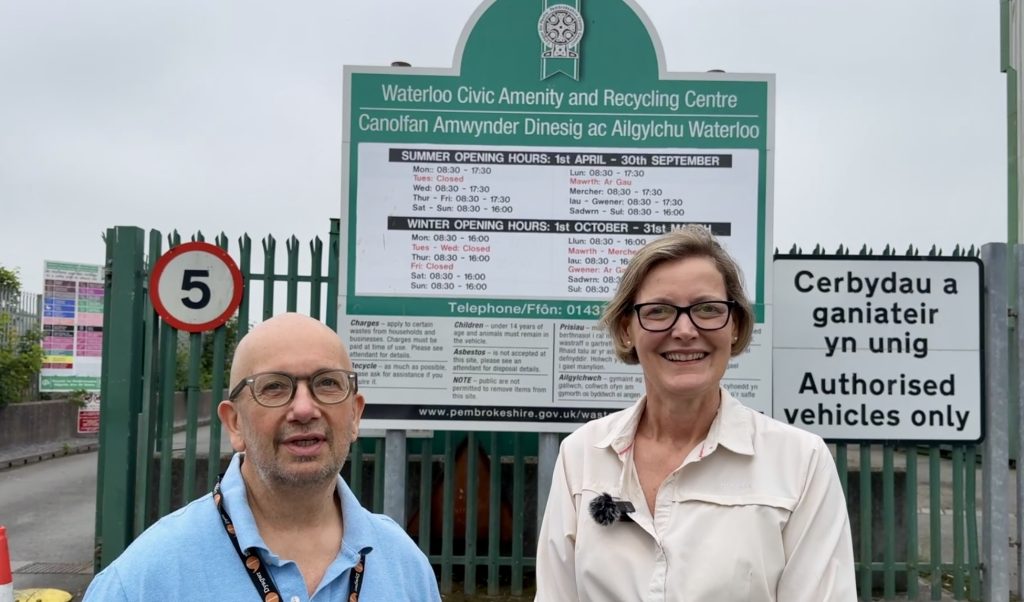
A PLAN to remove the booking system at Pembrokeshire’s waste and recycling centres is set to be brought before Cabinet later this year.
Council Leader Cllr Tessa Hodgson has confirmed that it is the intention of her administration to scrap the current system, which requires residents to book before using the county’s waste and recycling centres.
She has asked Cabinet Member for Residents’ Services, Cllr Rhys Sinnett, to work with officers on a report setting out the options for a new approach.
Cllr Hodgson said Pembrokeshire had a strong record on recycling, but added that the booking system remained a regular concern for local residents.
She said: “Pembrokeshire is consistently one of Wales’ best performing local authorities when it comes to waste and recycling, and I thank our staff and the people of Pembrokeshire for helping us continue to improve.
“However, the booking system is an issue that is raised with me time and time again by residents, and so removing the booking system is a priority for me and my administration.
“With modern technology such as number plate recognition and CCTV monitoring, I see no reason why we cannot ensure the sites are used appropriately and safely by council taxpayers, while minimising any unauthorised use, without the need for a booking system.”
Cllr Hodgson said the current arrangements could be “time-consuming and bureaucratic” and that the council should be able to protect the service while making it easier for residents to use.
She added: “I believe we can create a system that maintains high standards of waste disposal, provides value for money for taxpayers, and continues to maximise recycling, all without unnecessary bureaucracy.
“It is our administration’s intention that a report is brought to the September Cabinet meeting with a clear plan to remove the booking system from our waste and recycling centres.”
Cllr Rhys Sinnett said the council would look at a practical replacement which keeps sites safe and prevents misuse.
He said: “We know how important it is for residents to have straightforward, convenient access to their local waste and recycling centres, and I welcome this work to explore how we can make that happen.

“Our focus will be on developing a practical, modern approach that improves the experience for residents while maintaining safety, protecting the service from misuse, and continuing to deliver strong recycling performance for Pembrokeshire.
“I look forward to bringing forward proposals that strike the right balance for our communities.”
Any change would be subject to Cabinet considering the report and agreeing the next steps. The report is expected to go before members in September.

PEMBROKESHIRE COUNTY COUNCIL’S Deputy Leader has launched a major bid to halt controversial plans to close Stepaside School.
Cllr Paul Miller, who took over responsibility for education on May 15, has submitted a motion asking councillors to rescind two previous decisions which authorised officers to begin statutory consultation on closing Saundersfoot and Stepaside schools and replacing them with a single 3-11 primary school on the Saundersfoot site.

The proposal, backed by council in December 2025 and reaffirmed in March 2026, would have seen consultation begin in September.
But in a significant change of direction, Cllr Miller has now told members he no longer believes the proposal to discontinue Stepaside School is “the right one”.
In an email sent to all county councillors, he said he had reviewed the council’s school modernisation and reorganisation plans since taking on the education portfolio.
He said the authority’s work to date had focused mainly on surplus places, which he described as an “interesting estates and facilities metric” but one which “tells us very little about the educational experience of the children inside those buildings”.
Cllr Miller said he accepted that very small schools could become unviable, not only financially but educationally, because of pressures on leadership, staff capacity, mixed-age classes, peer groups and pupil wellbeing.
However, he said Stepaside was in a “materially different position” from schools with exceptionally low pupil numbers.
With around 100 pupils on roll, he said the school was “substantially larger than schools previously deemed unviable”.
He added that decisions affecting larger schools required a broader assessment of educational sustainability, leadership capacity, workforce resilience and pupil experience before closure could be justified.
Cllr Miller also raised the possibility of alternatives, including shared leadership arrangements or formal federation, which he said could strengthen the sustainability of both schools.
He further noted that the planned temporary full decant of Tenby VC School may use a significant proportion of existing surplus places at Saundersfoot School, potentially weakening the case for closing Stepaside as a response to surplus capacity in the Tenby cluster.

His motion asks council to rescind its decisions of December 12, 2025 and March 5, 2026 and to discontinue the proposed statutory consultation process relating to the closure of Saundersfoot and Stepaside schools.
He has asked for the motion to be dealt with at July’s full council meeting, describing it as the final ordinary meeting before the planned September consultation.
The move is likely to be welcomed by campaigners and parents who have opposed the closure of Stepaside School, but it also raises fresh questions about the future of the wider Saundersfoot proposal and the council’s school modernisation programme.
The Herald has previously reported strong local concern over the plans, with parents and residents arguing that Stepaside remains a viable village school and plays an important role in the community.

Pembrokeshire County Council has consistently said school reorganisation must take account of pupil numbers, surplus places, Welsh Government guidance, building condition, long-term sustainability and the need to provide high-quality education.
If accepted onto the agenda, Cllr Miller’s motion could force councillors to revisit one of the most sensitive education decisions currently facing the authority.
South Pembrokeshire MP Henry Tufnell welcomed the development, describing it as “absolutely fantastic news” and “a massive victory for our community”.
He said the council had listened following serious concerns raised by local parents, residents and community representatives.
Mr Tufnell added: “When a community stands together, raises its voice, and refuses to be ignored, this is exactly what can be achieved.”
He also thanked those who attended meetings, backed the campaign and spoke up for the future of local children.



Community8 hours ago
Saundersfoot Harbour regeneration project wins national planning award
SAUNDERSFOOT HARBOUR’S redevelopment has been named Best Project at the RTPI Cymru Awards for Planning Excellence 2026. The award recognises...


Business14 hours ago
Pembrokeshire-based Ascona Group expands UK portfolio with Truckhaven acquisition
PEMBROKESHIRE-BASED Ascona Group has completed the acquisition of Truckhaven (Carnforth) Ltd, a major trunk road services area in Lancashire. The...


Health2 days ago
Wales begins early NHS winter planning after long waits and ambulance pressure
Ministers say health boards and councils must act now to ease pressure on hospitals, ambulances and social care before winter...


Crime3 days ago
Judge calls pensioner a ‘dirty old man’ as he avoids jail for exposing himself to women
Judge says 75-year-old Stewart Laugharne behaved ‘disgracefully’ as he avoids jail but is ordered to sign sex offenders register A...
Health3 days ago
Stroke services consultation reaches halfway point as public urged to have say
HYWEL DDA University Health Board is urging people to take part in its consultation on the future of stroke services,...


Business3 days ago
Welsh firms eye share of £5bn defence drone boom
WELSH defence and aerospace firms could be in line for a share of billions of pounds in new military spending...


Community5 days ago
Thousands line Cardigan streets for Lord Rhys homecoming parade
THOUSANDS of people lined the streets and quayside in Cardigan on Saturday as the town marked 850 years since Lord...


Crime6 days ago
Dyfed-Powys Police rated only ‘Adequate’ in organised crime inspection
A WATCHDOG has rated Dyfed-Powys Police only “Adequate” in its response to serious and organised crime, despite praise for the...


News6 days ago
Two taken to hospital after aircraft ditches in Cardigan Bay
Coastguard helicopter spotted two casualties after light aircraft came down off west Wales coast TWO people were taken to hospital...


Sport6 days ago
Long Course Weekend gets underway in Tenby as thousands head for county
Three days of swimming, cycling and running begin with The Wales Swim at North Beach THOUSANDS of athletes and supporters...
-
Crime6 days ago
Dyfed-Powys Police rated only ‘Adequate’ in organised crime inspection
-

 Entertainment7 days ago
Torch cuts children’s cinema tickets to £5.25 for summer
-

 News4 days ago
Biker dies and woman seriously injured in Black Mountain crash
-

 Climate7 days ago
Welsh waters, Westminster profits: Crown Estate row reignited in Wales
-

 News7 days ago
Reform MS: ‘I felt like shouting get out of the water’
-

 Crime7 days ago
Former Swansea Prison inmate died 48 hours after release
-

 Crime6 days ago
Swansea man jailed for 16 years after attacking vulnerable woman
-

 Community7 days ago
Working-class young people ‘shut out’ of marine conservation careers in Wales