


Politics
‘We’re piling up laws never delivered’: former minister criticises own government

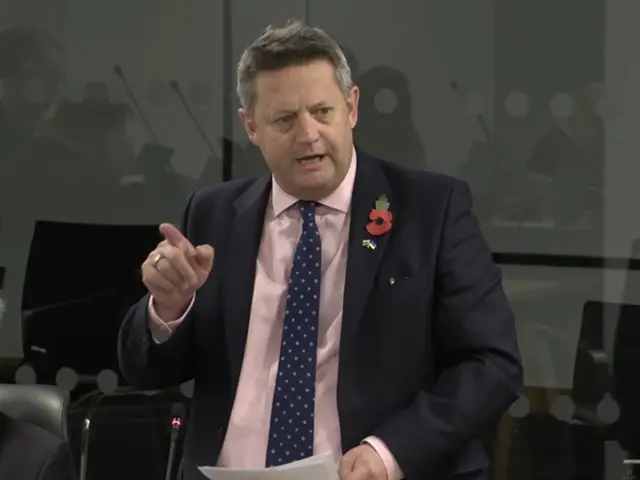
A FORMER minister has accused the Welsh Government of “piling up laws” that are “never delivered”, painting a picture of a pattern of incompetence over the past decade.
Labour’s Alun Davies criticised a seven-year delay in introducing an environment bill to plug post-Brexit gaps which left Wales with some of the weakest protections in western Europe, according to environment charities.
Mr Davies, who is first on Labour’s list for the new Blaenau Gwent Caerffili Rhymni seat at next year’s election, said: “We’ve got to do more than pass declaratory legislation… [which] doesn’t have any bite… All too often the vanity of politicians takes over and we believe we can change things quite fundamental and, usually, outside our control simply by passing laws.”
He added: “I remember when this was important and an emergency back in 2018.”
He accused Huw Irranca-Davies, the Deputy First Minister, of being able to offer “no credible explanation” of why it has taken seven years to bring forward the environment bill.

Mr Davies stressed the delay was not a one-off, questioning why it took ministers about a decade to implement public health and renting laws too.
Calling for a parliamentary inquiry, he asked: “Why is it we’re asked to vote for this legislation, time and time again, but the government isn’t able to deliver?”
He warned: “There are real failures of parliamentary and governmental processes here.”
The backbencher, who has twice been sacked from government, added: “We are creating increasingly bureaucratic and cumbersome new structures, targets, which probably won’t be met and, in fact, if you read the bill, won’t even be set until the end of the next Senedd.”
He made the comments as the environment bill, which would establish a watchdog and set a framework for biodiversity targets, passed the first stage in the Senedd. Similar watchdogs were set up in Scotland, Northern Ireland and England in 2021.
Mr Davies told the Senedd: “It’s increasingly worrying to me that what we’re doing is piling up laws… which are never delivered, never implemented and which create burdensome and cumbersome demands on public bodies which they themselves are unable to deliver.”
The Conservatives’ Janet Finch-Saunders was similarly scathing, describing delays as a “point of national shame” and a “serious political failure”. She suggested the Welsh Government will go down in history for kicking the can down the road.


She warned the bill pushes key decisions, such as actually setting targets, beyond the 2026 Senedd election when cross-party consensus on the issue could collapse.
Labour’s Mike Hedges, who chairs the Senedd’s legislation committee, concluded the bill “appears to have been deprioritised by the Welsh Government”.
He described the biodiversity target-setting framework as “ill-conceived”.
Delyth Jewell, Plaid Cymru’s shadow climate secretary, questioned why the Welsh watchdog was set to receive £300,000 less than its Scottish counterpart despite a wider remit.

And climate committee chair Llŷr Gruffydd warned last-minute government concessions “undermined” scrutiny as he called for the new watchdog to be “genuinely independent”.
During the debate on Tuesday November 11, Huw Irranca-Davies agreed to accelerate the timeline for setting targets from three years to two and bolster the body’s independence.
The Deputy First Minister and climate secretary also pledged to introduce a framework for short- and long-term targets, halve the time to report on missed targets to six months, and ensure the watchdog’s enforcement powers are active within two years.
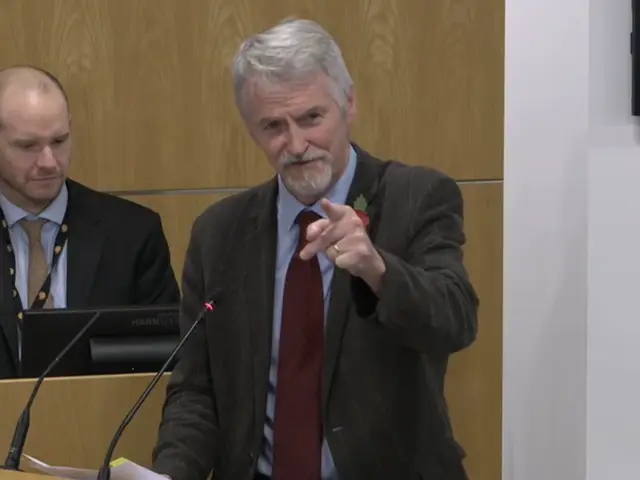
Turning to his colleague’s criticism, he joked: “I very much welcome all of the comments that members have made today and the spirit in which they were made – you too, Alun.”
Mr Irranca-Davies then rejected the charge that the legislation was weak, insisting the targets would not be “half-arsed” and telling Mr Davies: “I do think you’re unduly pessimistic on this – this is more than declaratory legislation. This has got the benefit, because it has taken a bit longer, of being exceptionally, exceptionally well-worked, well-crafted.”
Senedd Members voted 50-1 in favour of the general principles of the bill, which now moves to amendment stages, with only Reform UK’s Laura Anne Jones, who represents South Wales East, voting against.



WELSH LABOUR has called on the Plaid Cymru Government to set out whether it will act on a Senedd vote backing the creation of a new negotiating body for school support staff.
The proposed School Support Staff Negotiating Body would provide a national forum for discussing pay, terms and conditions for workers such as teaching assistants, caretakers, cleaners, cooks, administrative staff and lunchtime supervisors.
Supporters say the body is needed to address long-standing inconsistencies in pay and conditions across Wales, including concerns over term-time-only contracts, limited career progression and the lack of a dedicated national bargaining structure for non-teaching school staff.
The issue was raised in the Senedd by Welsh Labour’s Huw Thomas following the passing of an Opposition Day motion last week. The motion, tabled by Labour, secured cross-party support and called for progress on establishing a Welsh SSSNB.
During questions to the Cabinet Minister for Effectiveness and the Constitution, Mr Thomas pressed the Welsh Government on whether work had begun on legislation.
He asked: “Can you confirm that as the Cabinet Minister responsible for the legislative agenda, you are respecting the Senedd’s wishes and have begun preparing legislation for a School Support Staff Negotiating Body?”
Welsh Labour says the proposal would bring Wales into line with England, where legislation has already been taken forward to create a School Support Staff Negotiating Body for workers in state-funded schools.
The policy was also a Welsh Labour manifesto pledge and has been backed by trade unions including UNISON and GMB, which have campaigned for better recognition, fairer pay and clearer career structures for school support staff.
Labour argues that support staff play a vital role in the day-to-day running of schools and in supporting pupils’ learning, wellbeing and safety, but that their pay and conditions have not always reflected the importance of their work.
Mr Thomas, Welsh Labour’s spokesperson for Finance, Democracy, Citizenship and the Welsh Language, also pressed ministers for assurances that manifesto commitments would appear in the Programme for Government in the form originally promised.
Labour said the Plaid Cymru Cabinet Minister declined to give an unambiguous commitment that all manifesto pledges would be carried forward.
However, Opposition Day motions passed by the Senedd do not in themselves create legislation. They place political pressure on ministers to respond, but the Welsh Government is not automatically required to introduce a Bill.

Any new negotiating body would also require detailed work on funding, the role of local authorities, union representation, school budgets and how national terms would interact with existing council and school employment arrangements.
Welsh Labour says ministers must now provide a timetable for legislation and explain how they intend to work with unions, councils, schools and support staff on the creation of the body.

PLANS for new guidance on mobile phone use in Welsh schools have sparked a political row, after Labour accused Plaid Cymru of sending mixed messages over whether phones could be banned during the school day.
Education Minister Anna Brychan has announced that the Welsh Government will bring forward guidance aimed at restricting pupils’ use of mobile phones in schools.
The guidance is expected to set out what schools should consider when managing phone use, amid growing concern about distraction in classrooms, behaviour, social media use, and the impact of smartphones on pupils’ wellbeing.
The move could lead to tighter rules across Wales, although the question of whether there should be a national ban — or whether individual schools should retain flexibility — remains politically sensitive.
Welsh Labour said schools needed clarity, claiming the guidance had originally been commissioned while Labour was in government.
A Welsh Labour spokesperson said: “Schools need clear guidance on what is expected of them when it comes to the use of mobile phones. We commissioned this guidance when we were in government.
“Just a few weeks ago the First Minister seemed to rule out banning phones in schools, but today the Education Minister has been clear that could still be an option. Schools need clarity.
“What’s important is that schools and unions are engaged with and the school workforce is supported in these decisions.”
The row comes as ministers face pressure to address the growing role of smartphones in young people’s lives, both inside and outside school.
Supporters of tougher restrictions argue that phones are a major source of distraction and can contribute to bullying, anxiety and poor concentration.
Others have warned that schools need clear, practical rules that staff can enforce, with proper engagement with teachers, unions, pupils and parents.
The debate now centres on whether Wales should move towards a national ban, or leave individual schools to decide how far restrictions should go.


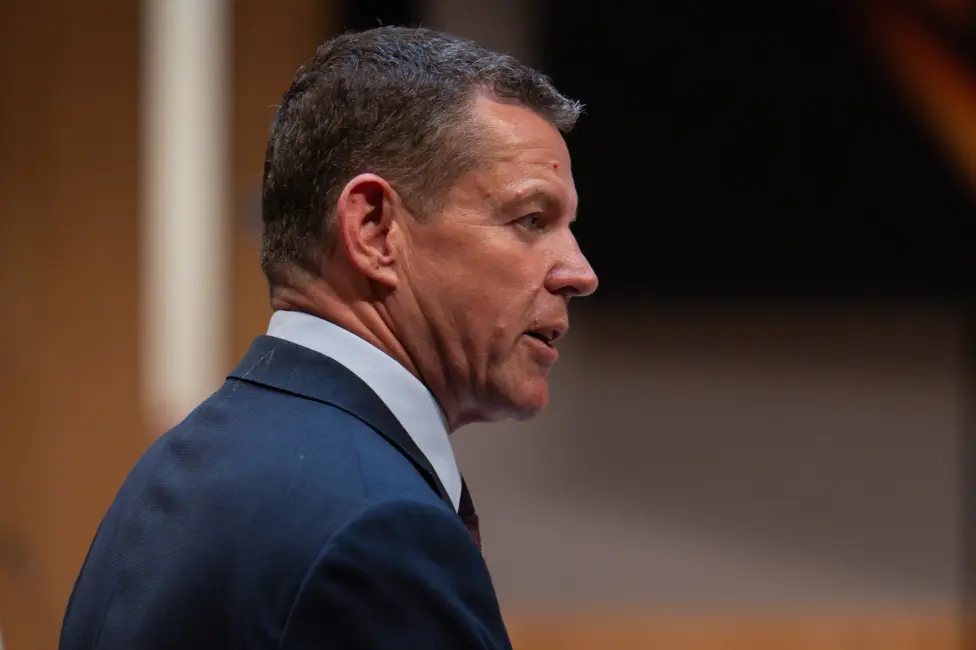
RHUN AP IORWERTH fielded questions on housing shortages, the Armed Forces, and the Nation of Sanctuary as he returned for his third First Minister’s Questions today.
The First Minister defended his new government’s work so far as he faced Senedd colleagues in the Siambr.
The First Minister clashed once again with opposition leader Dan Thomas, this time over the causes of the housing shortage.
Reform’s Welsh leader quizzed his Plaid Cymru counterpart on how the government planned to address Wales’ housing problems.
Mr Thomas said: “It is a fact that a lack of house building and uncontrolled immigration has led to a housing shortage across the UK.”
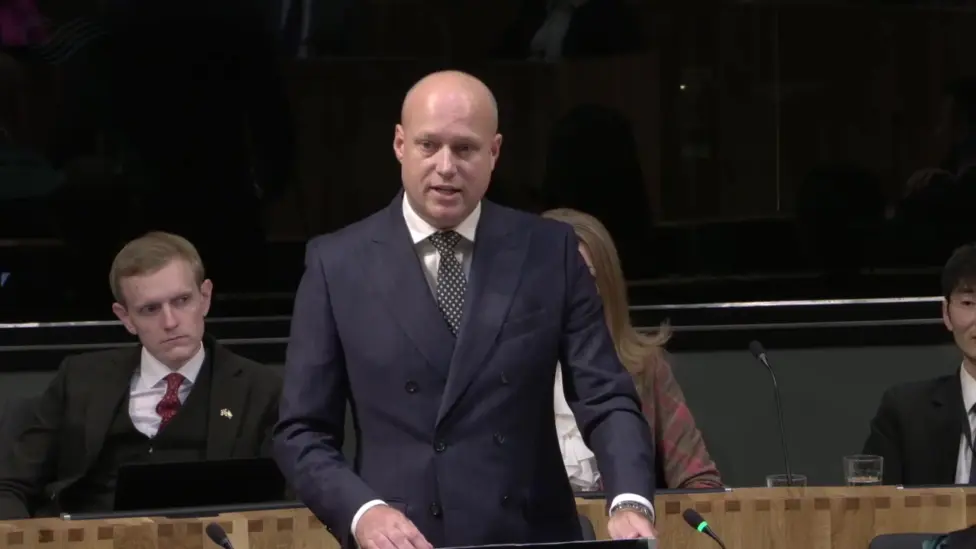
He welcomed Plaid’s promise to deliver 20,000 new homes by 2030 but said: “To deliver at that scale, we’re going to need radical reform of the planning system, we’re going to need ministerial intervention when councils do not deliver the number of homes that their communities need, and we need government and local government to work in partnership with house builders to leverage the billions of pounds that are needed to deliver 20,000 new homes.”
Acknowledging the “very real” housing problems found across Wales, Mr ap Iorwerth insisted these shortages are not driven by immigration.
He accused Mr Thomas of attempting to “create division”, arguing the government must focus on “practical solutions to the practical problem that we face”.
Mr Thomas said nobody is “blaming immigrants” but instead are “blaming uncontrolled and unplanned immigration”, which he described as having a “ripple effect” across the UK.
The opposition leader also questioned the First Minister on houses of multiple occupation (HMOs) which he described as a “big problem” across Wales, suggesting this too was caused, in part, by “uncontrolled immigration”.
Mr Thomas said HMOs are “changing the character” of streets across Wales and said: “Large companies are buying up family homes and turning them into HMOs, and people are not happy with this.”
Describing Mr Thomas as “again seeking to blame”, the First Minister said: “The leader of the opposition says he’s not blaming immigrants whilst then progressing to blame immigrants for the situation.

“He will have to forgive me for always focusing on the practical answers that are needed to the very real problems that we face, and that is a lack of social housing, which is why this government is getting on with building more social housing.”
The First Minister also clashed with another Reform member – Caerdydd Penarth MS Joe Martin.
Mr Martin questioned Mr ap Iorwerth about the “potential risks to public safety” due to the Nation of Sanctuary scheme.
The scheme, introduced in 2019, sets out how the Welsh Government can support refugees and asylum seekers in Wales.
It includes, but is not limited to: making sure refugees can find new accommodation when they leave asylum accommodation; helping refugee or asylum seeker survivors of domestic abuse to get support; and promoting an understanding of Welsh culture and heritage amongst asylum seekers.
Mr Martin said defenders of the scheme would say that it has primarily been used to support Ukrainian refugees but then added he did not know why it was “necessary” to spend additional money “over and above” what Westminster already spends to help Ukrainian families.
Mr Martin continued: “You won’t find anyone seriously contending that they’re the reason the scheme should be scrapped.
“But that’s because, so far, there have been zero instances of Ukrainian refugees trying to behead people in the streets. The same cannot be said for Sudanese asylum seekers.”
His comments were met with with disapproval from members from other parties.
Noting that it seemed the Siambr would “have to get used to this kind of contribution”, the First Minister accused Mr Martin of attempting “to drive wedges between communities”.
He said: “The Nation of Sanctuary policy did house mostly Ukrainian refugees.
“I understand the difficulty that the member has in addressing that issue given the fact that the former leader of Reform in Wales [Nathan Gill] is currently serving a lengthy jail term for taking money from the Russians, and one of the first calls made by their finance spokesperson was to tear down the Ukraine flag flying outside our Senedd.
“Let’s focus here on what unites us. Let’s focus on the leadership that’s incumbent on all of us to show in order to create cohesion between communities.”
The First Minister also noted that June 16 marks the tenth anniversary of the murder of Labour MP Jo Cox. Mr ap Iorwerth said the Senedd’s focus should be on “finding ways of getting over divisions rather than trying to create them”.
Interim Labour leader, Ken Skates, pressed the First Minister on finances, referring to a report by the Institute for Fiscal Studies which, prior to the election, said Plaid Cymru’s promises would require tax increases or cuts to services.
Mr Skates called on the First Minister to share if the Institute was right and, if necessary, to share what cuts will be made.
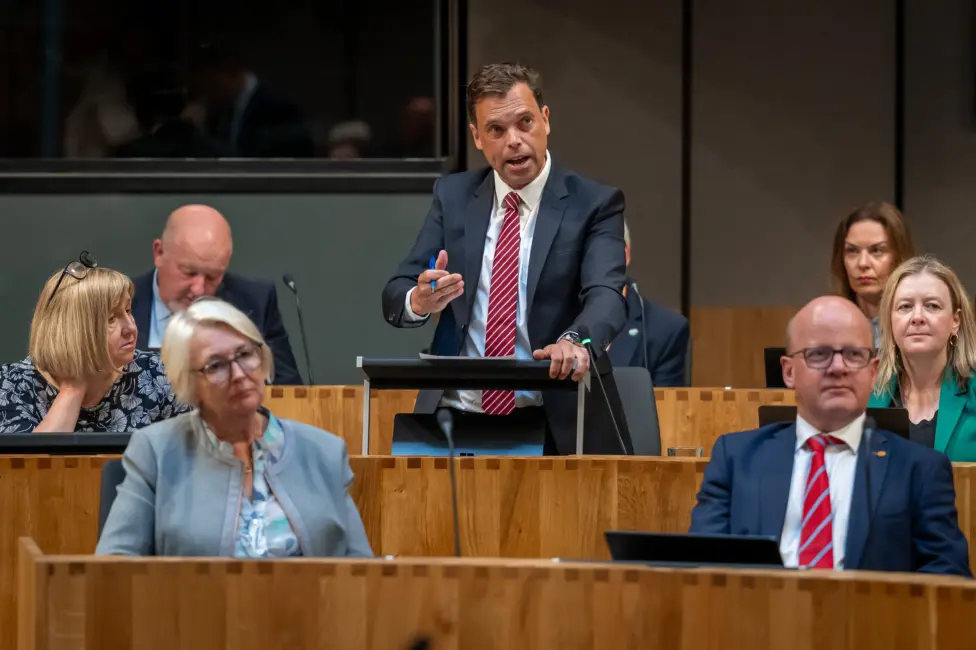
Pledging to “roll [their] sleeves up”, Mr ap Iorweth said his government will find “innovative ways” to “deliver what the people of Wales said they wanted us to.”
He also drew attention to the £55 million announced on June 16 to start delivering Plaid’s childcare offer across Wales.
Mr ap Iorwerth added: “We did more in 27 days as a government than the previous Labour administration did in 27 years.”
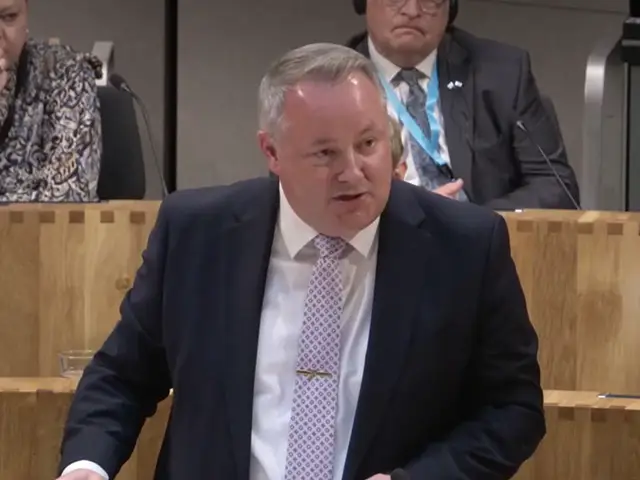
Leader of the Welsh Conservatives, Darren Millar, pressed Mr ap Iorwerth on whether he agreed that a strong defence industry in Wales is “essential” to the economy in a time when “war has returned to Europe”.
Mr Millar also called on the First Minister to pay tribute to the Armed Forces and the Welsh workers who provide them with the resources they need.
Revealing one of his first visits as First Minister was to see Rhondda-based Valley Veterans, Mr ap Iorwerth agreed with the Conservative leader noting the “very important part” the defence sector plays within the Welsh economy.
He added: “I absolutely understand that the changing face of international threats means that we need to make sure that we have the conventional forces in place that are able to stand up to that.
“At the same time, this is a government that will make sure that the ethical engagement around defence is as strong as it can possibly be. I think those are the kinds of assurances that the people of Wales want.”



Community5 hours ago
Police officer hailed hero after midnight sea rescue in Milford Haven
PC swam 100 metres offshore to save distressed woman heard calling for help in darkness A DYFED-POWYS POLICE officer has...


Local Government11 hours ago
Security privately arranged by Mayor at Beating of the Bounds
HAVERFORDWEST TOWN COUNCIL has confirmed that security personnel seen at this year’s Beating of the Bounds were privately arranged and...


Business2 days ago
Celtic Freeport five-year plan puts Milford Haven at centre of green energy future
Strategy promises investment, skilled jobs and new supply chains, but major barriers remain over grid connections, planning and delivery THE...


Education2 days ago
Closure of Ysgol Clydau approved after emotional council debate
COUNCILLORS WARNED RURAL COMMUNITIES WILL REMEMBER DECISION PEMBROKESHIRE councillors have voted to close Ysgol Clydau following an emotional debate over...


Education2 days ago
Manorbier school closure process to continue after narrow council vote
Questions remain over insurance, rebuilding costs and possible legal action by Diocese PEMBROKESHIRE councillors have voted to press ahead with...

Community2 days ago
The father, son and daughter lifeguard trio saving lives in Pembrokeshire
A FATHER, son and daughter are preparing to help keep beachgoers safe on the Pembrokeshire coast this summer as part...


Community2 days ago
Beating of the Bounds brings music, boats and tradition to Haverfordwest
CENTURIES-OLD CEREMONY DRAWS FAMILIES TO THE RIVERSIDE HAVERFORDWEST’S historic Beating of the Bounds returned on Sunday (Jun 14), with boats,...


Community2 days ago
Milford Haven School pupil praised after stepping in during real-life emergency
A YEAR 11 pupil at Milford Haven School has been praised after putting his first aid training into action to...


Community3 days ago
River festival brings crowds to Haverfordwest
A CELEBRATION of the River Cleddau brought crowds into Haverfordwest on Saturday (June 13) as the town’s River Festival returned...


Charity3 days ago
Voices at the Castle hailed as unforgettable night after weather setback
Russell Watson headlines spectacular charity concert at Pembroke Castle A SPECTACULAR evening of live music at Pembroke Castle has been...
-

 Community2 days ago
Pembrokeshire Chess Club crowned Welsh champions
-

 Crime5 days ago
Pembroke Dock teenager sentenced over train strangulation attack
-

 Education4 days ago
Diocese threatens legal action as Manorbier school closure battle intensifies
-

 Crime6 days ago
Man accused of six rapes including alleged Haverfordwest offence
-
Local Government11 hours ago
Security privately arranged by Mayor at Beating of the Bounds
-

 Local Government5 days ago
Taxi suspended after county-wide licensing checks
-

 Crime6 days ago
Brothers found guilty of causing death of Welsh dad in ‘reckless’ race
-

 Crime5 days ago
Currys worker denies stealing £2,500 of store stock