


Finance
Homebuyers in Wales set to benefit from major property market reforms


New plans aim to cut delays, reduce costs and stop house sales collapsing
THOUSANDS of homebuyers across Wales could save time and money under a major overhaul of the property-buying process announced by the UK Government.
The reforms are designed to tackle long-standing problems in the housing market, including lengthy delays, failed transactions and unexpected costs which can leave buyers and sellers out of pocket.
Ministers say the changes could reduce the average time taken to buy a home by around four weeks and save first-time buyers an average of £650.
Under the proposals, sellers and estate agents would be required to provide key information about a property when it is listed for sale. New “sales packs” would include details about a home’s condition, leasehold charges and the status of any buying chain.
The Government also plans to introduce earlier legally binding agreements between buyers and sellers to reduce the number of transactions which collapse late in the process.

A major part of the reforms will focus on replacing paper-based systems with digital property logbooks, electronic signatures, online identity checks and AI-assisted conveyancing.
Welsh Secretary Jo Stevens said: “Thousands of people across Wales will benefit from these reforms which will make buying a home faster, simpler and fairer.
“For too long the system has been difficult and complex. This government’s changes will save working people and families valuable time and money when they are buying their new home.”
Prime Minister Sir Keir Starmer said the current system leaves many families “in limbo” and makes home ownership more difficult than it should be.
Housing Secretary Steve Reed said buying or selling a home should not be “a drawn-out nightmare of delays, hidden costs, and failed deals.”
The Government says the reforms will be introduced in stages, with a new Code of Practice for property agents expected later this year.
From 2027, ministers plan to consult on mandatory qualifications for estate agents and the wider use of digital tools.

Legislation requiring sales packs, binding contracts and digital property information systems is expected before the end of the current Parliament.

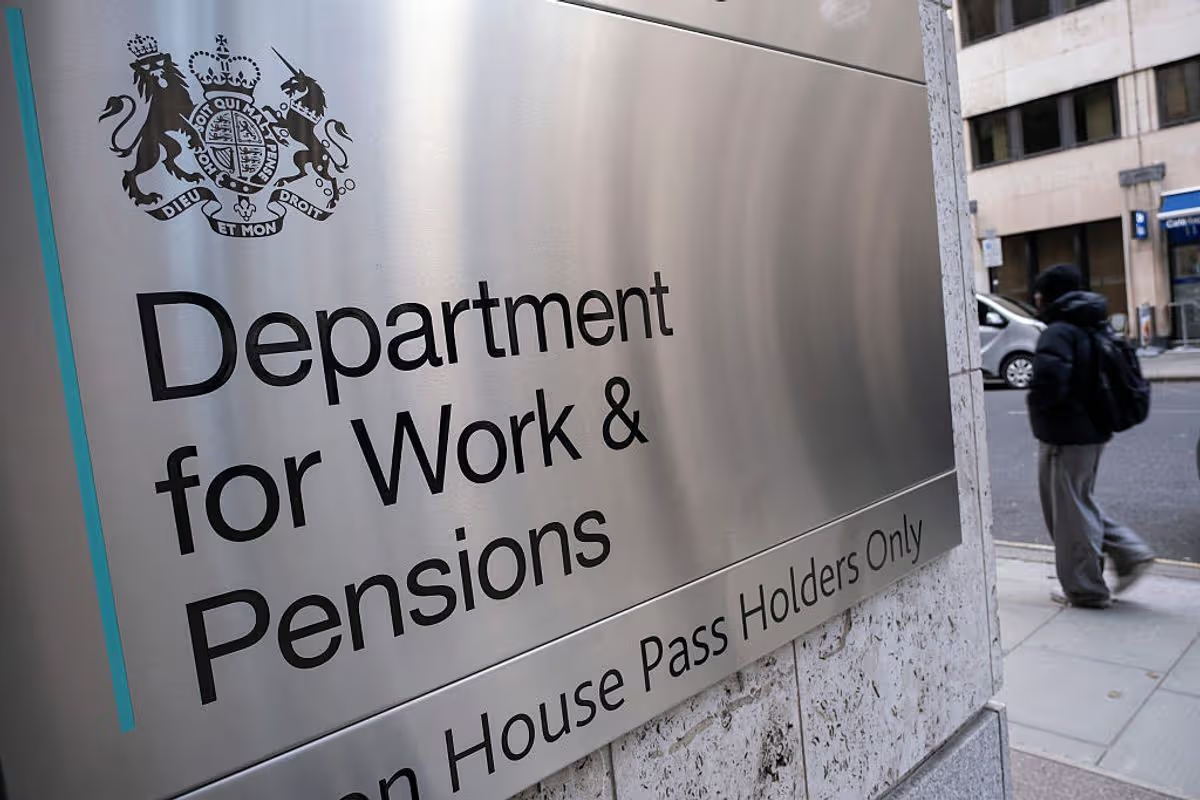
MORE than 9,000 people across South East Wales are to receive tailored employment support under a £32.5m expansion of the UK Government’s Connect to Work programme.
The funding will support around 9,100 disabled people, people with health conditions, and those facing complex barriers to employment, helping them move into work or closer to the labour market by 2030.
The Department for Work and Pensions said the programme replaces a “one-size-fits-all” approach with intensive, personalised help built around each individual.
Support will be delivered by specialist employment advisers, who will meet people in accessible community settings, including GP surgeries, cafés, parks and community hubs.
The help available will include matching people with suitable jobs, CV writing, interview preparation, direct work with local employers, and continued support once someone has started a role.
Work and Pensions Secretary Pat McFadden said: “For too long, disabled people and those with health conditions in South East Wales and across the country were written off and denied the chance to work. This Government is changing that.
“Connect to Work is built on a simple belief: that with the right support, built around the individual, people can and do get into work.
“Today’s figures prove it. Thousands of people are now closer to working, earning and building better lives, and with South East Wales set to launch its support offer, this is just the beginning.”
The announcement comes as the first official statistics for Connect to Work show that 14,000 people across England and Wales have already received personalised support through the programme.
The DWP said 2.8 million people are currently out of work due to ill-health, and that Connect to Work forms part of a wider £3.5bn employment support package.
Councillor Peter Bradbury, Cardiff Council’s Cabinet Member for Employment and Inclusive Growth, said: “We are delighted that Connect to Work is being introduced across the South East Wales region; this is a significant opportunity to support our residents into sustainable employment while strengthening our local communities and economy.
“Delivery will commence shortly across the region, with further details, including start dates, available on the Cardiff Council website.”
The South East Wales funding follows earlier announcements for Connect to Work in South West Wales, Mid Wales and North Wales.

AT LEAST 1.5 million people were taken to court over unpaid council tax last year, according to a new investigation by the GMB union.
The union said the figures showed a council tax system “completely broken”, with cash-strapped local authorities forced to pursue residents through the courts to recover unpaid bills.
The findings, released ahead of GMB’s annual congress in Blackpool on Tuesday (Jun 9), were based on Freedom of Information requests sent to all council tax-collecting local authorities in Britain.
Almost 200 councils replied within the statutory deadline.
The responses showed that 1,430,726 people were summoned to court in the financial year 2024/25. However, because many councils did not respond, GMB said the true figure was likely to be far higher.
The investigation also found that at least 4,593,838 council tax accounts were in arrears, while debt management proceedings had been launched against 3,231,480 accounts.
In total, at least £4.6bn is owed to councils in unpaid council tax.
In Wales, the figures showed £110,884,885 was owed, with 31,452 accounts in arrears, 14,792 facing debt management proceedings, and 34,437 people taken to court during 2024/25.
Broken system
Rachel Harrison, GMB National Secretary, said: “These horrifying figures show our council tax system is completely broken.
“Not only is the banding system woefully out of date, but forcing cash-strapped councils to pursue one and a half million people through the courts just to make ends meet can’t be the right way to do business.
“Austerity left deep scars on all our public services, which will last a generation or more.
“Meanwhile the lack of authority funding often means low pay for the people we rely on to look after our loved ones, to take our rubbish, to keep our towns and cities running.
“To fix all this, we need more guaranteed central government funding, progress on council tax reform so the richest pay their share, and changes to business rates so that authorities get more to regenerate our high streets.”
The highest regional total was recorded in Scotland, where £989m was owed and 245,294 people were taken to court.
London councils reported £625m owed, with 258,732 court summonses issued, while the West Midlands recorded 239,116 court cases and £490m in unpaid council tax.

A UK GOVERNMENT review into access to face-to-face banking services has begun, with communities, businesses and organisations being urged to submit evidence.
The independent review, chaired by former Which? director and former FCA board member Richard Lloyd OBE, will examine the impact of changes to in-person banking services across the UK.
It will look at whether branch closures and reduced access to banking services are causing harm to consumers, communities and businesses, particularly those who rely on face-to-face support.
The Call for Evidence opened today, Monday (Jun 8), and will run for six weeks, closing on July 20.
The evidence gathered will help shape recommendations to the UK Government, with final recommendations expected in October 2026.
Economic Secretary to the Treasury, Rachel Blake said: “Banking services matter to communities and businesses across the UK – and that includes face-to-face services.
“Whether you are responding as an individual or a business, your experience could shape the recommendations this review makes to Government.
“Where evidence shows people are being left behind, we will act – including through legislation if necessary.”
Richard Lloyd OBE said banking was “an essential service” needed by consumers, communities and businesses.
He said the review wanted to gather “the best possible up-to-date evidence” on the challenges faced by those who need in-person banking.
The review follows concerns across the UK about the loss of local bank branches, leaving many customers dependent on online services, telephone banking or limited alternatives.
The Treasury said the Government would act quickly where evidence showed intervention was needed to protect access to banking services.

Responses should be submitted by July 20 through the online Smart Survey on the review’s GOV.UK page. Those unable to use the survey can email [email protected].



Crime46 minutes ago
Prisons at breaking point: MPs warn Wales is paying the price of a failing system
Frozen healthcare budgets, overcrowded jails, homelessness on release and mounting pressure on staff are undermining rehabilitation across Wales, according to...


News14 hours ago
Brexit at 10: How Britain was sold a dream that cost us dearly
A decade after the referendum, the promised benefits remain hard to find while the economic costs are increasingly difficult to...


Crime16 hours ago
Worcestershire man jailed after violent attack on woman in Tenby
Defendant was already serving a suspended sentence when serious assault took place A WORCESTERSHIRE man has been jailed for more...


Climate18 hours ago
Offshore wind ‘could bring new generation of jobs to Milford Haven’
Pembrokeshire ports and Celtic Sea projects placed at centre of Wales’ green energy ambitions MILFORD HAVEN and Pembroke Dock could...


Community2 days ago
Police officer hailed hero after midnight sea rescue in Milford Haven
PC swam 100 metres offshore to save distressed woman heard calling for help in darkness A DYFED-POWYS POLICE officer has...


Local Government2 days ago
Security privately arranged by Mayor at Beating of the Bounds
HAVERFORDWEST TOWN COUNCIL has confirmed that security personnel seen at this year’s Beating of the Bounds were privately arranged and...


Business3 days ago
Celtic Freeport five-year plan puts Milford Haven at centre of green energy future
Strategy promises investment, skilled jobs and new supply chains, but major barriers remain over grid connections, planning and delivery THE...


Education3 days ago
Closure of Ysgol Clydau approved after emotional council debate
COUNCILLORS WARNED RURAL COMMUNITIES WILL REMEMBER DECISION PEMBROKESHIRE councillors have voted to close Ysgol Clydau following an emotional debate over...


Education3 days ago
Manorbier school closure process to continue after narrow council vote
Questions remain over insurance, rebuilding costs and possible legal action by Diocese PEMBROKESHIRE councillors have voted to press ahead with...


Community3 days ago
The father, son and daughter lifeguard trio saving lives in Pembrokeshire
A FATHER, son and daughter are preparing to help keep beachgoers safe on the Pembrokeshire coast this summer as part...
-

 Community4 days ago
Pembrokeshire Chess Club crowned Welsh champions
-
Local Government2 days ago
Security privately arranged by Mayor at Beating of the Bounds
-

 Crime7 days ago
Pembroke Dock teenager sentenced over train strangulation attack
-

 Education6 days ago
Diocese threatens legal action as Manorbier school closure battle intensifies
-

 Crime7 days ago
Man accused of six rapes including alleged Haverfordwest offence
-

 Crime2 days ago
Man wanted by court after failing to attend hearing over alleged shop thefts
-

 Local Government6 days ago
Taxi suspended after county-wide licensing checks
-
 Crime2 days ago
Man banned from roads after drink-driving offence