


News
Coastguards to gather at Westminster in row over emergency call-out payments

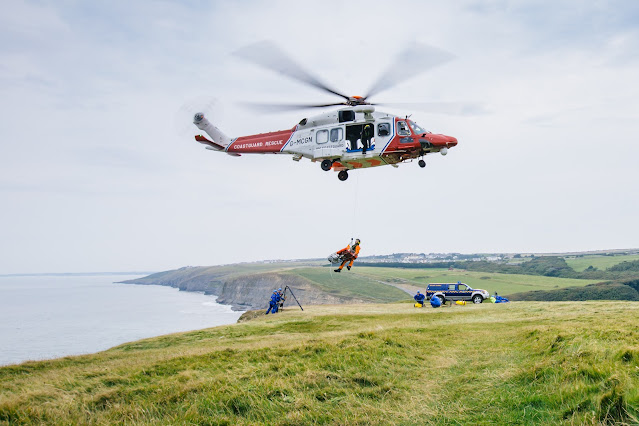
COASTGUARD rescue officers are to gather outside Parliament this week as pressure grows on the UK Government to reinstate emergency call-out payments.
Dozens of coastguards from across the country are expected at College Green, Westminster, at 5pm on Wednesday (July 1), where they will call for the Maritime and Coastguard Agency to reverse plans to remove hourly remuneration for emergency incidents and training.
The protest, organised with the GMB union, follows a Court of Appeal case which found that Coastguard Rescue Officers could be classed as workers when carrying out paid duties.
Until now, volunteer coastguards have been able to claim modest hourly payments when called out to emergencies or attending training exercises. The MCA says the legal ruling means the current arrangements cannot continue in their existing form, and that from September 2026 officers will instead be able to claim expenses only.
GMB says the decision is unacceptable and risks undermining one of the UK’s statutory emergency services.

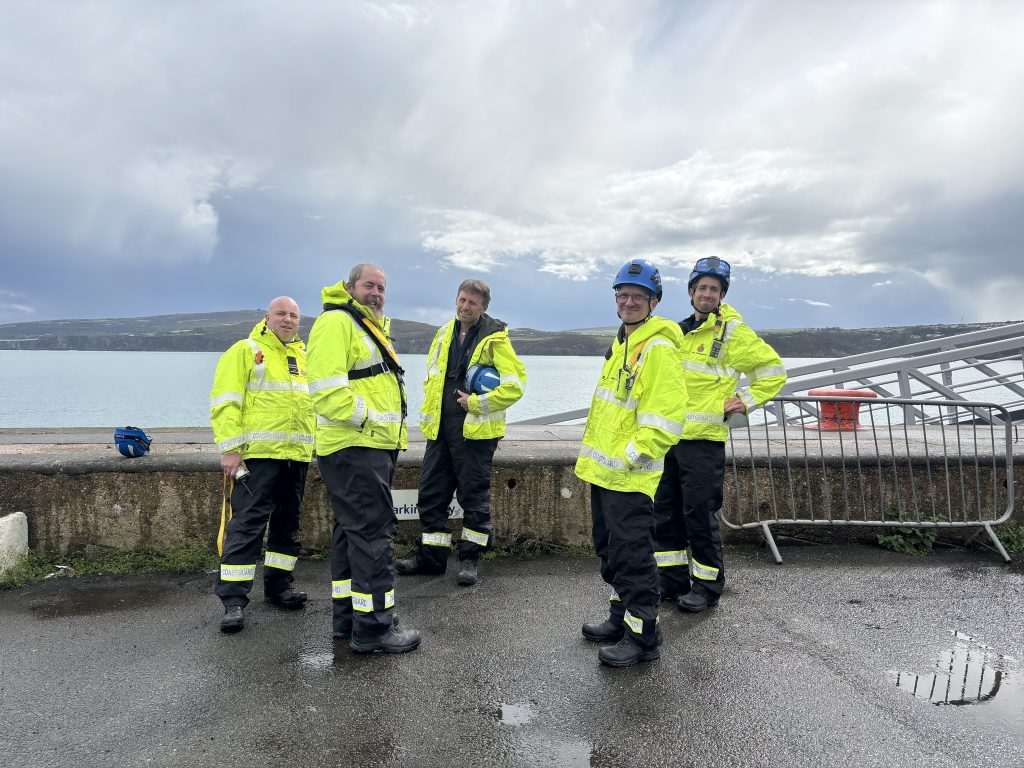
Coastguard Rescue Officers are often the first to respond when people are trapped on cliffs, cut off by tides, stuck in mud, missing near the coast or in difficulty in the water. They work alongside lifeboat crews, police, ambulance services, fire crews, air ambulances and Coastguard helicopters.
The issue is of particular importance in Pembrokeshire and across Wales, where coastguard teams are regularly involved in difficult and dangerous rescues along remote coastline, beaches, cliffs and tidal waters.
The Herald has repeatedly reported on incidents where coastguard teams have played a key role. These include the major rescue of three climbers at St Govan’s Head, where teams from Fishguard, St Govan’s and Tenby were deployed alongside helicopters, lifeboat crews, police and air ambulance teams.
In another incident, Milford Haven Coastguard Operations Centre coordinated the rescue of six children from the sea at Aberavon, with Port Talbot and Porthcawl Coastguard Rescue Teams among those sent to the scene.
Angle RNLI has also been tasked this year to searches coordinated by the coastguard, including concern for a fishing vessel near Marloes and a separate search after a vehicle was found abandoned on the Cleddau Bridge.
Supporters of the campaign say these incidents show how reliant coastal communities are on trained volunteers who leave work, family life or rest periods at short notice when pagers sound.
The Westminster photocall will take place after a Westminster Hall debate earlier the same day on the remuneration of coastguard volunteers. That debate is due to be opened by Liberal Democrat MP Alistair Carmichael.

The House of Commons Library says the Coastguard Rescue Service had more than 3,500 volunteers in 287 teams across the UK in 2024/25, supported by more than 100 employed operational staff. HM Coastguard responded to 39,147 incidents during the same year.
Plaid Cymru MPs have already raised concerns about the impact on Welsh coastal communities, warning that removing call-out payments could make it harder to retain and recruit trained responders.
The UK Government has defended the move, saying the change follows the Court of Appeal ruling and that the revised volunteer model is intended to protect the future of the service.
In a parliamentary answer, Transport Minister Keir Mather said changing the operating model was “not something which we wanted to do” but was a consequence of the legal position.
He said moving to a volunteer model with expenses, but without hourly remuneration, was judged to be the best option to protect the service and allow people to continue serving alongside their main employment.
The Government has also said serving Coastguard Rescue Officers are entitled to compensation for up to the previous six years of service, with the MCA calculating individual entitlements.
GMB argues that the answer should be to protect both the volunteer nature of the service and the right of coastguards to be fairly compensated when they are called out to save lives.
A GMB spokesperson said Coastguard Rescue Officers carry out rescues and save lives around the UK’s coast, including Scotland, Wales and England’s south coast.
The union said: “The coastguard is a statutory emergency service, like the police, fire or ambulance.
“They have always been given hourly remuneration for attending incidents and training exercises, but the MCA has now removed the payments.
“The move follows a landmark case by GMB Union which saw the Court of Appeal uphold a judgement classifying coastguards as workers.”
GMB says coastguards will be available for photographs and interviews at College Green on Wednesday evening.
The row comes only days after The Herald reported fresh concern over the loss of call-out payments, and amid a series of recent incidents showing how often coastguard teams are used across west Wales. In the past week alone, Milford Haven Coastguard paged lifeboats after an aircraft ditched in Cardigan Bay, while Fishguard and Teifi Coastguard teams helped stretcher an injured woman from the coast path at Dinas Island.
Earlier this year, coastguard teams from Fishguard, St Govan’s and Tenby were among the emergency services sent to a fatal climbing incident at St Govan’s Head.


HYWEL DDA University Health Board is urging people to take part in its consultation on the future of stroke services, as the process reaches the halfway point.
The second phase of the eight-week consultation began on May 28 and will remain open until July 26.
The health board is seeking views from patients, carers, staff, local communities and stakeholders on its preferred option for stroke services across Carmarthenshire, Pembrokeshire and Ceredigion.
Under the preferred option, a 24-hour acute stroke and rehabilitation unit would be based at Glangwili Hospital, with a stroke rehabilitation unit at Bronglais Hospital. Treat-and-transfer services would continue at Bronglais, Prince Philip and Withybush hospitals.
Stroke services are currently provided at all four main Hywel Dda hospitals, namely Bronglais, Glangwili, Prince Philip and Withybush. However, the health board says services do not consistently meet national clinical standards and that specialist stroke cover is not available 24 hours a day, seven days a week.
More than 1,700 people have already taken part in the second phase of consultation, either through public events or by completing the questionnaire.
Mark Henwood, Hywel Dda University Health Board’s Executive Medical Director, said: “We know how important stroke services are to members of our communities and to our staff.
“Providing timely, high-quality specialist care for people who experience a stroke is critical. Stroke care has advanced significantly, and evidence shows that patients have better outcomes in specialist units with access to expert teams and equipment around the clock.
“We are listening carefully to what people are telling us, and this feedback is important in helping us understand what matters most to our communities. Thank you to everyone who has already attended our engagement events, both in person and online. We look forward to speaking to more people before the consultation ends on July 26.”
Lee Davies, Executive Director of Strategy and Planning, said the health board had been meeting staff and communities across the three counties, as well as representatives from neighbouring health board areas.
He said people had raised questions about where they would go for diagnosis and treatment, how transfers between hospitals would work, and why stroke services could not continue as they are across all four hospital sites.
Mr Davies said: “It’s important to reassure people that, now and in the future, if you think someone is having a stroke, you should seek immediate help by calling 999.

“As happens today, and with any future option, they will be taken to the nearest appropriate hospital for assessment and initial treatment. If specialist treatment such as a thrombectomy is needed, patients would continue to be transferred to specialist centres in Bristol or Cardiff.
“Throughout this process we are working with the Welsh Ambulance Services University NHS Trust, and other providers such as the Adult Critical Care Transfer Service and national commissioners.
“Once an option for the future of stroke services is chosen, detailed modelling will take place to understand what dedicated transport arrangements will be needed, so this would not impact on emergency ambulance availability.
“We need to make changes to ensure we meet national standards and can provide safe, sustainable, accessible and kind services. We need to give people the best possible chance of recovery after the devastating effects of a stroke.”
The remaining public drop-in events are:
- Tuesday, June 30, 2pm to 7pm, Y Plas, Machynlleth, SY20 8ER
- Monday, July 6, 2pm to 7pm, Canolfan Creuddyn, Lampeter, SA48 7BN
- Wednesday, July 8, 2pm to 7pm, Pater Hall, Pembroke Dock, SA72 6DD
- Tuesday, July 14, 2pm to 7pm, Ivy Bush Royal Hotel, Carmarthen, SA31 1LG
- An online session will also be held on Tuesday, July 7, at 6:30pm.
Everyone is welcome to attend to find out more, ask questions and share their views.
The health board says all feedback received during this phase of consultation, along with views gathered in 2025 and the latest evidence, will be considered before a final decision is made later this year.
Further information, including the questionnaire, is available on the Hywel Dda stroke consultation website.
People can also contact the engagement team by emailing [email protected] or by calling 0300 303 8322, option 5.
Crime
Eight guilty over ‘industrial scale’ cocaine conspiracy into Pembrokeshire and Carmarthenshire

Police say gang used luxury cars, rural meeting points and local distributors to move cocaine into west Wales
EIGHT people have been convicted over what police have described as an industrial-scale conspiracy to supply cocaine into Pembrokeshire and Carmarthenshire.
The convictions follow a major Dyfed-Powys Police investigation into the large-scale movement of Class A drugs into west Wales over a nine-month period.
The case began when officers stopped a DPD courier van on the M4 near Pont Abraham, Carmarthenshire, on August 8, 2025. Inside, police found more than 1.6kg of high-purity cocaine, which the police say has an estimated value of almost £190,000.

Further enquiries uncovered what police say was a complex organised crime network involving upstream suppliers, couriers from outside the Dyfed-Powys area, wholesale customers and local distributors operating in Pembrokeshire and Carmarthenshire.
Tommy Lee Jones, aged 33, of Castle Quarry, Monkton, was identified by officers as playing a leading role as the head of the Pembrokeshire gang.
Police said Jones was sourcing multiple kilograms of cocaine on delivery dates from supplier Ahmed Al-Farraji and his associate Adam Noraddin, both from Cardiff.
According to Dyfed-Powys Police, Jones would make regular contact with the suppliers before large cash payments were handed over to Al-Farraji. The drugs were then transported in high-end luxury cars from Bristol and Birmingham to rural locations, including Stepaside, Lamphey, Hundleton and Monkton.
From there, the cocaine was distributed onwards by members of the gang based in Pembrokeshire and Carmarthenshire.
Kalum Haines, Leon Haines and Zak Fecci were identified as trusted members of the gang, taking possession of drugs directly from upstream suppliers and acting as distributors in Pembrokeshire.
Ryan Hare carried out the same role in Carmarthenshire and was identified as being responsible for organising the collection and delivery of the drugs seized by police on August 8.
Usman Afsar was found to have played a role in the conspiracy when he drove from Bristol to Pembrokeshire as a courier and met with gang members riding e-bikes in Pembroke.
Detective Sergeant Mark Jones, of Dyfed-Powys Police’s Serious and Organised Crime Team, said: “After a number of months of enquiries, we built a case clearly evidencing that Ahmed Al-Farraji travelled from Cardiff to meet with Tommy Lee Jones in rural locations.

“Upstream supply couriers would also drive from Bristol to Pembrokeshire on these dates and supplied Tommy Lee Jones with large amounts of cocaine.
“These deliveries were then collected by loyal customers of his and distributed throughout two counties.
“We estimate that the total amount of controlled drugs handled by the gang between February and November 2025 was that of large-scale commercial trafficking.”
A proactive police operation was later carried out to arrest the suspects over the course of a week. Warrants were executed by the Serious and Organised Crime Team, alongside Neighbourhood Policing and Prevention Teams, in Carmarthenshire, Pembrokeshire, Cardiff and Bristol.
The following defendants were charged with conspiracy to supply Class A drugs:
Tommy Lee Jones, aged 33, of Castle Quarry, Monkton; Ryan Hare, aged 27, of Heol Cae Pownd, Cefneithin; Kalum Haines, aged 22, of Woodland Park, Neyland; Leon Haines, aged 26, of Ashdale Lane, Pembroke; Zack Fecci, aged 20, of Hawkstone Road, Pembroke Dock; Ahmed Al-Farraji, aged 25, of Topaz Street, Cardiff; Usman Afsar, aged 41, of Woodborough Street, Bristol; and Adam Noraddin, aged 25, of Plas Nanthelyg, Cardiff.
All eight appeared at Swansea Crown Court.
Jones, Hare, Kalum Haines, Leon Haines and Fecci admitted their involvement. Al-Farraji, Noraddin and Afsar were found guilty following a six-week trial.
Officer in the case DC Sam Burson said: “These individuals have worked together as an organised criminal gang bringing large amounts of Class A drugs into our towns and villages.
“They have shown an utter disregard to the safety of the communities in Pembrokeshire and Carmarthenshire, and contributed with the adverse effect that drugs have on the social and economic wellbeing of the places that we live and work.
“Through detailed and thorough investigative analysis, we have brought charges against and dismantled a group of people who thought they could profit from their criminal activity.
“The strength of evidence against them has, however, resulted with positive outcomes and the conviction of these individuals.”
The defendants will be sentenced at a later date.
Cover image: Computer generated artists’ impression

WELSH defence and aerospace firms could be in line for a share of billions of pounds in new military spending after the UK Government published its long-delayed Defence Investment Plan.
The plan, announced on Tuesday, sets out how the Ministry of Defence will spend almost £300bn over the next four years, including an extra £15bn above the previous settlement.
Prime Minister Sir Keir Starmer said the investment would transform the Armed Forces, strengthen national security and support more than half a million defence-related jobs across the UK by the end of the decade.
But for Wales, the key question is whether the new money will translate into real contracts, skilled jobs and apprenticeships for Welsh companies, or whether the bulk of the spending will be concentrated elsewhere.
At the centre of the plan is a major shift towards drones, artificial intelligence, autonomous weapons and faster battlefield technology.
The Ministry of Defence says more than £5bn will be spent over the next four years on a “drone transformation” for the Armed Forces.
That includes £650m for inexpensive expendable autonomous systems, including drones and uncrewed ground vehicles, to increase the lethality of the Army, Commando Force and Special Forces.
The plan also includes nearly £2bn for a new Digital Targeting Web, designed to connect the Armed Forces more effectively and allow faster decisions on the battlefield.
A further £790m will be spent on protecting the UK and overseas bases from air, drone and missile threats, including new radars, sensors, directed energy weapons and expanded counter-drone systems.
The Government has also committed £11bn to munitions and weapons, including long-range strike weapons, low-cost cruise missiles and one-way effectors. Ministers say at least six new energetics factories will be built by 2030 to increase the UK’s capacity to produce munitions.
For Wales, those commitments are significant because the country already has a sizeable aerospace and defence sector, as well as a specific UK Government-backed plan to grow its role in autonomous systems.
Earlier this year, the UK Government announced a £50m Wales Defence Growth Deal, designed to make Wales a launchpad for next-generation autonomous technology.
That deal was presented as an opportunity to support high-skilled roles and strengthen Wales’ position in areas such as surveillance drones, autonomous systems, cyber security, advanced manufacturing and defence research.
The Defence Investment Plan now becomes the first major test of whether those ambitions are backed by procurement decisions.
Wales already has a substantial defence and aerospace footprint, with major employers including BAE Systems, General Dynamics UK, Airbus, Thales, GE Aerospace, Rolls-Royce and Safran.
The combined aerospace and defence sector in Wales directly employs around 16,000 people, with turnover of £3.7bn and a contribution of approximately £1.5bn in gross value added to the Welsh economy.
Wales is also home to a wider supply chain of engineering, electronics, software, cyber security and manufacturing firms that could potentially benefit from the move towards drones, AI and autonomous warfare.
But industry figures, unions and politicians are likely to ask how much of the promised spending will actually reach Wales.
Welsh Government has previously said Wales receives around 3% of total Ministry of Defence expenditure, with an ambition to increase that to 5% or more as overall defence spending rises.
The new plan will therefore be watched closely by ministers, unions, defence firms, universities and local authorities across Wales.
GMB Union said the Defence Investment Plan provided some stability after months of uncertainty, but warned that workers would judge it by whether it delivered secure jobs and investment.
Matt Roberts, GMB National Officer, said: “Today’s Defence Investment Plan provides some stability for a sector besieged by insecurity.
“The challenge now is delivery. Workers will judge this plan on real jobs, real investment, and real outcomes.
“We must rebuild our own sovereign capability, and strong defence depends on a strong workforce.
“Procurement must prioritise social value and public money must come with the right strings attached, fair pay, decent conditions, and trade union recognition.
“GMB welcomes renewed focus on defence investment, but the real test is whether this delivers jobs, skills, and secure work here in the UK.”
The Government has also announced a new £50bn defence export facility through UK Export Finance, aimed at helping British defence companies win contracts overseas.
That could be important for Welsh firms looking to scale up and compete internationally, particularly if smaller businesses can access support rather than being locked out by larger prime contractors.
The Wales Regional Defence and Security Cluster, launched earlier this year, was designed to bring together small businesses, larger contractors, universities and colleges to strengthen Welsh supply chains and improve access to Ministry of Defence work.
Its role is likely to become more important if the UK’s defence economy shifts further towards dual-use technology, cyber security, artificial intelligence and autonomous systems.
BAE Systems’ Glascoed site in Monmouthshire is one of the best-known defence manufacturing sites in Wales, employing hundreds of people in munitions work.
General Dynamics UK also has operations in south Wales, including work linked to armoured vehicles, tactical communications and systems integration.
Airbus has a major presence in north-east Wales, while Thales, Safran, GE Aerospace and other firms are part of a broader high-value manufacturing and technology base.
The Government says the new plan will also support the Global Combat Air Programme, with more than £8bn over the next four years for the next-generation stealth fighter jet being developed with Japan and Italy.
More than £63bn will be spent over the next four years on the UK’s nuclear deterrent, including Dreadnought and SSN-AUKUS submarines, a new warhead and the purchase of 12 F-35A aircraft.
Those programmes are not Wales-specific, but ministers argue that the wider increase in defence spending should support jobs and supply chains across the UK.
There are also potential implications for west Wales.
Pembrokeshire is home to important military training infrastructure, including Castlemartin Range, while Manorbier has long been associated with air defence training.
Cawdor Barracks near Brawdy has also been the focus of separate Ministry of Defence plans for the proposed Deep Space Advanced Radar Capability project, known as DARC.
Any increase in spending on drones, surveillance, radar, electronic warfare or autonomous systems could raise questions about whether Welsh military sites will receive further investment or new roles.
There may also be interest in whether Welsh ports, marine engineering firms and coastal infrastructure could play any part in the development of uncrewed naval vessels and high-speed military craft.
The Defence Investment Plan includes a shift towards what ministers call a “hybrid Navy”, combining traditional ships with autonomous vessels, AI and uncrewed systems.
Plans include at least six new Common Combat Vessels to act as control hubs for uncrewed systems in the 2030s, alongside high-speed boats for Royal Marine Commandos.
For coastal areas such as Pembrokeshire, that raises a natural question: will maritime defence investment create opportunities for Welsh ports, marine services and engineering businesses?
The plan has been delayed for months amid arguments in Whitehall over money.
Former Defence Secretary John Healey resigned after warning that the funding package fell short of what was needed to protect the UK and meet existing commitments.
Armed Forces Minister Al Carns also quit, saying the plan was not transformative enough in the face of rapidly changing warfare.
New Defence Secretary Dan Jarvis has said the character of warfare is changing rapidly, with uncrewed systems now defining conflicts in Ukraine and the Middle East.
He said the UK had to embrace new technology to give British forces the edge.
Sir Keir said the world was becoming more dangerous and volatile, and that the UK had to rebuild ammunition stockpiles, invest in cutting-edge technology and strengthen the Armed Forces.
The Conservatives have criticised the plan as “too little, too late”, while the Liberal Democrats said the Government had dangerously short-changed the Armed Forces.
Critics have also questioned whether the plan goes far enough to meet NATO expectations and whether the funding will be sufficient to deliver all the ambitions set out in the Strategic Defence Review.
The Government says defence spending will rise from £54bn a year under the previous government to almost £80bn a year by 2029, taking UK defence spending to 2.7% of GDP.
Ministers say the country remains on track to meet NATO defence spending targets by 2035.
There will also be political questions over how the plan is funded, with the Prime Minister saying some capital projects in areas such as roads and energy will no longer go ahead as previously planned.
For Wales, that raises a further issue: whether any Welsh infrastructure schemes could be affected by the wider reprioritisation of public spending.
The Government insists the plan will not take resources away from day-to-day frontline services.
For Welsh industry, however, the immediate question is more practical.
Will the £5bn drone programme include Welsh firms?
Will the new munitions spending benefit existing Welsh sites?
Will smaller companies get a route into defence contracts?
Will universities and colleges in Wales be given funding to train the workforce needed for the new defence economy?
And will west Wales, with its existing military estate and strategic coastal position, see any direct benefit?
The move towards drones and autonomous systems is no longer theoretical. It is already changing warfare.
The question now is whether Wales will be a serious part of that new defence economy, or whether it will once again be left fighting for a small share of UK military investment.



Health12 minutes ago
Stroke services consultation reaches halfway point as public urged to have say
HYWEL DDA University Health Board is urging people to take part in its consultation on the future of stroke services,...


Business58 minutes ago
Welsh firms eye share of £5bn defence drone boom
WELSH defence and aerospace firms could be in line for a share of billions of pounds in new military spending...


Community2 days ago
Thousands line Cardigan streets for Lord Rhys homecoming parade
THOUSANDS of people lined the streets and quayside in Cardigan on Saturday as the town marked 850 years since Lord...


Crime3 days ago
Dyfed-Powys Police rated only ‘Adequate’ in organised crime inspection
A WATCHDOG has rated Dyfed-Powys Police only “Adequate” in its response to serious and organised crime, despite praise for the...


News3 days ago
Two taken to hospital after aircraft ditches in Cardigan Bay
Coastguard helicopter spotted two casualties after light aircraft came down off west Wales coast TWO people were taken to hospital...


Sport4 days ago
Long Course Weekend gets underway in Tenby as thousands head for county
Three days of swimming, cycling and running begin with The Wales Swim at North Beach THOUSANDS of athletes and supporters...


Climate4 days ago
Welsh waters, Westminster profits: Crown Estate row reignited in Wales
PLAID CYMRU has renewed calls for the Crown Estate to be devolved to Wales after figures showed income linked to...

News4 days ago
Reform MS: ‘I felt like shouting get out of the water’
Paul Marr says children playing in streams at Pembrokeshire beaches deserve better protection from pollution risks REFORM UK MS Paul...
Health5 days ago
Senedd backs call to rule out hospital downgrades after heated NHS debate
Reform UK amendment passes as West Wales hospital fears remain central political issue THE SENEDD has backed a call for...

News5 days ago
Coastguard callout payments axe sparks fears for coastal communities
VOLUNTEER coastguards across the UK are set to lose callout payments, prompting concern over the future resilience of emergency cover...
-

 Crime6 days ago
Milford man threatened to smash parents’ windows, court hears
-

 Crime6 days ago
Haverfordwest father stole groceries amid cost-of-living struggle
-

 Crime6 days ago
Woman sentenced over neglect of child at Haverfordwest property
-

 Crime5 days ago
Police appeal after reported rape at Young Farmers rally
-

 Crime6 days ago
Dock woman given mental health treatment order after supermarket thefts
-

 Crime6 days ago
Hakin man stole Tesco goods to fund drink and gambling addictions
-

 Crime6 days ago
Grandmother banned after cocaine drug-drive offence
-
 Crime7 days ago
Government fraud squad hunts down Covid loan scams