


News
Police week of cyber crime action


DYFED POWYS POLICE helped people and businesses stay safe online as part of a Cyber Crime Week of Action.
The campaign was launched on Monday (Mar 2) by the National Crime Agency, who is working with a range of partners, including national and international law enforcement and the tech sector, to respond on a major scale to the most significant cyber-crime threats.
In recent years, a growing number of criminals have turned to using the internet and computers to disrupt IT infrastructure, steal or compromise the integrity of private data, commit fraud, steal people’s identities or to abuse vulnerable people.
Dyfed Powys Police’s specialist Digital and Cyber Crime Unit (DCCU) and key partner Get Safe Online are focussing on the cyber-crime threats affecting people and businesses within Carmarthenshire, Ceredigion, Pembrokeshire and Powys.
This week, the specialist detectives, high tech forensic investigators, analysts and researchers that form the DCCU raised awareness of cyber-crime and worked to ensure people have the knowledge and confidence to protect themselves from cyber-crime within the force area.

Detective Sergeant Rob Gravelle, of the DCCU, said: “Cyber-crime is not something that only happens in big cities. It is happening in Dyfed Powys right now and is an increasing problem. The DCCU is a specialist team at Dyfed Powys Police brought together to reduce cyber and cyber-enabled crime. We are a busy unit investigating all manner of digital or cyber-crime ranging from online fraud to child sexual exploitation. We are taking part in this Cyber Crime Week of Action to reduce the risk of people becoming victims of cyber-crime by offering them guidance on how to stay safe online and how to report an incident if someone is a victim of cyber-crime.”
To launch the week of action, a series of special assemblies took place at comprehensive schools throughout the force area to highlight to teenagers the dangers of ‘sexting’.
There was a focus on key cyber-crime issues including online child sexual exploitation, cyber bullying, revenge porn and online fraud through social media, training for police officers on investigating cyber-crime as well as a Get Safe Online Live event in Aberystwyth Town Centre which took place on Thursday (Mar 5).
A pop-up shop will be open in the town centre for shoppers, workers, businesses and visitors to call in and get expert advice from DCCU officers, Get Safe Online staff and Aberystwyth Neighbourhood Policing team.

Tony Neate, CEO of Get Safe Online, said: “Get Safe Online is delighted to be working in partnership with Dyfed Powys Police in educating people and businesses on how to avoid becoming a victim of cyber-crime. A significant amount of cyber-crime is preventable. We are actively encouraging consumers and businesses to ensure they have the latest security software installed on their computer to browse safely online. By taking basic crime prevention steps people can significantly reduce their chances of becoming a victim of crime online.”
Top tips for online safety:
- Delete suspicious emails and social media messages without clicking on links
- Install up-to-date antivirus security software
- Keep your computer up-to-date with the latest software patches and updates
- Be security-conscious on social media sites: log out when you’re done and don’t connect to people you don’t know
- Regularly change and use strong passwords and don’t share them with anyone
Be careful about what you share online, don’t give away more personal information than you need to on social media sites and back up important files and media content to safe and secure storage solutions i.e. external hard drive/ trusted cloud storage.




SCHOOL leaders have urged Wales’ new Plaid Cymru government to make school funding an urgent priority, after a union survey found more than half of respondents had buildings or areas closed or unfit for purpose.
NAHT Cymru said Welsh schools were facing “demoralising choices” between cuts to staffing, provision and essential repairs.
The school leaders’ union said 51% of Welsh members who responded to its latest survey reported buildings or areas that were either out of use or not fit for purpose.
More than nine in ten leaders, 91%, said they did not receive enough funding to maintain their school buildings and estate.
Laura Doel, national secretary of NAHT Cymru, said schools were under severe pressure, with some struggling with growing deficits.
She said: “There are many pressures contributing to this, from the increasing numbers of pupils with additional learning needs, a funding postcode lottery, rising costs, and the extra demands landing with schools after investment in health and social care failed to keep pace with demand.
“Many are facing demoralising choices between cutting teachers and teaching assistants, or wider educational provision — and between spending money on books or bricks.
“The simple truth is that schools are not getting the money they need to consistently deliver for pupils or even to maintain a safe and inspiring learning environment in some cases.”
Ms Doel said Plaid Cymru had spoken at its spring conference about “getting back to basics” in education.
She added: “What could be more basic than ensuring schools have sufficient funding?
“Now they have a golden opportunity to do the right thing and provide the urgent investment schools and children need.”
Call for fair funding
NAHT Cymru said the new administration would face competing demands, but argued there was a clear opportunity to “right a wrong” after it was confirmed last month that Wales would receive a further £555m in consequential funding from the UK Government over the next three years.

The union said the additional money was partly driven by significant increases in funding for pupils with additional needs in England.
Ms Doel said that during the 2026/27 budget process, the outgoing Welsh Government had failed to give schools their fair share of consequential funding.
She said an extra £113m had been offered to councils, but there were no guarantees it would reach schools, which face a £137m budget shortfall this financial year, according to the Welsh Local Government Association.
She added: “The additional consequential funding announced means Plaid now have an open goal to deliver a quick win for schools and right the wrong which saw them fail to receive anywhere near enough of the extra funding which previously came to Wales.
“We know the new Welsh Government will face difficult financial decisions, but little is more important than children’s learning and wellbeing, and the life chances that flow from those.”
Buildings concern
NAHT Cymru said Plaid’s manifesto had promised to survey the condition of the school estate.
Ms Doel said such a survey might provide a fuller picture, but added: “Ultimately it will only tell us what we already know from our own conversations with school leaders — that new funding is needed to better maintain, refurbish and rebuild schools.
“No child should have to learn in some of the conditions laid bare in our survey. It really is appalling.”
Among leaders who reported areas closed or unfit for purpose, 93% said basic building infrastructure such as windows, roofs and doors was not fit for purpose, while 2% said such facilities were out of use.
Toilet blocks were reported as not fit for purpose by 70%, with a further 2% saying they were closed.
Classrooms were reported as unfit by 64% of affected leaders, while 63% raised concerns about specialist facilities for additional learning needs, including dedicated classrooms, sensory rooms and outdoor spaces. A further 3% said ALN facilities were out of use.
Playgrounds were the area most likely to be reported as closed, with 8% of affected leaders saying they had playgrounds out of use.
One Welsh school leader told the union: “Our school is slowly but surely rotting away. With every passing winter — every storm, every period of wet and rainy weather — the leaks are getting bigger and more numerous, the drains are overflowing, the playgrounds, pavements and road surfaces on site are crumbling beneath our feet.
“We now have broken buildings for forgotten children. This is no way to raise and educate our most cherished resource in the 21st century.”
Another said their school had been in a six-figure deficit for three years and now had just £1,000 left in its repairs and maintenance budget.
They said: “We are a large school with over 400 pupils — £1,000 won’t cover an inch of the site.”
NAHT’s capital funding survey was carried out between February 2 and February 16 this year and was completed by 127 school leaders in Wales. Of those asked whether they had received enough capital funding over the last three years to develop their buildings and estate to meet pupils’ needs, 98% said they had not.

A WELSH GOVERNMENT mapping platform is being used to help communities, councils and emergency responders access vital local information across Wales.
DataMapWales, supported by Ordnance Survey data, brings together more than 3,000 datasets in one place, covering everything from public toilets and EV charging points to speed limits, active travel routes and Welsh language place names.
The platform, which began more than a decade ago as an environmental tool, is now also being developed to support emergency planning and response.
Flood risk support
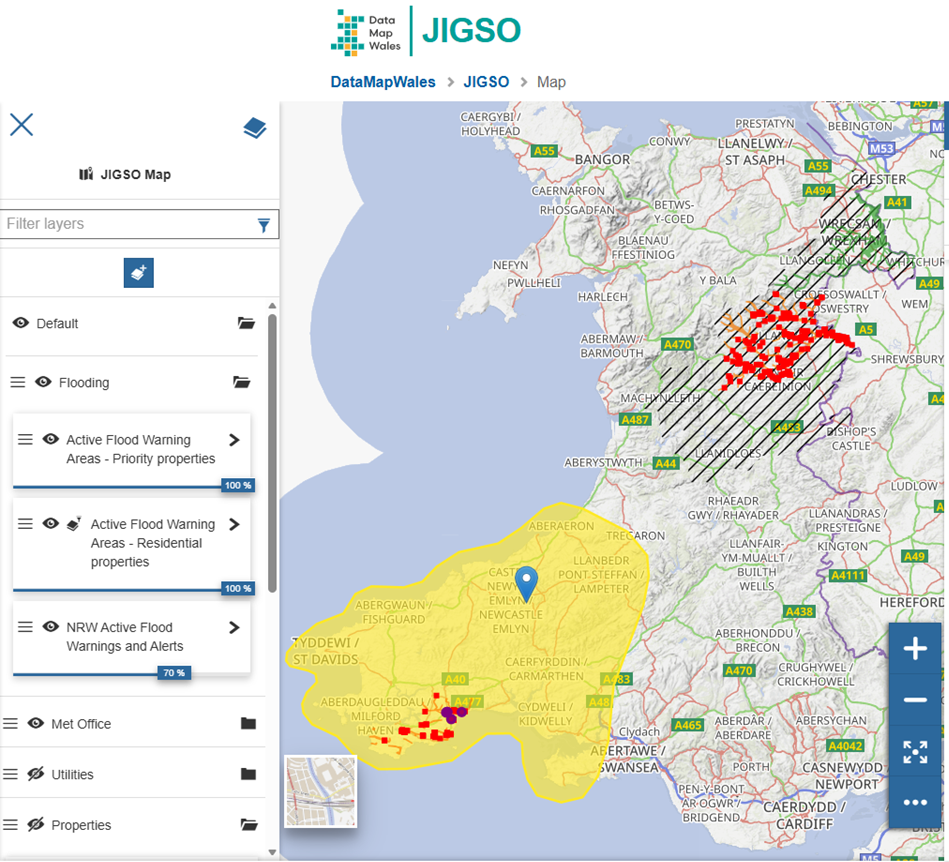
A new application called Jigso is being built to help Wales’ resilience community prepare for major incidents, including flooding, landslides and severe weather.
With climate change expected to bring more frequent flooding, the system is designed to help emergency services and local authorities identify affected areas more quickly.
The majority of emergency services, responder agencies and resilience organisations across Wales have already signed up to the application.
Jigso uses property-level data to help agencies identify vulnerable households and those most in need of help during an emergency.
The system was used during flooding in Monmouthshire last year to calculate the number of vulnerable households affected, helping emergency services respond more quickly.
Planning and public information
DataMapWales also supports local authorities with planning and decision-making, including active travel schemes, carbon modelling, land-use changes and deprivation mapping.
The website hosts around 600 open datasets which can be accessed directly by the public.
Dave Roberts, Head of Geography at the Welsh Government, said: “DataMapWales is constantly evolving. Looking after a smaller country, we are able to work in a very agile way in terms of what we are delivering and how the portal is used.

“Ordnance Survey data provides the backbone of DataMapWales and is key to the success and effectiveness of the platform.”
Pam Whitham, Customer Development Manager at Ordnance Survey, said: “We have had a very close relationship with the Welsh Government for many years and are delighted that it continues to use OS data extensively, particularly in DataMapWales.
“This is a fantastic portal where public sector and service providers across the country are able to access trusted and authoritative data to support their routine and critical services.”

MENTAL HEALTH support has become a key issue for businesses in Wales as employers face growing pressure to help staff manage financial strain, stress and wellbeing at work.
The issue is being highlighted during Mental Health Awareness Week, with new insight from Reed showing that support for employee wellbeing is now an important part of attracting and retaining staff.
Workers in Wales said they need an annual income of £42,000 to live comfortably, compared with an average regional salary of £36,000. That leaves a “comfort gap” of £6,000.
Reed’s latest salary guides also show that 71% of workers say pay has become more important since the cost-of-living crisis, with many employees feeling the pressure of rising everyday costs.
The strain is not only financial. Separate research shows almost one in four workers in Wales, 24%, say they have previously been formally diagnosed with a mental health condition — the highest reported proportion of any UK region.
Pay alone ‘not enough’
Becky Hole, Regional Director at Reed, said employers now needed to look beyond salary alone.
She said: “In Wales, financial pressure and mental health challenges are closely linked. Our data shows that many employees are placing greater importance on stability and support, particularly where salary growth is constrained.
“This means benefits that support work-life balance and mental wellbeing are becoming a much more important part of how valued people feel at work.
“Organisations that prioritise employee wellbeing also benefit in tangible ways. By providing stronger support for mental health, employers can lower staff turnover and reduce the long-term costs linked to ongoing recruitment and the loss of skilled, experienced employees.”
What workers want
WHEN asked what would help them manage stress, 35% of workers in Wales said they wanted more flexible working, 34% wanted better mental health training for managers, and 30% wanted clearer communication about support already available.
However, Reed said there remains a gap between what workers want and what they receive.
The most common benefits currently reported by workers in Wales are onsite parking, at 28%, flexi time, at 26%, and hybrid working, at 23%. Nearly one in five workers, 18%, said they receive no benefits at all.

Ms Hole added: “What this shows is a disconnect between what employees say would most help them manage stress and how clearly mental health support is currently embedded and communicated.
“However, Wales stands out when it comes to flexi time, with a higher proportion of employers offering this benefit compared to other regions — a positive step given its proven role in supporting employee wellbeing and work-life balance.
“Flexible working, open conversations about mental health and managers who are properly trained all come through strongly as priorities.
“Employers have a responsibility to look after their people, and those who want to help their workforce truly destress need to ensure their benefits are visible, accessible and actively support everyday mental resilience.”
Reed said businesses that take wellbeing seriously are more likely to retain skills, stability and trust over the long term.



News1 hour ago
State Opening overshadowed by Starmer leadership crisis
KING CHARLES has arrived at Parliament for the State Opening as Sir Keir Starmer faces the most serious crisis of...


News21 hours ago
Rhun ap Iorwerth becomes Wales’ new First Minister
PLAID CYMRU TAKES POWER AFTER HISTORIC SENEDD VOTE PLAID CYMRU leader Rhun ap Iorwerth has become Wales’ new First Minister...


News24 hours ago
Hotel was hit during a Luftwaffe bombing raid
THE COMMEMORATION, held on Tuesday (May 12), marked the anniversary of the wartime attack, with members of the community gathering...


News1 day ago
Starmer fights for survival as Labour civil war erupts
Cabinet split, ministers resign and MPs revolt as pressure mounts on Prime Minister after disastrous election losses KEIR STARMER is...


News2 days ago
Starmer accused of ignoring Wales in major ‘reset’ speech
Prime Minister pledges EU reset, British Steel nationalisation and youth jobs guarantee — but critics say Wales was left out...


Community3 days ago
Concern grows after child hospitalised following Tenby sea swim
PARENT SAYS BOY BECAME SERIOUSLY ILL AFTER SWIMMING DURING FAMILY VISIT CONCERN is growing in Pembrokeshire after a parent claimed...


News3 days ago
Rhun prepares for clash with Starmer as Plaid eyes power in Cardiff Bay
PLAID CYMRU leader Rhun ap Iorwerth has signalled he is ready for confrontation with Prime Minister Keir Starmer after the...


News4 days ago
Plaid Cymru celebrates historic victory as Rhun ap Iorwerth arrives at Cardiff Bay
CROWDS gathered outside the Senedd as Plaid Cymru leader Rhun ap Iorwerth arrived in Cardiff Bay following his party’s historic...


Crime4 days ago
Police standoff ends after four-hour incident in Pembroke Dock
ELIZABETH COURT SCENE STOOD DOWN AFTER DOMESTIC INCIDENT A FOUR-HOUR police standoff in Pembroke Dock has ended with a 21-year-old...


Crime4 days ago
Teen denies attempted murder of Milford Haven teacher
TEENAGER REMANDED AHEAD OF JULY TRIAL A 15-YEAR-old boy has denied attempting to murder a teacher during a stabbing incident...
-

 Crime6 days ago
Racial abuse suspect barricaded himself inside Johnston lodge
-

 Community7 days ago
Sixth-former firefighter balances schoolwork with saving lives
-

 Local Government6 days ago
Tenant says botched wetroom repair left her fearing flooding
-

 Crime4 hours ago
Man threatens to torch Silverdale Lodge through ‘demon drink’, court hears
-

 Crime6 days ago
Milford Haven woman denies causing suffering to cat
-
Crime4 days ago
Police standoff ends after four-hour incident in Pembroke Dock
-

 News7 days ago
Police asked to investigate alleged ‘sabotage’ of Senedd candidate’s campaign
-

 Local Government2 days ago
Council leadership hopeful responds after anti-Tory rally photos surface