


Politics
The Catalan crisis and Cymru


THE CRISIS in Catalonia has made for some strange political bedfellows, with Plaid Cymru and UKIP – for different motivations – railing against those seeking to preserve the Spanish state intact, while the Conservatives remain equivocal and Labour – as in Brexit – prefer to keep their heads down and hope it will all go away without anyone asking them what their position actually is.
And the reasons for those contortions, at least in Welsh politics are not too difficult to establish. While a core text of young socialists always used to be George Orwell’s ‘Homage to Catalonia’, the establishment of an independent Catalan state would only serve to stoke the well-banked fires of Welsh independence from the UK. With the Labour Party in Wales not only fundamentally unionist in the sense of wishing to ensure the UK stays together but devoted to the idea of the European Union, it does not want to see other European regions assert their independence.
In addition, at least part of Labour’s opposition is borne out of the thought that Catalonia – one of the richest Spanish regions – is seeking its independence partly because it does not want to continue funding poorer Spanish regions: a bit like Surrey declaring UDI because it did not want taxes raised there to contribute to the building of schools in Llanelli.
UKIP’s position has the merit of being both robust and transparently intellectually dishonest. A party built around the recreation of an independent UK is all in favour of other member states of the EU splitting up, especially as – they argue – the conflict highlights the fundamentally autocratic and centralising impulse of the EU. However, UKIP’s anti-unionist and pro-democratic position is not translated to national politics in the particular, only to foreign affairs in the abstract
In that, it is at least consistent with the keenest Brexiteers on the Conservative side, who are all in favour of using the trials of the Spanish state to illustrate their own view of an over-mighty EU without for one minute advancing the logic of that argument to the UK’s status quo. Which is, perhaps, why they are so reluctant to talk about it.

Of more moment, perhaps is that the EU has turned its face against Catalan separatism on the principle that it does not want to see its Union subject to further division. That attitude should be causing raised eyebrows in Edinburgh, or at least giving campaigners for independence considerable pause for thought. A key notion floated at the time of the Scottish independence referendum in 2014 was that Scotland would be an independent nation within the EU. That position – provided of course that the EU is intellectually consistent, coherent, and not prone to dabbling in its members’ internal politics – appears to be shot full of holes by the EU’s current attitude towards Catalonia. And it is worth bearing in mind that SNP supporters supported leaving the EU by a significant majority, which suggests that at least some of its members are prepared to see the lunacy of seeking to leave one union only to join another straight away.
And for Plaid Cymru, or at least those within in it who seek independence for Wales, who believe in the right of the Catalans to self-determination, Welsh self-determination, and who want to remain within the EU – or at least closely tied to it – the position is even more intellectually contorted. The EU – as an institution – shows no appetite at all to allow the federated parts of republics or semi-autonomous regions to divide themselves from the nation states of which they are constituent members. Quite how the attitude of the EU towards the Catalans gives intellectual succour to Plaid Cymru for their own hopes for an independent Wales within the EU requires a leap of logic that suggests faith and not rationality.


A CALL for a five month breathing space for a wind turbine application which was previously withdrawn late last year over a lack of information on how it may affect bats, is expected to be turned down and the scheme refused.
In December of last year, in an application recommended for refusal at Pembrokeshire County Council’s planning committee, Constantine Wind Energy Ltd sought permission for a 76-metre-high wind turbine at Summerton Farm, Sageston.
Back in 2024, an application to replace a current 60.5m high turbine on the site with one up to 90 metres, or just under 300 foot, at the site was refused on the grounds its height and scale would have a detrimental impact on the visual amenity of the locality, with the additional clause of failing to comply with supplementary guidance.
A report for committee members on the latest application says the smaller turbine than previously proposed, representing a 16-metre increase in height from a previously granted turbine “would not be sufficient for it to become an overbearing feature in the landscape,” with no objections from either the Council Landscape Officer or Natural Resources Wales.
However, concerns were raised by the council ecologist that the applicant’s Preliminary Ecological Appraisal Report was incomplete, with a bat survey not included.
It was recommended for refusal on the grounds that appraisal report, and technical note, “do not adequately address the impact of the proposed wind turbine on bat activity in the area”.
At the December meeting, members heard the scheme had been temporarily withdrawn to deal with issues raised, the application now returning to the June meeting, again recommended for refusal.
A report for members ahead of the June meeting says the application was withdrawn from the December agenda to allow the applicant time for consideration of the Council Ecologist’s request for further survey work.
“Further consultation took place with Natural Resources Wales (NRW), the result being that NRW agree with the Council Ecologist’s stance that additional survey work is required.

“The applicant has submitted a request for a further deferral of the application to allow the necessary surveys to be carried out. The bat survey programme requires surveys over Spring, Summer and Autumn. The Spring survey was completed on May 14 and the Spring and Summer surveys will take place on July 14 and September 7 respectively.
“The applicant expects a report to be issued to the council for consultation before the end of September, with consultation with NRW and the council ecologist expected to be completed during October 2026.
“On the assumption that the proposal is considered acceptable the applicant expects that the application could be considered at the November 2026 planning committee meeting.

“Accordingly, the applicant requests deferral of the application to the November 2026 planning committee meeting to avoid the unnecessary costs, resources and timelines for a resubmitted application.”
The application is recommended to be refused at the June meeting of Pembrokeshire County council’s planning committee on the basis that “the Preliminary Ecological Appraisal Report and Technical Note do not adequately address the impact of the proposed wind turbine on bat activity in the area. As such, therefore, the proposal is contrary to the requirements [of planning policy].”

AN OUTLINE business case to Welsh Government for new schools in Milford Haven, which would be “the most expensive capital project ever undertaken by the council” has been backed by senior councillors.
At the Pembrokeshire County Council Cabinet meeting of May 27, members were asked to approve the submission of an outline business case for the Milford Haven Schools redevelopment to Welsh Government, and to approve the new updated budget for the scheme, in light of completing the outline business case , and make provision within the capital programme.
It was previously reported at the May meeting of full council that the scheme, for both a new English Medium and a Welsh Medium School, won’t be built before 2030 and 2032 respectively.
At that meeting, Cabinet member for education, Cllr Guy Woodham, who had earlier announced he was stepping down from his Cabinet education role, said he felt a personal disappointment to be stepping down before there was “a spade in the ground”.
A report for Cabinet members, presented by Cabinet Member for Residents’ Services, Cllr Rhys Sinnett, said following the Sustainable Communities for Learning Strategic Programme Board considering a report on the draft business case it was recommended a new Welsh Medium 3-11 primary school be built on the existing Milford Haven Community Primary School (junior site) and an English Medium provision combined new primary and secondary school building on the existing secondary school site, with some sharing of services.
The schemes also include a 40-place Flying Start centre, a 36-place secondary learning resource centre and a 24-place primary learning resource centre.
It also includes a leisure centre on site, with Thornton Sports Hall demolished as part of scheme, following a March Cabinet backing to support a new leisure investment programme, the funding for that not forming part of the business plan approved.
The report added: “The estimated cost of the scheme has changed from £141,598,965 to £143,617,659, primarily as a result of a change of Welsh Government requirements, from the Building Bulletin to new Area Guidelines, which has required an increase in the Gross Internal Floor Area (GIFA) of the schools to comply, together with further development of the project towards more accurate costs.”
The scheme would see a funding split of: Welsh Government 67.75 per cent, Pembrokeshire County Council 32.25 per cent, a total contribution from the council of £46,316,467
In the report, Director of Resources Jonathan Haswell the scheme would be “the most expensive capital project ever undertaken by the council”.
Members backed the recommendation, new Leader Cllr Tessa Hodgson reflecting it was the first Cabinet meeting without Cllr Guy Woodham in the education role, having stepped back due to health issues, saying he had “worked so hard for this”.
Members backed the recommendations.

Mike Cavanagh, Head of Culture, Leisure, and School Modernisation stressed the business case was not the last part of the process with a full business case expected by the end of the year, and hopes construction would be complete by 2030 and ’32 respectively.

THE SENEDD Commission is often mentioned when discussing Welsh politics – but what actually is it and what does it do?
The Government of Wales Act 2006 gave the then National Assembly for Wales considerable new legislative powers.
It also created a legally separate Welsh Government and corporate body, which became known as the Senedd Commission, or originally the National Assembly for Wales Commission.
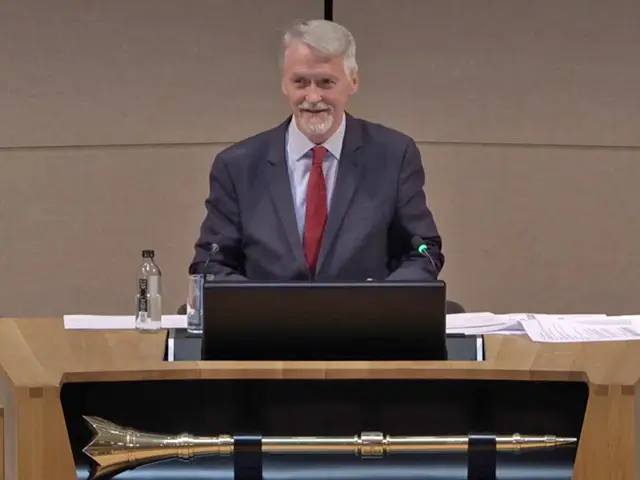
As the corporate entity for the Welsh Parliament, the Senedd Commission has responsibility over the Senedd’s property, staff, and services to support Senedd Members.
The commission is made up of the Llywydd and four other Senedd Members nominated by the main political groups.
Members appointed to the commission act as the “governing board” for the Welsh Parliament with responsibilities such as setting the organisation’s strategic aims and helping implement them.
The chief executive and clerk of the Senedd, a role currently held by Manon Bonner, is responsible for the effectiveness of the Senedd Commission.
In her role as clerk, she is also the principle accounting officer for the commission, meaning she has responsibility for ensuring that taxpayers’ money is spent in accordance with the law.
According to Senedd standing orders – written rules which govern Senedd proceedings – commissioners must be appointed as soon as is reasonably practicable after the election.
Chaired by the Llywydd, the commission consists of four other MSs, who, excluding the Llywydd, should each belong to a different political group.
If there are four or more political groups in the Senedd, the four largest groups must inform the business committee of who they wish from their group to be appointed to the commission.
If there are less than four groups, the business committee will decide the name of any additional members.
Unfortunately there’s no set date. The business committee met for the first time on Thursday May 21, and while the meeting was held in private, the agenda for the first committee included the appointment of Senedd commissioners.
Those appointments will be among the final steps in allowing the Senedd to resume work as usual following the election.
As such, it is likely that the new commissioners will be announced soon.


News7 hours ago
Yacht towed to safety after engine failure off Tenby
A YACHT was towed to safety by Tenby RNLI after suffering total engine failure around 15 miles south-east of the...


Crime1 day ago
Haverfordwest sex offender jailed over child abuse material
Registered offender used library computers to hide social media accounts A HAVERFORDWEST sex offender who used public library computers to...


Local Government1 day ago
Milford Haven school redevelopment moves a major step closer
£141.6m scheme could transform education in the town A MAJOR step forward has been taken in the long-awaited Milford Haven...


Crime2 days ago
Castlemorris man spared jail after knife confrontation over council tax debt
A CASTLEMORRIS man has avoided immediate custody after threatening enforcement officers with a knife during an early-morning visit over unpaid...


News2 days ago
Lifeboats and helicopter join search for missing person off Broad Haven
SEARCH teams carried out a major operation at Broad Haven after reports of a missing person. Little and Broad Haven...

News3 days ago
Multi-agency rescue after child falls on rocks while coasteering
Child airlift requested after four-metre fall near Lydstep A CHILD was rescued from rocks near Lydstep after falling around four...


News3 days ago
Police investigate ‘arson’ after vehicle fire spreads to property in Pembroke
A VEHICLE is believed to have been deliberately set alight during an alleged arson in Pembroke in the early hours...


News3 days ago
Four rescued after dinghy deflates off Pendine
FOUR people were rescued off Pendine on Wednesday evening after Tenby’s all-weather lifeboat was launched to reports of an inflatable...

News3 days ago
Hundreds attend major Diocese of St Davids gathering
Churches across West Wales urged to take message of faith back into their communities HUNDREDS of people gathered at Carmarthenshire...


News3 days ago
Vehicle destroyed in early morning fire in Pembroke
POLICE are investigating after a vehicle was destroyed in an early morning fire in Pembroke. The incident happened in the...
-

 Health3 days ago
Paul Davies warns health board over Withybush and Bronglais services
-
 Crime4 days ago
Police tip-off leads to drink-drive ban for Pembrokeshire pensioner
-

 Crime4 days ago
Steynton motorist banned after drink-drive collision
-
Crime3 days ago
Carmarthenshire man sent to Crown accused of 33 historic sexual offences
-

 Crime4 days ago
Warrant issued for man accused of taking wild goldfinches
-
 Crime4 days ago
Dock man given suspended prison sentence for third drink-drive offence
-

 Crime4 days ago
Dock motorist fined £1,600 after four speeding offences
-

 Local Government5 days ago
Dennison code breach raises serious questions over common sense at County Hall