


News
Two new coronavirus cases in Carmarthenshire, one in Pembrokeshire


FOUR new cases of corona-virus have been reported across the Hywel Dda Health Board area as of Sunday (Aug 16).
Three new cases have been reported in Carmarthenshire, but only one new case was reported in Pembrokeshire.
Across Wales 18 new cases were recorded as of Sunday, bringing the total number of cases to 17,561.
Dr Robin Howe, of Public Health Wales, said: “The Chief Medical Officer for Wales has paused his advice to shield as the prevalence rate of the coronavirus in our communities has reduced. This means that from today (16 August) people will no longer need to shield.
“Following confirmation by the Welsh Government that the essential travel restriction on public transport will be lifted from tomorrow (Monday, 17 August), we are reminding people of the need to act responsibility when using public transport.

“This includes planning journeys to avoid busy periods if possible, washing or sanitising hands at the start and end of each trip, and wearing face coverings.
“From 22 August, providing conditions remain stable, up to four households will be able to join together to form a single extended household, and a meal following a wedding, civil partnership or funeral will be allowed for up to 30 people indoors providing social distancing can be maintained.
“We welcome the amendments to regulations making it obligatory for hospitality businesses and other settings to collect contact details of customers from next week. This information is essential for Wales’ Test, Trace, Protect strategy for testing the general public and preventing the spread of coronavirus.
“We would remind the general public that as of yesterday (Saturday 16 August) anyone who arrives in Wales from Aruba, France, Malta, Monaco, the Netherlands and Turks and Caicos, or who has visited or made a transit stop in any of those countries or territories, will be required to isolate for 14 days. Advice on travelling abroad, including the latest information on quarantine requirements on returning home, can be found on the FCO website.
“Anyone with suspected symptoms of COVID-19 infection – a high temperature, a new, continuous cough, or a loss of smell or taste (anosmia) – must self-isolate and seek an urgent test.
“Confirmed cases must isolate for 10 days, with members of their household isolating for 14 days until the risk of passing on further infection has gone. Combined, these simple but effective actions will ensure the virus does not spread.
“Contact tracing continues as part of the Welsh Government’s Test, Trace, Protect strategy. Anyone who has a positive Coronavirus test will be contacted by a team of contact tracers, and asked for details of everyone they have had close contact with while they have had symptoms.

“Please keep a note of your activities so you can easily remember your whereabouts on a given day, along with who you were in contact with.
“If you are asked to self-isolate, you should do so to prevent further spread of the virus.”
Two new deaths suspected of being related to coronavirus were reported to Public Health Wales- this brings the total number of Welsh deaths to 1,589.
The total number of cases in the three counties to 1,206; 828 cases in Carmarthenshire, 74 in Ceredigion and 304 in Pembrokeshire.


THE WELSH CONSERVATIVES have called for urgent action on hospice funding after Hospice UK warned that services in Wales are facing growing pressure from rising demand, more complex patient needs and increasing staff strain.
Hospice UK says all adult hospices in Wales are now caring for patients with increasingly urgent and complex conditions, while half reported staff distress linked to being unable to support everyone who needs help.
The charity has warned that demand for palliative care in Wales is expected to rise significantly over the coming decades, at the same time as hospices face higher workforce costs, inflationary pressures and continued uncertainty over long-term funding.
Hospices provide end-of-life and palliative care for patients and families, often supporting people in their own homes and communities. Campaigners argue that without sustainable funding, more pressure could fall back on already stretched NHS services.
The Welsh Government has previously announced extra support for the sector, including a £4.3m package in March to help stabilise adult and children’s hospices, alongside a £3m annual uplift in hospice funding. Ministers said the money was intended to help protect staffing capacity and maintain essential services.
However, hospice leaders have continued to call for a longer-term settlement, arguing that one-off grants do not provide the certainty needed to plan services, retain staff and meet future demand.
Natasha Asghar MS, Welsh Conservative Shadow Cabinet Secretary for Health and Social Care, said the latest findings were “deeply worrying”.
She said: “Hospice staff do incredible work supporting patients and families through the most difficult moments imaginable.
“But they cannot be expected to carry on facing rising demand and growing pressure without proper support.
“Plaid Cymru must now deliver a sustainable funding model for hospices in Wales, so patients can receive the compassionate care they deserve, when and where they need it.”
The call comes as end-of-life care remains under increasing scrutiny across the UK, with charities warning that hospices are being asked to do more while relying heavily on charitable donations and short-term support.
Hospice UK has said sustainable funding is needed to ensure patients in Wales can access the right care, in the right place, when they need it.

Teams are being urged to get their carts ready as Fishguard Round Table brings back one of the town’s most popular community events
FISGHUARD is gearing up for one of its most colourful community events as the Fishguard Soapbox Derby returns on Saturday, June 27.
The event, organised by Fishguard Round Table, will get underway from midday and promises a day of speed, creativity, family fun and community spirit.
Teams are being encouraged to build their own soapbox carts and take part, with organisers hoping this year’s event will be the biggest and best yet.
The derby brings together racers, families, spectators and local supporters for a fun-filled day in the town, with prizes, food, stalls and entertainment also planned.
Organisers say the event is all about “speed, creativity and community”, giving teams the chance to show off their designs while spectators enjoy the action from the roadside.
The event poster promises “fun family action” and urges people to “race it, build it, watch it, love it”.
Fishguard Round Table, which supports community causes through its fundraising and events, is encouraging people to come along, support the racers and enjoy a full afternoon out.
Entries are currently open, with teams urged to get together and prepare their carts ahead of race day.


New study says marine conservation is becoming a “functionally middle-class” profession as barriers to entry grow
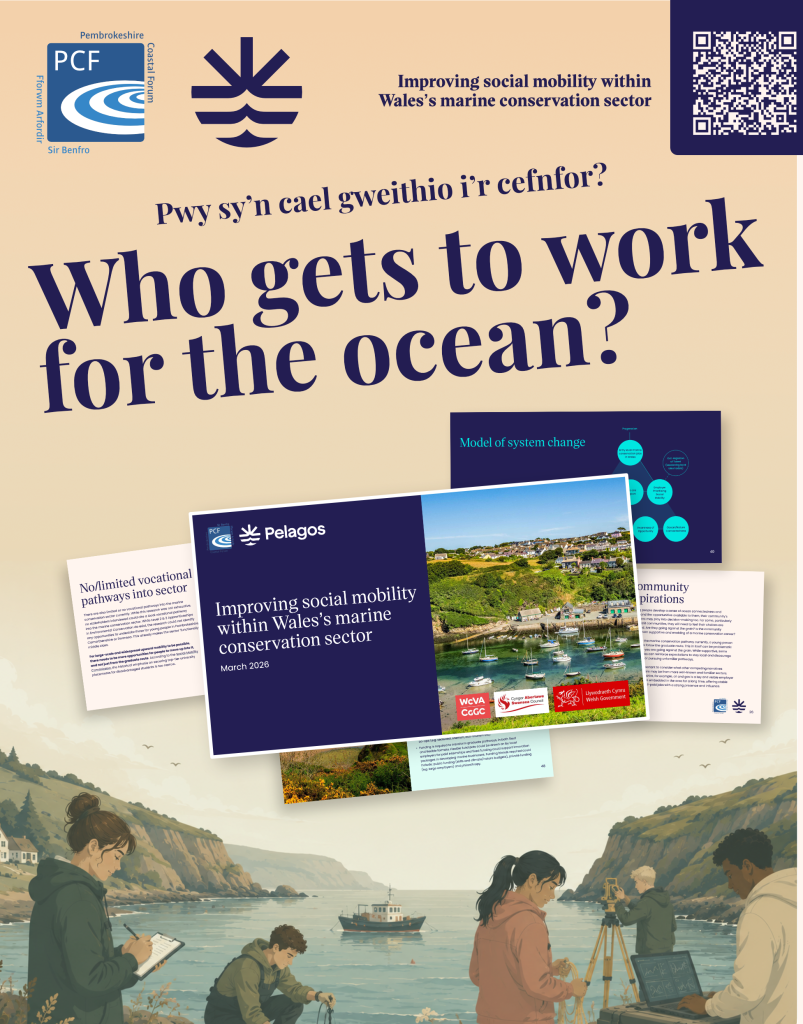
A NEW report has warned that marine conservation is becoming a “functionally middle-class” profession, with young people from working-class backgrounds facing significant barriers to entering the sector despite growing demand for environmental careers.
The study, Improving Social Mobility within Wales’s Marine Conservation Sector, published by Pembrokeshire Coastal Forum and Pelagos, says a lack of vocational training routes, a shortage of entry-level jobs and financial pressures are preventing many talented young people from pursuing careers protecting Wales’ coastline.
Researchers found there are currently no local vocational pathways into marine conservation in South West Wales, meaning university has become the main route into the profession. The report argues this risks excluding capable young people who cannot afford higher education or unpaid work placements.
The report describes marine conservation as becoming “functionally middle class”, warning that greater social mobility will only be achieved if more practical routes into the sector are developed alongside traditional graduate pathways.
Researchers interviewed 26 employers and stakeholders alongside 20 young people aged between 16 and 26 from Pembrokeshire, Carmarthenshire and Swansea between January and March this year. They also carried out an extensive review of existing research into social mobility and employment.
Among the biggest concerns identified was the severe shortage of entry-level jobs.
One graduate told researchers: “I’m now totally stuck. I’ve been applying for six months. Most jobs require a Master’s degree. I know so many people getting one but then being in the same position.”
Another employer revealed that a single vacancy attracted 293 applications, while another described the situation as “selling tickets to a gig that is oversubscribed”.
The report also highlights wider structural challenges facing young people in rural Wales.
Researchers say poverty, limited public transport, geographical isolation and reduced access to professional networks all make it harder for young people outside major cities to access higher education, internships and skilled employment. Around 31 per cent of children in Wales live in poverty, one of the highest rates in the UK, with many living in households where at least one adult is in work.
The study identifies four key factors influencing whether young people pursue marine conservation careers: their connection with the natural environment, awareness of career opportunities, community aspirations and academic confidence. It concludes that these must be supported by better funding, mentoring, employer engagement and significantly more entry-level opportunities if social mobility is to improve.
Sea Trust Wales Director Nadia Tomsa, who contributed to the research, said unpaid internships and fierce competition for experience were creating unnecessary barriers.
She said: “The conservation sector is becoming increasingly difficult to access, with a huge shortage of entry-level opportunities. Unpaid internships create a barrier to lower-income individuals gaining experience.
“I see numerous talented, passionate young people who are struggling to find a role in the marine conservation world.”
Ms Tomsa revealed that Sea Trust Wales recently received more than 100 applications for a two-month volunteer placement, many from graduates hoping to gain enough experience simply to compete for paid work.
The report concludes that Wales needs a joined-up vocational pathway into marine conservation alongside stronger financial support, mentoring and employer initiatives if the sector is to attract talent from all backgrounds rather than those who can most easily afford to enter it.
The research was funded through the Welsh Government’s Marine Resilience Fund.



Community2 hours ago
Working-class young people ‘shut out’ of marine conservation careers in Wales
New study says marine conservation is becoming a “functionally middle-class” profession as barriers to entry grow A NEW report has...

News5 hours ago
Reform MS: ‘I felt like shouting get out of the water’
Paul Marr says children playing in streams at Pembrokeshire beaches deserve better protection from pollution risks REFORM UK MS Paul...


Health1 day ago
Senedd backs call to rule out hospital downgrades after heated NHS debate
Reform UK amendment passes as West Wales hospital fears remain central political issue THE SENEDD has backed a call for...

News1 day ago
Coastguard callout payments axe sparks fears for coastal communities
VOLUNTEER coastguards across the UK are set to lose callout payments, prompting concern over the future resilience of emergency cover...


Farming1 day ago
Rural Wales ‘left out’ of net zero debate, warns carbon entrepreneur
A WELSH carbon entrepreneur has warned that rural Wales risks being left behind in the national conversation about net zero....


Local Government2 days ago
Tenby Spectacular row continues as organisers say key question remains unanswered
Round Table says legal clarity over pedestrian access is still holding up event plan TENBY ROUND TABLE has welcomed Pembrokeshire...


Community3 days ago
Manorbier fire scandal: Council’s payout just £63,777 after school destroyed
PEMBROKESHIRE COUNTY COUNCIL has accepted an insurance settlement which leaves it with just £63,777.07 after the catastrophic fire which destroyed...


News3 days ago
Bus overturns in major incident near Kidwelly
All passengers rescued as emergency services remain at scene A BUS overturned on the A484 between Kidwelly and Ferryside on...


Community4 days ago
Tenby Summer Spectacular cancelled amid council row over harbour access
Organisers say popular charity events cannot safely go ahead without clear powers to control crowds TENBY ROUND TABLE has announced...


News4 days ago
Motorcyclist dies after four-vehicle crash on A40 in Carmarthenshire
A MOTORCYCLIST has died following a four-vehicle collision on the A40 between St Clears and Whitland. Dyfed-Powys Police said the...
-

 Health6 days ago
Woman jailed assaults on police, harassment and XL Bully possession
-

 Crime1 day ago
Police appeal after reported rape at Young Farmers rally
-

 Crime6 days ago
Milford Haven woman spared jail despite string of shop thefts
-

 Community5 days ago
The gentle giant behind the tattoos
-

 Crime6 days ago
Spittal man to stand trial accused of ABH
-

 Crime6 days ago
Carmarthenshire pensioner, 86, accused of causing prostitution for gain
-

 Entertainment5 days ago
Harbour Fest to bring music, food and maritime magic to Milford Waterfront
-
Health5 days ago
Welsh Government refuses to halt Withybush and Bronglais service review