


Community
New grants will support community initiatives in south west Wales


PEOPLE in South West Wales with great ideas to improve their local communities are invited to apply for grants from a new fund designed to help them make those ideas a reality.
The new Community Changemakers Fund will directly support local people and organisations who want to drive positive local change in communities along the South West Wales rail network.
The initiative has been launched by South West Wales Connected (SWWCo), a Community Rail Partnership set up to support the communities along the railway line throughout Carmarthenshire, Pembrokeshire, Neath Port Talbot and Swansea. SWWCo is hosted by 4theRegion, a community interest company based in High Street Station, Swansea, which is also backing the Community Changemakers initiative. The grants will be administered by the Carmarthenshire Association for Voluntary Services (CAVS) and are designed to be easy for local people to apply for.
The aim of the fund is to support communities along its railway lines to make change happen in their local places. The initiatives could include COVID-safe community events, creative and cultural initiatives, projects to clean up or improve local spaces, projects to support local businesses or “buying local”, projects to promote sustainability or climate action, projects to promote walking and cycling, and much more.
Each person or organisation can apply for a grant of between £300 and £1,000. The main criteria is that groups can demonstrate how the funding will improve community well-being and/or sense of place. They will need to state what the money will be used for and what difference their project will make. Their project will need to start and finish during 2021.

South West Wales Connected Community Rail Officer Jennifer Barfoot said: “We are passionate about supporting local people who aim to improve their communities in innovative ways, making small interventions that help create pride of place and promote well-being in the community. This new fund is designed to be easy to apply for, and will support changemakers within local communities around railway stations, helping them to bring about exciting change in their areas.”
Jackie Dorrian, Health and Wellbeing Officer with the Carmarthenshire Association for Voluntary Services, which will be administering the grant, said: “South West Wales Connected Community Rail Partnership has launched this new community grant fund to support communities along the railway line to make change happen in their local places. It will assist local people to make their area more attractive, not only for themselves but for others who visit the area. It will help to bring more community focus to the area and enhance what is available.”
Head of Community Rail at TFW Hugh Evans said: “We are pleased to be match funding this initiative. This fund will help local people bring about real improvements in their communities and will also help raise the awareness of the rail industry. We’re committed to reaching out to local communities and are very much looking forward to seeing what projects this funding helps to get off the ground.”
Dawn Lyle, Chair of 4theRegion, said: “We know that local people living in communities are best placed to know what’s needed – not top-down interventions. That’s why we’re delighted to be able to help make these grants available for “real people!” If you have a great idea for improving your community and live in an area served by the South West Wales rail network, I urge you to get in touch and find out more about how to apply. 4theRegion is committed to creating positive change throughout the region and this project will certainly help to achieve that.”
More info about the fund can be found here: http://www.southwestwales.co/changemakers-fund/



PEMBROKESHIRE County Council has stressed it has not “requested or given direction” that Tenby’s much-loved Summer Spectacular should be cancelled after fears have been raised it may not go ahead.
Earlier this week, organisers Tenby Round Table said it was “with enormous sadness,” announcing that the Tenby Summer Spectacular events, scheduled for August 16 and 30, are cancelled until further notice.
The events, which have been a staple in Tenby’s summer calendar for many years, but the Round Table says negotiations with Pembrokeshire County Council have failed to produce a clear, workable agreement on temporary restrictions for pedestrian access during the event.
Without that, they say, they cannot legally or safely control crowd numbers.
A spokesperson said that legal and logistical uncertainty from the council meant organisers could not commit to running such a large-scale event this year, adding the situation has not improved despite months of requests, meetings, and professional safety consultations.
In a statement issued earlier this week, Tenby Round Table said: “We have done everything a responsible event organiser can do.”
It claimed: “PCC’s Public Realm department has had nine months to answer one question on safe and controlled access to the harbour. It has not done so.”
The group maintains that similar crowd management techniques are standard elsewhere in the country and vital for safety.
The Round Table added: “Given the lack of clarity and the time needed to arrange these events, we cannot commit to running events for thousands of people based on a legal position that PCC’s own officers have admitted is still not settled.”
It has stressed the cancellation is provisional, giving the council “a final deadline of June 25 to provide a clear, accurate, and legally grounded answer,” adding: “If they do, we will do everything in our power to reinstate the events.”
It said it was still working with relevant authorities ahead of a council licencing committee meeting in July, which will decide on whether a licence to host the events is renewed.
Responding, Pembrokeshire County Council Deputy Leader Cllr Paul Miller said the council supports the Spectacular and “has not requested or given direction that the event should be cancelled”.

He added: “The Spectacular is a much-loved event with significant number of attendees. As a result, we have an important duty to make sure the event can take place safely to address the concerns formally raised by the responsible authorities under the licensing act, which include the blue light services.
“Tenby Harbour is a working harbour and a key community asset – and just as every year this event needs to be licensed, and the organisers need to provide important information on how they plan to safely manage the event.
“As a council, we very much want this event to go ahead, but we have to make sure the event is safe for the public, with the right safety measures in place.
“Once the organisers provide the required information, the licensing sub-committee (currently scheduled for July) will consider the event application, in exactly the same way they consider the large number of other events which occur across Pembrokeshire each year.”
Local Member, Cllr Sam Skyrme-Blackhall, added: “I want to see the Spectaculars go ahead. It is important for locals and visitors alike to celebrate Tenby, have fun and raise money for worthy causes.
“I am really encouraged from meetings that I have had with senior officers that everyone is ready to do all that they can to enable these events to go ahead.”
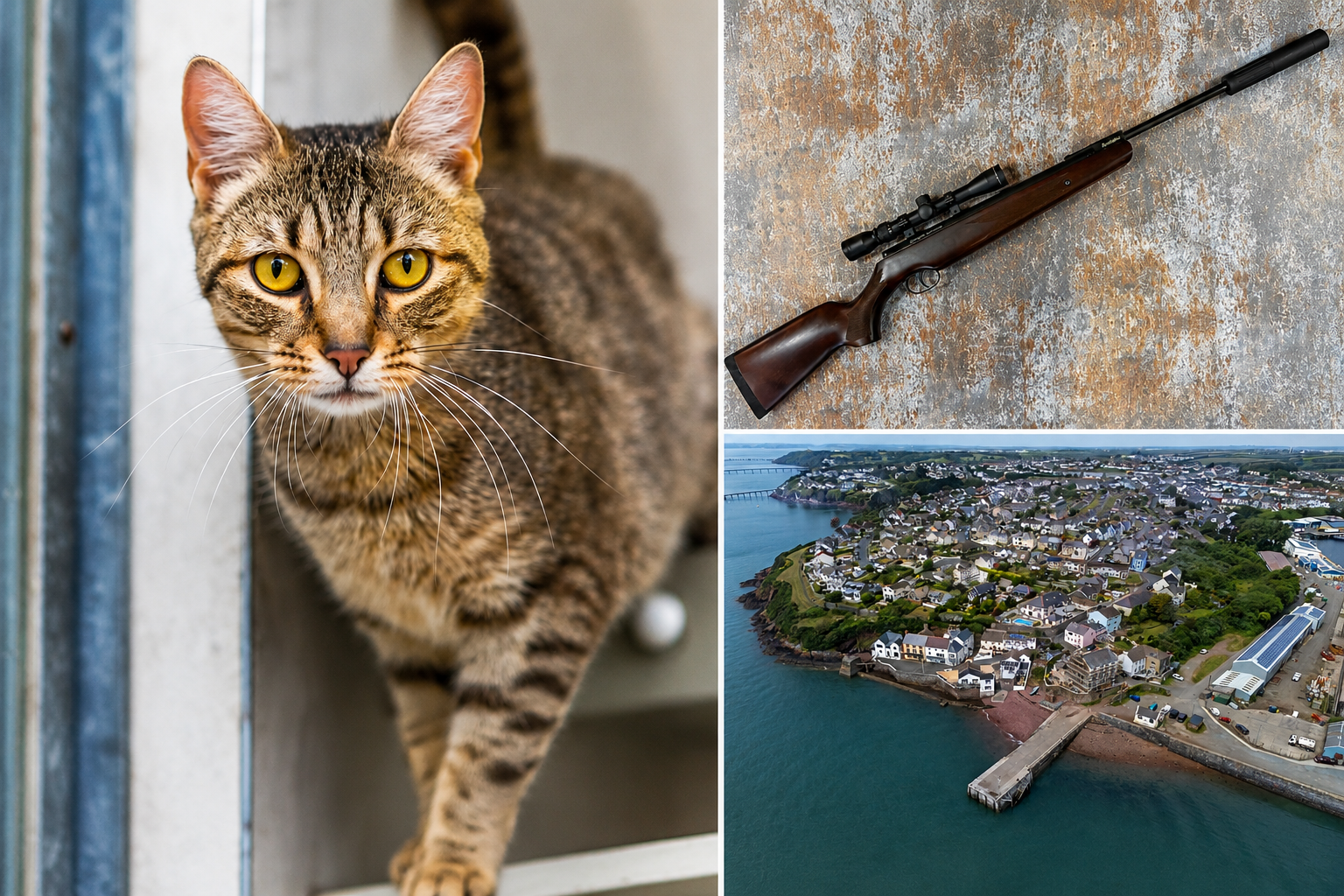
RSPCA says police are also investigating after further reports in same town
FRESH concerns have been raised in Milford Haven following reports of new animal shootings in the town.
The RSPCA has confirmed it is aware of further incidents and said Dyfed-Powys Police are also believed to be involved.
An RSPCA spokesperson said: “This is concerning and our hearts go out to anyone who has been affected by these incidents.
“Anyone with any information is asked to contact the RSPCA appeals line number on 0300 123 8018 and refer to incident number 01751732 or please contact the police who are also investigating.”
The latest reports follow earlier incidents in the Hakin area, where cats and wildlife were targeted with an air gun.
Earlier this month, the RSPCA issued an appeal after a cat died after being shot for a second time. A pigeon was also put to sleep after being found with an airgun pellet injury, while several cats had previously been shot in the area.
The charity said anyone caught deliberately using an air gun to injure an animal can face up to five years in prison and an unlimited fine under the Animal Welfare Act.
Deliberately injuring or killing wild birds is also a criminal offence under the Wildlife and Countryside Act 1981.
The RSPCA added that cats and wildlife are particularly vulnerable because they are often outside with nobody to protect them.
Anyone with information should contact the RSPCA appeals line on 0300 123 8018, quoting incident number 01751732, or contact Dyfed-Powys Police.

Authority denies cancelling event as organisers await licensing decision
PEMBROKESHIRE COUNTY COUNCIL has insisted that it wants the Tenby Summer Spectacular to go ahead, after organisers announced the cancellation of this summer’s events amid a row over harbour access and crowd control.
Tenby Round Table said earlier this week that the popular charity events, scheduled for Sunday, August 16 and Sunday, August 30, had been cancelled “until further notice” because organisers did not believe they had the clear powers needed to safely manage pedestrian access at Tenby Harbour.
The events are among Tenby’s best-known summer attractions, drawing thousands of residents and visitors to the harbour for entertainment, food, drink and fireworks, while raising money for local good causes.
But the council has now said it has not asked for the events to be cancelled and that the matter remains part of the normal licensing process.
Deputy Leader Cllr Paul Miller said: “Pembrokeshire County Council supports the Spectacular as we have for nearly 15 years. The Council has not requested or given direction that the event should be cancelled.
“The Spectacular is a much-loved event with significant number of attendees. As a result, we have an important duty to make sure the event can take place safely to address the concerns formally raised by the Responsible Authorities under the Licensing Act, which include the blue light services.
“Tenby Harbour is a working harbour and a key community asset – and just as every year this event needs to be licensed, and the organisers need to provide important information on how they plan to safely manage the event.”
Cllr Miller said the council wanted the event to proceed, but had to be satisfied that suitable safety arrangements were in place.
He added: “As a council, we very much want this event to go ahead but we have to make sure the event is safe for the public, with the right safety measures in place.
“Once the organisers provide the required information, the Licensing Sub-Committee, currently scheduled for July, will consider the event application, in exactly the same way they consider the large number of other events which occur across Pembrokeshire each year.”
Local county councillor Sam Skyrme-Blackhall also said she wanted to see the Spectacular continue.
She said: “I want to see the Spectaculars go ahead. It is important for locals and visitors alike to celebrate Tenby, have fun and raise money for worthy causes.

“I am really encouraged from meetings that I have had with senior officers that everyone is ready to do all that they can to enable these events to go ahead.”
The dispute now appears to centre on whether organisers can provide the information required by licensing officers and responsible authorities before the application is considered next month.
Tenby Round Table has previously said the issue relates to the safe management of large crowds around the harbour, including control of pedestrian access.
The council says those concerns must be addressed through the licensing process, while stressing that no instruction has been given to cancel the events.
The future of this year’s Spectaculars now appears to depend on whether an agreed safety plan can be produced before the July hearing.



Local Government16 hours ago
Tenby Spectacular row continues as organisers say key question remains unanswered
Round Table says legal clarity over pedestrian access is still holding up event plan TENBY ROUND TABLE has welcomed Pembrokeshire...


Community1 day ago
Manorbier fire scandal: Council’s payout just £63,777 after school destroyed
PEMBROKESHIRE COUNTY COUNCIL has accepted an insurance settlement which leaves it with just £63,777.07 after the catastrophic fire which destroyed...


News2 days ago
Bus overturns in major incident near Kidwelly
All passengers rescued as emergency services remain at scene A BUS overturned on the A484 between Kidwelly and Ferryside on...


Community3 days ago
Tenby Summer Spectacular cancelled amid council row over harbour access
Organisers say popular charity events cannot safely go ahead without clear powers to control crowds TENBY ROUND TABLE has announced...


News3 days ago
Motorcyclist dies after four-vehicle crash on A40 in Carmarthenshire
A MOTORCYCLIST has died following a four-vehicle collision on the A40 between St Clears and Whitland. Dyfed-Powys Police said the...


News3 days ago
Rhun ap Iorwerth urges new deal for Wales after Starmer quits
First Minister says next Prime Minister must focus on greater powers, fair funding and respect for Wales’ democratic mandate FIRST...


News3 days ago
How Labour’s landslide victory unravelled in just two years
Prime Minister announces resignation after losing support within his own party as Andy Burnham emerges as overwhelming favourite to take...


News3 days ago
Long Course Weekend set to bring thousands to Pembrokeshire
Three days of swimming, cycling and running will once again transform Tenby into one of the UK’s biggest endurance sporting...


Community4 days ago
The gentle giant behind the tattoos
Pembrokeshire security worker Josh Davies praised for professionalism, kindness and proving first impressions can be wrong JOSH Davies is hard...


Charity5 days ago
Toy Story fans fill charity toy box at Haverfordwest cinema
Donations pour in for SNAP Specialist Play as families embrace Toy Story 5 launch A TOY STORY-themed charity appeal at...
-

 News7 days ago
Crash on Freeman’s Way causes school-run chaos across Haverfordwest
-

 Health5 days ago
Woman jailed assaults on police, harassment and XL Bully possession
-

 Crime5 days ago
Milford Haven woman spared jail despite string of shop thefts
-
Community4 days ago
The gentle giant behind the tattoos
-

 Local Government7 days ago
Pembrokeshire faces accessible housing shortage as 403 people wait for homes
-

 Crime5 days ago
Spittal man to stand trial accused of ABH
-

 Crime5 days ago
Carmarthenshire pensioner, 86, accused of causing prostitution for gain
-

 Entertainment4 days ago
Harbour Fest to bring music, food and maritime magic to Milford Waterfront