


News
Buckingham palace announces Prince Philip’s funeral arrangements


PRINCE PHILIP’S royal ceremonial funeral will take place April 17 at Windsor Castle — a slimmed-down service amid the COVID-19 pandemic that will be entirely closed to the public.
Philip, also known as the Duke of Edinburgh, took part in planning his funeral and its focus on family was in accordance with his wishes. The 99-year-old duke, who died Friday, also took part in designing the modified Land Rover that will carry his coffin.
“Although the ceremonial arrangements are reduced, the occasion will still celebrate and recognize the duke’s life and his more than 70 years of service to the Queen, the UK and the Commonwealth,” a palace spokesman said Saturday while speaking on condition of anonymity in line with policy.
Prince Harry, Philip’s grandson who stepped away from royal duties last year and now lives in California, will attend the service along with other members of the royal family. His wife, the Duchess of Sussex, who is pregnant, has been advised by her doctor not to attend.
Palace officials said the ceremony would be conducted strictly in line with the British government’s COVID-19 guidelines, which restrict the number of people attending funerals to 30. They declined to say whether the royal family would be required to wear masks.

The palace appealed to the public not to gather in Windsor, and for those who wished to pay their respects to Philips to stay at home instead.
“While there is sadness that the public will not be able to physically be part of events to commemorate the life of the duke, the royal family asks that anyone wishing to express their condolences do so in the safest way possible and not by visiting Windsor or any other royal palaces to pay their respects,″ the palace spokesman said. “The family’s wish is very much that people continue to follow the guidelines to keep themselves and others safe.”
The announcement comes after military teams across the U.K. and on ships at sea fired 41-gun salutes Saturday to mark the death of Philip, honouring the former naval officer and husband of Queen Elizabeth II whom they considered one of their own.
Batteries in London, Edinburgh, Cardiff and Belfast — the capitals of the four nations that make up the United Kingdom — as well as other cities around the U.K. and the Mediterranean outpost of Gibraltar fired the volleys at one-minute intervals beginning at midday. Ships including the HMS Montrose, a frigate patrolling the Persian Gulf, offered their own salutes.
“The Duke of Edinburgh served among us during the Second World War, and he remained devoted to the Royal Navy and the Armed Forces as a whole,” Gen. Nick Carter, chief of the defence staff, said in a statement. “A life well-lived. His Royal Highness leaves us with a legacy of indomitable spirit, steadfastness and an unshakeable sense of duty.”
Members of the Commonwealth, a group of 54 countries headed by the monarch, were also invited to honour Philip. The Australian Defence Force began its salute at 5 p.m. local time outside Parliament House in Canberra, and New Zealand planned to offer its own tribute on Sunday.
Philip joined the Royal Navy as a cadet in 1939 and once had a promising military career. In 1941, he was honoured for his service during the battle of Cape Mattapan off the coast of Greece, when his control of searchlights aboard the HMS Valiant allowed the battleship to pinpoint enemy vessels in the dark. Philip rose to the rank of commander before he retired from active duty.

Two years after the war ended, Philip married Elizabeth at Westminster Abbey when she was 21 and he was 26. Philip’s naval career came to an abrupt end when King George VI died in 1952 and his wife became queen.
At the queen’s coronation in 1953, Philip swore to be his wife’s “liege man of life and limb” and settled into a life supporting the monarch. The couple had four children — Charles, the heir to the throne, Anne, Andrew and Edward.
Before he retired from official duties in 2017, the prince carried out more than 22,000 solo public engagements and supported over 780 organizations, including the Duke of Edinburgh’s Award for young people.
Members of the public continued to honour Philip’s life of service on Saturday, leaving flowers outside Buckingham Palace and Windsor Castle despite appeals from authorities and the royal family to refrain from gathering.
“I think everyone would like to pay their respects,” Maureen Field, 67, said outside Windsor Castle. “Because of the virus, a lot of people have to stay away. He didn’t want a big funeral. He wanted a very private time with his family to say their goodbyes. So, we’ve all got to respect that.”
Mike Williams, 50, travelled from his home in Surrey, southwest of London, to Buckingham Palace to honour the prince.
“He’s a massive loss to the country and to the world, I think, so we wanted to come and pay respects,” Williams said. “I don’t know what it achieves, but it just felt like the right thing to do.”
(Associated Press, London – by James Brooks and Tom Rayner)



Campaigners say Carmarthenshire must properly consider alternatives after judge’s ruling and last-minute amendment to statutory notice.
A HIGH COURT judge has warned Carmarthenshire County Council that alternative proposals to closing Ysgol Meidrim must be given proper and conscientious consideration before any final decision is made.
The ruling follows a judicial review challenge brought by parent Leia Perry over the council’s decision to consult on the future of the Welsh-medium rural primary school.
Although the High Court did not halt the closure process, campaigners say the judgment raises serious questions about the way the council has handled the matter.
Ysgol Meidrim, near St Clears, currently has around 30 pupils and has been earmarked for closure, with children expected to transfer to other schools from January 2027.
But the school community has mounted a determined campaign to keep it open, arguing that the school remains central to the future of the village, the Welsh language and rural life in the area.
The judgment, handed down by His Honour Judge Jarman KC, found that the challenge should be allowed to proceed, but ultimately dismissed it on the basis that the council still has an opportunity to properly consider alternatives during the ongoing process.
However, the judge made clear that those alternatives must now be considered conscientiously.
Campaigners say this is a significant warning to the council.
Ffred Ffransis, speaking on behalf of Cymdeithas yr Iaith in Carmarthenshire, said the organisation was not a party to the legal action, but understood why a parent of a child with severe medical needs had taken the case.
He said: “The judge criticised the lack of clear communication from the council and that governors had the impression that the council had not yet seriously considered alternatives to closure of Ysgol Meidrim, but found that the evidence did not yet reach the high threshold for legal intervention.
“He has warned the council that they must give conscientious consideration to the alternative proposals drawn up by governors.”
The governors’ proposals include developing the school as part of a wider community hub and exploring federation options rather than closure.

Cymdeithas yr Iaith said the council now had two choices: to press ahead regardless, or to withdraw the closure notice and enter into genuine discussions with governors over their plans.
Mr Ffransis added: “The council must at least demonstrate a new open attitude during the objections period to discussing the alternative proposals.”
The row has deepened after Carmarthenshire County Council was forced to withdraw and reissue its closure notice just three days after it was first published.
According to Cymdeithas yr Iaith, the original notice, issued on June 16, listed nearby Ysgol Bancyfelin as one of three receiving schools. The notice was then withdrawn after it emerged that Ysgol Bancyfelin was already over capacity.
A revised closure notice has now been issued, with the objection period extended until July 17.
The campaign group said this raised further concerns about the way the process was being handled.
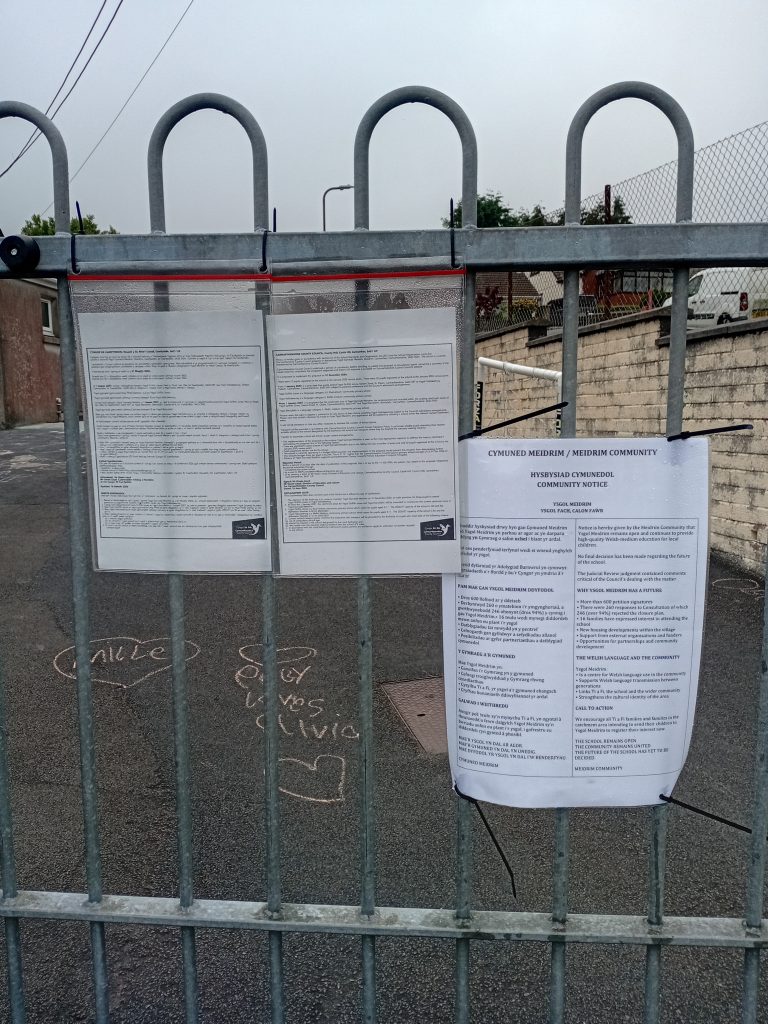
Notices have also been placed at the school gates by supporters, making clear that Ysgol Meidrim remains open and encouraging parents to register children there.
One notice states that the judicial review judgment was critical of the council’s handling of the matter and that the future of the school has not yet been decided.
The campaign has attracted wider attention because of the Welsh Government’s presumption against closing rural schools.
Under the School Organisation Code, councils must carefully consider all reasonable alternatives before deciding to close a rural school, including federation and wider community use.
Campaigners argue that Ysgol Meidrim is not simply an education issue, but a question about the survival of Welsh-speaking rural communities.
The council has previously cited low pupil numbers, surplus places, budget pressures and curriculum challenges as reasons for proposing closure.
But opponents say the financial savings are small compared with the impact on the village and its Welsh-medium provision.

Defendant remanded in custody as court hears allegations spanning Wales and South West England
A MAN accused of carrying out a series of high-value thefts from Currys stores across Wales and South West England has appeared before magistrates in connection with an alleged offence in Haverfordwest.
Ilia Patchkoria, aged 27, of no fixed abode, appeared before Llanelli Magistrates’ Court facing multiple theft allegations involving electrical goods worth tens of thousands of pounds.
Among the charges is an allegation that Patchkoria stole items worth £1,525 from the Currys store in Haverfordwest on May 23 this year.
The court heard that the Haverfordwest incident forms part of a wider series of alleged offences said to have taken place at Currys stores across Wales and England.
Other charges relate to alleged thefts at stores in Carmarthen, Barnstaple, Plymouth, Truro, Penzance and Torquay. The total value of the goods involved in the various allegations runs into many thousands of pounds.
According to the court register, the largest single alleged theft took place at the Carmarthen branch, where goods valued at more than £7,600 are said to have been taken.
Patchkoria indicated guilty pleas to some matters before the court. Magistrates ordered that he be remanded in custody while proceedings continue.
The case has been adjourned until July 2, when it is due to return before Llanelli Magistrates’ Court.
It is not yet known precisely what items were allegedly taken from the Haverfordwest store, although Currys outlets typically stock a range of high-value electrical goods including laptops, mobile phones, gaming consoles and household technology.
No verdicts have been reached in relation to the outstanding allegations.
The Herald has approached Currys for comment on the alleged Haverfordwest theft and to establish whether the incident caused any disruption to customers or store operations.
Photo caption: Currys in Haverfordwest was among several stores allegedly targeted in a cross-country theft spree (Pic: Herald).

FAMILY REMEMBERS “KIND AND LOVING” CALLUM HANSON
THE FAMILY of a 22-year-old man from Haverfordwest who died following a road traffic collision have paid tribute to their “kind and loving” son, brother and grandson.
Callum Hanson sadly passed away in hospital on Wednesday (Jun 17) after a collision on the A4075 near Cross Hands, Pembrokeshire.
In a tribute released through Dyfed-Powys Police, his family said Callum lived life to the fullest despite his own personal challenges.
They said he was a deeply caring person who had spent the last month looking after his grandad, who also recently passed away.
Callum had a passion for gaming and motorbikes, and was training to become a mechanic at college.
He will be remembered by his mum Joanne, dad Carl, sister Kacey, nan Heather, girlfriend Emily, and his wider family and friends.
The family have asked for privacy at this difficult time.
Police are continuing to appeal for witnesses. Officers want to hear from anyone who was travelling on the A4075 between Canaston Bridge and Yerbeston at around 6:15pm on Wednesday (Jun 17).
Anyone with information can contact Dyfed-Powys Police online, by emailing [email protected], or by calling 101, quoting reference 362 of June 17.



News22 hours ago
Tragic tribute paid to Haverfordwest man after A4075 collision
FAMILY REMEMBERS “KIND AND LOVING” CALLUM HANSON THE FAMILY of a 22-year-old man from Haverfordwest who died following a road...


News2 days ago
Motorcyclist, 22, dies in A4075 crash in Pembrokeshire
A 22-year-old woman remains in hospital after two-vehicle collision A MOTORCYCLIST has died following a serious two-vehicle crash on the...

Community2 days ago
Why police will be visiting every home in Pembrokeshire
New operation aims to knock on more than 257,000 doors across Dyfed-Powys over the next three years DYFED-POWYS POLICE has...


Crime2 days ago
Prisons at breaking point: MPs warn Wales is paying the price of a failing system
Frozen healthcare budgets, overcrowded jails, homelessness on release and mounting pressure on staff are undermining rehabilitation across Wales, according to...


News3 days ago
Brexit at 10: How Britain was sold a dream that cost us dearly
A decade after the referendum, the promised benefits remain hard to find while the economic costs are increasingly difficult to...


Crime3 days ago
Worcestershire man jailed after violent attack on woman in Tenby
Defendant was already serving a suspended sentence when serious assault took place A WORCESTERSHIRE man has been jailed for more...


Climate3 days ago
Offshore wind ‘could bring new generation of jobs to Milford Haven’
Pembrokeshire ports and Celtic Sea projects placed at centre of Wales’ green energy ambitions MILFORD HAVEN and Pembroke Dock could...

Community4 days ago
Police officer hailed hero after midnight sea rescue in Milford Haven
PC swam 100 metres offshore to save distressed woman heard calling for help in darkness A DYFED-POWYS POLICE officer has...


Local Government4 days ago
Security privately arranged by Mayor at Beating of the Bounds
HAVERFORDWEST TOWN COUNCIL has confirmed that security personnel seen at this year’s Beating of the Bounds were privately arranged and...


Business5 days ago
Celtic Freeport five-year plan puts Milford Haven at centre of green energy future
Strategy promises investment, skilled jobs and new supply chains, but major barriers remain over grid connections, planning and delivery THE...
-

 Community6 days ago
Pembrokeshire Chess Club crowned Welsh champions
-

 Crime2 days ago
Milford Haven man jailed for breaching domestic violence protection order
-
Local Government4 days ago
Security privately arranged by Mayor at Beating of the Bounds
-

 News2 days ago
Crash on Freeman’s Way causes school-run chaos across Haverfordwest
-

 Crime4 days ago
Man wanted by court after failing to attend hearing over alleged shop thefts
-

 Crime4 days ago
Man jailed after admitting strangulation and assaults
-
 Crime4 days ago
Man banned from roads after drink-driving offence
-

 Crime4 days ago
Man sentenced over stalking campaign and lock knife offence