


News
First Pembrokeshire beach-side Changing Place facility opened


AN IMPORTANT facility supporting disabled access to Pembrokeshire’s Blue Flag beaches has been opened in time for the summer season.
As part of Pembrokeshire County Council’s commitment to improving facilities and access to opportunities across the County, a Changing Place and Family Room has been developed at Whitesands beach, St Davids.
This will improve inclusivity at this popular destination and allow those who may otherwise not be able to visit due to lack of facilities to accommodate their needs to enjoy the area.
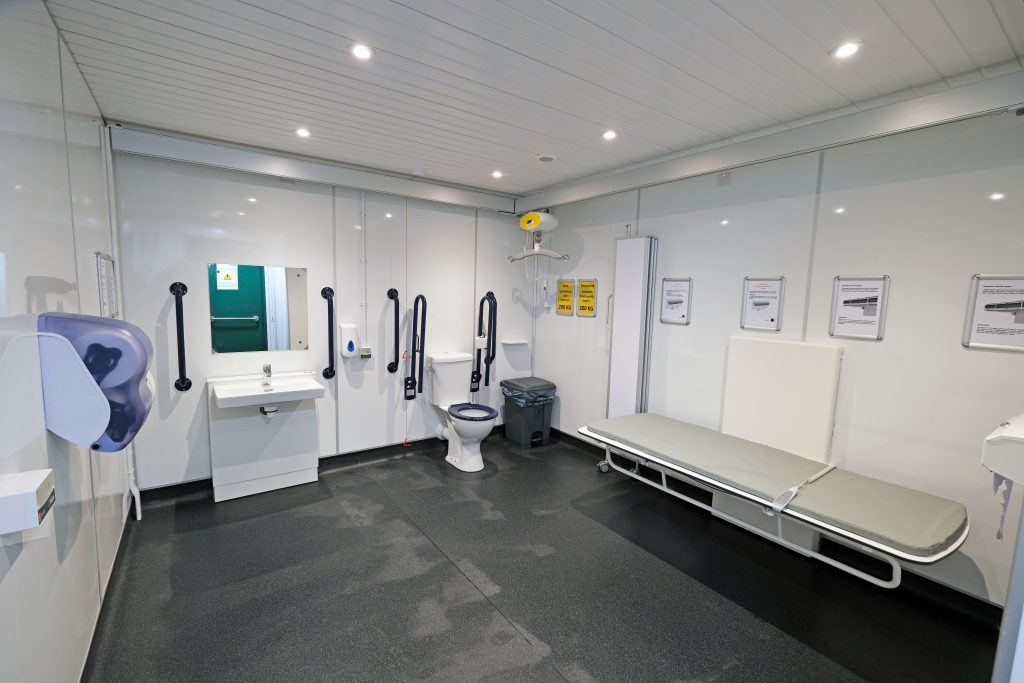
A Changing Place facility has more space and essential equipment including a height adjustable, adult-sized changing bench, a peninsular toilet, privacy screen and ceiling hoist.
Cabinet Member for Residents’ Services Cllr Rhys Sinnett said: “Many people, and especially adults, with disabilities cannot use standard accessible toilets because they require specialised equipment and extra space for themselves and their carers. This means inadequate toilet provision can often be a barrier for days out and limits opportunities to enjoy places in the same way as non-disabled individuals.

“The installation of a Changing Place facility at this location will ensure a fully inclusive opportunity is available for all. It will enhance and expand on the current offering for those persons with a disability at this designated easy access beach, which currently includes a standard accessible toilet and a beach wheelchair hire scheme in the summer.
“This is Pembrokeshire’s first beach-side Changing Place facility, we hope that if this is successful we can identify other areas which would benefit from such a development.”
Pembrokeshire Coast National Park Authority Beach Wheelchair and Outdoor Mobility Co-ordinator, Angela Robinson added: “The Changing Place facility is going to make a huge difference to the local community and tourism as we move forward in making the Pembrokeshire Coast more accessible for all.
“The new facilities are a welcome step in the right direction and complement the beach wheelchair and rollator, which are available to hire for free at Whitesands.”
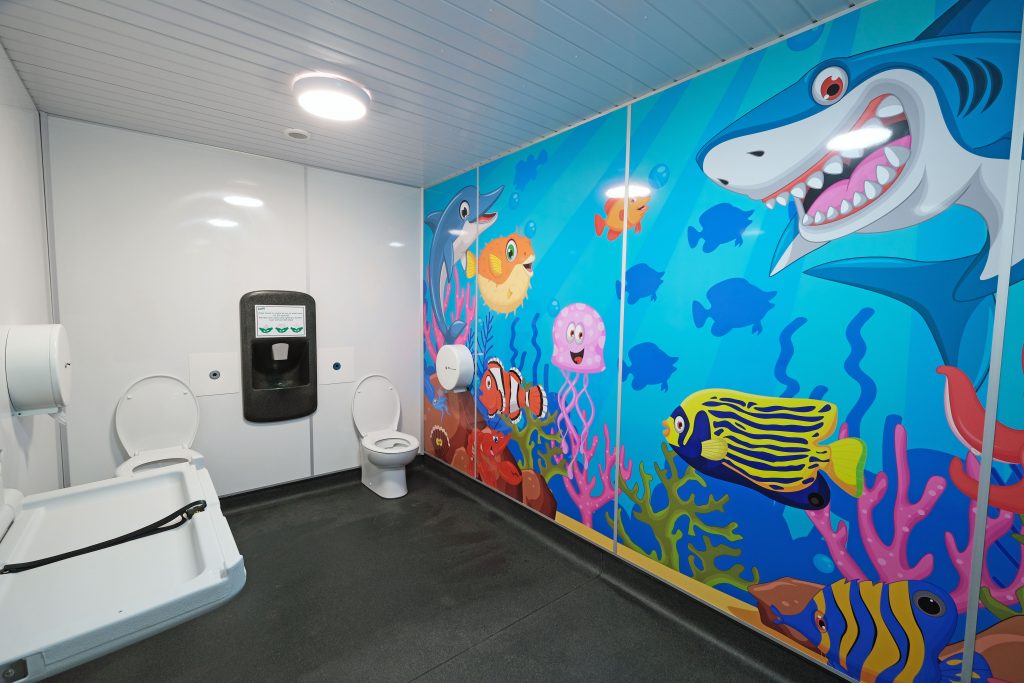
The Family Room is a first for Council owned or managed public convenience sites and recognises the difficulties families can experience using toilet facilities. The room provides a standard size toilet as well as a smaller one aimed at younger children, a baby changing unit and a large space to accommodation pushchairs.
The redesign and redevelopment of the existing building also includes enhancements to the interior and exterior and installation of a water refill station.
Access to the Changing Places toilets is available for those who require the use of this specialised equipment. A key card can be collected from Whitesands Beach House Café, the Car Parking Attendant on site or Oriel Y Parc Visitor Centre in St Davids, during operational hours.

The project has been part funded by the Welsh Government’s Brilliant Basics Fund 2022-2023 to improve the visitor experience across Wales and match funded by Pembrokeshire County Council.
Deputy Minister for Arts, Sport and Tourism, Dawn Bowden, said: “The projects supported through the Brilliant Basics fund make a real difference. Local tourism amenities have a big part to play in making a trip a memorable one. These facilities often go unnoticed, but they are an important part of a visitor’s experience and also benefit those who live in the area.”
More about beach wheelchairs and the other mobility equipment that is available to hire for free can be found online at Pembrokeshire Coast.


FIRST MINISTER Rhun ap Iorwerth has told European ambassadors that Wales is ready to play a stronger role in rebuilding relationships with the EU.
Speaking at Europe House in London yesterday, the First Minister addressed representatives to the UK from major EU nations, setting out his government’s ambition for closer cultural, economic and political co-operation with Europe.
The meeting came just a day after Mr ap Iorwerth made his first overseas visit as First Minister, travelling to Dublin on Wednesday.
In his speech, he described Wales as an “internationalist nation” and said the Welsh Government wanted to strengthen ties with European neighbours.
He said: “This Welsh Government is determined to take meaningful action to strengthen cultural and economic ties with our European neighbours.
“But we must have the tools to do this. That means a stronger Welsh voice in international engagement.”
Mr ap Iorwerth also repeated his support for a closer UK-EU relationship, saying Wales would continue to make the case for the UK to rejoin the Single Market and Customs Union.
He said doing so would “reduce friction, restore alignment and unlock the full potential of our shared economies.”
The First Minister said international engagement was already helping Welsh exports, inward investment and job creation, but added that Wales wanted to build further partnerships across Europe.
He also said the relationship with Europe was about more than trade.
“For generations, opportunities to live, study and work across Europe have shaped Welsh lives and broadened horizons,” he said.
“We are determined that the next generation will not be denied those opportunities.”

Mr ap Iorwerth said Wales was “full of national pride” while also being “confidently internationalist”.
He added: “We stand ready to work with you to deliver that future, together.”

A 19-YEAR-OLD man has admitted deliberately placing human faeces in a public swimming pool, causing it to close for cleaning.
Dyfed-Powys Police said officers investigated a series of alleged criminal damage incidents at Newcastle Emlyn Leisure Centre between November 2025 and May 2026.
The man, from the Cardigan area, was identified and interviewed by police.
During interview, he admitted deliberately placing the waste in the pool, which led to its closure while cleaning was carried out.
Police said the matter has been dealt with by way of an Adult Community Resolution and the investigation is now closed.

A FORMER Swansea Prison inmate died from combined drug toxicity just 48 hours after being released, an official investigation has found.
Jason Maynard, 43, left HMP Swansea on May 23, 2024. Two days later, he was pronounced dead by paramedics after being found unresponsive in the back of a friend’s car.
The Prisons and Probation Ombudsman report says Mr Maynard had been given overdose-reversal medication before leaving custody and warned about the heightened risk of overdose after a period of reduced drug tolerance.
After his release, he attended his first probation appointment and was placed in temporary hotel accommodation by Swansea Council.
The following day, police were called after concerns were raised that Mr Maynard had a cut above his eye and appeared incoherent. He refused hospital treatment and was taken to his mother’s home.
The report says he later used drugs and drank alcohol with friends. He then fell asleep in a car outside an address, where he was later found unresponsive.
Mr Maynard had missed a substance misuse appointment on May 24 but attended the service the next day. Staff noted he had “blue around his mouth”, which caused concern about possible drug use.
The Ombudsman found that prison, probation and support services had taken appropriate steps before and after his release.
Its findings said Mr Maynard had received suitable substance misuse support, had been referred for accommodation, and had licence conditions in place covering drug and alcohol use, engagement with services and drug testing.
The report concluded that the necessary referrals and support arrangements had been made, but Mr Maynard died later the same day he attended the community substance misuse service.



Community3 hours ago
Working-class young people ‘shut out’ of marine conservation careers in Wales
New study says marine conservation is becoming a “functionally middle-class” profession as barriers to entry grow A NEW report has...

News5 hours ago
Reform MS: ‘I felt like shouting get out of the water’
Paul Marr says children playing in streams at Pembrokeshire beaches deserve better protection from pollution risks REFORM UK MS Paul...


Health1 day ago
Senedd backs call to rule out hospital downgrades after heated NHS debate
Reform UK amendment passes as West Wales hospital fears remain central political issue THE SENEDD has backed a call for...

News1 day ago
Coastguard callout payments axe sparks fears for coastal communities
VOLUNTEER coastguards across the UK are set to lose callout payments, prompting concern over the future resilience of emergency cover...


Farming1 day ago
Rural Wales ‘left out’ of net zero debate, warns carbon entrepreneur
A WELSH carbon entrepreneur has warned that rural Wales risks being left behind in the national conversation about net zero....


Local Government2 days ago
Tenby Spectacular row continues as organisers say key question remains unanswered
Round Table says legal clarity over pedestrian access is still holding up event plan TENBY ROUND TABLE has welcomed Pembrokeshire...


Community3 days ago
Manorbier fire scandal: Council’s payout just £63,777 after school destroyed
PEMBROKESHIRE COUNTY COUNCIL has accepted an insurance settlement which leaves it with just £63,777.07 after the catastrophic fire which destroyed...


News3 days ago
Bus overturns in major incident near Kidwelly
All passengers rescued as emergency services remain at scene A BUS overturned on the A484 between Kidwelly and Ferryside on...


Community4 days ago
Tenby Summer Spectacular cancelled amid council row over harbour access
Organisers say popular charity events cannot safely go ahead without clear powers to control crowds TENBY ROUND TABLE has announced...


News4 days ago
Motorcyclist dies after four-vehicle crash on A40 in Carmarthenshire
A MOTORCYCLIST has died following a four-vehicle collision on the A40 between St Clears and Whitland. Dyfed-Powys Police said the...
-

 Health6 days ago
Woman jailed assaults on police, harassment and XL Bully possession
-

 Crime1 day ago
Police appeal after reported rape at Young Farmers rally
-

 Crime6 days ago
Milford Haven woman spared jail despite string of shop thefts
-

 Community5 days ago
The gentle giant behind the tattoos
-

 Crime6 days ago
Spittal man to stand trial accused of ABH
-

 Crime6 days ago
Carmarthenshire pensioner, 86, accused of causing prostitution for gain
-

 Entertainment5 days ago
Harbour Fest to bring music, food and maritime magic to Milford Waterfront
-
Health5 days ago
Welsh Government refuses to halt Withybush and Bronglais service review