


News
Cornerstone 4G phone mast unconditionally backed

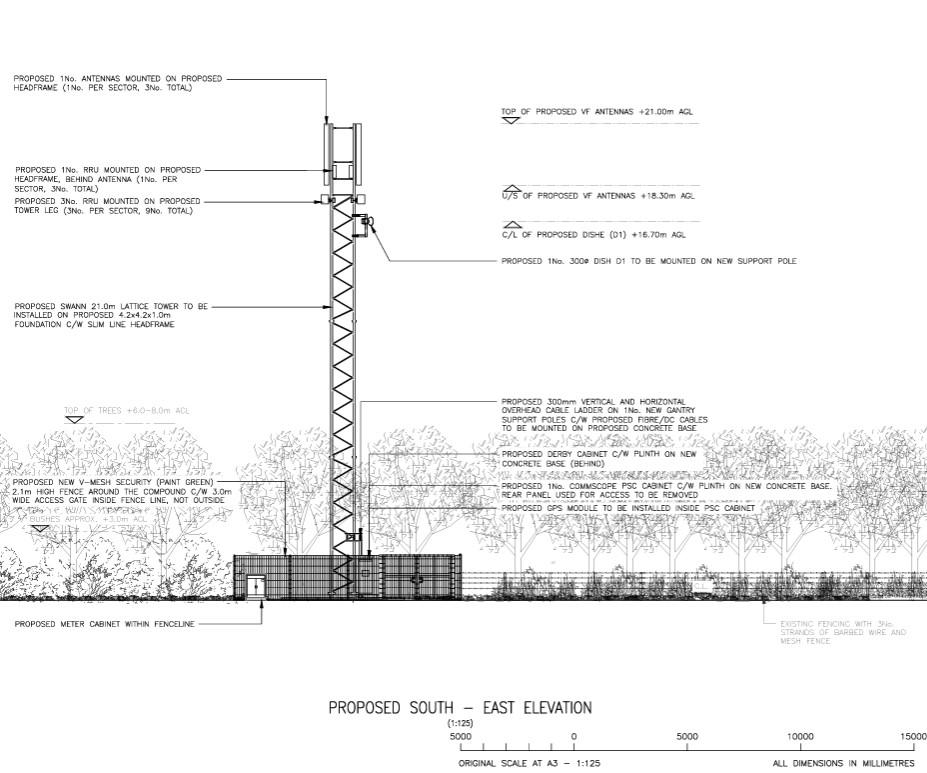
A NEAR 70-foot-high 4G telecommunications tower scheme in north Pembrokeshire has been unconditionally backed by county planners.
Applicant Cornerstone sought what – in planning terms – is called prior approval for the installation of a 21-metre lattice tower supporting three antennas and associated works on land at Castle Farm Villa, Llanreithan, Hayscastle.
A report for planners says the radio base station “would allow a shared rural network in this rural area of Hayscastle for two of the main operators, to provide 4G connection, which would provide a reliable and fast communications services; to facilitate significantly improved connectivity for residents, businesses and visitors to locality.”
The application was supported by local community council Brawdy.
Cornerstone, in a supporting statement, says: “To keep up with growing demand from mobile phone users we need to upgrade existing base stations or build new base stations. An upgrade can be done in a number of ways, often by redeveloping the site to enable an increase in the number of technologies, or increasing the number or height of the antennas. However, even after these upgrades, in some busy areas the demand for services can still exceed the capability of the local base stations.”

It adds: “We recognise that the growth in mobile communication has led, in some cases, to public concern about perceived health effects of mobile technology, in particular about siting masts close to local communities.
“Quite naturally, the public seeks reassurance that masts are not in any way harmful or dangerous. We are committed to providing the latest independent peer-reviewed research findings, information, advice and guidance from national and international agencies on radiofrequency (RF) electromagnetic fields.
“Cornerstone ensure that our radio base stations are designed and built so that the public are not exposed to radio frequency fields above the guidelines set by the International Commission on Non-Ionizing Radiation Protection (ICNIRP). In fact, radio base stations operate at low power and emit levels of radiofrequency fields many times lower than the ICNIRP general public guidelines.”
An officer report says a site visit was carried out to assess the impact of the proposed development, considering that the siting and design of the mast and associated structures would be acceptable.
“As such, the prior approval of the local planning authority is not required,” the report concluded.
Recent plans by Cornerstone for a 20-metre-high, timber-clad telecoms tower on land opposite the National Trust car park at Trehilyn West, Trefasser, near Goodwick, were turned down by Pembrokeshire Coast National Park planners.



A FREE woodland event in north Pembrokeshire will invite people to reconnect with the Welsh language, local landscape and cultural traditions through storytelling, creativity and time spent in nature.
Dod yn ôl at fy nghoed / To Return to My Trees will take place on Friday, July 17, from 10am to 4pm, at Canolfan Llwynihirion and Allt Tŷ Canol, near Brynberian.
The event is being hosted by Cwm Arian as part of the Preseli Woodlands Project and will be led by Welsh Druid, author and celebrant Deborah Rose Hālani.
Participants will spend time in the ancient woodland of Allt Tŷ Canol, exploring how Welsh language, landscape, folklore and local traditions have shaped one another over generations.
Organisers say the day is open to everyone, including those reconnecting with their own heritage, people learning about Welsh culture for the first time, or anyone who wants to build a deeper connection with the place they call home.
Sophie Jenkins, Outreach and Engagement Coordinator at Cwm Arian Renewable Energy, said: “Conservation isn’t only about protecting species and habitats. It’s also about nurturing our relationship with the places we live.
“The Welsh language, our stories and our landscapes have evolved together over centuries, yet many people feel disconnected from one or all of those things.
“Whether someone is rediscovering a part of their own heritage or beginning a relationship with Cymru for the first time, we hope this day creates space to connect more deeply with the land, with culture and with community.”
The Preseli Woodlands Project brings together nature restoration and cultural heritage through activities designed to help people experience, understand and care for Pembrokeshire’s woodland heritage.
The project is a partnership between Cwm Arian Renewable Energy, the South and West Wales Wildlife Trust and Pembrokeshire Coast National Park Authority.
It is funded through the Welsh Government’s National Forest for Wales Landscape Scheme 2025–2027 and administered by WCVA.
The event is free, but places are limited and advance booking is essential.

To book, email [email protected].
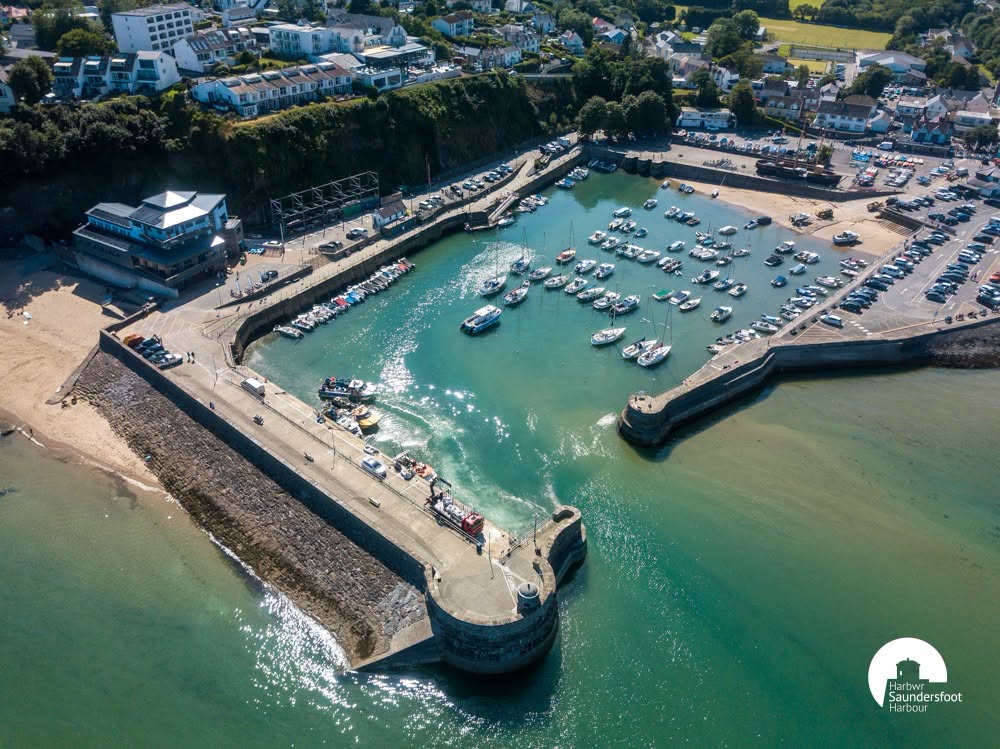
SAUNDERSFOOT HARBOUR’S redevelopment has been named Best Project at the RTPI Cymru Awards for Planning Excellence 2026.
The award recognises Phase 2 of the Saundersfoot Harbour Redevelopment Project, which has helped transform the harbour into a year-round destination with new commercial, community and visitor facilities.
Delivered by Saundersfoot Harbour, with planning input from Pembrokeshire Coast National Park Authority, the project was praised by judges as “an exemplar for coastal economic resilience in smaller settlements” and “a very good example of planning enabling place-based regeneration.”
Judges highlighted the scheme’s economic and community benefits, including investment, job creation, new local business space, improved public access, year-round activity, major events, and the reuse of brownfield and heritage assets.
They also recognised the role of planners in dealing with design changes, conservation area issues, flood risk, accessibility, and the coordination of several linked schemes within a working harbour.
Sara Morris, Director of Place and Engagement at Pembrokeshire Coast National Park Authority, said the award was a testament to the value of good planning.
She said: “We are delighted that Phase 2 of the Saundersfoot Harbour Redevelopment Project has been recognised by RTPI Cymru.
“This award is a real testament to the value of good planning in helping places adapt, thrive and deliver lasting benefits for their communities.
“Saundersfoot Harbour is a hugely important location, both locally and strategically, and this project shows how careful planning can support regeneration while respecting the character, heritage and environmental challenges of a coastal setting.
“I would particularly like to thank Andrew Richards and Nicola Gandy, who both led on the planning aspects of the project for the Authority.
“The judges’ comments underline the strength of the partnership approach behind the project, and we are very pleased to see the work of our planning team recognised alongside Saundersfoot Harbour’s ambition and commitment.”
Ted Sangster, Chairman of Saundersfoot Harbour Commission, congratulated the National Park Authority on the award.

He said: “As a trust port, we operate very much as a commercial business but with no shareholders and therefore no dividends to pay. Our strategy is to provide real, long-term benefit for our community and all users of the harbour.
“The successful Phase 2 of the harbour development now provides both an active fishing and recreational sailing harbour and a year-round visitor attraction serving an increasingly diverse range of users, and has created around 100 new jobs so far.
“Our work with local businesses and stakeholders has been greatly assisted by the open and consultative partnership with the National Park, which is based on the shared aim of sustainable economic delivery and social benefit to our community.”
As winner of the Best Project category in Wales, the Saundersfoot Harbour project will now be automatically entered as a finalist in the UK National Awards for Planning Excellence.
The national finalists are due to be announced by the RTPI on October 7, ahead of the UK national finals on December 3.
The National Park Authority also welcomed recognition for the Dark Skies Guidance for Wales, which won the Chair’s Award at the RTPI Cymru Awards.
The guidance was developed by a working group from across Wales, including the Authority’s Principal Planning Officer for Strategic Policy, Gayle Lister.
Sara Morris added: “It is particularly pleasing to see the Dark Skies Guidance for Wales recognised alongside the Saundersfoot Harbour project.
“Protecting dark skies is an important part of caring for the special qualities of Wales’ landscapes, and this guidance reflects the value of collaboration across planning, conservation and environmental disciplines.”
The RTPI Cymru Awards for Planning Excellence celebrate outstanding plans, projects and people that demonstrate the power of planning to make a positive difference to places and communities.

Engineering, fintech and beauty brands feature in national growth rankings
THREE Welsh businesses have been named among Britain’s 100 fastest-growing companies, highlighting the growing diversity of Wales’ scale-up economy.
Avantis Group, an engineering business delivering marine and offshore energy upgrade projects, was the highest-ranked Welsh company in the ORESA Executive Search Growth Index 2026.
The company placed 43rd nationally after achieving two-year compound annual revenue growth of 105.9%.
It was joined on the list by fintech firm ANNA Money, ranked 56th, and fast-growing beauty brand Hair Syrup, ranked 67th.
Orlando Martins, founder of Growth Index, said the results showed the strength and breadth of Wales’ business community.
He said: “Wales continues to produce ambitious companies across a wide range of sectors.
“What is particularly encouraging is the range of businesses, both in the top 100 and among the companies that narrowly missed out, from engineering and fintech to consumer brands.”
Now in its fifth year, the ORESA Executive Search Growth Index ranks the 100 fastest-growing companies in the UK.
This year’s list points to the resilience of Britain’s scale-up economy, with the average company achieving compound annual revenue growth of 136.1% over two years.
Together, the Growth Index 100 generated more than £11 billion in annual revenues, with businesses on the list ranging from data centres and art galleries to GB News and Popeyes UK.
Financial services remained the largest sector represented, accounting for a quarter of all companies featured.
Healthcare also continued to rise, helped by strong performances from biotechnology businesses, while retail enjoyed a resurgence after several more difficult years.

The report also notes that pure-play AI businesses are beginning to make a visible impact on the rankings, although they have not yet come to dominate the list.
The Growth Index is compiled through independent analysis of Companies House data. Growth is measured by two-year compound annual growth rate in revenues, with companies required to have a minimum base-year turnover of £100,000 and a minimum final-year turnover of £5 million.



Community7 hours ago
Saundersfoot Harbour regeneration project wins national planning award
SAUNDERSFOOT HARBOUR’S redevelopment has been named Best Project at the RTPI Cymru Awards for Planning Excellence 2026. The award recognises...


Business13 hours ago
Pembrokeshire-based Ascona Group expands UK portfolio with Truckhaven acquisition
PEMBROKESHIRE-BASED Ascona Group has completed the acquisition of Truckhaven (Carnforth) Ltd, a major trunk road services area in Lancashire. The...


Health2 days ago
Wales begins early NHS winter planning after long waits and ambulance pressure
Ministers say health boards and councils must act now to ease pressure on hospitals, ambulances and social care before winter...


Crime3 days ago
Judge calls pensioner a ‘dirty old man’ as he avoids jail for exposing himself to women
Judge says 75-year-old Stewart Laugharne behaved ‘disgracefully’ as he avoids jail but is ordered to sign sex offenders register A...
Health3 days ago
Stroke services consultation reaches halfway point as public urged to have say
HYWEL DDA University Health Board is urging people to take part in its consultation on the future of stroke services,...


Business3 days ago
Welsh firms eye share of £5bn defence drone boom
WELSH defence and aerospace firms could be in line for a share of billions of pounds in new military spending...


Community5 days ago
Thousands line Cardigan streets for Lord Rhys homecoming parade
THOUSANDS of people lined the streets and quayside in Cardigan on Saturday as the town marked 850 years since Lord...


Crime6 days ago
Dyfed-Powys Police rated only ‘Adequate’ in organised crime inspection
A WATCHDOG has rated Dyfed-Powys Police only “Adequate” in its response to serious and organised crime, despite praise for the...


News6 days ago
Two taken to hospital after aircraft ditches in Cardigan Bay
Coastguard helicopter spotted two casualties after light aircraft came down off west Wales coast TWO people were taken to hospital...


Sport6 days ago
Long Course Weekend gets underway in Tenby as thousands head for county
Three days of swimming, cycling and running begin with The Wales Swim at North Beach THOUSANDS of athletes and supporters...
-
Crime6 days ago
Dyfed-Powys Police rated only ‘Adequate’ in organised crime inspection
-

 Entertainment7 days ago
Torch cuts children’s cinema tickets to £5.25 for summer
-

 News4 days ago
Biker dies and woman seriously injured in Black Mountain crash
-

 Climate7 days ago
Welsh waters, Westminster profits: Crown Estate row reignited in Wales
-
 News7 days ago
Reform MS: ‘I felt like shouting get out of the water’
-

 Crime7 days ago
Former Swansea Prison inmate died 48 hours after release
-
 Crime6 days ago
Swansea man jailed for 16 years after attacking vulnerable woman
-
 Community7 days ago
Working-class young people ‘shut out’ of marine conservation careers in Wales