


News
Tenby talks: did Adams listen?



AT a meeting in the mayor’s parlour on Tuesday, May 27, IPPG Leader Jamie Adams responded to an invitation to meet with Town Councillors and respond to their concerns about the conduct of business at County Hall.
Expressing concern about the services being delivered to Tenby, Cllr Christine Brown told the meeting: “People in Tenby feel that they are not getting the service they should from Pembrokeshire County Council because of the stories they are hearing in the media. Is it right when services are being cut that the local authority is paying for a top barrister to defend its actions over the Chief Executive’s pension? “We give YOU the money – each person who pays tax – and it is being used wrongly in my opinion!” she added. Seeking to mollify the Town Councillors, IPPG leader Jamie Adams gave a remarkable account of the pension fiasco: “In terms of the Authority’s position, we were challenged by the Welsh Audit Office about process. The Auditor had a different view to us after they had taken legal advice, and when the Public Interest Report had been published there was an exchange of legal views. “The Council did not want to be standing accused without checking its legal position. The Audit Office said they didn’t mind that” he told councillors. Going on and not mentioning that the County Council had conceded that its actions were unlawful, the IPPG leader suggested: “The Local Government Act 1972 is clear on the responsibilities which officers and members have, and the Auditor’s interpretation of that law is now different.” Cllr Christine Brown responded to the IPPG leader: “What we all have in our hearts is the standards of our town. They need to be as high as we can make them. We are been drip fed comments and cuts, and this is affecting us badly.” Cllr Brown added: “This all stemmed from us having no warning of cuts. Pembrokeshire County Council is seen as a failing authority. You can read it in the press, and you can watch it on TV. Tenby is the premier town for tourism, and we see no future at the moment. Why PCC decided to side automatically with the CEO strikes me as incredible. “ Jamie Adams said: “The pension scheme was never about individuals, we have 30 senior staff. There was a police consideration to evaluate any wrong doing by any person, it terms of process – it was not the best in terms of the way that it was undertaken.” Pension decision was ‘clumsy and clunky’ Jamie Adams said that members of the Town Council just needed “a little bit of understanding” and that this would be “useful” to members in appreciating how the decision was made. Councillor Adams then repeated the discredited tale he had told County Councillors about the unlawful payments scheme being concocted as the Council had found it too difficult to recruit senior officers and that three prospective appointees had not reported to their posts because packages had not been competitive enough. He added: “I admit that it was a clunky and clumsy decision. Hindsight is a great thing and in the future we will do things differently.” He tried to placate councillors by saying: “I have no intention of implementing the pension scheme again in the future.” Move forward ‘as one team’ Jamie Adams continued: “What worries me is that there now seems to be more focus on process than on the delivery of services to the people of Pembrokeshire. When people see one side of decisions, and money spent to defend decisions people see that it is linked [that services could be cut because of them].” Astonishingly, a less than contrite Cllr Adams then appeared to fix the blame for the scandals engulfing the Council as the responsibility of those Councillors and others trying to pierce the veil of secrecy at County Hall to investigate them: “The [pensions] matter could have been dealt with sooner, but it has suited some people to drag it on. Our focus should be on services. This and other matters have been a distraction.” Continuing to claim that the ends justify the means, the IPPG leader continued: “My focus is on outcomes above process. I communicate this with great regularity. Some members are more focussed on process than on the people of this county. I’d like to see the council move forward as one team without internal strife.” ‘Killing the goose’ Referring to the Council’s cut to gardening services and its effect on Wales in Bloom, Mayor of Tenby, Cllr Sue Lane said: “At times we get the perception that we are an annoying distraction and not a full partner in the delivery of services. The local authority could work more effectively with us. We have worked together but the cuts were a bolt from the blue. We are not privy to everything that was happening. “Revenue from Tenby is vital to the county and we can’t let standards drop. We are not getting the real deal at the moment” Jamie Adams responded by suggesting that after cutting the service he wished to shuffle its burden onto others: “I am aware of the impact of Wales in Bloom. This Authority is struggling with watering flowers and we should engage with community partners to help with this work, or change the plants.” Cllr Mike Evans said “The slashing, slashing, slashing is now killing the goose that lays the golden egg. Cllr Christine Brown asked why Pembrokeshire County Council wants to have the lowest council tax in Wales, but then struggles to pay for services. To this question Cllr Adams said that people were struggling and could not afford higher taxes, adding: “If this challenge of finances is about anything it’s about making the Authority fit for purpose.” Councillor Adams’ appearance before Tenby’s Town Council follows hot on the heels of the vote of no confidence in the County Council by Pembroke’s Town Council reported in last week’s Pembrokeshire Herald and the strongly-worded letter sent to the IPPG leader by Solva Community Council, which stated that the County Council was bringing the whole of local government in Pembrokeshire into disrepute. Dissatisfaction with the County Council has been caused by a series of revelations about the way in which the IPPG-led authority has continued to insulate its highest paid officers from the effects of deep cuts in budgets – including funding a luxury German sports saloon for its CEO – while effecting deep cuts in services to the general public and to the wages of its lowest paid employees. The IPPG leader’s eagerness to rewrite history also appears to have permeated into the officer cadre at County Hall, with European Manager Gwyn Evans disciplined for doctoring reports of meetings of a grants panel. The question that has to be asked is which town or community council will be next to express its own concerns about the effect IPPG governance is having on the County.

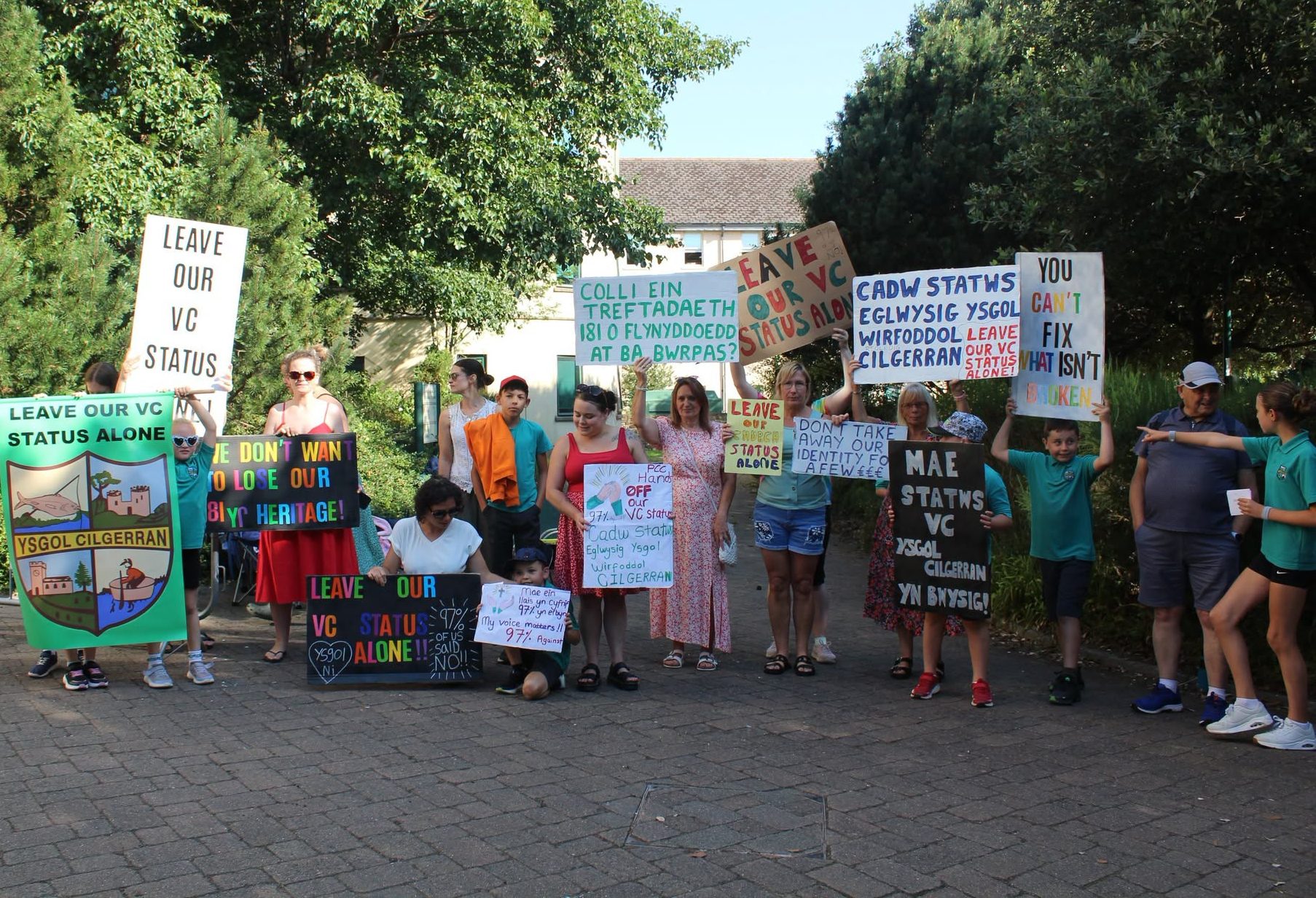
Year 6 pupil says the school’s 180-year connection with the Church should be celebrated, as the Church in Wales warns legal action could follow
PUPILS, parents and governors have spoken out against plans to remove the Church in Wales status of Ysgol Cilgerran.
The Church in Wales has released a series of videos featuring members of the school community as opposition continues to Pembrokeshire County Council’s decision to change the Welsh-medium primary school from a Voluntary Controlled school to a community school.
In one of the videos, Year 6 pupil Ffion makes a direct appeal for the school’s historic identity to be protected.
She said: “We have a strong connection between the school and the church, and that’s something to celebrate, not take away.”
Ffion added that supporters would continue campaigning against the change, saying: “We’re still fighting and we won’t stop.”

Parent and chair of governors Kelly Davies has also explained why retaining the school’s Voluntary Controlled status matters to her family and the wider Cilgerran community.
Former pupil and safeguarding governor Sarah Moore made a further appeal outside Pembrokeshire County Hall, calling for the school to be allowed to retain its identity.
Ysgol Cilgerran was founded by the Church and has served the community for more than 180 years.
Pembrokeshire County Council voted in May to proceed with the statutory process of discontinuing the existing Voluntary Controlled school and establishing a community school on the same site.

The proposal attracted overwhelming opposition during the consultation process.
Of the 203 responses received, 197 objected to the change, representing 97% of those who took part. Just three respondents supported the proposal.
The council has argued that changing the school’s status would improve its long-term resilience and make it possible for Ysgol Cilgerran to federate with neighbouring community schools should that become necessary in the future.

It has said there is currently no proposal to federate the school, replace its leadership or alter its Welsh-medium provision.
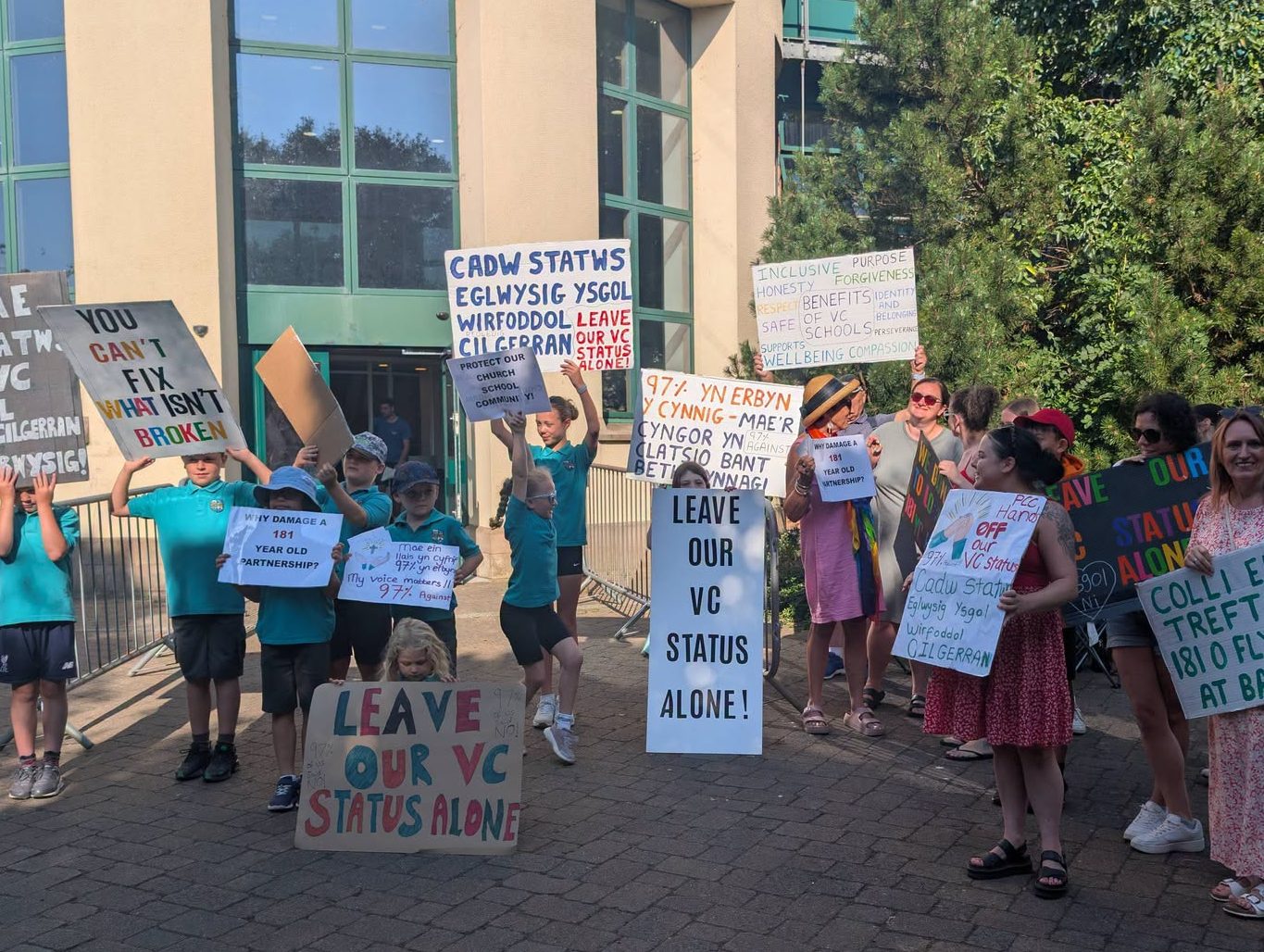
However, the Church in Wales has described the move as a “gratuitous attack” on faith education and has warned that legal action could follow if the council proceeds.
The Church also disputes the council’s position regarding the school site, part of which is Church-owned, and has indicated that the land would not automatically be made available for a successor community school.
Campaigners say Ysgol Cilgerran is a thriving school and that its Church status remains an important part of its history, character and relationship with the local community.

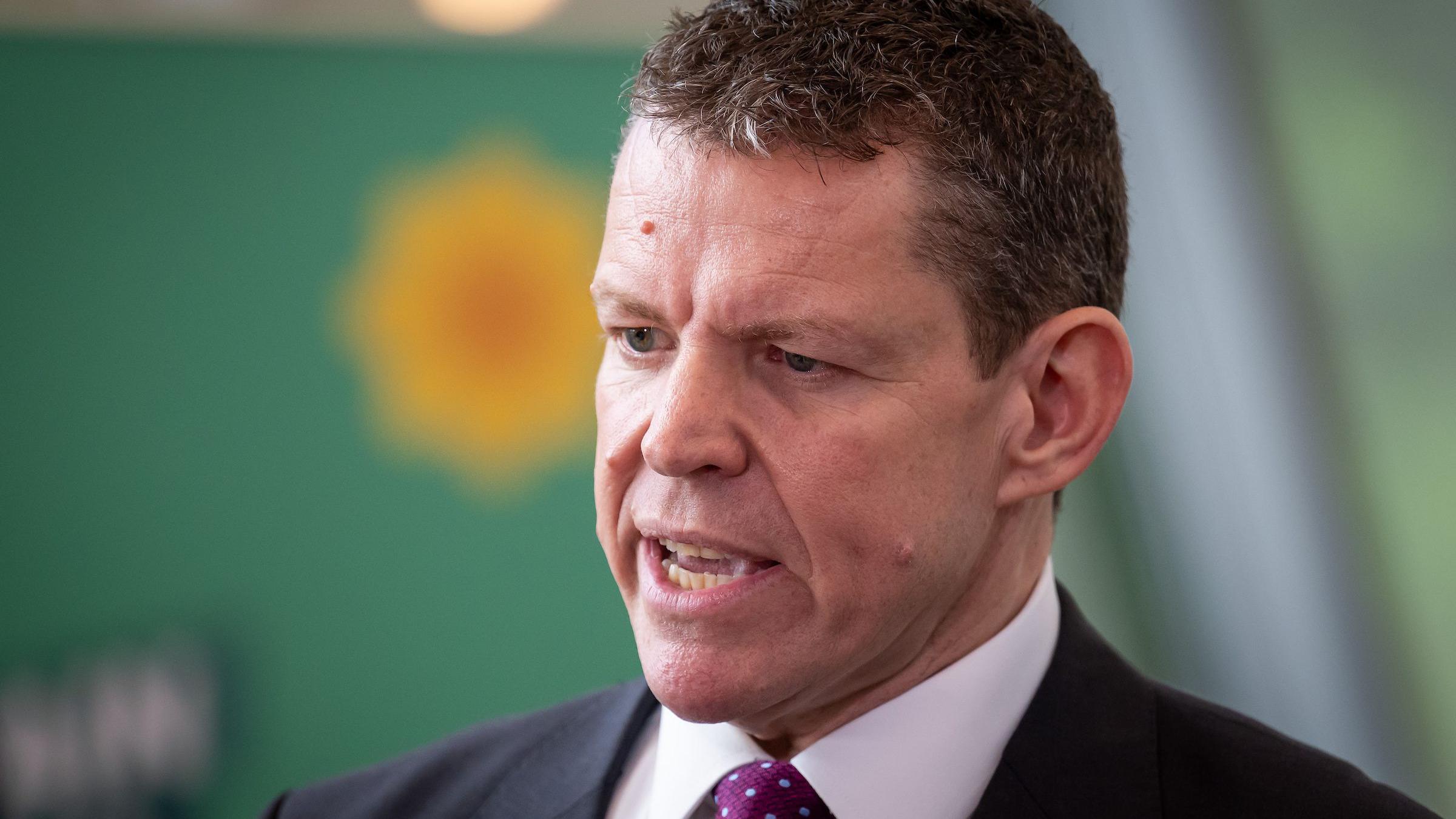
Labour, Reform UK, the Conservatives and Liberal Democrats unite against Plaid Cymru after row over additional learning needs funding
THE NEW Plaid Cymru government faced its first major political defeat on Tuesday when its supplementary budget was rejected by the Senedd.
Labour voted alongside Reform UK, the Welsh Conservatives and the Liberal Democrats against the government following a row over spending for children with additional learning needs (ALN).
The supplementary budget was published in late June and included almost £300 million of additional funding. It would have allocated an extra £145 million to NHS Wales, £40 million to improve school buildings and £20 million to increase the stock of social housing.
However, the government does not have a majority of MSs in the Senedd. This meant that, to pass the budget, Plaid Cymru needed to secure support from other parties. Although it gained the backing of the two Green MSs, this was not enough when the vote took place on Tuesday.
The government lost the vote by 49 votes to 44.
Welsh Conservative leader Darren Millar called it “bonkers” to bring the budget to a vote without securing the necessary support, knowing that the Senedd was likely to reject the proposals.
The Welsh Conservatives, Welsh Labour, the Liberal Democrats and Reform UK all voted together to defeat the budget.
It was the first Welsh government budget, supplementary or otherwise, to be voted down in the history of the Senedd, showing just how divided Welsh politics has become.
So why did this happen?
Most importantly, Labour had demanded that an extra £100 million be spent on ALN by next April.
The party claimed the money could have come from £340 million allocated to Wales following increased UK Government spending on special educational needs and disabilities in England.
However, Plaid Cymru failed to meet these demands in full, offering an extra £40 million this year and proposing to increase funding by the same amount over the following two years.
If maintained, this would have resulted in £120 million of additional funding over three years, £20 million more than Labour was asking for, but spread across a longer period.

Labour was not satisfied with this offer and voted against the budget, securing its defeat and refusing to support Plaid Cymru’s proposed compromise.
New Welsh Labour leader Ken Skates had urged Plaid Cymru to withdraw the budget and bring it back during the summer recess once a deal had been agreed.
Mr Skates defended Labour’s decision to vote against the package, saying: “What Plaid were asking for was for us to compromise on what’s best for children.”
A joint statement from Welsh Labour local authority leaders also criticised the Welsh Government for implying that there would be no additional funding for ALN if the budget was not passed.
That was the message First Minister Rhun ap Iorwerth appeared to give on Tuesday when he said the Welsh Government’s proposed funding for ALN “would not be possible” if the budget was voted down.
Labour warned that this would have “real consequences” for some of the most vulnerable young people in Wales.
The government has also faced criticism from the NAHT and ASCL teaching unions, which have launched a trade dispute over dissatisfaction with a proposed teacher pay award and what they described as a “failure to adequately fund schools” dealing with increasing numbers of pupils with ALN.
However, by voting down the budget, opposition parties have rejected Plaid Cymru’s compromise and potentially delayed any agreement until the autumn, increasing the pressure already faced by schools.
Although existing ALN funding has not been paused, progress towards increasing it has now been significantly delayed.
The defeat also means that the wider NHS and education funding package, which Mr Skates had described as “welcome”, will not be passed in its current form because the measures were presented as one complete supplementary budget.
This means that the row over ALN has also had a knock-on effect on proposed funding for the NHS, school buildings and social housing.
In response to the defeat, the Welsh Government told The Pembrokeshire Herald that it was “committed to supporting children and young people with additional learning needs”.
It defended its position by arguing that the funding allocated to Wales following the UK Government’s SEND spending decisions was intended to help write off historic local authority debts relating to ALN, rather than pay directly for services.
Plaid Cymru’s Finance Minister, Elin Jones, accused Labour of acting as a “destructive opposition” by refusing to vote the budget through.
However, the government restated its commitment to developing a “sustainable, long-term solution” for ALN.
Details of what this package might look like remain unclear, particularly given the increased pressure on Plaid Cymru to secure the support of other parties.
The Senedd’s sole Liberal Democrat MS, Jane Dodds, also voted against the budget.
She said the proposals failed to meet her demands for increased funding for healthcare in Powys hospitals and for patients receiving treatment across the border in England.
Reform UK also voted against the supplementary budget because it failed to meet the party’s red lines, according to spokesperson Cai Parry-Jones.
These included stopping overseas spending, guaranteeing jobs for all newly qualified student nurses and midwives, and making further commitments on ALN funding.
Reform’s Welsh leader used the defeat as an opportunity to declare that “Plaid Cymru cannot govern this country”.
This was Reform UK’s first major opportunity to demonstrate its new influence in the Senedd as the second-largest party, and it did so during an historic vote.
It was the first time a Welsh government budget had been rejected by the Senedd, only months after a century of Welsh Labour dominance was brought to an end.
What happens next?
What happens next remains unclear.
If an agreement can be reached, the Senedd could return during the summer recess to vote on a revised budget.
However, it may not be until the autumn that a workable funding package is agreed.
This means that additional ALN funding will not arrive for the time being, while the wider spending promised for the NHS, schools and housing will also be delayed.
All opposition parties have criticised the Welsh Government for failing to properly engage with them and negotiate a deal before bringing the budget to a vote.
Given the historic nature of Tuesday’s defeat, it is clear that something went wrong in the operation of the new government.
That is why the First Minister has promised an “even more cooperative approach”, something that will be essential if Plaid Cymru is to deliver the change it promised the people of Wales in May.

Council commits a further £2m after 18 households helped to buy homes during first year
A SCHEME aimed at helping local people buy homes in Pembrokeshire has been extended following what the council described as a successful 12-month pilot.
Pembrokeshire County Council’s Cabinet unanimously agreed to continue and expand Homebuy Pembrokeshire, which offers eligible buyers an equity loan to bridge the gap between the mortgage they can secure and the cost of a suitable property.
The scheme was launched in June 2025 with £1m raised through the Second Homes Council Tax Premium.
It had initially been expected to support up to 15 households during its first year, but ultimately helped 18 households purchase properties across the county.
A total of £814,000 was invested through the pilot.
Applicants must demonstrate a local connection to Pembrokeshire, meet income and property criteria, and show they can afford the ongoing financial commitments associated with owning a home.
The scheme is primarily intended to help first-time buyers who have savings and can obtain a mortgage, but are unable to afford a suitable property in the area where they live or have established local ties.
Cabinet Member for Housing, Cllr Michelle Bateman, said: “Homebuy Pembrokeshire has provided an important opportunity for local buyers to access suitable homes that meet their needs.
“The scheme has made a positive difference to households across the county and supports the council’s wider commitment to increasing housing choice and improving access to affordable housing.”
Following Cabinet approval, the programme will continue with a number of changes intended to reflect current mortgage lending and housing market conditions.
A further £2m has been approved for the scheme over the next two years, subject to satisfactory delivery.
Cllr Bateman added: “This is a clear demonstration of how income generated through the Second Homes Council Tax Premium can be used to support housing opportunities in Pembrokeshire.

“Homebuy Pembrokeshire helps people who have savings and access to mortgage finance, but who are unable to secure a suitable home because of challenging market conditions.”
One household supported through the scheme said: “Using the scheme to purchase a property has massively helped my family, as we have been able to own a property as well as creating a space for us to grow.”
Further information is available from Pembrokeshire County Council’s housing team by emailing [email protected] or calling 01437 764551.



Crime3 hours ago
Milford Haven teacher ‘fought for her life’ during alleged knife attack
Crown says teenage pupil planned classroom assault and intended to kill, as attempted murder trial reaches closing speeches LIVE FROM...


News3 hours ago
Andy Burnham becomes Labour leader and prepares to enter No 10
Former Greater Manchester mayor promises an ‘unashamedly Labour’ government after completing extraordinary return to Westminster ANDY BURNHAM has been formally...


News4 hours ago
Motorcyclist dies following collision near Narberth
Police appeal for witnesses and footage after fatal crash on B4313 at Redstone A MOTORCYCLIST has died following a collision...


Local Government1 day ago
Stepaside school saved as council abandons closure proposal
Governors welcome decision but maintain original plans were based on outdated information STEPASIDE Community Primary School will remain open after...

Crime1 day ago
Footballer given 200 hours’ unpaid work for eye-gouging assault during match
Magistrates heard Robert Hedley put an opposing player in a headlock before gouging at his eyes during a match in...


Community1 day ago
Tenby Summer Spectaculars brought to an end after harbour licence revoked
Round Table says it was willing to make major safety changes but could not secure the access controls needed to...

Local Government3 days ago
Catapult attacks suspected after wildlife deaths at Pembroke Mill Pond
Wildlife Crime Officers are investigating after the town council said around five animals showed signs of deliberate injury WILDLIFE found...


Crime3 days ago
Narberth retailer speaks of shoplifting toll after ‘collectable bear’ stolen
Independent shop owner said rising costs meant businesses could not afford to absorb losses caused by theft A NARBERTH retailer...


Crime3 days ago
Teen accused of attempting to murder teacher says she lied about stabbing
Defendant accepts teacher was terrified and that a knife wound to the head could kill, but denies deliberately attacking her...


Local Government5 days ago
Calls grow for independent investigation into Manorbier school closure
Councillor alleges misleading figures, inadequate insurance and poor treatment of staff CALLS for an independent investigation into the controversial closure...
-

 News7 days ago
Milford Haven Coastguard coordinates rescue of injured paddleboarder
-

 Crime3 days ago
Letterston footballer guilty of eye-gouging assault during match
-

 Crime7 days ago
Ann Widdecombe: Welsh politicians pay tribute as murder probe launched
-
 Business3 days ago
Former St Davids GP surgery to holiday let and home conversion conditionally approved
-

 Education7 days ago
Saundersfoot graduate secures teaching job before completing degree
-
 Education6 days ago
Welsh Government under fire to spend extra £340m on ALN
-
Community4 days ago
Call for investigation into Manorbier school closure as councillor seeks apology
-
 Climate6 days ago
Minister denies plan to cut livestock numbers over ‘left-wing ideological climate targets’
DavidTwera
March 12, 2026 at 12:08 pm
Contemporary consumers are finding that CBD [url=https://www.cornbreadhemp.com/pages/store-locator ]cbd shop near me[/url] can seamlessly fit into a daily wellness practice. Whether added into morning coffee or taken as an after-dark capsule, cannabidiol molds to personal lifestyles. Its soft interaction with the endocannabinoid system helps the body preserve internal equilibrium. Multitudes worldwide now see it an indispensable part of their self-care toolkit.