


Business
Homebase enters administration, putting 2,000 jobs at risk


HOMEBASE, the beleaguered home improvement chain with stores in Haverfordwest and Bridgend, has collapsed into administration, placing 2,000 jobs in jeopardy. The company has struggled with rising costs and shifting consumer demand, which led to the closure of other Welsh stores in Newport, Brecon, Mold, and Cardiff in recent years.
Hilco, Homebase’s owner, had been attempting to sell the struggling retailer but failed to secure a complete buyer. The owner of The Range, CDS Superstores, has agreed to acquire up to 70 Homebase locations along with the brand itself, protecting approximately 1,600 jobs. However, this deal leaves 49 stores without a buyer, with thousands of additional jobs at risk in stores and at the head office. Teneo, the appointed administrators, declined to specify which locations face potential closure.
For now, the 49 stores will continue trading as Teneo seeks a buyer, with no immediate redundancies planned. In the new arrangement, CDS Superstores has acquired Homebase’s brand name and intellectual property, ensuring the Homebase brand will persist online, while physical stores will convert to The Range.
Damian McGloughlin, CEO of Homebase, described the past three years as “incredibly challenging” for the DIY sector. He cited the downturn in consumer spending following the pandemic, persistent inflation, global supply chain disruptions, and unusual weather patterns as factors that impacted Homebase’s performance. Despite restructuring and investment efforts, the business has not been able to turn its fortunes around.
Teneo joint administrator Gavin Maher acknowledged the uncertainty this announcement brings, urging any interested buyers for the remaining stores to make contact.

The current administration marks the end of a troubled chapter for Homebase, which Hilco bought for £1 in 2018 after Wesfarmers, its previous owner, admitted to several strategic missteps, including underestimating winter demand and cutting popular product lines. Homebase reported an £84.2 million loss last year, highlighting its continued financial struggle amid competition from budget-friendly rivals such as B&M and Home Bargains, which have thrived in the value-driven market.
Homebase was founded in 1979 by Sainsbury’s and the Belgian-owned department store chain GB-inno-BM. Over the years, it expanded rapidly, absorbing the Texas Homecare chain in the 1990s before changing hands several times in the 2000s.


WELSH defence and aerospace firms could be in line for a share of billions of pounds in new military spending after the UK Government published its long-delayed Defence Investment Plan.
The plan, announced on Tuesday, sets out how the Ministry of Defence will spend almost £300bn over the next four years, including an extra £15bn above the previous settlement.
Prime Minister Sir Keir Starmer said the investment would transform the Armed Forces, strengthen national security and support more than half a million defence-related jobs across the UK by the end of the decade.
But for Wales, the key question is whether the new money will translate into real contracts, skilled jobs and apprenticeships for Welsh companies, or whether the bulk of the spending will be concentrated elsewhere.
At the centre of the plan is a major shift towards drones, artificial intelligence, autonomous weapons and faster battlefield technology.
The Ministry of Defence says more than £5bn will be spent over the next four years on a “drone transformation” for the Armed Forces.
That includes £650m for inexpensive expendable autonomous systems, including drones and uncrewed ground vehicles, to increase the lethality of the Army, Commando Force and Special Forces.
The plan also includes nearly £2bn for a new Digital Targeting Web, designed to connect the Armed Forces more effectively and allow faster decisions on the battlefield.
A further £790m will be spent on protecting the UK and overseas bases from air, drone and missile threats, including new radars, sensors, directed energy weapons and expanded counter-drone systems.
The Government has also committed £11bn to munitions and weapons, including long-range strike weapons, low-cost cruise missiles and one-way effectors. Ministers say at least six new energetics factories will be built by 2030 to increase the UK’s capacity to produce munitions.
For Wales, those commitments are significant because the country already has a sizeable aerospace and defence sector, as well as a specific UK Government-backed plan to grow its role in autonomous systems.
Earlier this year, the UK Government announced a £50m Wales Defence Growth Deal, designed to make Wales a launchpad for next-generation autonomous technology.

That deal was presented as an opportunity to support high-skilled roles and strengthen Wales’ position in areas such as surveillance drones, autonomous systems, cyber security, advanced manufacturing and defence research.
The Defence Investment Plan now becomes the first major test of whether those ambitions are backed by procurement decisions.
Wales already has a substantial defence and aerospace footprint, with major employers including BAE Systems, General Dynamics UK, Airbus, Thales, GE Aerospace, Rolls-Royce and Safran.
The combined aerospace and defence sector in Wales directly employs around 16,000 people, with turnover of £3.7bn and a contribution of approximately £1.5bn in gross value added to the Welsh economy.
Wales is also home to a wider supply chain of engineering, electronics, software, cyber security and manufacturing firms that could potentially benefit from the move towards drones, AI and autonomous warfare.
But industry figures, unions and politicians are likely to ask how much of the promised spending will actually reach Wales.
Welsh Government has previously said Wales receives around 3% of total Ministry of Defence expenditure, with an ambition to increase that to 5% or more as overall defence spending rises.
The new plan will therefore be watched closely by ministers, unions, defence firms, universities and local authorities across Wales.
GMB Union said the Defence Investment Plan provided some stability after months of uncertainty, but warned that workers would judge it by whether it delivered secure jobs and investment.
Matt Roberts, GMB National Officer, said: “Today’s Defence Investment Plan provides some stability for a sector besieged by insecurity.
“The challenge now is delivery. Workers will judge this plan on real jobs, real investment, and real outcomes.
“We must rebuild our own sovereign capability, and strong defence depends on a strong workforce.
“Procurement must prioritise social value and public money must come with the right strings attached, fair pay, decent conditions, and trade union recognition.
“GMB welcomes renewed focus on defence investment, but the real test is whether this delivers jobs, skills, and secure work here in the UK.”
The Government has also announced a new £50bn defence export facility through UK Export Finance, aimed at helping British defence companies win contracts overseas.
That could be important for Welsh firms looking to scale up and compete internationally, particularly if smaller businesses can access support rather than being locked out by larger prime contractors.
The Wales Regional Defence and Security Cluster, launched earlier this year, was designed to bring together small businesses, larger contractors, universities and colleges to strengthen Welsh supply chains and improve access to Ministry of Defence work.
Its role is likely to become more important if the UK’s defence economy shifts further towards dual-use technology, cyber security, artificial intelligence and autonomous systems.
BAE Systems’ Glascoed site in Monmouthshire is one of the best-known defence manufacturing sites in Wales, employing hundreds of people in munitions work.
General Dynamics UK also has operations in south Wales, including work linked to armoured vehicles, tactical communications and systems integration.
Airbus has a major presence in north-east Wales, while Thales, Safran, GE Aerospace and other firms are part of a broader high-value manufacturing and technology base.
The Government says the new plan will also support the Global Combat Air Programme, with more than £8bn over the next four years for the next-generation stealth fighter jet being developed with Japan and Italy.
More than £63bn will be spent over the next four years on the UK’s nuclear deterrent, including Dreadnought and SSN-AUKUS submarines, a new warhead and the purchase of 12 F-35A aircraft.
Those programmes are not Wales-specific, but ministers argue that the wider increase in defence spending should support jobs and supply chains across the UK.
There are also potential implications for west Wales.
Pembrokeshire is home to important military training infrastructure, including Castlemartin Range, while Manorbier has long been associated with air defence training.
Cawdor Barracks near Brawdy has also been the focus of separate Ministry of Defence plans for the proposed Deep Space Advanced Radar Capability project, known as DARC.
Any increase in spending on drones, surveillance, radar, electronic warfare or autonomous systems could raise questions about whether Welsh military sites will receive further investment or new roles.
There may also be interest in whether Welsh ports, marine engineering firms and coastal infrastructure could play any part in the development of uncrewed naval vessels and high-speed military craft.
The Defence Investment Plan includes a shift towards what ministers call a “hybrid Navy”, combining traditional ships with autonomous vessels, AI and uncrewed systems.
Plans include at least six new Common Combat Vessels to act as control hubs for uncrewed systems in the 2030s, alongside high-speed boats for Royal Marine Commandos.
For coastal areas such as Pembrokeshire, that raises a natural question: will maritime defence investment create opportunities for Welsh ports, marine services and engineering businesses?
The plan has been delayed for months amid arguments in Whitehall over money.
Former Defence Secretary John Healey resigned after warning that the funding package fell short of what was needed to protect the UK and meet existing commitments.
Armed Forces Minister Al Carns also quit, saying the plan was not transformative enough in the face of rapidly changing warfare.
New Defence Secretary Dan Jarvis has said the character of warfare is changing rapidly, with uncrewed systems now defining conflicts in Ukraine and the Middle East.
He said the UK had to embrace new technology to give British forces the edge.
Sir Keir said the world was becoming more dangerous and volatile, and that the UK had to rebuild ammunition stockpiles, invest in cutting-edge technology and strengthen the Armed Forces.
The Conservatives have criticised the plan as “too little, too late”, while the Liberal Democrats said the Government had dangerously short-changed the Armed Forces.
Critics have also questioned whether the plan goes far enough to meet NATO expectations and whether the funding will be sufficient to deliver all the ambitions set out in the Strategic Defence Review.
The Government says defence spending will rise from £54bn a year under the previous government to almost £80bn a year by 2029, taking UK defence spending to 2.7% of GDP.
Ministers say the country remains on track to meet NATO defence spending targets by 2035.
There will also be political questions over how the plan is funded, with the Prime Minister saying some capital projects in areas such as roads and energy will no longer go ahead as previously planned.
For Wales, that raises a further issue: whether any Welsh infrastructure schemes could be affected by the wider reprioritisation of public spending.
The Government insists the plan will not take resources away from day-to-day frontline services.
For Welsh industry, however, the immediate question is more practical.
Will the £5bn drone programme include Welsh firms?
Will the new munitions spending benefit existing Welsh sites?
Will smaller companies get a route into defence contracts?
Will universities and colleges in Wales be given funding to train the workforce needed for the new defence economy?
And will west Wales, with its existing military estate and strategic coastal position, see any direct benefit?
The move towards drones and autonomous systems is no longer theoretical. It is already changing warfare.
The question now is whether Wales will be a serious part of that new defence economy, or whether it will once again be left fighting for a small share of UK military investment.

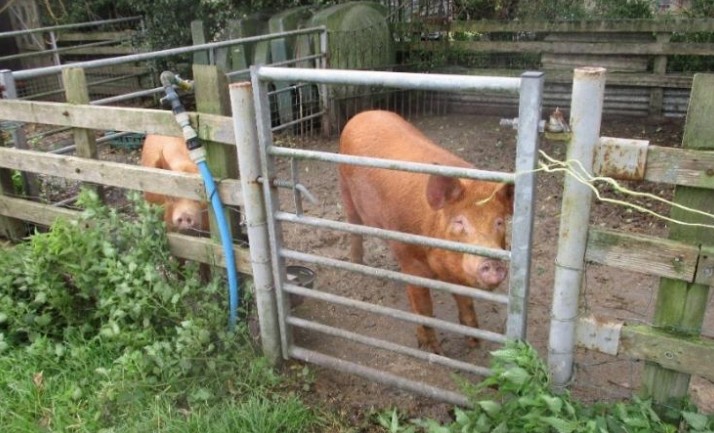
A CALL to allow a Pembrokeshire farm to keep welfare facilities to care for rare breed breeding Tamworth pigs has been given the go-ahead.
In an application to Pembrokeshire County Council, Sharron Nicolas, through agent Hayston Developments & Planning Ltd, sought a certificate of lawfulness permission for the creation of a welfare flat within a previously-approved agricultural building, plus a rear lean-to extension and the erection of two further sheds at Fairybank Fields Farm, Bethesda, near Clynderwen.
An application for a certificate of lawfulness allows an applicant to keep a development if they can provide proof of occupancy or use, without any enforcement taking place, over a prolonged period.
The previous agricultural building application was granted back in 2003.

A supporting statement accompanying the application said the two-level welfare unit in the 2003-granted shed “contains the necessary elements to allow overnight stays which are essential when the pigs are farrowing.”
It added: “Mr Allan and Mrs Sharron Nicholas have been owners of Fairybank Fields since 1998. Unfortunately, Mr Nicolas died in February 2025. Although managing the farm at Bethesda, they lived at Pleasant View, Cold Blow, Narberth meaning a round trip of some 12 miles per visit – a visit which was required on a daily basis because of the need to feed and generally care for their animals – which were and still are rare breed pigs together with a number of beef cattle.
“It is essential that the pigs require continuous care when farrowing or when there are other pressures on animal health. When such occasions occurred, it was the practice of Mr Nicholas to spend the night at the farm and to use the welfare provision.”
It said Mr Nicholas would have spent approximately three months’ worth of nights (circa 90 nights) staying over at Fairybank Fields – a period of some 12 years when the bedroom above had been created to late 2024 when his brother assisted Mrs Nicholas in caring for the pigs as Mr Nicholas was too ill.
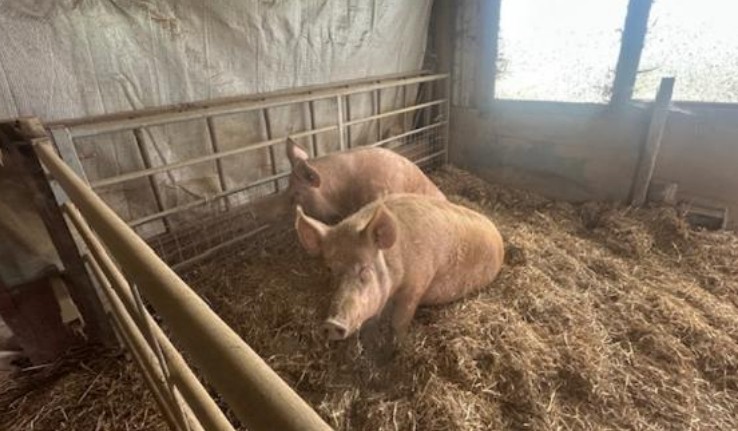
It went on to say: “Whilst the principal activity at the Farm is the breeding of the rare breed, the Tamworth Pig of which there are only currently 290 breeding sows in the UK, Mr and Mrs Nicholas also have had beef cattle on their farm and Mrs Nicholas intends to re-start that element in 2026.”
An officer report recommending approval said a site visit had been undertaken finding no evidence of the unit being occupied as a separate residential dwelling, nor as a primary residence.
It said a range of evidence was submitted in support of the application, including a detailed timeline, aerial imagery and multiple witness statements “which consistently indicate that the rear extension to Building 1 was constructed circa 2008, Shed 2 was completed in September 2012 and Shed 3 was erected in 2015”.
It said historic aerial photographs and witness statements demonstrated “on the balance of probability, that the operational development was substantially completed well in excess of four years prior to the submission of the application and has not been subject to any material interruption,” considered to be lawful by virtue of immunity from enforcement action.

It was granted approval on that basis.

A FRESH call to allow the retrospective conversion of office space to a chocolate factory, a beauty salon and laundrette has been submitted after a previous refusal.
In an application refused by Pembrokeshire County Council in March, Mr M Williams, through agent Preseli Planning Ltd, sought retrospective permission for the subdivision of an office on land off Scotchwell Cottage, Cartlett, Haverfordwest into three units forming a chocolate manufacturing, a beauty salon, and a launderette, along with associated works.
A supporting statement, for the chocolate manufacturing by ‘Pembrokeshire Chocolate Company,’ as part of the scheme said: “The operation comprises of manufacturing of handmade bespoke flavoured chocolate bars.
“Historically there was an element of counter sales, but this has now ceased. The business sales comprise of online orders and the delivery of produce to local stockist. There are no counter sales from the premises.”
It said the beauty salon “offers treatments, nail services and hairdressing,” operating “on an appointment only basis, with the hairdresser element also offering a mobile service”.
It said the third unit of the building functions as a commercial laundrette and ironing services known as ‘West Coast Laundry,’ which “predominantly provides services to holiday cottages, hotels and care homes”.
The application was refused on the grounds it represents an unjustified out of centre use with regard to the salon and nail bar, “insufficient information has been provided to justify the loss of B1 employment floorspace,” and “the introduction of a hairdressing salon and nail bar, uses typically found within established shopping centres, into this out of centre location would undermine the strategic role, vitality, and viability of Haverfordwest town centre”.
Since then, a resubmitted application aimed at addressing the reasons for refusal has been lodged.
A supporting statement with that resubmitted application says it has “included additional evidence in terms of a sequential assessment, financial viability and client needs to justify the mixed-use unit having an out-of-town centre location, which is of a scale that would not undermine the vitality and viability of the town centre and has a saturation of similar services being offered”.
It adds: “The application has also provided additional evidence to justify the loss of 70 square metres of a B1 unit not being harmful to employment land provision in the settlement, where adequate alternative provision remains.”
It says the scheme “would represent a suitable re-use of the building, which would not undermine the vitality and viability of the town centre or result in harmful loss of employment land,” and would not “result in any significant harmful impacts upon neighbouring amenity or the character of the area”.
The latest application will be considered by county planners at a later date.




Business44 minutes ago
Welsh firms eye share of £5bn defence drone boom
WELSH defence and aerospace firms could be in line for a share of billions of pounds in new military spending...


Community2 days ago
Thousands line Cardigan streets for Lord Rhys homecoming parade
THOUSANDS of people lined the streets and quayside in Cardigan on Saturday as the town marked 850 years since Lord...


Crime3 days ago
Dyfed-Powys Police rated only ‘Adequate’ in organised crime inspection
A WATCHDOG has rated Dyfed-Powys Police only “Adequate” in its response to serious and organised crime, despite praise for the...


News3 days ago
Two taken to hospital after aircraft ditches in Cardigan Bay
Coastguard helicopter spotted two casualties after light aircraft came down off west Wales coast TWO people were taken to hospital...


Sport4 days ago
Long Course Weekend gets underway in Tenby as thousands head for county
Three days of swimming, cycling and running begin with The Wales Swim at North Beach THOUSANDS of athletes and supporters...


Climate4 days ago
Welsh waters, Westminster profits: Crown Estate row reignited in Wales
PLAID CYMRU has renewed calls for the Crown Estate to be devolved to Wales after figures showed income linked to...


News4 days ago
Reform MS: ‘I felt like shouting get out of the water’
Paul Marr says children playing in streams at Pembrokeshire beaches deserve better protection from pollution risks REFORM UK MS Paul...


Health5 days ago
Senedd backs call to rule out hospital downgrades after heated NHS debate
Reform UK amendment passes as West Wales hospital fears remain central political issue THE SENEDD has backed a call for...


News5 days ago
Coastguard callout payments axe sparks fears for coastal communities
VOLUNTEER coastguards across the UK are set to lose callout payments, prompting concern over the future resilience of emergency cover...


Farming5 days ago
Rural Wales ‘left out’ of net zero debate, warns carbon entrepreneur
A WELSH carbon entrepreneur has warned that rural Wales risks being left behind in the national conversation about net zero....
-

 Crime6 days ago
Milford man threatened to smash parents’ windows, court hears
-

 Crime6 days ago
Haverfordwest father stole groceries amid cost-of-living struggle
-

 Crime6 days ago
Woman sentenced over neglect of child at Haverfordwest property
-

 Crime5 days ago
Police appeal after reported rape at Young Farmers rally
-

 Crime6 days ago
Dock woman given mental health treatment order after supermarket thefts
-

 Crime6 days ago
Hakin man stole Tesco goods to fund drink and gambling addictions
-

 Crime6 days ago
Grandmother banned after cocaine drug-drive offence
-

 Crime7 days ago
Government fraud squad hunts down Covid loan scams