


Top News
Five ‘hidden heroines’ to be celebrated at Pembrokeshire’s new heritage centre


When it comes to fighting for their nation – be it politically, culturally, socially and ethically – the women of Wales have proven themselves invincible.
Yet despite their significant achievements, Wales’ heroines have remained largely hidden, and their stories forgotten.
Now, thanks to the commitment of the ‘Monumental Welsh Women’, five influential females have finally been acknowledged following commissions to erect public statues in their honour.
“Despite what so many women have done and achieved in Wales, there wasn’t one single public statue commemorating their achievements,” said Pembrokeshire historian Angela John, who has been one of the Monumental Welsh Women who has campaigned for their recognition for the last eight years.
“There has been a complete lack of visibility.”


Later this week, Angela will be giving a talk in her home town of Newport, Pembrokeshire, on the five women selected.
The first was Betty Campbell, a black woman of poor parentage who was told at school that the problems for a working class black girl would be ‘insurmountable’. Despite this stark statement, Campbell won a place as one of the first female students to study at the Cardiff Teacher Training College where she enrolled whilst the mother of three young children. She taught at Butetown, Cardiff, for 28 years where, as a black teacher, she experienced some hostility from parents. In the 1970s, she became Wales’ first black head teacher at Mount Stuart where she began teaching children about slavery, black history and the system of apartheid.
“Betty Campbell was a huge influence in Wales who won the poll for the first statue which was unveiled in Central Square, Cardiff in 2021,” explained Angela John.
The following year saw the arrival of Mountain Ash’s Elaine Morgan, born into a poor mining family but who won a scholarship to study at Oxford.
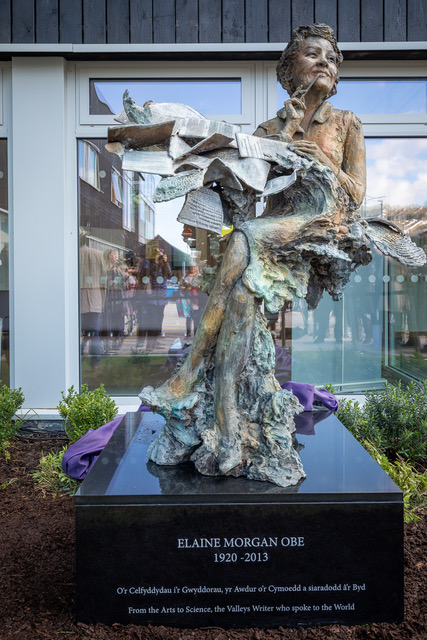
Following her graduation she taught for three years with the Workers’ Educational Association and began writing plays to help make ends meet. She then began making an impact in the male-dominated world of the small screen with her first television scripts accepted before she even owned her own TV set. Elaine Morgan went on to become a top TV writer, a feminist icon and a ground-breaking evolutionary theorist, winning a host of awards and scripting some of the best loved dramas in television, including ‘How Green Was My Valley’, and ‘The Life and Times of Lloyd George’.
The Elaine Morgan statue is located in Oxford Street, Mountain Ash.
In 2023, Ceredigion celebrated the arrival of Llangrannog’s Sarah Jane Rees, better known by her bardic name of Cranogwen.

Her first claim to fame was as a master mariner and for two years she worked as a sailor on cargo ships between Wales and France before returning to London and Liverpool to further her nautical education. She gained her master mariner’s certificate – a qualification that allowed her to command a ship in any part of the world. Back in West Wales, overcoming opposition to the appointment of a woman, she became a head-teacher at 21, educating the children of the village, and also taught navigation and seamanship to local young men. Many men who would later go on to sail and captain ships across the world’s oceans were trained by Sarah Jane Rees.
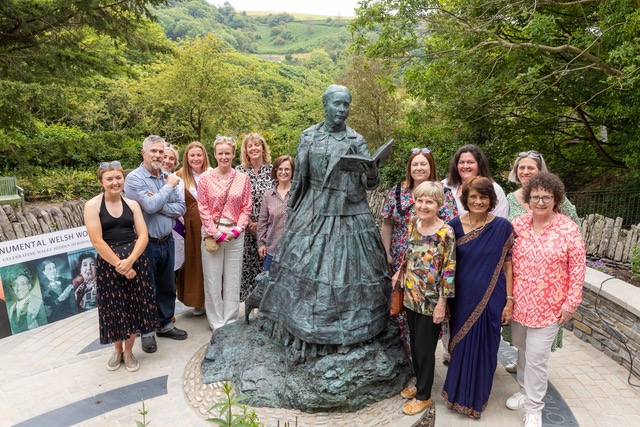
In 1865 her writing skills turned her into an instant Welsh celebrity as she became the first woman to win a poetry prize at the National Eisteddfod, beating some of the major male Welsh poets of the day. Her winning poem – Y Fodrwy Briodasal (The Wedding Ring) – was a satire on the married woman’s destiny, using the wedding ring as a recurring symbol.
At a time when public speaking by women was frowned upon, Cranogwen embarked on a career as a lecturer, Temperance campaigner and a preacher, travelling across America twice, and often facing opposition from male preachers when she took to the pulpit.
Her statue is situated in the centre of Llangrannog, close to the church, where she was buried.
The fourth statue, erected in 2024, is that of the iconic Lady Rhondda (Margaret Haig Thomas), a suffragette who made the fight for the women’s vote front page news.
She brought Emmeline Pankhurst to Wales and confronted the anti-suffrage Prime Minister Asquith by jumping on his car. She also set fire to a post box and was sent to prison, where she went on hunger strike while during the First World War she ensured women played a vital role, recruiting them into the women’s services. She became Commissioner for Wales in the Women’s National Service Department, then Chief Controller of women’s recruitment at the Ministry of National Service in London.
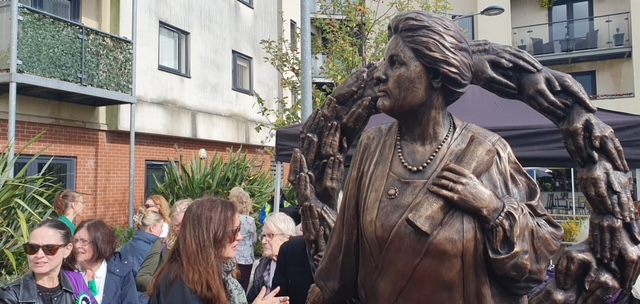
She went on to become the greatest global business woman of her era and sat on the board of no fewer than 33 companies, and chaired seven of them. She oversaw an industrial empire of mines, shipping and newspapers and became the first, and to date, the only female, to be President of the Institute of Directors.
The fifth and final statue, which be unveiled later this year,is in honour of Elizabeth Andrews who was a great social reformer and campaigner for women’s rights.
She was one of the most influential Welsh female political activists of the early 20th century, being an internationalist, a suffragist and a socialist. Forced to leave school at 13 to help her parents make ends meet, the Welsh-speaking dressmaker brought the needs of working-class women into the political arena because she shared their lives and voiced their hopes and fears.
She became the first Labour Party Women’s Organiser for Wales and set up women’s sections, describing them as ‘working women’s universities.’ One of her earliest tasks was translating leaflets from English to Welsh to urge women to use their newly-won vote. She also became one of Britain’s first female magistrates and put the needs of women and children at the heart of her campaigns.
“Whittling our original list of 50 down to just five has been difficult, as there have been so many incredible women here in Wales who have achieved so many significant things for their nation,” concluded Angela John.
“But throughout our campaign, the support we’ve had has been tremendous with regular features on the media and support from the Welsh government who decided to give us £20,000 funding towards the cost of each statue, with each one costing around £100,000 to produce.
“We’ve also seen a huge public interaction, particularly with the number of school children who’ve been involved.
“This shows the enormous changes in the ways in which people are now relating to Welsh history. Previously, it was taught around kings and queens, their battles and all their relevant dates, while now there’s far more attention being given to race and social issues, so history is no longer such an elite subject but is there for everybody. The fabric of everyday life has become as much a part of people’s understanding of history as anything else.
“And each our five statues have gone a long way in helping to address this.”
Angela John will be speaking at Bethlehem Chapel, Newport, Pembrokeshire this Wednesday, February 26, at 7pm.


Mayor’s charities named as civic leaders gather at St Katharine and St Peter’s Church
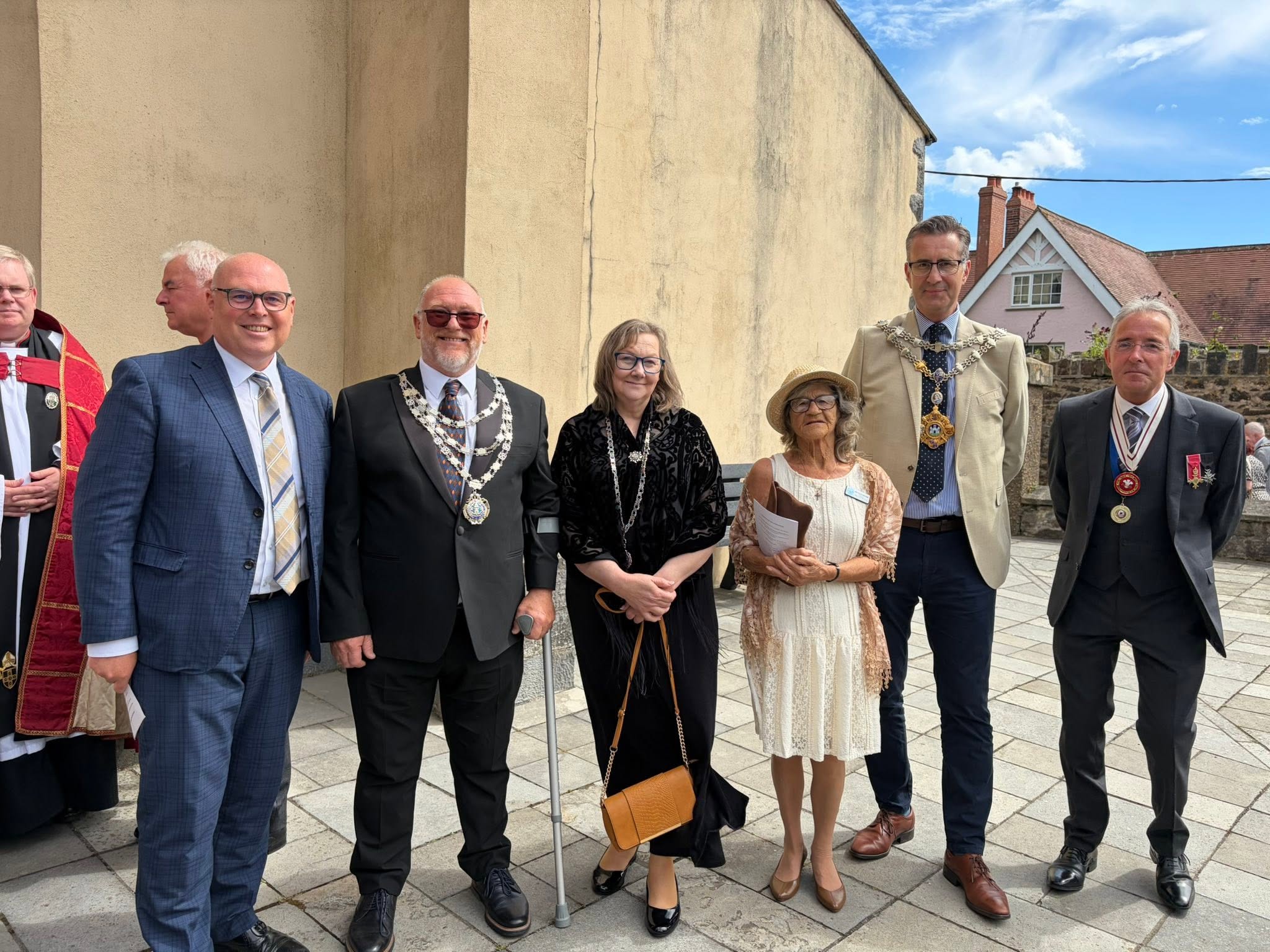
THE CIVIC SERVICE of the Mayor of Milford Haven, Cllr Mark Woodward, took place at St Katharine and St Peter’s Church on Saturday (June 20).
The service marked Cllr Woodward’s election as Mayor and First Citizen of Milford Haven.
It was conducted by Rev Dr Adrian Furse and Canon John Cecil, with music from church organist Richard Stephens, Gelliswick Community Choir and Milford Haven Town Band.
Guides and Brownies, Milford Haven Sea Cadets and Royal Marines Cadets were also among those taking part, with councillors Colin Sharp and Yvonne Southwell acting as ushers.
Refreshments followed at Milford Haven Bowling Club.
Local MS Paul Davies was among those attending the service and wished the new mayor all the best for his term in office.
Cllr Woodward’s chosen charities for the year are Patch Charity and Greenacres Rescue.
Photo caption:
Civic guests attended the Mayor of Milford Haven’s service at St Katharine and St Peter’s Church on Saturday (Pic: Supplied)

Donations pour in for SNAP Specialist Play as families embrace Toy Story 5 launch
A TOY STORY-themed charity appeal at a Haverfordwest cinema has got off to a flying start, with families donating toys to support children with additional needs across Pembrokeshire.
The Palace Cinema has teamed up with local charity SNAP Specialist Play to collect new and pre-loved toys during screenings of the newly released Toy Story 5.
The appeal centres around an “Andy’s Toys” donation box, inspired by the beloved Pixar films, which has already been filled by generous filmgoers.

Cinema manager Hannah Cramp said the response from the community had exceeded expectations.
Families attending opening screenings have arrived carrying bags of toys, with many children keen to share their own treasured items to help others.
The cinema has transformed its foyer into a colourful Toy Story-themed experience, complete with hand-painted decorations, character silhouettes, bunting and famous film slogans including “Reach for the Sky” and “To Infinity and Beyond”.
Many visitors have also embraced the spirit of the occasion by attending in costume as their favourite Toy Story characters.

The toys are being donated to SNAP Specialist Play, a charity based within the Child Health Department at Withybush Hospital.
SNAP supports pre-school children with additional and complex needs through specialist play sessions designed to encourage communication, physical development and sensory learning.
Its facilities include sensory rooms, therapeutic play spaces and bespoke equipment used by speech and language therapists, occupational therapists and physiotherapists.
Project manager Cindy Jenkins said the charity was delighted by the partnership and grateful for the generosity shown by local families.

She said every toy donated would be put to good use, either during specialist play sessions, at family events, or through seasonal initiatives such as Christmas gift boxes for children and their siblings.

The appeal will continue until mid-July, with organisers hopeful that even more donations will be received over the coming weeks.
Anyone attending Toy Story 5 at the Palace Cinema is invited to bring along a new or good-quality pre-loved toy to support the appeal.

Cover photo:
Fancy dress fun: Palace Cinema manager Hannah Cramp helping launch the Toy Story charity appeal.

PATIENTS are facing some of the worst medicine shortages ever seen in the UK, with pharmacists warning the situation now poses a serious risk to safety.
The National Pharmacy Association said shortages affecting commonly used medicines are becoming more frequent, lasting longer, and causing increasing disruption for patients, GP surgeries and pharmacies.
The warning comes as Serious Shortage Protocols for Creon, used by people with pancreatic cancer and cystic fibrosis to help digest food, have been in place since May 2024 and have now been extended until July 10, 2026.
HRT treatment Estradot has also been under a Serious Shortage Protocol since December 2024, with the current extension also running until July 10.
Patients travelling between pharmacies
A survey by the National Pharmacy Association found that 98 per cent of pharmacies had encountered patients who had visited several pharmacies in one day to find a prescription.
It also found that 96 per cent of pharmacies believed the current situation posed a serious risk to patient safety, while 89 per cent said they had been unable to dispense a medicine at least once a day because of supply problems.
Some pharmacy teams have also faced anger and abuse from patients unable to obtain medication.
Olivier Picard, Chair of the National Pharmacy Association, said: “Medicine shortages are becoming more frequent, lasting longer and causing increasing disruption for patients.
“These shortages are some of most severe the UK has experienced.
“It is deeply distressing to find patients who have travelled from pharmacy to pharmacy to find the medicines they need without success.”
Calls for urgent taskforce
The NPA is calling on the government to convene an emergency taskforce involving manufacturers, wholesalers, clinicians and pharmacists.
It also wants changes to rules which currently stop pharmacists from making simple substitutions, such as changing a tablet to a capsule or a cream to an ointment, even where a safe alternative is available.

Professor Victoria Tzortziou Brown, President of the Royal College of GPs, said medicine shortages were frustrating for patients, GPs and pharmacists, and added pressure to already stretched services.
She said the College supported pharmacists being able to make limited changes to prescriptions where a medicine is unavailable and a safe alternative exists.
She added: “The most important thing is that patients are able to access the medication they need safely and without delay.”
The Cystic Fibrosis Trust and Pancreatic Cancer UK have also raised concerns about the impact of shortages of pancreatic enzyme replacement therapy, including Creon, on people who rely on the medication to digest food, maintain weight and stay well enough for treatment.



Charity15 hours ago
Toy Story fans fill charity toy box at Haverfordwest cinema
Donations pour in for SNAP Specialist Play as families embrace Toy Story 5 launch A TOY STORY-themed charity appeal at...


Community20 hours ago
Lord Rhys emerges from the mist in St Davids
Giant puppet begins historic journey marking 850 years since the first Eisteddfod MIST swirled around St Davids Cathedral on Friday...


News2 days ago
Tragic tribute paid to Haverfordwest man after A4075 collision
FAMILY REMEMBERS “KIND AND LOVING” CALLUM HANSON THE FAMILY of a 22-year-old man from Haverfordwest who died following a road...


News3 days ago
Motorcyclist, 22, dies in A4075 crash in Pembrokeshire
A 22-year-old woman remains in hospital after two-vehicle collision A MOTORCYCLIST has died following a serious two-vehicle crash on the...


Community3 days ago
Why police will be visiting every home in Pembrokeshire
New operation aims to knock on more than 257,000 doors across Dyfed-Powys over the next three years DYFED-POWYS POLICE has...


Crime3 days ago
Prisons at breaking point: MPs warn Wales is paying the price of a failing system
Frozen healthcare budgets, overcrowded jails, homelessness on release and mounting pressure on staff are undermining rehabilitation across Wales, according to...


News3 days ago
Brexit at 10: How Britain was sold a dream that cost us dearly
A decade after the referendum, the promised benefits remain hard to find while the economic costs are increasingly difficult to...


Crime4 days ago
Worcestershire man jailed after violent attack on woman in Tenby
Defendant was already serving a suspended sentence when serious assault took place A WORCESTERSHIRE man has been jailed for more...


Climate4 days ago
Offshore wind ‘could bring new generation of jobs to Milford Haven’
Pembrokeshire ports and Celtic Sea projects placed at centre of Wales’ green energy ambitions MILFORD HAVEN and Pembroke Dock could...

Community4 days ago
Police officer hailed hero after midnight sea rescue in Milford Haven
PC swam 100 metres offshore to save distressed woman heard calling for help in darkness A DYFED-POWYS POLICE officer has...
-

 Community6 days ago
Pembrokeshire Chess Club crowned Welsh champions
-

 Crime3 days ago
Milford Haven man jailed for breaching domestic violence protection order
-

 Local Government5 days ago
Security privately arranged by Mayor at Beating of the Bounds
-

 News3 days ago
Crash on Freeman’s Way causes school-run chaos across Haverfordwest
-

 Crime4 days ago
Man wanted by court after failing to attend hearing over alleged shop thefts
-
 Crime4 days ago
Man banned from roads after drink-driving offence
-

 Crime4 days ago
Man jailed after admitting strangulation and assaults
-

 Crime4 days ago
Man sentenced over stalking campaign and lock knife offence