


Business
The role of private aviation in Welsh air travel today


Wales might not be the first country you think of when it comes to private aviation, but you’ll be surprised to find that it does play a nuanced role in the nation, especially in Pembrokeshire. While Wales isn’t home to many private airports or billionaire jet-setters, private flights play a vital role in the Welsh aviation economy. This article explores the state of private aviation in Wales, its implications for Pembrokeshire residents, and how it compares to the broader UK private aviation sector.
At a glance
Wales’ primary airport is Cardiff Airport (CWL), located in the Vale of Glamorgan. Historically, Cardiff Airport has seen fluctuating passenger numbers, with a peak of approximately 2.1 million passengers in 2007. However, by 2019, this number had declined to around 1.65 million. The COVID-19 pandemic further impacted these figures, with passenger numbers dropping to approximately 219,984 in 2020 and 123,825 in 2021. There was a partial recovery in 2022, with passenger numbers reaching 859,805.
Cardiff Airport primarily serves commercial flights but also accommodates private aviation needs. However, the lack of dedicated private jet facilities means that amenities such as luxury lounges, concierge services, and dedicated terminals are limited compared to other regions. This has implications for Welsh residents, particularly those in Pembrokeshire, who rely on private aviation for business and leisure. For long-haul flights, some Welsh residents prefer to fly first-class to Heathrow before switching to a private jet charter.
Welsh private aviation infrastructure
Wales lacks dedicated private jet airports that cater exclusively to private aviation. Private flights typically utilise facilities at Cardiff Airport, which has its fixed-base operator, Signature Aviation. Passengers can enjoy a private check-in, exclusive lounges, and complimentary refreshments.
Unfortunately, experienced private travellers who are used to flying from Farnborough or London City Airport may find services here to be lacking compared to private airports. As a result, private aviation in Wales remains underdeveloped, limiting its appeal to high-net-worth individuals and corporate travellers.

Air travel in Pembrokeshire
Pembrokeshire does not have a commercial airport, so residents must rely on car transfers to access larger airports like Cardiff Airport or airports in England for commercial and private flights. The region is served by Haverfordwest Airport (Withybush Airport), a small airfield primarily used for general aviation and flight training.
Haverfordwest Airport is a valuable resource for local aviation enthusiasts, but it hardly suits the needs of most Pembrokeshire residents as it lacks the infrastructure to support larger private jets. For Pembrokeshire residents, private aviation often involves travelling to Cardiff or across the border to England, adding time and complexity to their travel plans.
Wales vs the rest of the UK
Wales lags behind England in the private aviation sector. In 2024, 12,702 private jet flights were made in the UK, most of which departed from English airfields. This is not necessarily due to a lack of demand in Wales; England has an established private aviation infrastructure, so even Welsh private travellers will drive to destinations like Bristol or Birmingham for their charter flight.
For example, London Luton Airport and Farnborough Airport are major international hubs for private aviation, offering state-of-the-art facilities and services tailored to high-net-worth individuals. In contrast, Wales’ limited infrastructure means it has not experienced similar growth. This disparity highlights the need for investment in private aviation hubs for Wales to serve its residents better and attract high-value travellers.

What does this all mean for Pembrokeshire residents?
For Pembrokeshire residents, the limited access to commercial and private aviation necessitates reliance on ground transfers to access larger airports. This reliance can add time and complexity to travel plans, making private aviation less convenient compared to regions with dedicated facilities.
For example, a Pembrokeshire resident looking to fly privately to London or Europe would need to travel to Cardiff Airport or an English airport like Bristol or Exeter. This additional travel time can offset the convenience of private aviation, particularly for short-haul flights. However, the benefits of private travel outweigh those of commercial flight when travelling long-haul, even if it means a couple of hours’ drive beforehand.
A sleeping giant of private aviation
It’s clear to see that private aviation in Wales is slightly choked by the sheer availability and height of resources in the nation next door. While the UK has seen growth in private aviation, a very small portion of that is taking place in Welsh airfields due to the lack of infrastructure. Addressing these infrastructure gaps could enhance accessibility and convenience for Welsh travellers opting for private charters, but such developments would need to balance economic benefits with environmental considerations.

For now, Pembrokeshire residents must navigate the limited local aviation infrastructure, relying on nearby airports and car transfers to access private jet facilities. However, with strategic investments and a focus on sustainability, Wales has the potential to develop a thriving private aviation sector that meets the needs of its residents and attracts high-value visitors from around the world.



CARDIFF AIRPORT is preparing for a busy Easter getaway, with more than 46,000 passengers expected to travel through the airport over the holiday period.
The figure represents an 18% increase compared to the same period last year, reflecting growing demand for both sunshine destinations and European city breaks.
The busiest routes this Easter are set to be Alicante, Dublin and Málaga, with flights operated by airlines including Ryanair, Vueling and TUI Airways.
Travellers heading for warmer weather can also take advantage of direct flights to the Canary Islands, including Tenerife, Lanzarote, Gran Canaria and Fuerteventura, alongside popular destinations such as Faro and Palma.
The airport says the increase builds on a strong start to 2026, with passenger numbers continuing to rise.

Chief executive Jon Bridge said the airport is approaching the one million passenger mark and expects the summer season to be its busiest since the pandemic.
He said: “It’s been an incredibly positive start to the year, and we’re looking forward to welcoming more passengers over the Easter period.
“Our teams are working hard to ensure travellers can start their holidays smoothly.”
Passengers travelling over Easter are being advised to allow extra time for their journey and check with airlines for the latest updates.

A total of 46,158 passengers are expected to pass through the airport between March 27 and April 12, with arrivals and departures almost evenly split.
Cardiff Airport said it continues to expand its range of destinations, including the addition of a direct service to Toronto, as it looks to strengthen its role in connecting Wales to international travel.

State-of-the-art 22-metre craft marks reset after £3.6m pilot boat controversy
THE PORT OF MILFORD HAVEN has taken delivery of a new 22-metre pilot vessel, marking a major investment in safety and operational capability on one of the UK’s busiest waterways.
The vessel, named Llanion, has arrived in Welsh waters following a successful delivery voyage from the Netherlands, where it was built by Next Generation Shipyards.
Designed specifically for pilotage operations, the new craft features a modern hull design, self-righting capability, and advanced safety systems, enabling it to operate in challenging conditions while supporting the safe movement of vessels across the Milford Haven Waterway.
Its arrival effectively brings to a close a long-running saga surrounding a previous generation of pilot boats built locally in Pembrokeshire at a reported cost of around £3.6 million. The Pembrokeshire Herald previously reported extensively on the issue, including a front-page story highlighting concerns about the vessels’ performance and suitability for operational use.
Those vessels were later withdrawn from frontline service following safety concerns raised by crews.
Since taking over as Chief Executive, Tom Sawyer has overseen a shift in direction at the Port, with a stronger emphasis on operational reliability, safety and long-term performance. The commissioning of Llanion is widely seen as part of that reset, addressing issues that had affected confidence in the pilot fleet.
Tom Sawyer said: “This project is a testament to collaboration and innovation. Working closely with our partners and our own technical teams, we now have a vessel that reflects the highest standards of design, safety and operational capability.
“Llanion will play a key role in supporting the safe and reliable movement of vessels on the Milford Haven Waterway for years to come.”
The new vessel is the result of a five-year collaboration between the Port of Milford Haven, naval architects BMT, Camarc Design and the Dutch shipyard, with Port teams closely involved throughout.
Dirk Keizer, Technical Director at Next Generation Shipyards, said the company was “extremely proud” to deliver the vessel, adding that it “excels in safety, performance and reliability.”
Ed Soothill, Technical Director at Camarc Design, said it was “wonderful to see Llanion arriving in Milford Haven,” while Steven Lee, Chief Naval Architect at BMT, described the vessel as “the Port’s next generation pilot boat.”
The Port of Milford Haven is the UK’s largest energy port and a key economic driver in Pembrokeshire, supporting thousands of jobs and handling a significant share of Britain’s oil and gas imports.

Photo caption:
New arrival: The Port of Milford Haven’s 22-metre pilot vessel Llanion (Pic: Port of Milford Haven).
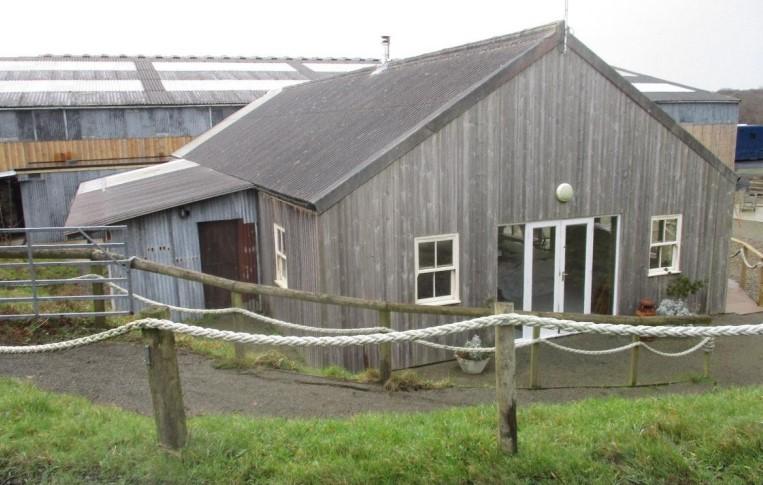
A CALL to allow a former riding stables to keep a multi-purpose building built without permission has been allowed, but its new purpose for wedding venues will need a new application.
In an application submitted to Pembrokeshire Coast National Park, Lawson & Penny Owen of LJP Owen Ltd, through agent Hayston Developments & Planning Ltd, sought permission for a certificate of lawfulness for a multi-use building at Johns Barn, Nolton Stables, Nolton.
In application for a certificate of lawfulness allows an applicant to keep a development if they can provide proof of occupancy or use over a prolonged period.
A supporting statement said the building had been used for a variety of purposes including a meet and greet use in connection with the operation of a family-owned riding stables, for various parties and occasions including birthday parties and for expansion with weddings and wedding receptions.
It added: “Mr Lawson Owen’s grandfather, along with his sons, started the stables early 1960s and his mum and dad ran the stables from 1975. Mr Owen left school in 1995 and LJP Owen Ltd took over running the stables from 2005 (Lawson, James and Penny). There is no planning history in respect of the construction of this mainly timber building which has been designed and used since 2016 for a variety of activities within Use Class D2, nor in respect of the subsequent extension, which was added by Summer 2020 and which contains a toilet block.
“Although the multi-purpose building was constructed to act as a meet and greet centre and toilets in conjunction with the established riding school / pony trekking centre based at Nolton Stables, the first use towards the end of December 2016 was to host a family event to which over 100 guests were invited.”
It said the facility predated other ventures at the site including a horse riding experience and ‘zorbing’ and segwaying.
It said that Covid restrictions in place from 2020 “resulted in the abandonment of pony trekking and hence the sale of the horses from Nolton Stables as it was economically impractical to feed and maintain the animals, saddles etc for an extended period when there was no income,” adding: “Zorbing and segwaying also had to cease because of the associated level of social contact.”
It went on to say: “The principal use of the building is now multi-purpose with wedding venue ceremonies now popular too and subsequent reception with a number of the guests staying in holiday accommodation in and around Nolton; some of which is currently managed by the applicants or to be developed by the applicants. (An application for nine holiday units is currently awaiting validation and processing by PCNP).”

An officer report in part supported the certificate of lawfulness, but felt the current use of the barn as a wedding venue, from 2022, “is considered to be a further change of use from the equine use to a sui generis use,” with a continuous period of use of for a longer period needed for that element of the ‘lawfulness’ application.
In granting the certificate of lawfulness for the building itself and equine use, it said: “The unauthorised building has a lawful equestrian activity use and any change of use from this has not yet become lawful,” adding the use as a wedding venue would require a separate planning application.



Business3 hours ago
New pilot vessel Llanion arrives at Milford Haven
State-of-the-art 22-metre craft marks reset after £3.6m pilot boat controversy THE PORT OF MILFORD HAVEN has taken delivery of a...


Business1 day ago
Could Primark be coming to Haverfordwest? Major retailer in talks for former Wilko site
Council confirms advanced discussions as speculation grows over high street boost HAVERFORDWEST could soon see a major high street revival,...


Business1 day ago
Rail investment ‘could unlock 40,000 jobs and £11bn for Wales’ says new report
RAILWAY stations across Wales could help unlock around 40,000 jobs and more than £11 billion for the economy by 2036,...


Local Government1 day ago
Milford Haven set for £200m investment with schools, leisure centre and rail upgrade
Council outlines major plans for town with backing from Welsh Government MILFORD HAVEN is set for a major transformation with...


Community2 days ago
Broad Haven volunteers secure ‘national asset’ status for nature reserve
A SMALL stretch of woodland and former opencast coal mine has been transformed into a nationally recognised biodiversity site, in...


Entertainment3 days ago
Tenby steams up in spectacular style as crowds flock to festival
Colourful parade, towering creations and Victorian flair bring town centre to life TENBY was transformed into a vibrant Victorian fantasy...


Crime4 days ago
Publican jailed for six years for supplying cocaine and cannabis
Milford Haven man sentenced at Swansea Crown Court following drug dealing operation A MILFORD HAVEN publican has been jailed for...


Local Government4 days ago
Poverty summit highlights support efforts across Pembrokeshire
A SUMMIT bringing together key organisations from across Pembrokeshire has highlighted both the scale of local poverty and the work...


Education5 days ago
Milford Haven school plans unveiled but funding not yet secured
PLANS for a new £100 million school in Milford Haven have been unveiled, but the project has not yet secured...


News5 days ago
Council unveils plans for new state-of-the-art secondary school in Milford Haven
PEMBROKESHIRE COUNTY COUNCIL has revealed plans for a new state-of-the-art school in Milford Haven, promising modern, inspiring learning spaces for...
-

 Crime6 days ago
Mother given community order after admitting child cruelty offence
-

 Health5 days ago
NHS waiting list falls — but cancer delays and diagnostic backlog worsen
-

 News7 days ago
Senedd votes to ban Greyhound racing in Wales to protect animal welfare
-

 News7 days ago
Senedd vote to ban greyhound racing hailed as ‘landmark moment’ by charities
-

 News6 days ago
Reform secures first Pembrokeshire councillor in Hakin by-election win
-

 Crime6 days ago
Woman stole from pharmacy despite ban, court hears
-

 Crime5 days ago
Illegal workers found at Cardigan takeaway after immigration raid
-

 News7 days ago
Could Pembrokeshire hold the key to St Patrick’s lost birthplace?