

Business
Post Office spent £600m to keep using flawed Horizon system


Roch postmaster among those still seeking compensation
THE POST OFFICE has spent more than £600 million of public money continuing to use the discredited Horizon IT system—despite accepting more than a decade ago that it needed replacing.
New documents reveal that then Prime Minister Tony Blair and senior Labour ministers were warned as far back as 1999 about serious flaws in the original £548 million deal with Fujitsu. A Treasury memo at the time flagged that the Post Office would not own the core computer code, leaving them locked into the supplier and vulnerable to spiralling costs. Officials warned Fujitsu could use the situation to “drive a costly settlement.”
Since then, the total spent on Horizon contracts has reached £2.5 billion, including £600 million spent since 2012 when the Post Office first admitted it needed to move on from the system. Replacement efforts have repeatedly failed, with a £40 million IBM project abandoned in 2016 and another attempt scrapped in 2022.

The latest replacement project—an internal system called New Branch IT (NBIT)—has run into delays and ballooning costs, with estimates now topping £1 billion. Despite past failings, the Post Office and Fujitsu are expected to remain in partnership until at least 2030.
The scandal surrounding Horizon continues to grow, following the wrongful prosecution of over 900 sub-postmasters. Although private prosecutions based on Horizon data were halted in 2015, campaigners say the damage done is still being felt by victims across the UK—including here in Pembrokeshire.

One of them is Tim Brentnall, who was just 22 when he and his parents bought the Roch Post Office. In 2010, he was prosecuted after a £22,500 shortfall appeared in the accounts—despite doing nothing wrong. Advised to plead guilty, he received an 18-month suspended sentence and 200 hours of community service. His conviction was quashed in 2021.
Earlier this year, Brentnall told the BBC he was “in disbelief” after being offered less than 17% of the compensation he had claimed. The offer came with a 50-page letter rejecting much of his legal and forensic case, and over 15,000 documents to sift through. He is now re-submitting the claim.
“There are people far older than me who should be enjoying their lives now,” he said. “Instead, they’re still fighting. People are dying without seeing justice. It’s not right.”
The Post Office says it is “fundamentally changing” as an organisation and has paid out more than £768 million to over 5,100 people affected by the Horizon scandal. However, many victims and campaigners say the compensation process remains slow, unfair, and deeply distressing.
Postal minister Gareth Thomas recently confirmed a further £276.9 million in government funding for the Post Office, including £136 million for future IT projects. He said the continued use of Horizon reflected “past underinvestment” and that postmasters needed better tools going forward.
A spokesperson for Tony Blair said the former PM took concerns over the Horizon contract seriously at the time and acted on independent advice. “It is now clear the Horizon product was seriously flawed. Mr Blair has deep sympathy for those affected.”
A separate 1999 memo was also sent to then-Chancellor Gordon Brown, but a spokesperson for Mr Brown said he would not have seen it and had no involvement in awarding the contract.

Despite public statements about reform, doubts remain over whether NBIT will ever be delivered—and whether true justice will ever be achieved for those whose lives were torn apart by the Horizon scandal.



A NEW development agency will “improve productivity”, according to a Welsh Government minister – but opponents have dubbed it “yet another quango”.
Enterprise, connectivity, and energy minister Adam Price outlined his plans in the Senedd on Tuesday July 7.
He said: “Less than three weeks into this administration, we announced the most ambitious economic goal in Wales in two decades; namely, halving Wales’s productivity gap with the UK within ten years.
“If we are going to meet that challenge, we need a fundamental change in how we approach economic development in Wales. The proposed new agency will be a key driver in achieving that change.”
Mr Price previously faced criticism on his plans when he raised the proposal in the Senedd last month.
Reform’s shadow minister for economy and transport, Jason O’Connell, then described the idea of a new agency as “another unnecessary bureaucratic quango”.
Speaking in the Siambr, Mr Price said: “Creating a new development agency is a crucial part of driving the positive changes in productivity that we need. But it needs to be a much wider, collective effort across Wales.
“We need – collectively and collaboratively – to look at the current landscape and work with local and regional partners to create an economic development system where roles are clear and we’re all working together as one team for the people of Wales.”
As set out in Plaid’s 100 day plan, the party will be establishing an “expert panel” to advise the development of the new agency, which he confirmed will be chaired by Jonathan Lewis.
He said: “The appointment of the chair of the panel to advise on the remit and operating model of the new agency is a key stepping stone in the journey towards making Wales the best place in the United Kingdom to start a business, to grow a business, and to invest in a business.”
The minister told colleagues he would confirm the full membership of the panel in the coming weeks.

Reform’s Jason O’Connell told the Siambr that it was a “shame” MSs were once again debating “the creation of yet another quango”.

Noting the importance of scrutiny for “better government”, Mr O’Connell accused Plaid Cymru of denying the chamber that scrutiny.
He said: “If taxpayers are funding this new development agency, then they deserve transparency. Minister, you say you want the new agency to provide support, advice and guidance, but you’ve said nothing about how.
“So, let me give you a suggestion. Decades ago, Welsh Labour scrapped the Welsh Development Agency, WDA1. They promised a simpler, better support mechanism for Welsh businesses. But instead, we’ve got a patchwork of organisations: Business Wales for advice, the Development Bank of Wales for finance, and now what we’re proposing is WDA2 to sit on top. The current system is too confusing.”
Reform’s shadow economy minister then claimed Business Wales returns £18 of economic value for every £1 that’s invested. He also questioned Mr Price on why he has no plans to bring Business Wales into the new WDA to make things “less confusing and more accessible”.
Responding, Mr Price said his government “absolutely” wants to make sure businesses can access a “streamlined level of support”.
Mr O’Connell also asked about attracting inward investment to Wales, noting the “real test” is whether that investment becomes “rooted across Welsh communities up and down the country”.
He said: “In the last WDA, Wales welcomed major international employers, created thousands of jobs, and celebrated new investment, as short-lived as it was.
“But those companies moved production elsewhere when the government reduced the support. They took high-paying jobs with them, because their supply chains were never truly anchored in Wales, and it was easy to do so.”
The Pontypridd Cynon Merthyr MS drew attention to the Irish economy where “inward investors are expected to work with local suppliers, strengthen domestic supply chains, and create opportunities for already-established local businesses in that country to grow alongside them”.
Mr Price noted his agreement with the shadow minister on the need to be strategic about inward investment.
He said: “Foreign direct investment has a role in any economy, but we need to actually focus it on those areas that will be more embedded – through supply chains, as he suggests – in the Welsh economy that actually build on our existing and possible future strengths.”

Labour’s Shav Taj said her party shares Plaid Cymru’s ambition for a “new type of Wales, a reinvigorated Wales, a Wales that attracts more investment and ultimately creates good jobs”.
The Labour spokesperson for economic transformation told the Siambr that what the people of Wales want to know is what “meaningful difference” these internal arrangements will make.
She also drew attention to the work of the previous Labour government in ensuring a strong economy for Wales, including setting up the Development Bank of Wales and hosting the Wales investment summit.
Ms Taj said it’s the “practical” questions that are important and pressed Mr Price on when the new agency will get staff, whether they will be new staff or shuffled from other departments, and how much the new agency will cost the Welsh public.
She also pushed for confirmation on the “constitutional status” of the agency, notably whether the Senedd will need to legislate “at some point” for it to get going.
Ms Taj added: “Ultimately, this is about jobs, jobs for the future, high-skilled jobs, and young people in Wales are really watching to see whether or not your government is going to do any better than we did.”
Mr Price responded: “They [development agencies] have played a central role in virtually anywhere that you can think about in the nations and regions that have closed an economic gap, and few of those nations or regions that have had one have got rid of them.
“We’re one of the few exceptions. There may be a reason for that, and I suggest it’s because they are an incredibly valuable tool.
“Do you need to get the design right? Absolutely. The right relationship in terms of how arm’s length it is from government but how close it is from a government – getting that right is absolutely important and it’s one of the key questions that we’ve already done a lot of thinking on, and we will continue as we go through the design process.”
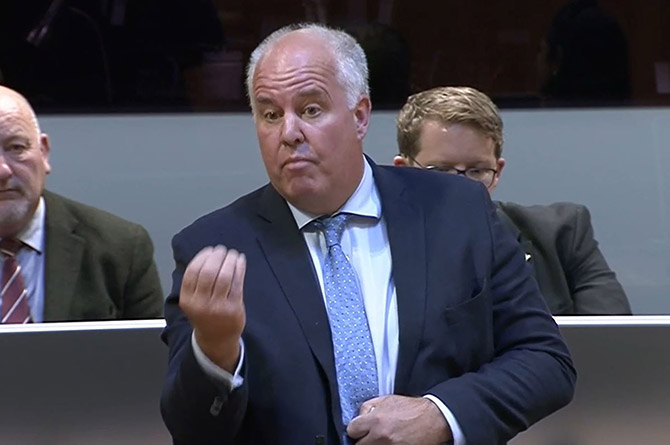
Pen-y-Bont Bro Morgannwg MS, Andrew RT Davies, expressed the Conservatives support for “the principle” but said there was “too much blank space” around the new agency.
He asked Mr Price for a timeframe in which he expects to bring the organisation into existence, whether it be 12 months, two years, or by the end of this Senedd term
Mr Davies also questioned the cost and said: “I’m not going to ask you for every pound, shilling and pence, but can you give an indication on what your thinking is of the type of budget that you will make available to the organisation?”
He continued: “When we look at the old WDA, it had a complete offer, from building industrial sites, gaining the planning permission and promoting foreign direct investment.
“Does this organisation, in your mind, need to do all that, or will it be more specific in what it does about promoting Wales as a destination for inward investment? And when we look at the organisation, are we thinking of an organisation that will look like Natural Resources Wales with a remit letter, or will this be a unique organisation that hasn’t been seen in the Welsh public landscape before?”
Mr Price confirmed the new agency will be a statutory body, and said he plans to bring forward legislation “fairly soon”.
He also noted the Welsh Government’s ambition for the new agency to be operational “as soon as possible”, but said he could not provide a specific date.

A RETROSPECTIVE call to let a Pembrokeshire beauty salon stay on the site of a former edge-of-town printing business has been given the go-ahead by county planners.
In an application to Pembrokeshire County Council, Sarah Collins of SC Skin Care Ltd, sought retrospective permission for the change of use from shop to a beauty clinic at 60A, Cartlett, Haverfordwest.
No adverse comments around the proposals were made by Haverfordwest Town Council.
An officer report recommending approval said the unit was most recently occupied by Mobad, a printing business specialising in commercial graphics, which operated between 9 and 5pm, Monday to Friday; the change of use seeking to open 9am-7pm Monday-Saturday, with no external alterations proposed.
It said the application was in retrospect as the change of use happened back in March, the clinic accommodating three treatment spaces, with one full time member of staff.
It concluded: “The application seeks retrospective planning permission to change the use of an existing commercial unit to a beauty and aesthetics clinic (sui generis) within the sustainable and accessible settlement boundary of the Hub Town of Haverfordwest.
“Whilst beauty and aesthetics services are a use ordinarily directed to town centres the proposal involves the continued occupation of an existing commercial premises and is not considered likely to undermine the vitality or viability of Haverfordwest Town Centre.
“The proposal would not result in any unacceptable impacts upon the character or appearance of the area, residential amenity, highway safety, drainage infrastructure or biodiversity subject to the imposition of conditions requiring the provision of secure cycle parking and ecological enhancement measures.”
It finished by saying the scheme “represents an appropriate and sustainable form of development that complies with the relevant provisions [of planning policy].”
The application was conditionally approved.

A CALL to allow a Pembrokeshire seaside hotel to become short-term holiday let accommodation to ensure its long-term viability in a changing tourism sector has been given the go-ahead.
In an application to Pembrokeshire Coast National Park, Abergavenny-based Kyle Williams, sought permission for a change of use of The Hildebrand Hotel, 29 Victoria Street, just off Tenby’s Esplanade seafront, from a traditional hotel to a short-term holiday letting operation.
A supporting statement accompanying the application said the scheme seeks to “secure the continued viable use of the property through its operation as professionally managed holiday accommodation, providing high-quality visitor accommodation within the established tourism destination of Tenby”.
It added: “The Hildebrand Hotel is an established visitor accommodation property located within Tenby, Pembrokeshire, one of Wales’ premier coastal tourism destinations.”
It says no significant external alterations are proposed, adding the “character, appearance and scale of the building will remain unchanged”.
“The accommodation will be let on a short-term basis to visitors and tourists, supporting the local visitor economy whilst ensuring the building remains occupied, maintained and economically viable.”
It added: “The proposed use will ensure the continued occupation and maintenance of the building. The hospitality sector has experienced significant operational challenges in recent years, including staffing pressures, increasing energy costs and changing visitor preferences.
“The proposed use offers a flexible operational model capable of maintaining the long-term viability of the property.”
Tenby Town Council said it raised no fundamental objection to the proposal, but did raise concerns about the practical implications of changing from a hotel to self-contained holiday accommodation, with existing parking pressures on Victoria Street and the need for robust waste disposal arrangements.
It requested that, should planning permission be granted, appropriate conditions be imposed to safeguard residential amenity in relation to parking and waste management.
Tenby Civic Society had raised concerns that no justification has been provided to demonstrate that the existing hotel use is unsustainable, and that Tenby should continue to maintain a varied range of visitor accommodation.
One neighbouring occupier raised no objection to the proposed change of use but expressed concern regarding the potential for the property to change to residential use in the future if it fails to meet the occupancy requirements associated with its change of use.

They also raised concerns that the building could subsequently be converted to flats or a House in Multiple Occupation (HMO), which was considered would alter the character of Victoria Street.
An officer report, which recommended approval, said those schemes “are not before officers for consideration and supposition cannot be considered a material planning consideration, so the application must be considered on the basis of the current proposal”.
It added: “The proposal does not involve any external alterations to the building or changes to the site’s access arrangements. The character and appearance of the property, and its contribution to the Tenby Conservation Area, would therefore remain unchanged.”
The application was conditionally approved by Park planners, conditions including it shall be used solely for short-term holiday accommodation and for no other purpose.



Crime9 hours ago
Teacher stabbing trial: The first week of evidence
Jury hears accounts of alleged planned classroom attack, teacher’s fear she was dying, and boy’s words after leaving school A...


Community12 hours ago
Haverfordwest Castle refurbishment reaches new heights as roof goes on
Major milestone reached in project to transform historic gaol building into flagship visitor attraction A MAJOR milestone has been reached...


Business2 days ago
Pembrokeshire lands £98m share of Wales marine energy boom
New industry report says county has received the second highest level of marine energy investment in Wales, supporting more than...
Crime2 days ago
First aider tells jury teacher was “crying, shaking” after classroom stabbing
A SCHOOL first aider has told a jury that teacher Vicki Williams was “crying, shaking” and in “complete shock” after...


Crime2 days ago
Teacher feared she was dying after Milford Haven classroom stabbing
A TEACHER allegedly stabbed in the head at Milford Haven Comprehensive School told a jury she feared she was dying...


News2 days ago
Farage to resign as MP and fight Clacton by-election amid finance row
NIGEL FARAGE has announced he will resign as MP for Clacton and stand again in the by-election he intends to...
Crime3 days ago
Teacher tells jury there were ‘no issues’ with accused pupil hours before ‘stabbing’
Milford Haven teacher gives evidence as trial of 15-year-old continues at Swansea Crown Court A TEACHER allegedly stabbed at Milford...


News3 days ago
Major incident stood down after fire at Impala Terminal in Milford Haven
Fire involved decommissioned oil tank containing residual crude oil and around 60 cylinders A MAJOR incident declared during a fire...


News3 days ago
Large fire breaks out at Impala Terminal in Milford Haven
Black smoke seen for miles as emergency services respond to incident at former Puma Energy site A LARGE fire has...
Crime3 days ago
Prosecution outlines ‘planned attack’ as Milford Haven teacher stabbing trial opens
Jury hears teenager allegedly brought kitchen knife into school before teacher was stabbed in the head THE JURY in the...
-
 Education7 days ago
Education secretary vows to tackle ‘root causes’ of antisocial behaviour in schools
-

 Education6 days ago
Ysgol Glannau Gwaun celebrates prestigious Gold Active Travel award
-

 Community7 days ago
Closure-threatened Stepaside school expected to remain open
-
 Education7 days ago
First Minister pressed on biological sex, additional learning needs, and NHS jobs
-

 Farming3 days ago
Pembrokeshire slaughterhouse given urgent improvement rating after audit failure
-

 Community7 days ago
Saundersfoot Harbour regeneration project wins national planning award
-
News3 days ago
Large fire breaks out at Impala Terminal in Milford Haven
-

 Entertainment2 days ago
Swing and big band classics heading to Torch Theatre