


Politics
‘Barriers need ripping down’: alarm over ‘shameful’ disability employment gap

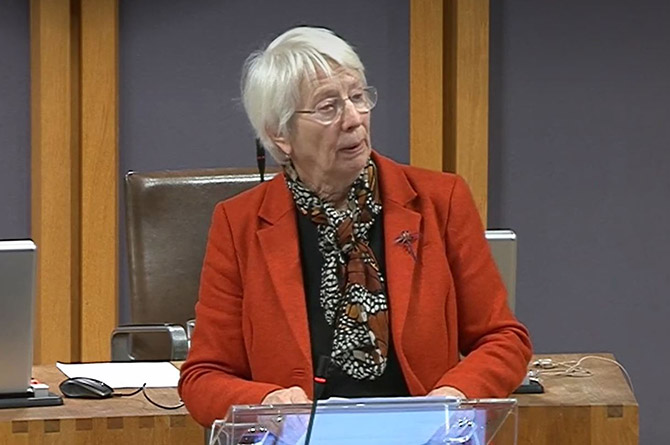
WALES needs to take a wrecking ball to the barriers disabled people face getting and keeping a job as a “tsunami” of proposed benefits cuts approaches, the Senedd heard.
Jenny Rathbone led a debate on the Senedd equality committee’s report on tackling the disability employment gap, which found too many people face unnecessary barriers.
The gap, which is the difference of employment rates between disabled and non-disabled people, stands at 31% in Wales and has consistently been higher than elsewhere in Britain.
Ms Rathbone said: “We are running out of time. We must get on with it now. This is not about pay slips and productivity – it is about independence, dignity, equality of opportunity and what matters so much to the wellbeing of the individual and of society as a whole.”
The Labour politician, who chairs the equality and social justice committee, told the Senedd: “We need action this day and we need a wrecking ball to the barriers.”

Conservative Altaf Hussain warned that 26% of employed disabled people have not received any reasonable adjustments despite the right being enshrined in the Equality Act 2010.

He pointed to research showing the average cost of adjustments was £75, saying: “We know conclusively it’s not expensive to treat disabled people properly but barriers, sadly, still exist.”
Plaid Cymru’s Sioned Williams warned UK ministers’ proposals to cut benefits, including personal independence payment (Pip), will have a “cataclysmic” impact on disabled people.
She told the Senedd: “The specific barriers that disabled people face in accessing employment, identified in our report, must be addressed before changes to eligibility and support for disabled people are implemented.”

Ms Williams urged Welsh ministers to keep a promise to incorporate the UN convention on the rights of disabled people into law by the end of the Senedd term.

Labour’s Hefin David raised the Engage to Change project, which provided employment support to more than 1,000 young people before funding ran out in 2023. “Having that kind of programme running full-time across Wales would be really important,” he said.
Calling for a learning disability employment strategy for Wales, the Caerphilly Senedd Member emphasised the importance of shaping jobs to people’s unique skills.

Dr David, whose daughter is autistic and learning disabled, said: “My daughter can’t read very well, she can’t count very well but you put some plasticine in front of her and she’ll create some amazing things that go way beyond anything I could do.”

Welsh Liberal Democrat leader Jane Dodds said: “Far too many disabled people are feeling let down: they’re losing out but much more importantly we are losing out in society.”
Ms Dodds warned 90% of people in Wales on the standard rate of Pip for daily living could lose their entitlement under proposals. She said: “Instead of being empowered, people are being pushed aside, left to navigate a storm of rising need and shrinking support.”
The ex-social worker urged the Senedd to show leadership, with disabled people making up about 7% of the Welsh Parliament’s staff compared with 11% in the wider Welsh workforce.
Mark Isherwood, who chairs the cross-party group on disability, expressed concerns about Welsh ministers accepting five of the committee’s seven recommendations “in principle”.
He described the Welsh Government’s formal response as inadequate and unacceptable in light of a 2018 commitment to end the practice from the then-permanent secretary.
Labour’s Julie Morgan recounted a “horror story” from one witness about a young disabled girl being the only pupil in her school year who was not allowed to go out on placement.
She also raised evidence from campaigner Dan Biddle who warned statistics show if you are disabled and not in work by the age of 26, it is unlikely you will ever become employed.
Ms Morgan said: “That’s why it is so important to start early, to make sure that disabled children and young people are given absolutely equal rights right from the beginning.”
Responding to the debate on June 11, Jane Hutt said ensuring disabled people can participate fully in society is one of the key values of the Welsh Government.
She told Senedd Members: “We want an inclusive approach to employment that supports disabled people to have equitable access to fulfilling and fair work.”
Wales’ social justice secretary highlighted an ongoing consultation on a draft ten-year disability rights plan which has been criticised for lacking concrete targets.
Pressed for a timeline on incorporating the UN convention, which was an unambiguous commitment in Labour’s 2021 manifesto, Ms Hutt did not provide any such timeframe.



A PADDLEBOARDING and canoeing company’s call for an extension to a boat shed at Pembroke’s South Quay, below its historic castle, has been submitted to county planners.
In an application to Pembrokeshire County Council, G Booth of Paddle West CIC, through agent James Dwyer Associates, seeks permission for an extension to the stone-built boathouse, adjacent to the cliff on South Quay fronting the Mill Pond, Pembroke.
A supporting statement says: “It is intended to erect a single storey ‘lean-to’ building, or ‘shed’ for the storage of boats, such as canoes and kayaks, and related equipment, on a vacant space adjacent to the existing stone-built boathouse.”
It adds: “The boathouse and the intended adjacent boat storage shed is located, as is to be expected, in close proximity to water, the Mill Pond. The Mill Pond is the main area of activity for Paddle West, a Community Interest Company, providing boating activities, kayaking, canoeing and paddle boarding, frequently for young people and families.”
It goes on to say: “It is intended that the structure would be lightweight, erected on the exiting hard standing. The ‘shed’ would be used for the storage of boats and related equipment.”
With regard to the historic setting, it adds: “Although the stone-built boathouse appears not to be listed, it is recognised that the walls above are listed and together they are a piece.
“Accordingly, through form and external materials proposed, timber cladding and profile sheet roofing, the aim is to ensure that the structure would be subservient and muted and not detract or compete with the visual aesthetic of the boathouse or historic walls. In effect the addition would blend into the background.”
The application will be considered by county planners at a later date.
The boathouse is sited near to the new Henry Tudor Centre in South Quay, which is due to open in Spring 2027.

The centre, expected to receive around 30,000 visitors a year, will tell the story of Henry Tudor, son of Pembroke, his Welsh ancestry and his impact on our national story, Welsh culture and our wider British heritage.
The restored derelict South Quay buildings will also house a new library and community café, and a healthcare, social services and supported employment facility in the adjoining premises.
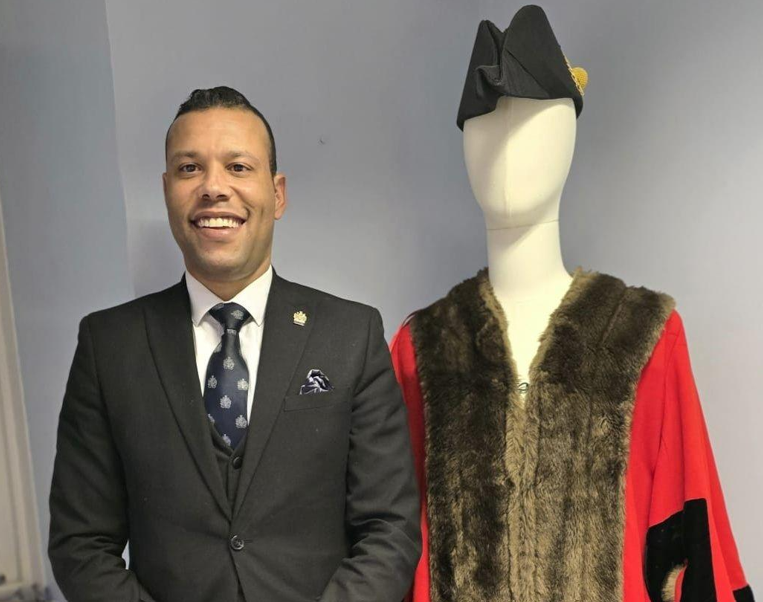
A PEMBROKESHIRE town council will soon have its first-ever person of colour as mayor, and its youngest mayor in a century.
Haverfordwest Town Councillor Randell Iziah Thomas-Turner, aged 37, is to become mayor this May.
Cllr Turner said: “Tonight [March 19], I had the honour of accepting the nomination as mayor-elect — a moment that will forever stay with me.
“In doing so, I am humbled to be making history as the first mayor of colour in Haverfordwest and the youngest mayor in a century. This is not just my achievement, it belongs to every person who believes in progress, representation, and the power of community. This is a new chapter for our town — one built on unity, opportunity, and hope.
“My mayor-making will take place this May, and I cannot wait to officially step into the role and begin serving the people of Haverfordwest with pride, passion, and purpose. Haverfordwest is the best in the West — and together, we are just getting started.

“Diversity is not a challenge to overcome, but a strength to embrace. When people from different backgrounds, experiences, and perspectives come together with respect and openness, we unlock new ideas, stronger solutions, and deeper understanding.”
It’s a double celebration for the Thomas-Turner family.
Wife, and fellow town councillor, Dani, has been voted as sheriff of the town for the second-year-running, the first woman to serve as sheriff for two consecutive years.
“The coming civic year will be one to watch as my husband Councillor Randell Izaiah Thomas-Turner is becoming the first mayor of colour in Haverfordwest’s history,” said Cllr Dani Thomas-Turner, adding: “It’s going to be a year of history and memory making for sure.”


A WELSH Government-funded scheme to provide rates relief for hospitality businesses has been backed by senior Pembrokeshire councillors.
A report for members of Pembrokeshire County Council’s Cabinet at their March meeting said: “Welsh Government has introduced the Food and Drink Hospitality Rates Relief, this relief is aimed at eligible businesses in Wales in the food and drink hospitality sector for example, pubs, restaurants, cafes, bars and live music venues.
“The aim of the relief is to support eligible businesses to manage continued cost pressures. The relief will apply to all eligible occupied properties by offering a discount of 15 per cent on non-domestic rate bills for the period April 1 to March 31, 2027. The relief is capped at £110,000 per business across Wales.
“As this is a temporary measure, Welsh Government is providing the relief by reimbursing local authorities that use their discretionary relief powers under Section 47 of the Local Government Finance Act 1988.”
It concluded: “The food and drink hospitality rates relief 2026-27 requires the local authority to adopt a discretionary scheme [as outlined] and in accordance with the criteria and conditions specified in the guidance issued by Welsh Government.

“It is proposed that Cabinet resolve to adopt [the scheme] which can be applied to administer the relief. Welsh Government will reimburse local authorities for the relief provided in line with their guidance via a grant under section 31 of the Local Government Act 2003.”
Members backed the recommendation.
All eligible businesses must apply for this relief by the March 31, 2027, and an application form will be available on the council’s website from the April 1.
The maximum cash value of the rates relief allowed, across all properties in Wales occupied by the same business should not exceed £110,000. Businesses claiming the relief must declare that the amount being claimed does not exceed those limits.



Crime20 hours ago
Publican jailed for six years for supplying cocaine and cannabis
Milford Haven man sentenced at Swansea Crown Court following drug dealing operation A MILFORD HAVEN publican has been jailed for...


Local Government22 hours ago
Poverty summit highlights support efforts across Pembrokeshire
A SUMMIT bringing together key organisations from across Pembrokeshire has highlighted both the scale of local poverty and the work...


Education2 days ago
Milford Haven school plans unveiled but funding not yet secured
PLANS for a new £100 million school in Milford Haven have been unveiled, but the project has not yet secured...


News2 days ago
Council unveils plans for new state-of-the-art secondary school in Milford Haven
PEMBROKESHIRE COUNTY COUNCIL has revealed plans for a new state-of-the-art school in Milford Haven, promising modern, inspiring learning spaces for...


Health2 days ago
NHS waiting list falls — but cancer delays and diagnostic backlog worsen
Record progress claimed by Welsh Government as critics warn key targets are still being missed THE NHS in Wales has...


Crime3 days ago
Rapist jailed after ‘abhorrent’ attacks on woman and children
Haverfordwest man told police “women won’t have sex without force” A HAVERFORDWEST man who raped a woman and a young...


News3 days ago
Reform secures first Pembrokeshire councillor in Hakin by-election win
Late Reform candidate takes seat as independent surge and Labour withdrawal shape contest REFORM UK candidate Scott Thorley has won...


News3 days ago
Scott Thorley elected as Pembrokeshire’s first Reform councillor
REFORM UK candidate Scott Thorley has won the Hakin by-election after securing 179 votes. The full result is as follows:...


News4 days ago
Police confirm man has died after being recovered from River Cleddau
Major emergency response in town centre after concerns raised for man in water A MAN has died after being recovered...


Community4 days ago
Davies and Kurtz urge groups to seek employability funding
Community organisations in Pembrokeshire encouraged to apply for new grants supporting skills and job access LOCAL Senedd Members Samuel Kurtz...
-

 News7 days ago
Rayner and Lammy visit Wales to discuss justice and community safety
-

 News6 days ago
Fishguard linked to allegations in Many Tears Animal Rescue investigation
-

 News4 days ago
Emergency services flood Haverfordwest after reports of person in river
-

 Local Government7 days ago
Investigation confirmed after inspectors visit Many Tears Animal Rescue
-

 Crime3 days ago
Mother given community order after admitting child cruelty offence
-

 Business7 days ago
Oil firm praised for putting customers first during price surge
-

 Community7 days ago
Town hall takeover plan questioned as cost figures conflict
-

 News4 days ago
Senedd vote to ban greyhound racing hailed as ‘landmark moment’ by charities